


 Claim Ownership
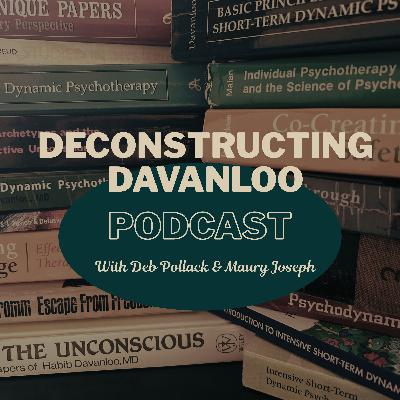
Deconstructing Davanloo
Subscribed: 2Played: 10
Subscribe

© Deborah Pollack and Maury Joseph
Description
Habib Davanloo was the developer of Intensive Short-Term Dynamic Psychotherapy (ISTDP), a type of short-term psychodynamic psychotherapy that has gained popularity in recent decades.
Davanloo's work is bold, original, and compelling, yet often presented with a certainty that leaves little room for reflection or alternative viewpoints. Deconstructing Davanloo offers another path: reading his cases with space open for context, critique, and dialogue about multiple levels of meaning. By engaging his ideas thoughtfully, we aim to support the evolving, creative development of the ISTDP tradition.
Davanloo's work is bold, original, and compelling, yet often presented with a certainty that leaves little room for reflection or alternative viewpoints. Deconstructing Davanloo offers another path: reading his cases with space open for context, critique, and dialogue about multiple levels of meaning. By engaging his ideas thoughtfully, we aim to support the evolving, creative development of the ISTDP tradition.
13 Episodes
Reverse
In this episode Deb and Maury continue to marvel at the range of possibilities for understanding the part 1 of the German architect case, and share several hypotheses for what could be happening in the case that go beyond Davanloo’s formulation. The discuss issues of authority, compliance, and omniscience as these emerge in the case. As they finish their read through of part 1 of the case, they begin to consider what they’ve learned, and try to couple their critique with empathy for Davanloo, for the pressures he was under as he was writing these foundational texts. New music by Danny Joseph!References:Davanloo, H. (1990). Unlocking the Unconscious. Wiley.Malcolm, J. (1981). Psychoanalysis: The Impossible Profession. New York: Alfred A. Knopf.
n their continued close read of the German Architect, Deb and Maury highlight issues around suggestion and leading the witness, philosophy of science questions around creating falsifiable hypotheses, and they offer alternate lines of interpretation in the case, especially regarding the emergence of the story of the man in the bistro. Importantly, they offer the possibility that the incident with the man in the bistro is not unequivocally a “breakthrough,” but might also reflect a variation on the earlier defiant transference enactment that has become visible in the case. They finish by reflecting on the importance of revisiting and reinterpreting cases, rather than accepting any one interpretation as final.References:Apfelbaum, B., & Gill, M. M. (1989). Ego analysis and the relativity of defense: Technical implications of the structural theory. Journal of the American Psychoanalytic Association, 37(4), 1071-1096. https://doi-org.libezproxy2.syr.edu/10.1177/000306518903700410 (Original work published 1989)Davanloo, H. (1990). Unlocking the Unconscious. (Wiley).Pollack, D. (2024). On closing the frame: An existential argument for setting a time-limit in ISTDP. Journal of Contemporary ISTDP.
In this episode, Deb and Maury continue their exploration of the German Architect, and encounter a number of complex topics. First is the possibility of a parapraxis, a possible mishearing by Davanloo, that might reveal the meaning-making system through which Davanloo filters the patient's behavior and speech. Then, they consider a critique of the notion of a "locked" unconscious, and the ways that concept can shape a therapist's perception of the clinical process. Finally, they examine the complex interpersonal process of the transcript, considering both Davanloo's and alternate narratives of the interaction that's unfolding, leading to a discussion of the potentials and pitfalls that occur when the therapist begins to behave in a way that might reinforce, rather than challenge and resolve, the patient's transference resistance.References:Davanloo, H. (1990). Unlocking the Unconscious. Wiley.Kuhn, N. (2014). Intensive short-term dynamic psychotherapy, a reference. Experient, Charleston, SCJoseph, M. (2025). The spirit of ISTDP. Journal of contemporary ISTDP, 3, 122-133Racker, H. (1972). The meanings and uses of countertransference. Psychoanalytic Quarterly, 41, 487-506
In this episode, Deb and Maury address a listener comment about timing when sharing hypotheses with patients. They continue with their textual analysis of the case of the German Architect. They look at ways that Davanloo's words may be conveying epistemic authority, and they consider various interpretations of meaning of the patients' utterances and body language.Here is Maury's bit of writing on counterpower anxiety:For Davanloo, striated muscle anxiety is seen as a signal that confirms the effectiveness of an intervention. We assume that anxiety is a signal that defenses are failing and unconscious contents are coming closer to consciousness. Thus, anxiety in the clinical process generally suggests that the therapist’s intervention is working. There are exceptions, however, when anxiety does not point to the effectiveness of the therapist’s interventions. In certain contexts, striated muscle anxiety points instead to the therapist’s failure to listen. Here is an example:A therapist has the hypothesis that the patient is defending against feelings of anger towards him. He regards everything the patient says as an effort to avoid this anger. Meanwhile, there is no striated muscle anxiety. If the therapist were listening to anxiety, he would note this absence and begin to wonder if he is “barking up the wrong tree.” Sadly, he continues to listen to his hypothesis, but not to the absence of the patient’s anxiety. Finally, the patient takes a big sigh and says, “I feel you are not listening to me. None of what you are saying is making sense to me, and I feel like you are twisting my words to fit your theory. I need you to hear me."What happened here? Does this large sigh validate the therapist’s hypothesis about hidden anger? One possibility is that the therapist’s efforts finally broke through the patient’s defenses, triggering a rise of striated muscle anxiety and a new wave of defenses—the patient now attempts to change the therapist’s behavior or control him. Some therapists would see it this way, code the patient’s feedback as defensive, and continue to pursue the anger they believe is there.Another interpretation of the anxiety, however, is that it is triggered by the risks associated with speaking “truth to power.” The patient openly criticizes a person he depends on but who is not listening. I call this manifestation of anxiety a “counter-power sigh.” The patient is not resisting the therapist’s therapeutic efforts; he is resisting the therapist’s efforts to overpower him (Foucault, 1981; Fors, 2021). No wonder the patient becomes anxious. Who among us has not experienced the dangers that come when we stand up to someone trying to overpower us? The counterpower sigh comes when patients must make a massive and frightening effort to speak openly and truthfully to someone who is exerting power over them, here manifested as the power to interpret what is going on in the patient’s mind. The counterpower sigh occurs when the patient’s wish to save the therapy overwhelms his fear of what might happen if he speaks truth to power.I am highlighting counterpower sighs here as an important caveat. It is not true that “all signs of striated muscle tension are universally and inevitably signs that therapy is moving along in a positive way.”A counterpower sigh can arise when the patient tries to break out of a sadomasochistic enactment. If we mistake the counterpower sigh for an unequivocal sign that the work is going well, we may continue to enact a sadomasochistic power dynamic and miss the patient’s supervision.References:Davanloo, H. (1990). Unlocking the Unconscious. John Wiley.
On today's episode, we welcome our first guest, Norwegian psychologist Jon Anders Lied, author of An Introduction to Intensive Short-Term Dynamic Psychotherapy (2025). The conversation is a shared walk through the woods of ISTDP learning. We highlight complex intergenerational dynamics in the teaching of Davanloo's ideas, and the resulting polyphony of the field-- how "what ISTDP is" is something different to everyone, and the importance of avowing that. We also hear Jon Anders' thoughts about our recent discussion of the German Architect. Throughout the episode is a clear thread of empathy and concern for the experiences of trainees, and a wish to support them in learning theory, technique, and the complex practice of being with the patient even when theory and technique fall short.Jon Anders Lied is a Norwegian clinical psychologist and ISTDP therapist, working in clinical practice, teaching, and supervision. You can check out his book here:Lied, A. (2025). An Introduction to Intensive Short-Term Dynamic Psychotherapy: Foundations of Clinical Practice. Routledge.Also mentioned: The International Experiential Dynamic Therapy Association's biennial international conference to be held in Dubrovnik, Croatia, 7-9 Oct, 2026.
Deb and Maury catch up after taking some time off for the winter holidays. They share what they each have been reading and listening to, and how these relate to what they've been discussing on the podcast. They also read and respond to some listener comments and questions before delving back into the Case of the German Architect. The two attempt to look at the case from a relational perspective to account for alternative conceptualizations of what could be happening in the session.References:Davanloo, H. (1990). Unlocking the Unconscious. WileyDorpat, T. L. (1996). Gaslighting, the double whammy, interrogation, and other methods of covert control. Jason Aronson.Joseph, M. (2025). The spirit of ISTDP. Journal of contemporaryISTDP 2(1). Klein, E. (Host). (Jan 2, 2026). This Question Can Change Your Life (Podcast episode). The Ezra Klein Show.Raubolt, R. (2006). Power games: Influence, persuasion, and indoctrination in psychotherapy training. Other Press.Zeig, J. K. (2014). The induction of hypnosis: An Ericksonian elicitation approach (1st ed.). Milton H. Erickson Foundation Press.Why Theory podcast with Todd McGowan & Ryan Engley
In this episode, Deb and Maury respond to a listener's comment that is related to Buddhist ideas about enlightenment. Then they dive into Davanloo's first case presented in Unlocking the Unconscious: "The German Architect."The two begin a table read of the transcript and consider the unconscious relational dynamics between the therapist and the patient as they begin to unfold. They wonder whether a misalliance is starting to happen, and whether that is a necessary part of the procedure.Deb and Maury end the episode by reminding the listeners that theirs is but one perspective on the case, and they welcome other takes and perspectives, including in the comments.References:Davanloo, H. (1990) Unlocking the Unconscious. Wiley.
In this episode Deb and Maury wrap up their foray into how Davanloo engages with Freud in Unlocking the Unconscious (1990). Deb joins their session from the Evolution of Psychotherapy conference in Los Angeles where she makes some comments about parellel themes between ISTDP and some of the other psychotherapy presentations. The two attempt to answer the question, "So what?" together. Why does the way that Davanloo textually interact with Freud matter to the everyday ISTDP practitioner?They summarize their earlier discussions by suggesting that Davanloo took on a dominant tone when relating to Freud as a "straw man" for his argument about the superiority of the techniques of ISTDP to free association. They wonder how the themes of triumph, power, and domination might trickle down into how Davanloo relates to his patients and students, and how students might in turn relate to their patients. They conclude that power differentials are inevitable and necessary in psychotherapy, but the lack of reflexiveness about how power is being wielded could be problematic.In the next episode, the two will start looking at the Case of the German architect in the first chapter of Unlocking the Unconscious.References:Barthes, R. (1977). The death of the author. In S. Heath (Trans.), Image-music-text (pp. 142–148). Hill and Wang. Davanloo, H. (1990). Unlocking the Unconscious. Wiley.
In this episode Deb and Maury conclude their examination of how Davanloo positions himself to Freudian theory by continuing to consider the various ways he quotes and talks about Freud in Unlocking the Unconscious.Deb gets irritated that he doesn't quote Melanie Klein more, since she considers Kleinian theory to be a strong influence on ISTDP metapsychology. They also discuss the ways that the superego is discussed, frequently engaging battle imagery evoking notion that one could ultimately conquer the superego through the techniques of ISTDP.Deb and Maury challenge this premise and consider what it might mean to be "clear" of a superego, likening some of the ways ISTDP has been taken up as similar to trends of the "human potential movement," where techniques were aimed at somehow "clearing" out the causes of human suffering.Deb makes an interesting interpretation and the two decide that the next episode will tackle the question of, "So what?" They plan on exploring what their interpretations of Davanloo's text might mean for contemporary ISTDP training, discourse, and practice.References:Davanloo H. (1990) Unlocking theunconscious. Chichester: John Wiley & Sons.
Celebrating 100 downloads and 100 followers on Instagram!In this episode Deb and Maury engage with a listener's comment to consider claims to "truth" and what they entail, suggesting it might be useful to differential local truths from an "Ultimate" Truth.Next they dig in to some of the key references to Freud in Davanloo's Unlocking the Unconscious. Throughout their analysis, they consider whether Davanloo was giving Freud enough credit, potentially using him as a straw man to prop up his own theory. They also acknowledge Davanloo's clear admiration for Freud and try to contextualize some of his tone and style with his socio-cultural position. They conclude by speculating on Davanloo's mixed feelings towards Freud, and the fact that they will take one more episode to consider their textual relationship.ReferencesBrod, Thomas (2010). Calving the iceberg: Davanloo’s new model of pressure, resistance, & therapeutic alliances in psychoanalytic psychotherapy. Ad Hoc Bulletin of STDP, 14:1 p 5-17, April 2010.Davanloo. H. (1984). Short-term dynamic psychotherapy. In Comprehensive Textbook of Psychiatry, 4th ed., H. Kaplan and B. Sadock (Eds.) Baltimore: William & Wilkins.Davanloo H. (1990) Unlocking the unconscious. Chichester: John Wiley & Sons.
After advising each other on proper turkey-brining techniques for Thanksgiving, Deb and Maury begin at the beginning, with the very first line of Davanloo's Unlocking the Unconscious, "One of the main aims of all forms of dynamic psychotherapy is to enable the patient to experience his true feelings, but this can only be accomplished by overcoming resistance." (UU, p. 1).The hosts consider how Davanloo is positioning himself epistemologically with this statement, what is meant by "true feelings," and what that term implies clinically. They go on to carefully consider several key claims that Davanloo makes throughout the first page of the book, including, "What Freud could not possibly have forseen were the complications to which this increasingly passive technique would lead." (UU, p. 2). They consult Freud's paper, Analysis Terminable and Interminable (1937), in order to investigate this claim more fully. Deb suggests that not only did Freud forsee these "complications," but he also seemed to predict Davanloo's technique to some extent. Maury questions the passive/active dichotomy that Davanloo sets up here, and suggests that he may be over-simplifying the technique of free association to set up a straw man argument. He also points out that the "complications" Davanloo lists all occur with ISTDP, as well as psychoanalysis.The episode ends with Deb commenting on a parallel process. She feels aligned with Davanloo in wanting to go faster in their analysis. Maury reminds her that given how important Freudian theory is to Davanloo's framing of ISTDP, it makes sense that they might need a few episodes on how he engages with Freudian theory.References:Davanloo, H. (1990). Unlocking the unconscious: Selected papers of Habib Davanloo. John Wiley & Sons.Freud, S. (1937). Analysis terminable and interminable. (Standard Edition, vol. 23, pp. 216-253). London: Hogarth.
US Congressman John Lewis once famously encouraged all Americans to "get in good trouble, necessary trouble." On this episode of the podcast, Deb and Maury further explain why they think it's a good thing to stir up some trouble through their project of "Deconstructing Davanloo."First, Deb explains that the term "deconstruction" does not mean tearing something down, but rather that the title of the podcast is a nod to the work of post-structuralist philosopher, Jaques Derrida. Derrida used the term deconstruction to challenge the idea that texts have fixed or essential meanings. Derridean deconstruction is therefore a process of looking for multiple meanings within textual data while recognizing that there is no true, one-to-one correspondence between the signifier (word) and signified (the thing the word is trying to symbolize). Maury suggests that the sheer amount of data with Davanloo's cases offers us a treasure trove of text, open for interpretation of multiple and layered meanings. Deb and Maury offer the project of this podcast as a counterpoint to more "orthodox" readings of Davanloo, where his work has been taken as handed down wisdom to be accepted as is. Deb references Aner Govrin's 2016 book, Conservative and radical perspectives on psychoanalytic knowledge: The fascinated and the disenchanted, as helpful in framing the ISTDP community as consisting of both "fascinated" and "troubled" sub-communities. Govrin's work suggests that an intellectual community needs both camps, the fascinated and the troubled, to be active in order to ensure ongoing vitality and evolution. (Errata: Deb mis-communicated the title of Govrin's book, full reference below). Deb and Maury agree that while they see themselves leaning more towards a "troubled" reading of Davanloo, they are simultaneously fascinated by his work, and that both the "troubled" and the "fascinated" are part of a necessary dialectic. In that vein, Deb and Maury take turns sharing the top 3 things they love about Davanloo. For Maury it is Davanloo's "maverick" stance of pushing against the status quo in psychoanalysis, his development of the pathways of anxiety discharge, and his emphasis of timing in clinical interventions. Deb's top 3 things she admires about Davanloo are his confidence in calling it like he sees it, his desire to "bust open the door" to the unconscious, and his emphasis on working through conflicts of conscience.Deb and Maury and the episode by letting listeners that episode 3 will be a deep reading of Davanloo's engagement with Freudian theory through his references to Freud in "Unlocking the Unconscious," specifically in the beginning of the chapters Clinical Manifestations of Superego Pathology, Part 1, and Intensive Short-Term Dynamic Psychotherapy with Highly Resistant Patients, I: Handling Resistance. They also encourage listeners to send them questions, comments or concerns by reaching out to either of them directly or messaging on their instagram account, @deconstructing_davanlooReferences: Davanloo, H. (1990). Unlocking the unconscious: Selected papers of Habib Davanloo, MD. John Wiley and Sons.Govrin, A. (2016). Conservative and radical perspectives on psychoanalytic knowledge: The fascinated and the disenchanted. Routledge.
What is this podcast about?In the landscape of modern psychotherapy, few figures have inspired as much admiration, anxiety, and controversy as Habib Davanloo, the founder of Intensive Short-Term Dynamic Psychotherapy (ISTDP). His case reports read like dispatches from a revolutionary frontier—complete with heroic struggles, breakthroughs, and an almost mystical confidence in his own method. But beneath that certitude lies a question that has rarely been asked aloud within the ISTDP community: what happens when we stop taking Davanloo entirely at his own word?Deconstructing Davanloo is a podcast devoted to that question. It begins from a simple but radical premise: that Davanloo’s brilliance and his blind spots are inseparable. His writing is electrifying, but it is also curiously devoid of self-reflection. His voice is authoritative, absolute—handing down insights as if from on high, untroubled about the possibility of countertransference, bias, or the epistemological limits of the human mind. This tone, while intoxicating, has helped to cultivate a culture around ISTDP that can at times prize certainty over inquiry, devotion over dialogue. Too often, the literature is understood not as an evolving theory but as scripture.This podcast proposes an alternative. Rather than accepting Davanloo’s formulations as finished truths, we take them as living hypotheses—provocative, incomplete, and worthy of interrogation. We read his case reports not as unassailable demonstrations, but as texts: stories that reflect not only the patient’s psyche but Davanloo’s own mind, his historical moment, and the analytic assumptions of his time. In doing so, we invite listeners to join us in a collective act of re-thinking—one that blends close reading, theoretical analysis, and clinical reflection. Across episodes, the hosts and their guests will explore Davanloo’s major papers alongside the work of later ISTDP teachers and neighboring traditions in psychoanalysis, attachment theory, and affective neuroscience. Each conversation aims to illuminate what still shines in Davanloo’s vision and what might need revision or reintegration.Deconstructing Davanloo is not a project of debunking or deification. It is an act of dialogue. The hosts share the conviction that the ISTDP community’s vitality depends on its willingness to think critically about its origins. Davanloo published only nineteen cases; his method, powerful as it is, remains an unfinished experiment. If we treat his words as final, we risk stagnation—repeating his moves rather than extending his thought. But if we bring to his work the same curiosity and rigor that he once brought to the analytic canon, we may discover new paths forward.In the end, the podcast is an invitation—to therapists, trainees, and scholars alike—to join in a shared project of intellectual and ethical reappraisal. To admire Davanloo’s genius while also asking what his confidence conceals. To appreciate his method’s unique power while inquiring seriously into its limits. And, most of all, to model a form of discourse that values reflection over reverence. Because only by questioning our founding figures can a living tradition continue to evolve.Mentions: The Journal of Contemporary ISTDP
Comments


Download from Google Play

Download from App Store
 United States