


Deconstructing Therapy
Subscribed: 3Played: 6
Subscribe

© 2024
Description
A podcast redefining the way we approach healing, relationships, and mental health. We challenge the status quo and traditional therapy frameworks that often fall short in today’s rapidly evolving society. Through conversations with therapists, activists, and thought leaders, we explore bold, community-centered approaches to mental health that honor the complexities of our world. Together, we’ll uncover how connection, shared stories, and innovative practices can adapt therapy to the needs of our time. Let’s reimagine what healing looks like in the here and now.
23 Episodes
Reverse
Deconstructing Therapy – Season 2, Episode 7 Healing Is Not Neutral: Therapy, Power, and the Systems That Shape Us with Maria Fakouri, MA, RP
What happens when therapy can no longer ignore the world we are living in?
In this season finale of Deconstructing Therapy, Alefyah sits down with Maria Fakouri, a Palestinian therapist whose work challenges the limits of Western psychotherapy and calls us into a more honest, relational, and liberatory practice.
Maria shares how the past two years disrupted the illusion that therapy exists outside of politics, systems, and collective trauma. As both a therapist and someone directly impacted by genocide, she found herself navigating an impossible tension—holding her own grief while witnessing a field that often refused to name the very realities shaping that pain.
Together, Alefyah and Maria explore what it means to practice therapy in a world on fire—and why neutrality is not only impossible, but harmful.
This conversation asks therapists to reckon with a deeper question:
Are we helping people heal… or helping them adjust to systems that harm them?
Throughout the episode, we explore:
The disorienting split between therapist identity and lived reality in times of collective trauma
How dominant therapy models reinforce individualism while ignoring systemic harm
The concept of “spiritual bypassing” and how it shows up in clinical spaces
Why clients are seeking therapists who can hold both personal and collective pain
The shift from individual-focused intake to starting with the world and its impact
The role of authenticity, vulnerability, and therapist self-disclosure in liberatory practice
How therapy can either reinforce or challenge systems like capitalism, racism, and colonialism
The emotional labor of witnessing violence while continuing to show up as a therapist
Maria also speaks to the courage required to move away from the “white gaze” in therapy and toward a practice rooted in community, truth-telling, and collective care. Her work reminds us that sometimes the most powerful thing a therapist can do is not to fix—but to name, to witness, and to stand alongside.
Ultimately, this episode invites us to reimagine therapy not as a tool for adaptation, but as a space for awareness, resistance, and transformation.
Because healing is not neutral. And neither is the work we do.
Maria Fakouri, MA, RP is a Palestinian therapist offering anti-oppressive, trauma-informed psychotherapy in Ontario, Canada. Her work centers the lived experiences of Palestinians and others navigating trauma under systems of oppression.
Maria writes and speaks through a liberation-focused, anti-colonial, and neuro-queer lens, inviting both therapists and communities to move beyond individualistic models of care toward approaches that are relational, culturally grounded, and rooted in justice.
Instagram: @mar._underscoreunfiltered Practice: Decliance (Ontario, Quebec, and select Canadian provinces) Booking: mariafakhouripsychotherapy.jnapp.com Email: [email protected]
Website: DeconstructingTherapy.com Instagram, Facebook, TikTok: @DeconstructingTherapy
BuyMeACoffee.com/DeconstructingTherapy
Special thanks to George Alvarez for his steady presence and support behind this work, and to Rayana Sims Consulting and Chanson Brummett for their contributions in helping bring this episode into the world.
#EmotionallyFocusedTherapy #EmotionallyFocusedCouplesTherapy #EmotionallyFocusedTherapist #DeconstructingTherapy #RelationalHealing #CulturallyResponsiveTherapy #DecolonizeTherapy #LiberationPsychology #PalestinianVoices #QueerTherapist
About the GuestConnect with MariaConnect with Deconstructing TherapySupport the PodcastSpecial ThanksHashtags
Chapters
(00:00:00) - In the Elevator With Therapy(00:00:22) - De deconstructing therapy(00:05:00) - Ashkenazi therapist on the white gaze(00:10:55) - "It's Not Worth It"(00:11:40) - How a Palestinian therapist shifted her perspective(00:15:23) - You're More Vulnerable On The Internet(00:18:58) - Since the election, has your practice changed?(00:23:03) - How I Learned To Love My Therapist(00:28:19) - "What is the Meaning of Your Job?"(00:31:49) - How to Be More Vulnerable in Therapy
Deconstructing Therapy – Season 2, Episode 6
The Sacred Mess of Becoming: Finding Beauty in Impermanence with Brandon Liu, LMFT
What happens when therapists stop trying to be the expert and instead allow their humanity into the room?
In this episode of Deconstructing Therapy, Alefyah sits down with Brandon Liu, a licensed marriage and family therapist and certified Emotionally Focused Therapist whose work centers cultural identity, relational attunement, and healing through authentic connection.
Brandon shares how his journey toward becoming a therapist began with a childhood desire to heal others, shaped by growing up in a medical family and navigating a complex Asian American identity. But it was a transformative undergraduate course on family psychology that helped him see the powerful impact of intergenerational patterns, masculinity, emotional expression, and cultural expectations.
Together, Alefyah and Brandon explore how our cultural histories shape the ways we relate to vulnerability, work, identity, and emotional intimacy — and how therapists must grapple with their own stories in order to show up authentically for others.
This conversation also dives deeply into what makes Emotionally Focused Therapy (EFT) unique: the understanding that healing is not a one-way process. When therapists allow themselves to be emotionally present, therapy becomes a bi-directional relational experience, where both client and therapist grow.
Brandon also reflects on his own recent relationship loss and how that experience has deepened his empathy for clients navigating grief, ambiguity, and the loss of imagined futures.
Throughout the conversation, we explore:
How intergenerational family patterns shape our emotional worlds
The subtle ways masculinity and cultural expectations influence vulnerability
Why many therapists enter the field seeking answers for their own inner chaos
The difference between therapeutic self-disclosure and emotional overexposure
The importance of authenticity and humanity in the therapy room
Cultural expectations of work, productivity, and success in Asian immigrant families
How therapists must care for their own nervous systems while caring for others
The beauty of messy healing and relational authenticity
Brandon introduces the Japanese philosophy Mono no Aware — the bittersweet awareness of life’s impermanence — and how recognizing the temporary nature of relationships, moments, and experiences can deepen our presence, gratitude, and connection.
Ultimately, this episode invites therapists and listeners alike to embrace the messy, vulnerable, and deeply relational nature of healing.
Because therapy isn’t about perfect expertise. It’s about two humans meeting in the sacred space of connection.
Brandon Liu, LMFT is a licensed marriage and family therapist and certified Emotionally Focused Therapist. He works with individuals and couples, with a particular focus on Asian men, Asian couples, and healthcare professionals navigating relational and emotional challenges.
Brandon is a Supervisor in Training in Emotionally Focused Therapy, holds a certificate in Medical Family Therapy, and serves on the board of the Chicago Emotionally Focused Therapy Community. He is also connected with the Community of Asian Therapists in Chicagoland (CAATCH).
He is the founder of Hazakura Counseling, a practice dedicated to fostering relational health and e...
Chapters
(00:00:00) - Brandon Leo(00:03:10) - How the culture of immigrants affects you(00:05:24) - What Were the Messages You Got From Dad About Masculinity(00:13:22) - How a Therapy Client's Grief Affects Me(00:17:32) - The Hardest Part of Therapist Work(00:19:37) - What Do You Do When Life's Getting Intense?(00:20:41) - Asian Americans talk about self-care(00:26:33) - Therapist on the Need for Authenticity(00:32:15) - Deconstructing Therapy: Sakura Season
Episode 5 | Season 2
Safety Is Not a Feeling: Power, Privilege, and Listening Deeply
Guest: Jay Seiff-Haron, Psy.D
In this expansive and honest conversation, Alefyah sits down with therapist, trainer, and anti-oppression educator Jay Seiff-Haron to explore what happens when we let our clients challenge our worldview—especially around safety, power, and privilege. Jay reflects on growing up Jewish and queer, navigating whiteness and passing, and later becoming part of a Jewish–Muslim family, holding both marginalization and access within the same body.
Together, Alefyah and Jay examine how Western therapy—shaped by colonial and individualistic assumptions—often treats safety as an internal feeling rather than a reality shaped by power, history, and structural violence. They explore how therapists can unintentionally dismiss real danger by framing it as anxiety, distortion, or resistance, and why deep listening requires a willingness to be changed by what clients are telling us about the world they live in.
This episode is a call to complexity: resisting binaries of oppressed vs. privileged, refusing to rank suffering, and practicing a form of listening rooted in humility, justice, and shared humanity.
Highlights & Takeaways
Safety is not always a feeling—it is often shaped by material reality and real threat
Holding privilege and marginalization as parts, not opposites
The danger of turning oppression into a competition
Jewish identity, whiteness, and intergenerational survival strategies
Passing, visibility, and choosing when to lead with different parts of self
Neurodivergence and justice sensitivity as moral attunement
How colonial psychology trains therapists to overlook suffering
Why EFT already contains the tools for liberation—if we let context back in
Letting clients reshape our understanding of the world through deep listening
Mentioned
Emotionally Focused Therapy (EFT)
Liberation-oriented and anti-oppression clinical practice
Neurodivergence and justice sensitivity
White Supremacy Culture (Tema Okun)
Decolonizing Western psychology
Cross-cultural and interfaith relationships
Palestinian Children’s Relief Fund (PCRF)
Connect with Jay Seiff-Haron
Training & Consultation: eft-lifeline.com
Liberation-oriented EFT trainings, facilitated dialogue, and consultation for therapists and allied professionals.
✨ Connect with Deconstructing Therapy (Alefyah Taqui) Therapy / Consultation • All Podcast Episodes Instagram: @taquitherapy • @deconstructingtherapy Facebook • TikTok • YouTube
Special Thanks: George Alvarez & Rayana Consulting
Chapters
(00:00:00) - When Do You Listen to Your Clients?(00:00:37) - Deconstructing Therapy(00:01:48) - In the Elevator With a Jew(00:06:39) - "No Jew Is Ever Privileged or Discovered"(00:11:45) - How Having ADHD and Autism Has Helped Me Understand the World(00:14:32) - How EFT Changed My Therapy Work(00:20:48) - White Privileged Therapists on Compassion(00:27:36) - Privileged People on Decolonizing Their Identity(00:31:26) - Deconstructing Therapy: Palestinian Children's Relief
Episode 4 | Season 2
Bridging Worlds: A Cultural Broker’s Lessons on Migration, Attachment, and Relentless Curiosity Guest: Liliana Baylon (@lilianabaylon)
In this deeply reflective conversation, Alefyah sits down with therapist, trainer, and cultural bridge Liliana Baylon to explore what it means to live—and heal—between worlds. The eldest daughter in a migrant family, Liliana grew up translating language, systems, and emotion for her loved ones long before she had the words cultural broker. She shares how those early experiences shaped her path from business and mediation work into therapy, play therapy, and Emotionally Focused Therapy (EFT)—and how each step invited her to zoom out, see the larger system, and keep asking questions.
Together, Alefyah and Liliana trace the tender intersections of migration, family roles, and attachment through a cultural lens. They talk about the weight of being “the bridge,” the loneliness of belonging nowhere, and the quiet wisdom found in rituals and traditions that Western therapy often overlooks. Liliana describes how EFT first made her feel like her family “did attachment wrong,” and how curiosity, therapy, and compassion helped her rediscover the love that had always been there—just spoken in a different language.
This episode is a meditation on curiosity as resistance: a way of humanizing our parents, reclaiming ancestral healing, and refusing to let any one lens—Western or traditional—define what care looks like.
Highlights & Takeaways
The cultural broker: eldest child, translator, advocate, and bridge between two worlds
From MBA to mediation to therapy—when purpose shifts from planning to human connection
“Zooming in and out”: child, couple, family, community—the whole system needs healing
When EFT training first felt like “we did attachment wrong,” and what came after
Pathologizing vs. contextualizing: seeing trauma and resilience in migration stories
Humor, repair, and humility when working cross-culturally
Rediscovering traditional healing and balancing it with clinical science
“Nothing’s wrong with you”: exploring, integrating, and letting go with choice and compassion
Curiosity as a daily practice—for clients, systems, and the self
Mentioned
Emotionally Focused Therapy (EFT)
EMDR and Play Therapy
Cultural brokerage and migration-informed therapy
Traditional healing practices & University of New Mexico’s program on curanderismo
Parallel processes between therapist and client
The power of rituals, gardens, and nonverbal connection
Connect with Liliana Baylon
Training & Consultation: lilianabaylon.com Therapy Services: Healing Relationships Counseling Services
✨ Connect with Deconstructing Therapy (Alefyah Taqui)
Therapy / Consultation • All Podcast Episodes Instagram: @taquitherapy • @deconstructingtherapy Facebook • TikTok • YouTube
Special Thanks: George Alvarez & Rayana Consulting
Chapters
(00:00:00) - How to Explore Your Anxiety(00:00:35) - Deconstructing Therapy(00:01:55) - Teaching as a healer: What Got You into This Work?(00:10:23) - Working with migrants and first-generation families(00:16:48) - What EFT Community Members Need to Know(00:17:39) - "In the World of Curiosity"(00:18:46) - How EFT helped me learn how to Love my Parents(00:25:49) - How to assess a patient's care(00:26:37) - How to Let Go of Anxiety and Cognitive Challenges(00:31:02) - How to help a migrant parent with his trauma(00:37:14) - Wonders of Traditional Healing and the EFT
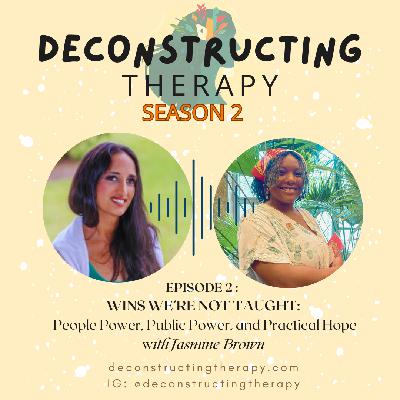
Episode 3 | Season 2
Wins We’re Not Taught: People Power, Public Power, and Practical Hope Guest: Jasmine Brown (@jasminebrownformayor)
In this grounded and inspiring conversation, Alefyah sits down with organizer and activist Jasmine Brown to trace her journey from early disillusionment to practical hope. Jasmine shares how watching her parents work without “getting ahead,” moving through low-wage jobs, and witnessing police harm lit a lifelong fire for justice—and how learning itself transformed her: not just learning to read, but learning how to learn, to stay curious, and to make knowledge actionable.
From her first protest at Pensacola’s Graffiti Bridge to speaking at city council against Florida Power & Light’s monopoly contract, Jasmine reflects on what organizing taught her about connection, courage, and how much common ground truly exists across political lines. Whether she’s door-knocking in the South or trading soil and plant starts with neighbors across the political spectrum, Jasmine reminds us: most people want the same things—dignity, housing, community, and care.
A turning point comes from a delegation with the International People’s Assembly to Cuba, where culture isn’t an add-on—it’s woven into political life. Jasmine describes dancing as grounding, popular education as a practice of dignity, and CENESEX’s model of supporting harmed people while educating families, so we don’t throw people away. Along the way, she names the wins we’re rarely taught—slave rebellions, local mutual-aid victories—and why remembering them sustains the long game. As she says, “You don’t have to take down the war machine—just pick up a broom.”
Since this recording, Jasmine has launched a campaign for Mayor of Pensacola, running on the slogan “Pensacola for the people, not the developers.” Her movement continues the message of this episode: real power begins face-to-face, with everyday people talking—and acting—together.
Highlights & Takeaways
The awakening: refusing to normalize exploitation and extraction
From anger to action: channeling frustration into local campaigns (public power, utilities, housing)
Learning how to learn: curiosity → agency → actionable change
Cuba & culture: music/dance as organizing infrastructure, not extras
CENESEX model: protect the harmed person and keep working with the family/community
Hidden histories, real wins: why we’re not taught them—and why they matter
Finding common ground across difference—knocking on doors, not walls
“Pick up a broom”: regulate overwhelm through small, tangible steps
Mentioned
Pedagogy of the Oppressed — Paulo Freire
Septima Poinsette Clark — “the power of people when they are given the truth”
James Baldwin — “Those who say it can’t be done…” (guiding inspiration)
Assata: An Autobiography — Assata Shakur
Revolutionary Suicide — Huey P. Newton
Zora Neale Hurston — anthropology & everyday life
International People’s Assembly (delegation to Cuba)
CENESEX (Cuba) — National Center for Sex Education
Connect with Jasmine Brown
Instagram: @jasminebrownformayor Campaign: Pensacola for the Pe...
Chapters
(00:00:03) - Deconstruction: Jasmine Brown(00:01:10) - Jasmine on How She Came to Love Environmentalism(00:05:58) - Did Your Parents Push You Into Psychology?(00:09:52) - Independents Turn from Blue to Green(00:15:11) - Participants on the 2020 election(00:20:21) - USWS on the Cuba Trip(00:26:42) - How to reach out to the people of the US(00:33:35) - Picking Up A Broom: DeShawn's Therapy

Comments

Download from Google Play

Download from App Store
 United States