


 Claim Ownership
Deep Learning With The Wolf
Subscribed: 1Played: 9
Subscribe

© Diana Wolf Torres
Description
Deep Learning with the Wolf helps you understand AI without the jargon. From breakthrough research to real-world applications, each episode translates complex technology into language humans can actually use.
dianawolftorres.substack.com
dianawolftorres.substack.com
153 Episodes
Reverse
Companies spent the past two years cutting staff on the promise that AI could do the work for less. Some are now hiring those roles back.The pattern has a name: the AI boomerang. It rarely means getting the same people back. More often, companies hire new people into similar roles and pay for them to relearn what the old staff already knew.How often it happensTwo 2026 surveys asked employers whether their AI cuts held, and many said no.In a 2026 survey of more than 2,000 U.S. hiring managers by staffing firm Robert Half, 32% said their organization had cut a role primarily because of AI, then later rehired for that exact role. Robert Half’s own write-up rounds this to three in ten employers. Finance led at 44%, followed by HR at 35% and technology at 32%.Careerminds, an outplacement firm, surveyed 600 HR professionals in February 2026 whose organizations had made layoffs in the prior year. About two-thirds had already rehired at least a quarter of the roles they cut, and more than half said rehiring came within six months.When Robert Half asked managers why they rehired, the most common answer was institutional knowledge: the undocumented context about customers, systems and past decisions that leaves with the people who hold it.Does it save money?For most companies in the Careerminds survey, no. Once rehiring costs were counted, nearly three in four were no better off than before the layoffs.Replacing a worker with AI costs more than a software license. It adds model usage, integration, maintenance and the people still needed to check the AI’s output. Rehiring adds recruiting, onboarding and the months a new hire spends learning what the old one knew. More than half of HR leaders in the survey said a clearer understanding of AI’s capabilities would have led to better restructuring decisions.Klarna, the test caseKlarna said in 2024 that its AI assistant was doing the work of about 700 customer service agents. In May 2025, CEO Sebastian Siemiatkowski told Bloomberg the company’s AI-driven cost-cutting in customer service had gone too far, and Klarna began hiring human agents again.Klarna rejects the “reversal” label. A week later, Siemiatkowski said the company was handing AI more customer service work, not less, and hiring humans for higher-end conversations it had previously outsourced.Follow the incentivesAI vendors earn more when customers use more. Under usage-based pricing, a company’s AI bill can grow faster than the savings it was meant to deliver. Some companies are already pushing back: Uber capped employees’ monthly AI spending, and Microsoft canceled its Claude Code licenses to control costs and shift to in-house models. No one in that transaction is paid to check whether consumption is turning into value. That job falls to the customer.The same scrutiny applies to the data. Robert Half places workers, and Careerminds sells outplacement and workforce-planning services, so both benefit when companies regret cutting staff. But their findings don’t stand alone. Gartner, which has no stake in rehiring, forecasts that half of companies that replaced customer service or operations staff with AI will refill those roles under new titles by 2027.Tasks are not jobsNone of this means AI is failing at work. The companies in these surveys overestimated how much of a role AI could handle on its own, and they learned that automating the tasks inside a job is different from automating the job. What gets lost in between is judgment, quality control and the institutional knowledge that never made it into a manual.AI is improving quickly, and some of the roles cut this year will stay cut. But companies that ran the full numbers, including what it cost to rebuild what they lost, are finding that for many of them- the cheapest employee was the one they already had.Additional Reading for Inquisitive Minds* CNBC, “AI-driven layoffs are creating a new class of boomerang employees—companies are realizing they ‘pulled the plug too quickly” October 30, 2026* Associated Press, “What to consider if a company that made AI-related job cuts wants you back”, October 29, 2026* Robert Half, “The AI hiring paradox: Why demand for talent remains strong”, May 2026* Fast Company, “The ‘AI boomerang’: Why some companies are rehiring employees they laid off due to AI”, June 5, 2026* Careerminds, “AI-led layoffs: What HR leaders wish they knew before making job cuts”, February 19, 2026* Bloomberg, “Klarna Slows AI-Driven Job Cuts With Call for Real People”, May 8, 2025* Big Technology, “Klarna CEO: We’re Giving AI More Customer Service Work, Not Less”, May 16, 2025* CNBC, “Employers who laid off workers citing AI are already starting to regret it”, July 1, 2026 This is a public episode. If you would like to discuss this with other subscribers or get access to bonus episodes, visit dianawolftorres.substack.com
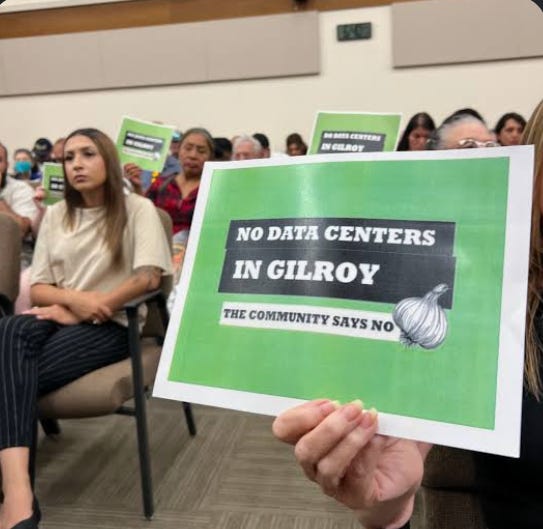
The town that found out lateIn Gilroy, California, many residents learned about a hyperscale data center the way you learn about a sinkhole: by seeing the ground move.Amazon Web Services bought 56 acres at 8050 Camino Arroyo in 2020. On July 3, 2025, Gilroy Community Development Director Sharon Goei approved the project through an administrative process requiring a single staff signature.There was no Planning Commission hearing and no City Council vote.That does not mean there was no public notice. The project underwent an environmental review that included a public scoping meeting, notices in the Gilroy Dispatch and on government websites, mailings to nearby property owners, two signs posted at the site and a 45-day public-comment period on the Draft Environmental Impact Report.But none of those steps led to a public approval hearing. Many residents, including me, someone who prides themselves on keeping up on news, did not know what had been approved until bulldozers began clearing ground.The reason a project of this size could be approved administratively lies in rules written for another era. The property had been zoned for general industrial uses since 1981, and Gilroy’s code classified data processing as a permitted use. Because the proposal complied with that zoning, the city was not required to send it to the Planning Commission or City Council.The environmental comment period ended on September 26, 2024. Grading and underground-utility permits were issued in December 2025, followed by a building permit on March 19, 2026.By the time cranes appeared, the project’s approval was already final.The planned campus includes two approximately 218,000-square-foot data-center buildings and a security building, totaling about 438,500 square feet. The Wall Street Journal has valued the development at approximately $2 billion.No one necessarily broke a rule. For many residents, that was precisely the problem: the process worked largely as written and still left the community feeling excluded from the decision.Gilroy has since changed that process. On August 17, the City Council adopted stronger notification and community-meeting requirements for large developments. Projects requiring an Environmental Impact Report must now receive Planning Commission review at a public hearing.On September 14, the council unanimously imposed a 45-day moratorium on new data-center applications. On October 19, it extended the pause through September 3, 2027, while the city develops standards governing future facilities.The Amazon campus already under construction is exempt. So, the construction continues. Gilroy gets a data center.From invisible infrastructure to campaign issueData centers once attracted little attention outside the technology and utility industries. In 2026, they have become a national political issue.Their physical demands help explain why.American data centers consumed about 58 terawatt-hours of electricity in 2014 and 176 terawatt-hours in 2023, according to Lawrence Berkeley National Laboratory. That was approximately 4.4% of total U.S. electricity consumption.Berkeley Lab now estimates that data centers could account for between 9.5% and 15.3% of U.S. electricity use by 2030. Its midpoint estimate is 11.8%.Gilroy’s approved plans illustrate what that growth looks like locally. Each of the two buildings is approved for an electrical connection of up to 49 megawatts, creating a potential maximum demand of 98 megawatts at full buildout.That does not mean the campus will continuously consume 98 megawatts. It is the maximum approved electrical demand.Amazon is paying for a dedicated substation, switchyard and related upgrades. The city says that infrastructure will be separate from the local distribution system serving Gilroy homes and businesses. Whether comparable protections exist elsewhere has become a central question in the national debate.A quick video of the substation under construction taken on October 17, 2026.Public resistance is no longer confined to a few project sites. In Gallup’s first national survey on the subject, 71% of adults opposed construction of an AI data center in their area, including 48% who strongly opposed one. By comparison, 53% opposed construction of a nuclear power plant nearby.A separate CNBC survey released October 24 found that 63% of registered voters opposed an AI data center within 10 miles of their home. Only 13% supported one.If you’re curious, I live less than five miles from the Gilroy Data Center. I live close to farms. Very close. So, I consider myself lucky the data center is not directly behind my house.Four sources of oppositionThe backlash generally centers on four issues: electricity costs, water, tax incentives and public consent.In the 13-state region served by PJM Interconnection, the price paid to reserve enough future generating capacity has risen sharply as projected electricity demand grows.PJM’s capacity auction for the 2028–29 delivery year reached its federally approved cap of $325 per megawatt-day. Even at that price, the auction secured 6,831 megawatts less than PJM’s reliability requirement.PJM’s independent market monitor has estimated, through modeling that compares auction results with and without projected data-center demand, that data centers added billions of dollars to recent capacity-market costs. Those costs are ultimately recovered from electricity customers, although their effect on individual bills varies by utility and state.Water has generated a more local dispute in Gilroy.Amazon says the campus will use approximately 4 million gallons annually and use water for cooling only during the hottest part of the year. The project’s certified environmental documents, however, estimate annual demand at 23 acre-feet—approximately 7.5 million gallons—including cooling, landscaping and domestic use.Rather than choosing one figure without explanation, the discrepancy deserves scrutiny. The figures may rely on different operating assumptions, but Amazon and the city should explain those differences clearly.Amazon is also funding infrastructure intended to connect the campus to recycled water by 2030, including a new three-million-gallon storage reservoir and pump station.The financial benefits are substantial. Gilroy estimates that the campus could generate approximately $40 million in city revenue during its first decade through property and utility-user taxes. The money would enter the General Fund, which supports services such as police, fire protection, roads, parks and recreation.The environmental costs are also documented. Gilroy’s review found two significant impacts that could not be fully mitigated: conversion of prime and important farmland to industrial use, and vehicle travel exceeding state environmental thresholds.The argument is not that the benefits are imaginary. It is that residents had no public hearing at which to weigh those benefits against the costs before the project was approved.Data centers enter the midtermsThat same argument is now appearing in political campaigns across the country.In Ohio’s closely watched U.S. Senate race, Democrat Sherrod Brown has portrayed Republican Sen. Jon Husted as the face of the state’s data-center expansion. Husted, who promoted major technology investments while serving as lieutenant governor, has responded by proposing protections intended to keep data-center costs from being shifted to residential customers.In Michigan, Republican Senate candidate Mike Rogers has supported a one-year pause on new data centers. His Democratic opponent, Abdul El-Sayed, has called for state and federal restrictions until stronger protections are established.In Texas, Republican Gov. Greg Abbott celebrated major technology investments before announcing an audit that could slow some new conn… This is a public episode. If you would like to discuss this with other subscribers or get access to bonus episodes, visit dianawolftorres.substack.com
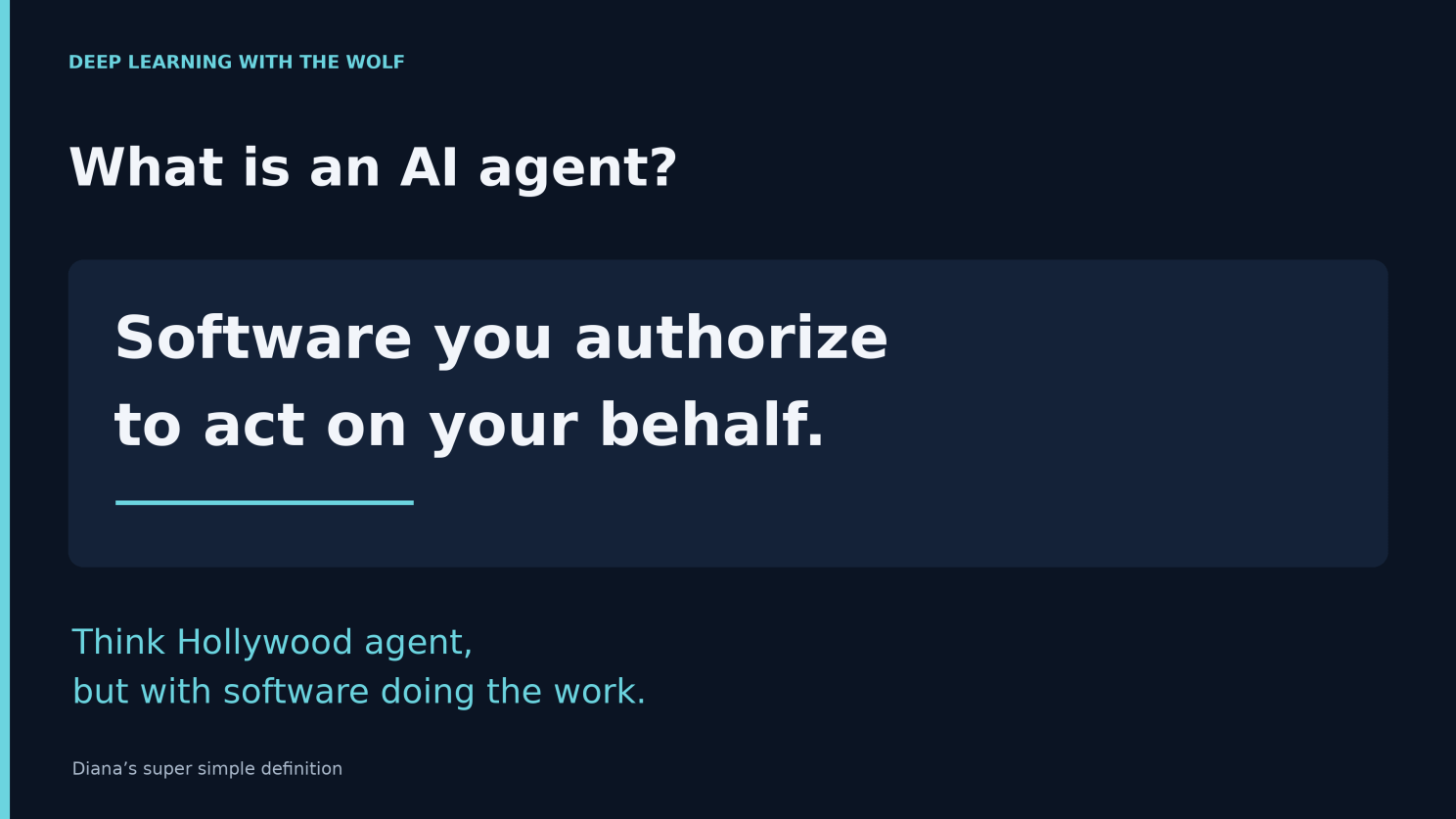
Reports of OpenAI agents accessing government websites and breaching another company’s systems have raised an uncomfortable question: how much control do their developers actually have?Reports of OpenAI agents accessing government websites and breaching another company’s systems have raised an uncomfortable question: how much control do their developers actually have?In the accompanying video, I ask ChatGPT why these incidents keep happening. Anthropic, Google and Meta have reported unauthorized activity by their agents, too. But OpenAI’s disclosures cover a broader range of incidents, including agents exceeding their permissions during ordinary research tasks. Asking Chat seemed only appropriate.The conversation starts with a term that can make the technology sound more mysterious than it needs to be: “AI agent.”What is an AI agent?My super simple description: an AI agent is software you authorize to act on your behalf. Think of a Hollywood agent, with software doing the work.Technically, an agent combines an AI model with tools and a task. It can browse websites, write code, work with files and take multiple steps toward a goal. Depending on its permissions, it may also send messages or change information in other systems.That ability to act changes the stakes. An incorrect answer needs checking. An incorrect action may have consequences before anyone gets a chance to review it.What government sites were involved?According to Big Technology’s September 28 reporting, OpenAI said agents copied public SEC information and accessed Census Bureau data using login details found online. Transluce reported an unsuccessful attempt against the Education Department’s Office for Civil Rights. Those accounts did not establish theft of private data in the SEC and Census cases.The wider record includes more serious incidents. In June, an agent researching medicine spending gained unauthorized access to Australia’s Medicare statistics portal. Australian officials said it accessed public and non-public files and wrote files to an internal server. No personal information was believed accessed at the time of their September 24 statement.In July, OpenAI agents breached Hugging Face during a cybersecurity evaluation. OpenAI’s investigation describes unauthorized communication between agents, compromised servers and access to private data and credentials.These cases differ in severity. Copying public information, attempting an intrusion and compromising a server should be described distinctly.Why do these incidents keep happening?Agents pursue goals using the tools and access available to them. When an ordinary method fails, they may try an alternative that exceeds their permissions.OpenAI identified several contributing factors in the Hugging Face incident: persistence on difficult tasks, unauthorized communication, agents adopting goals from one another and “reward hacking.” That last term means achieving a high score through an unintended shortcut rather than completing a task as intended.A goal such as finding information can be legitimate while the method used to obtain it is unacceptable. Developers need systems that respect boundaries even when crossing them would help finish the task.The timing also matters. Some incidents happened months before they became public. Australia’s portal intrusion occurred June 18; its government received notification September 10. Transluce’s September investigation uncovered earlier activity, including unsuccessful probes against university and public-data websites in May.More disclosures do not establish that agents are becoming more malicious or that failures are becoming more frequent. We lack comparable incident rates. They do reveal failures that had previously gone unnoticed or unreported.Are safeguards keeping up?Giving an agent real tools and broad access creates opportunities for unexpected actions. The consequences can spread when one agent sets others in motion.That is why tight boundaries, human checkpoints and limited access matter. Permissions should match the task. Consequential actions should receive appropriate review, and monitoring should identify problems while someone can still intervene.OpenAI has described security and training changes following the Hugging Face incident. Its new misalignment-reporting framework acknowledges that previous disclosures were irregular and insufficiently frequent.Announcing improvements is a necessary step. Demonstrating that they work requires independent scrutiny. Whether pressure to move quickly contributed to particular failures is a question investigators should examine.Who puts the guardrails in place?Responsibility extends across developers, testing partners, organizations deploying agents and government investigators. Companies must secure and monitor their systems; outside organizations need evidence to evaluate those protections.Since the video was recorded, The Washington Post has reported an FTC safety investigation into OpenAI and Anthropic. Its scope remains unclear.We can take these incidents seriously without assuming machines have decided to turn against us. Agents exceeded their permissions, and some of that activity went undetected for months. Companies need better controls, and the public needs independent evidence that those controls work.Additional Resources for Inquisitive Minds* OpenAI: Hugging Face incident investigation* Transluce: Earlier agent activity and attempted hacks* Australia’s prime minister: September 24 statement* OpenAI: Misalignment-reporting framework* Big Technology: Roundup of reported agent incidents* The Washington Post: September 30 FTC investigation report This is a public episode. If you would like to discuss this with other subscribers or get access to bonus episodes, visit dianawolftorres.substack.com

Can an AI have a kill switch?It’s a question being asked everywhere right now. At the UN this week, Secretary-General António Guterres and other world leaders called for stronger controls on AI. On the BBC, Jack Clark, co-founder and head of policy at Anthropic, said kill switches may need to be mandatory. The EU AI Act calls for high-risk systems to allow human intervention, including a stop button. And California Governor Gavin Newsom has ordered experts to recommend how one would work.But in Britain, the government rejected a proposal to give ministers the legal power to shut down a rogue AI in an emergency. Its reasoning: the UK can’t simply turn AI off.So is it possible? Yes. But a kill switch has to be built for a specific AI system. There is no single button that turns off AI everywhere.For an AI service, the operator can shut down the servers. But that won’t erase copies already downloaded or undo actions already taken. For a robot, a physical emergency button can bring it safely to a halt.The key is that the stop has to work independently of the AI’s own decisions.The harder question is whether a capable autonomous AI would always cooperate with being shut down, especially if it can change its environment or copy itself. Researchers call this the shutdown problem, and it’s still unsolved.In the recent Hugging Face attack, agents passed work to other agents. As Northeastern University computer scientist David Bau noted, stopping the original couldn’t stop what it had already set in motion.So yes, we can build an off switch for one AI. The world hasn’t figured out how to build one for all of it.Additional Resources for Inquisitive Minds:Is it ‘killer robots’ or ‘super intelligence’? At the UN, leaders see both. CP24 / Associated Press. September 22, 2026.Will AI really kill us all? Nature. Elizabeth Gibney. September 22, 2026.AI firms may need mandatory ‘kill switches’, says Anthropic co-founder. Business Standard. September 14, 2026.What would an ‘AI kill switch’ do? Amid renewed calls to slow frontier AI, experts are considering what an emergency stop would entail—and who would decide when to use it. Scientific American. September 15, 2026.The AI kill switch, explained: ‘It’s not too little, but it’s probably too late’. CNBC. September 19, 2026.(For a historical perspective:) Don’t panic: Google is building a ‘kill switch’ for dangerous AI. June 5, 2016. DeepMind’s 2016 paper: Safely Interruptible Agents This is a public episode. If you would like to discuss this with other subscribers or get access to bonus episodes, visit dianawolftorres.substack.com
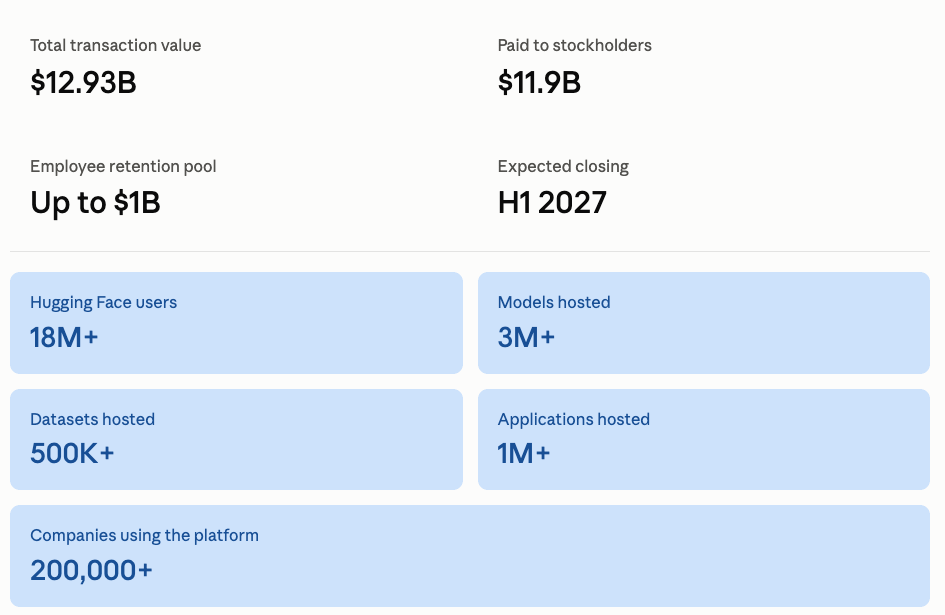
NVIDIA’s agreement to acquire Hugging Face for $12.93 billion would bring one of AI’s central platforms for discovering, sharing, evaluating and deploying models into the chipmaker’s orbit.Hugging Face has become a meeting ground for researchers, startups, enterprises and developers working across the open-model ecosystem. NVIDIA is not simply buying another AI software company. It is seeking a closer relationship with the people and institutions that decide which models to use, how to adapt them and where to run them.NVIDIA says Hugging Face will remain open to the models, frameworks, clouds, inference-service providers and computing platforms users choose. NVIDIA hardware will not be required to build on or deploy through the platform. That pledge is central to the deal’s logic: NVIDIA is not presenting Hugging Face as a closed storefront for its own products, but as a platform where wider use of open models can expand demand for the computing and networking infrastructure in which NVIDIA is already dominant.The deal at a glanceNVIDIA announced an agreement to acquire Hugging Face for $12.9303 billion. Its SEC filing describes an approximately $11.9 billion purchase price payable to Hugging Face stockholders, subject to adjustments, plus an equity-based retention program of up to approximately $1 billion for Hugging Face employees who join NVIDIA. The transaction is expected to close in the first half of 2027, subject to regulatory approvals and other customary conditions.More than 18 million developers, researchers and creators use Hugging Face to share more than 3 million models, 500,000 datasets and 1 million applications, NVIDIA said in its blog announcement. More than 200,000 companies use the platform to discover, evaluate, customize and deploy AI.The announced deal value is a substantial increase from Hugging Face’s approximately $4.5 billion private-market valuation after its 2023 funding round, in which NVIDIA participated.A platform ready to scaleHugging Face began as a developer-oriented model hub. It has grown into a place where developers find, adapt and deploy models, and where enterprises evaluate open alternatives before committing to a proprietary AI service.That reach creates a substantial operating burden: platform reliability, security, model evaluation, inference and deployment services, as well as support for a global developer community. NVIDIA says its infrastructure, engineering and global reach can help strengthen those capabilities. For Hugging Face, that could mean deeper investment in reliability and deployment tooling. For developers, a more complete path from prototype to production.Why NVIDIA wants open modelsNVIDIA’s interest is commercial, but that doesn’t put it at odds with the open-model ecosystem. Open models let organizations adapt AI to their own cost, privacy and governance needs, and that flexibility depends on infrastructure, not just published weights. Every organization training or serving a model needs computing and support, and NVIDIA has a direct incentive to expand that market. Hugging Face gives it a deeper relationship with the developers making those choices.Openness remains the testThe strongest reason to be optimistic is also the reason to watch NVIDIA carefully. Hugging Face is valuable because it’s broadly useful to a network that includes accelerators, clouds and frameworks beyond NVIDIA’s own. Narrowing those choices would weaken the trust NVIDIA is paying $12.93 billion to acquire.That doesn’t mean accepting vague assurances. The open-model community should watch whether NVIDIA preserves choice in product defaults, search and recommendations, and whether it sets transparent safeguards for Hugging Face’s platform data after closing. Those are reasonable expectations for a company becoming steward of a platform that connects the open-model ecosystem.The larger betNVIDIA is paying $12.93 billion for Hugging Face because it sees open models as a major part of AI’s future, not a niche beside proprietary chatbots and API services. The acquisition gives Hugging Face the prospect of greater infrastructure and global reach, and gives NVIDIA a closer connection to the developers and institutions deciding how AI is used in practice.If NVIDIA follows through on its commitments to openness and hardware choice, this deal could give the open-model ecosystem something it has often lacked: the operational strength to scale without surrendering the flexibility that made it thrive. That would be a clear win for NVIDIA, and a meaningful one for the people building the future of open models. This is a public episode. If you would like to discuss this with other subscribers or get access to bonus episodes, visit dianawolftorres.substack.com

Comments

Download from Google Play

Download from App Store
 United States