


 Claim Ownership
DigiTech Video
Subscribed: 0Played: 1
Subscribe

© Copyright MarketScale
Description
Ready, Set, AUTOMATE!
See how Digitech can streamline your UV print production with speed, precision and automation to suit your needs. Backed by over 30 years of experience in digital printing.
See how Digitech can streamline your UV print production with speed, precision and automation to suit your needs. Backed by over 30 years of experience in digital printing.
32 Episodes
Reverse
The Service in Review video shows recorded but not pre-arranged, zoom calls directly to our customers. In these calls we asked them, "How are we doing? Their answers were as we expected, "you guys are doing great, don't change a thing!" Give this one a watch and listen to all the things they had to say about not only the TruFire machine, but about Digitech as a whole. We have come to realize here at Digitech that while the performance of the machine is important, it is imperative that the service we provide is top notch in an industry that seems to be slacking in that department.
Introducing the world's first Digital Print & Cut system for rigid & corrugated materials! Digitech's TruFire digital printing equipment with it's NEW available TruCORR package. Designed for Custom Packaging & Display Boxes.
Introducing the world's first Digital Print & Cut system for rigid & corrugated materials! Digitech's TruFire digital printing equipment with it's NEW available TruCORR package. Designed for Custom Packaging & Display Boxes.. Specifically modified to handle corrugated paper with just the right amount of automation -- PRINT, CREASE, and CUT INLINE. • Customizable for volume AND specialty item “ONE-OFF” production• Intuitive vacuum system (2X) the air volume of our standard system• Digitech’s proprietary Queue it up software loads multiple images • QR code’s load the crease and cut files on the cutter• Conveyor automation system feeds (1) or (2) two cutters • Mirrored QR placement for quick reading and registration on the back • Double sided display boxes....no problem! DigiTech’s TruFire integration capabilities with flatbed cutters offer solutions to help automate your manufacturing process. Whether it’s B-Flute for custom display boxes or card stock for custom packages, Digitech offers solutions with flexibility and efficiency.
In this video you will get a background view of what goes into the TruFire printer. What components make it unique to us and what are the parts that push our platform beyond our competitors. From the Engineers, to the software developers, to the R&D team, Digitech works best as one. The TruFire features the industries flattest table, an advanced ink delivery system, to go along with industry leading software and top notch service. The TruFire flatbed printer helps to streamline your print shops operations while not sacrificing any of the key aspects including quality, adhesion, and time.
In this video you will see one of our many happy customers! We got to visit with the great folk at https://www.stokessigncompany.com/ up around the Austin, Texas area. This video features the LTX2 in its natural habitat! A production environment. Printing between 500-1000 boards a day the TruFire has exceeded all expectations. The newest software package that helps their operators "queue it up" was a custom package specifically for Stokes that we are proud to stand behind.
Daniel Litwin spoke to Patrick Coldewey, President and CEO of DigiTech, about the automation hiring process within the printing industry. The conversation covered a breadth of points, including the Great Resignation, skilled workers aging out, and how smaller companies use automation [in hiring] to their advantage. The Great Resignation is not showing any signs of slowing down, and in fact, recent labor statistics show that 4.3 million people quit their jobs in January 2022. This is only a slight improvement from the highest numbers that were seen in November 2021. Workers are biding their time to find a new opportunity, and only a few are reporting “buyer’s remorse” or regret over quitting their jobs preemptively.Naturally, the printing industry hasn't been spared from this trend either. As a legacy workforce ages out and a new workforce fails to gain steam, the answers to more efficient printing processes might be found in automation technologies. This episode highlights the challenges of the Great Resignation and guides listeners to potential solutions and strategies to deal with the situation.
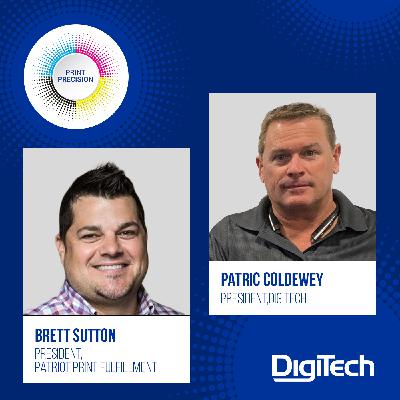
Print Precision kicked off a four-part series with a case study on integrating TruFire into a small printing operation. Brett Sutton, President at Patriot Print Fulfillment, joined DigiTech’s President, Patric Coldewey, and Host Daniel J. Litwin a look at the one-year journey documenting TruFire printer’s adoption strategies. One week into the partnership, Sutton said his company had already seen results.“I wanted to offer something different where we’re helping people out that need help and can’t get it otherwise because they had to spend way much more than they needed to get something done,” Sutton said. Sutton’s background is restaurant print fulfillment, but a couple years ago, he branched out with Patriot Print Fulfillment to tackle additional areas. “What we do today is the large format flatbed printing for the fulfillment side of things,” Sutton said. “I also do embroidery in-house. We try to offer a one-stop-shop fulfillment. We pretty much encompass all of the aspects of printing except off-set.”Sutton considers himself a bit of a gambler, but when he searched for new print technology, he didn’t feel much risk betting on DigiTech’s TruFire LTX2. “The speed alone was what drew me over there to watch it,” Sutton said of his first experience seeing the TruFire. “I realized the machine I had that at the time was a great entry-level machine but wasn’t going to cut it for the way I wanted to take this company and grow it. Flash forward to one week ago, and the TruFire LTX2 made its debut at Patriot.If Sutton had one complaint about the TruFire, it was that it is so fast, work is backed up in his cutting area. Not to worry—Sutton said a new cutter is on its way. It’s a challenge he was more than willing to solve.
Print Precision kicked off a four-part series with a case study on integrating TruFire into a small printing operation. Brett Sutton, President at Patriot Print Fulfillment, joined DigiTech’s President, Patric Coldewey, and Host Daniel J. Litwin a look at the one-year journey documenting TruFire printer’s adoption strategies. One week into the partnership, Sutton said his company had already seen results.“I wanted to offer something different where we’re helping people out that need help and can’t get it otherwise because they had to spend way much more than they needed to get something done,” Sutton said. Sutton’s background is restaurant print fulfillment, but a couple years ago, he branched out with Patriot Print Fulfillment to tackle additional areas. “What we do today is the large format flatbed printing for the fulfillment side of things,” Sutton said. “I also do embroidery in-house. We try to offer a one-stop-shop fulfillment. We pretty much encompass all of the aspects of printing except off-set.”Sutton considers himself a bit of a gambler, but when he searched for new print technology, he didn’t feel much risk betting on DigiTech’s TruFire LTX2. “The speed alone was what drew me over there to watch it,” Sutton said of his first experience seeing the TruFire. “I realized the machine I had that at the time was a great entry-level machine but wasn’t going to cut it for the way I wanted to take this company and grow it. Flash forward to one week ago, and the TruFire LTX2 made its debut at Patriot.If Sutton had one complaint about the TruFire, it was that it is so fast, work is backed up in his cutting area. Not to worry—Sutton said a new cutter is on its way. It’s a challenge he was more than willing to solve.
Color is an essential aspect of printing. Managing it and ensuring it’s correct can be a challenge for operators. Ideally, print companies want high-quality color profiles that are accurate while also keeping ink costs down. Mike Adams, an expert on color correcting in the industry, joined Print Precision host Daniel Litwin and DigiTech Founder and President Patric Coldewey. Adams is the President and CEO of Color Correct and has 16 years of experience. Adams said, “When there’s a color problem, most people think they need to re-linearize. That’s the process of printing set patches from 0 to 100% of each color. Then you read the dot grains, and it creates a curve.”While linearization has been a pillar in color correction, Adams noted it’s a “misguided strategy.” He argued that linearization doesn’t fix color problems. His advice is to create a new profile. He added, “The biggest culprit of bad color is usually the artwork.”Adams noted that DigiTech printers are in a different category regarding speed and the longevity of print heads. “With our printers, we want users to get the most out of their investment, using the print heads throughout the lifetime of the printer,” Coldewey said. Next, they talked about reducing ink usage so that high-volume print jobs are “good enough.” Coldewey noted, “There are steps to take for some signs where color isn’t as important.”Adams acknowledged that this is possible with gray component replacement. He explained, “The color’s value doesn’t change, but the lightness or darkness can. It’s replaced by black, so it’s adjustable to save ink and increase margin.”
Color is an essential aspect of printing. Managing it and ensuring it’s correct can be a challenge for operators. Ideally, print companies want high-quality color profiles that are accurate while also keeping ink costs down. Mike Adams, an expert on color correcting in the industry, joined Print Precision host Daniel Litwin and DigiTech Founder and President Patric Coldewey. Adams is the President and CEO of Color Correct and has 16 years of experience. Adams said, “When there’s a color problem, most people think they need to re-linearize. That’s the process of printing set patches from 0 to 100% of each color. Then you read the dot grains, and it creates a curve.”While linearization has been a pillar in color correction, Adams noted it’s a “misguided strategy.” He argued that linearization doesn’t fix color problems. His advice is to create a new profile. He added, “The biggest culprit of bad color is usually the artwork.”Adams noted that DigiTech printers are in a different category regarding speed and the longevity of print heads. “With our printers, we want users to get the most out of their investment, using the print heads throughout the lifetime of the printer,” Coldewey said. Next, they talked about reducing ink usage so that high-volume print jobs are “good enough.” Coldewey noted, “There are steps to take for some signs where color isn’t as important.”Adams acknowledged that this is possible with gray component replacement. He explained, “The color’s value doesn’t change, but the lightness or darkness can. It’s replaced by black, so it’s adjustable to save ink and increase margin.”
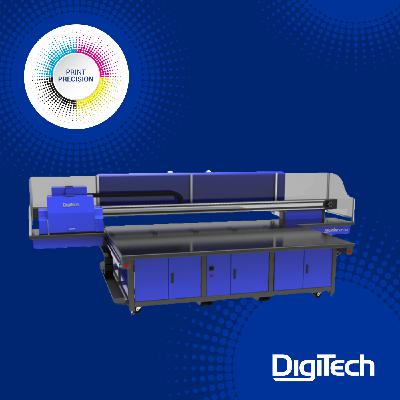
For our industry's customers, getting face to face with the right printing machine is more troublesome than ever, with tradeshows out of the picture until at least April 2022. And if you've listened to previous episodes of the show, like such as with our friends at Sign Master and Parrott Printing, they reiterated the importance of being thorough with finding the right printing solution.On this episode of Print Precision, a podcast by Digitech, Host Daniel Litwin talked with Patric Coldewey, President at Digitech. They dig into the process needed to take place to make sure ensure a graphics supplier, sign company, or commercial printer can find the suitable printing machine to fit their needs. So how are we getting folks to see our printers in person? "We're having demo weeks," Coldewey said. "We're having two or three demos a day. Some of them are live. Some of them are Zoom demos. We're getting people in front of them and telling people within driving distance to bring 50 to 100 sheets over here and watch the printer run."Obviously, a tradeshow environment is nice because you can go from one machine to the next, according to Coldewey. When you're doing that, you're sitting and watching the machine, but you can get confused at tradeshows because there's so much information. With that being said, even though you are sitting and watching the machine at tradeshows, it is easy to get confused due to the influx of information."The biggest thing I like to emphasize for customers if you're looking for a piece of equipment, don't take anybody's word for it," Coldewey said.
For our industry's customers, getting face to face with the right printing machine is more troublesome than ever, with tradeshows out of the picture until at least April 2022. And if you've listened to previous episodes of the show, like such as with our friends at Sign Master and Parrott Printing, they reiterated the importance of being thorough with finding the right printing solution.On this episode of Print Precision, a podcast by Digitech, Host Daniel Litwin talked with Patric Coldewey, President at Digitech. They dig into the process needed to take place to make sure ensure a graphics supplier, sign company, or commercial printer can find the suitable printing machine to fit their needs. So how are we getting folks to see our printers in person? "We're having demo weeks," Coldewey said. "We're having two or three demos a day. Some of them are live. Some of them are Zoom demos. We're getting people in front of them and telling people within driving distance to bring 50 to 100 sheets over here and watch the printer run."Obviously, a tradeshow environment is nice because you can go from one machine to the next, according to Coldewey. When you're doing that, you're sitting and watching the machine, but you can get confused at tradeshows because there's so much information. With that being said, even though you are sitting and watching the machine at tradeshows, it is easy to get confused due to the influx of information."The biggest thing I like to emphasize for customers if you're looking for a piece of equipment, don't take anybody's word for it," Coldewey said.
On previous episodes of Print Precision from DigiTech, we’ve covered a simple truth – quality is the cheapest thing you can offer your customers. There’s no substitute for a high-quality flatbed printer like the DigiTech TruFire, which allows you to eliminate rework costs, up printing speed without a dip in results, and more.However, not every organization has the capital to make a significant purchase. That leads to the search for a “cheap” flatbed printer – but what does that actually mean? Not everyone's budget is the same, but where should a lower cost reflect in the quality, speed or flexibility of printing hardware?To find out, host Daniel Litwin was joined for this episode of the podcast by DigiTech President Patric Coldewey and Founder and CEO of SignMaster.com, Tommy Trucks, who shared their leading insights about finding the right flatbed printing solution for every unique operation.The most important consideration, even when looking for a more affordable option, is throughput. When you can print at greater speeds, you don’t have to turn down business you otherwise might have, and you can recoup the cost of the printer more quickly.“The capital expenditure is always a big deal, [but] the printer with the biggest capital expenditure on the front end is not always the most expensive,” Trucks said. “We’ve benefited greatly in upgrading our equipment.”
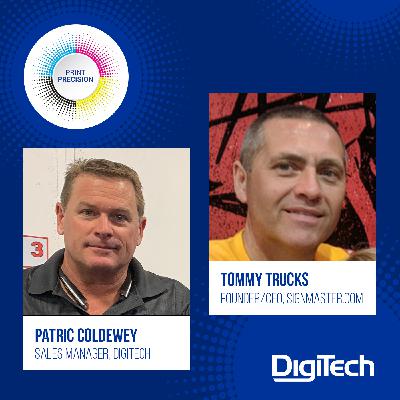
On previous episodes of Print Precision from DigiTech, we’ve covered a simple truth – quality is the cheapest thing you can offer your customers. There’s no substitute for a high-quality flatbed printer like the DigiTech TruFire, which allows you to eliminate rework costs, up printing speed without a dip in results, and more.However, not every organization has the capital to make a significant purchase. That leads to the search for a “cheap” flatbed printer – but what does that actually mean? Not everyone's budget is the same, but where should a lower cost reflect in the quality, speed or flexibility of printing hardware?To find out, host Daniel Litwin was joined for this episode of the podcast by DigiTech President Patric Coldeway and Founder and CEO of SignMaster.com, Tommy Trucks, who shared their leading insights about finding the right flatbed printing solution for every unique operation.The most important consideration, even when looking for a more affordable option, is throughput. When you can print at greater speeds, you don’t have to turn down business you otherwise might have, and you can recoup the cost of the printer more quickly.“The capital expenditure is always a big deal, [but] the printer with the biggest capital expenditure on the front end is not always the most expensive,” Trucks said. “We’ve benefited greatly in upgrading our equipment.”
A surprising trend during the pandemic that presented printing companies with opportunities was unexpected growth in demand for yard signage. Patric Coldewey, Founder and President of Digitech, and John Parrott, Vice President of Parrott Printing, explored this interesting side-effect of COVID-19 and provided context regarding how this opportunity made a difference for printers during some tough months.

Comments

Download from Google Play

Download from App Store
 United States