


 Claim Ownership
Battling Archetypes
Subscribed: 2Played: 3
Subscribe

© Stephen Douglas
Description
Battling Archetypes applies the Twelve Tools of the Disinfolklore analytical method to the folkloric structures hiding inside modern propaganda, memes, and geopolitics. Each episode decodes how Russia, MAGA, and other Disinfolklorists archetype reality — and how Counter Disinfolklore can unmask the wolf in sheep’s clothing.
www.disinfolklore.net
www.disinfolklore.net
44 Episodes
Reverse
Munich Speech ForecastIt’s a very interesting day, a very good day for Disinfolklore and for what I forecast on the basis of data back in February in my Munich speech, February 2025.I see what Donald is doing to all of us, to the markets, to the whole of humanity really, through the medium of all these various things which most of us have never really heard about, like helium and fertiliser and all these things. Basically, Donald is wrapping us up inside a Disinfolklore universe. This for me is the primary purpose of everything that is going on at the moment. It’s good to be able to voice this and talk about this.I was going to talk today — I was on the fifth episode of the five speeches which I prepared after James asked about reflexive control about five weeks ago. This is the final speech. The most perfect example ever of reflexive control is in our information space at the moment, with Donald starting an unlawful war and then expecting everyone else to come and rescue him from it.This is what I’ve called inevitability farming, which is beloved of authoritarians, where you create the inevitability. That, in its essence, is reflexive control.We don’t consider it part of military doctrine as such. If you consider everything that Donald is doing as part of a combat strategy to occupy, dominate our minds and to exercise coercive control over every choice we make in our lives — whether that’s about women over their bodies, whether it involves family, whether it’s about shopping, whether it’s about millions of people potentially starving to death in Malaysia unless they do something — then the reflexive control which we’re watching happen on a global scale now is precisely what I watched operating inside Russian-occupied Ukraine, 2015 to 2018.I was going to talk about that. James’s question five weeks ago is completely relevant today, and the structures which the Disinfolklore analytical method provides enable us to interpret the news which is going on today just as much as five weeks ago, and hopefully onwards into time.Disinfolklore.eu is the main website. That’s where my oeuvre going forward into the future will live, along with disinfolklore.net, where there’s the newsletter.That was my proposal. I had a couple of tweets this week. I was inspired again this week by all of this malarkey, and I wrote a few things which I could talk about briefly and then go on to the main part.Re-archetyping UkraineObviously my main project, and many of our main projects since the beginning of the war, was to — now I have the language to describe it — re-archetype humanity’s perception of Ukraine. My ambition for this, as many of you know, is to re-archetype humanity’s perception of Ukraine and ancient Ukraine and the past 6,000 years.What we’re obviously seeing this week in the Middle East, which is bringing joy to many of our hearts after a very hard, metaphorically hard winter for us by comparison to Ukrainians, is President Zelensky in the Middle East, bringing arms and bringing hope and modelling how you act as a superpower.The Comedian, the Druid, and the DunceYet again, in my March or February 2025 speech, the Munich speech, I archetyped the entire war in Ukraine as a titanic struggle between Druidy Don — Disinfolklore — Duncy Putin, and the Comedian.Druidy Don: he’s truthy. He’s not really a druid, but he certainly models one.Duncy Putin: he never learns, wakes up each morning like Pangloss or like your favourite folktale hero with no memory of what he learned — or your favourite AI chatbot — with no memory of what he learned from the day before.The Comedian, the arch-comedian: the Russians obviously tried to archetype him as the comedian, as a bit of a joke, but the joke is on them because he’s a great actor, a proper comedian, a proper master of the juridical realm of sovereignty, which is the archetype going back thousands of years in Indo-European culture, and also of the magico-religious.Whereas Don, Druidy Don — no one can doubt his magical powers to wrap humanity, including the markets. I’m following the apocalyptic FT Financial Times app on my phone. It’s quite funny, they keep falling for these trolls that the war is going to be over in five minutes. These are the money people, and every corner of humanity is being wrapped up inside this Disinfolklore universe.On the other hand, we have the Comedian, President Zelensky, who is using his powers for good. No one can doubt he’s got the powers. You see him in Saudi Arabia and all these countries, with the greatest army humanity has seen, blowing up Russian oil wells like there’s no tomorrow. There certainly is no tomorrow for Russia. The next day he arrives in Saudi Arabia, casually as you like, and Don and Rubio and everyone trying to cast negative spells all over him, but they bounce off him like raindrops off a Mackintosh.The Sorcerer and His ApprenticeI made this prophecy using the Disinfolklore analytical method. Am I looking at the archetype of the apprentice and the master? I made this a month before Prigozhin’s coup because it seemed to me, looking at the data, that Prigozhin, the Chef, the Chef Sorcerer, was in fact Druidy Duncy Putin’s, the Chief Sorcerer’s, successor — anointed successor.That was just looking at this archetypal story of the sorcerer and his apprentice, which reappears in different Indo-European traditions. At a certain point, the apprentice is ready to take over from the master, but the master is afraid that the apprentice will kill him. That is, as expressed by Georges Dumézil, one of my great influences, the plight of the sorcerer.It just so happens that the Russians archetyped Prigozhin to try and disguise and conceal his role inside the power vertical — maybe not always intentionally, but it had the effect of doing it — as the Chef. An archetypal identity. I then archetyped him as the Chef Sorcerer, as in sauce. The Chef himself had published a book of fairy tales and got Donald elected the first time with his Internet Research Agency and his Disinfolklore propagation apparatus.Prigozhin’s Changing CharacterOne of the indicators I had for why Prigozhin’s role was suddenly changing, his character was changing, was when we started to see him being quoted in the New York Times, the Washington Post, and other conventional media operations as a kind of truth-teller, the counterpoint to Putler. Even if Ukraine said this or that, or one of us said this or that on Twitter, no one would listen to us. Prigozhin was being used as a kind of ventriloquist for the truth in these media organs.It seemed to me that this was a change in character, because up until that point, for people like me who had been following Wagner since 2015, when I first physically came in touch with them in eastern Ukraine, this was a brutal operation, a Nazi operation, part of the Russian army, coupled with this Disinfolklore propagation apparatus that managed to get Donald elected and Brexit done and didn’t quite drive humanity nuts.Through the medium now of Donald, they are succeeding down the line and driving humanity nuts with all of this blowing hot and cold, ten-dimensional chess or whatever they’re archetyping Donald’s nonsense as today.It was that change in role of Prigozhin — suddenly from Putin’s chef, someone who was always archetyped as being outside the power vertical, wasn’t quite proper, wasn’t part of the establishment, the security establishment, was an oligarch, archetyped as Putin’s chef. He wasn’t in charge of Rosneft and all that. It was his being given these plum jobs in Ukraine, such as the Kyiv region — assassinating all the political leaders, assassinating President Zelensky — and then given the plum job of Bakhmut or Artemivsk to conquer, which was supposed to be taken by the end of July. He was given Popasna, killed thousands of people in Popasna, and then got bogged down in Bakhmut.Obviously most people in the real world weren’t following this. I was watching how his character was changing in the media. I see that same pattern today with President Zelensky. I wrote a piece about that because I think this kind of magical process is going on with President Zelensky at the moment. Obviously dark days lie ahead and there are dark days on the front in Ukraine, but at the same time I see the same signs that I saw then: that something’s going to happen.Putler Dials Don Up to ElevenI couple that with my insight that I think Putler is on his last legs. I wrote a piece today about how I think Putler has dialled up Druidy Don Disinfolklore to eleven, riffing off Spinal Tap. This is what we’re seeing now. He’s kind of maxing out on it, because he or she who controls Druidy Don Disinfolklore will rule Russia.Whoever has the Epstein kompromat or however they’re controlling Don — the chip in his head, God knows what it is — whoever in the Russian power vertical controls that will control Russia. Putler is hanging on for dear life to it.We see this acceleration of madness: the selling out of all of the allies, permanent changes in our global security architecture, and as far as I can see, the inevitable destruction, sadly, of the American military, if, as I strongly suspect is going to happen, they’re going to do a ground invasion of Iran, which is going to turn into, I believe, a worse disaster than even Iraq.Of course, all that suits Duncy Putin: this chaos. Meanwhile, Ukraine’s bombing Isluga and Yalabuga and all of these things. Long may that continue. As ever, anything Russia touches turns to rubbish.Preliminary Thoughts: Where We Are TodayThose were just some of my preliminary thoughts to set the context of where I think we are today. I’m hyper-aware I don’t want to contribute to this craziness that has entered all of our brains. It’s exactly the same craziness we saw in MAGA people in America at election time, that we’ve seen Donald doing on Page Eight in the New York Post in the 1980s. Now things have got really real and it’s in every corner of humani
The Trito Myth ContinuedTrita is a herdsman whose cattle are stolen by the negation, by the snake. In Vedic India, the negation is called the Naga. Who wouldn’t argue that Druidy Don is today’s negation? Or Duncey Putler, the negation of the post–World War II legal order.Then with the help of Zeus Pater — Zeus Pater, Skyfather, Zeus in Greek, Jupiter in Rome — in Vedic India, or sometimes on his own, Trita manages to get his cattle back.Capital from CattleAfter retrieving his cattle, his capital — the word capital comes from cattle, and that’s how fundamental they were — he establishes the first ritual, the first rite of sacrifice, to commemorate, to memorialise and give thanks to the Skyfather. This culture-forming sacrifice, self-sacrifice manifesting as the sacrifice of the twin.We have Trita, third man. Manu, the first man — human, or Mannus in Germanic tradition. In India, it’s Manu. Yama in India, coming from Aryaman, who gives his name to Iran, to the name Iran. In the Zoroastrian era, Yama starts his life as kind of the lord of the treasury, becomes celestialised, archetyped as a deity, and then is transmitted into Tibetan Buddhism and into Hinduism.We see this in Odin, who is on the same level as Yama — again, archetyping, all archetyping along with Indra as well — of the Lord of Death, the first monarch. Again that rich sound at the end of monarch. The first king to self-sacrifice and die and lead all other humans into the afterlife. This is the function of Yama, twin, over Manu, who’s the first sacrificer. Manu is in the same position as Trita.The MN Sound Across TraditionsIn the Germanic tradition, we have Tuisto, whose name also means twin, and Mannus, with two Ns, different from Manu but pretty close, who’s the first of the Germanic-speaking peoples. In Wales, we have Manawyddan. In Ireland, we’ve got Éremón, who’s cognate, I believe, with Aryaman — the first high king of Ireland in the Indo-Europeans after the three invasions of Ireland. In Iran, Aryaman, who gave his name to Iran.The same immanences in all these traditions, the same archetypes, the same sounds, the same MN sounds in all of these names passed over thousands of years.Skyfather and UkraineHow much do we talk about the sky today? Sky Shield protecting Ukraine’s sky. How appropriate that this should have been an imminence in the minds of the first Indo-Europeans. Skyfather, Zeus Pater, in their village on the right bank of the Dnipro, south of Zaporizhzhia. Zeus Pater lived there. He spread from there into our culture, into our minds through the Trito myth and through Trita’s sacrifice, establishing the rite after he gets his cattle back.Both Sides Archetype as TritaThis is my original addition to the Trito myth: both sides archetype themselves as Trita, the good and the bad. Everyone identifies with the herdsman whose cattle has been stolen. Donald identifies with Trita and sees himself in Trita’s position. Duncey Putler does too. President Zelensky does too. We do. Everyone identifies with the herdsman whose cattle have been stolen.When we hear Donald and Duncey Putler grievance mining — what I call grievance mining — moaning about this or that, they’re identifying, they’re acting out their feelings of being persecuted. Like Trita was persecuted by having his cattle taken away. Someone has come and stolen our children, our cattle, our houses. They’ve taken away our peace of mind. They’ve taken away our husband, our wife, our girlfriend. Something we value, our love. We overcome obstacles and we retrieve them, either through the intercession of Zeus Pater, or whichever deity you believe in, something in the sky, or just by our own exertions.Both sides do this. Duncey Putler archetypes himself as Trita, claiming Ukraine’s people are his cattle. Donald archetypes himself as Trita. All of these MAGA people, these America First people, these Reform people in England, these AfD people — their origin story is the same.The Need for a StandardIf everyone identifies with Trita, we need a standard against which to decide what is right. When is Trita right in retrieving what he sees or perceives as his cattle? When is he not right? When is he sinister? He’s wrong. He’s gone into someone else’s territory claiming their cattle are his and he’s taken them back from there. He has invaded Iran. He has invaded Ecuador or invaded Venezuela.The Troll: The Fundamental MetaphorThe fundamental metaphor in the Disinfolklore analytical method is the troll. Again, the TR sound in troll. That’s not a coincidence, because it was in search of some meaning to this pattern which I kept on noticing — Trump, troll, Trump, troll, TR — that I ended up reading the Rig Veda from 1100 BCE.The archetypal troll tale, the Three Billy Goats Gruff — three brothers Gruff, crossing a bridge, looking for pastures new, economic migrants — this is the story of all Indo-European migration. This is how one language family spread from Mykolaivka village south of Zaporizhzhia city into the geographical space between Ireland and India by tradition, and then across the whole of the Americas, and even Australia, apparently.This is the story of all Indo-European migration, and again, this is my original contribution to the interpretations of Three Billy Goats Gruff, immanent in this tale, which was first translated into English in 1860. It immediately became the most popular of all troll tales. There are thousands of troll tales, but this is the archetypal one as evidenced by my search of 33,000 sources in the Dow Jones Factiva database, which I did April–May 2020 when I first started looking into this in seriousness.The Three Billy Goats’ GruffThe troll guards the bridge, like the bridge trolls I dealt with in eastern Ukraine, the Russian occupiers on the other side of the bridge. The troll guards the bridge. First Billy Goat Gruff says, don’t eat me. I’m just going over to the other side for pastures new. A bit of economic migration. I’m going to Stanford to do machine learning. Then I’m going to contribute to the creation of Anthropic. Don’t eat me. My brother’s coming after me, my tribesmen, my fellow Indian machine learning expert. He’s much fatter. Preserve your appetite. He goes by and he goes off and works on Anthropic.The second one comes: I’ve actually got this brilliant idea for an electric car and I’m going to go to MIT, and it’s going to make a lot of people rich and facilitate zillions of new technological trajectories we can’t even dream about right now. My sister is following me, my fellow economic migrant, and she’s really big. She’ll satisfy you for a year. Then the third one comes along and kills the troll. Then he takes over the White House.What’s interesting is the way the story is told. The troll is the negative entity. Yet no one talks about internet goats. We talk about trolls. They’re the ones who lived. The archetypal troll lived. The goats have negative connotations. The word sacrifice comes from the sacrifice of the goat, which goes back to the Trito myth, because after Trita retrieves his cattle, he establishes his first ritual to sacrifice to the Skyfather.Arya: The Geographical AreaIf Trita decides to move beyond his area — arya, arya, arya, centre — Aryaman describes a geographical area as well, the mana, the energy in the centre. It’s a spatial area. The word area then pops up again in, I think, the eighteenth century in English. This term arya is really common in West Asia, in Armenia — Armenia, which is a distinct branch of the Indo-European languages — as well as in the Aryan or the Iranian branch. It’s so common in the Iranian branch that many people refer to the Iranian branch as Arya.Basically, it comes down to meaning an area. It’s the area where your community lives. It’s your area. The story of all Indo-European migrations is deciding to move beyond your area and to steal someone else’s cattle, whether it’s their women or their children or their cattle or their space.When Trita Is WrongThen Trita is in the wrong. If he crosses the Don, if he crosses the Donets and attempts to take land which is not his, then by right he cannot call on Skyfather to protect him. He cannot call on international law. He breaches territorial integrity. Nor can he commemorate this in a May 9th parade and expect us to agree he is Trita. He archetypes himself as Trita, but we make a judgement: no, sorry, mate, you’re not. You’re a usurper. He’s justifying moving into someone else’s land west of the Don and taking their cattle by saying these are my cattle anyway, this is Russian land. Donald says Greenland is America.This is the oldest story in Indo-European culture from the same community that left Mykolaivka village. Somehow their descendants took over the entire space between Ireland and India, apart from Basque country and obviously the Hungarians and the Finns and one or two others, but basically most of the area between Ireland and India.The Refugee Convention as StandardIf everyone can model themselves as Trita, as the third man — TR again — we need a standard. If those goats crossing the bridge are escaping persecution, if they have a well-founded fear of persecution on the grounds of certain protected characteristics, then they can cross that bridge. They should be free to cross that bridge without being killed. That’s the Refugee Convention, 1951. That’s what I mean when I talk about the post–World War II legal and social order settlement defining the content of what is right.If they’re merely economic migrants and cannot rely on the Refugee Convention, then we have other means. We have visas and other systems. If Trita decides to cross into someone else’s territory and steal their capital, then Trita is in the wrong because we have a standard of judgement to judge that when Putler models himself as Trita, he is in the wrong when it comes to Ukraine, whereas President Zelensky and the Ukrainian people are Trita. Someone has come into their land and taken the
This is the “what can we do” part. I was concerned that we were going to be wrapped up in the same kind of Disinfolklore galaxy as I watched unfurl inside the minds of Ukrainians stuck in the occupation between 2015 and 2018, and that I have witnessed — and I’m sure many of us have witnessed — people we know who have gone MAGA unfurl inside their minds. What I was concerned about was that this would be a Disinfolklore universe of many different concatenating galaxies.Last time, I talked about the three archetypal characters: Druidy Don, Disinfolklore himself; Duncey Putler; and the Comedian. Tonight, I’m going to talk about what we can do to resolve this problem and to assuage my fears and our fears that we are going to be wrapped up in a Disinfolklore universe.Re-Archetyping and the Future of DisinfolkloreIt’s really about re-archetyping, and it’s about the future of Disinfolklore. It’s about archetyping and re-archetyping. What I used to call counter-Disinfolklore, which could be called infolklore, but really it’s this mechanism of archetyping and re-archetyping, which I’ve talked about before, which gives us the clue of what is to be done.As I use this term archetype and re-archetype, I want you to focus on the ‘Rch’ element in the signifier Archetype. Arch-e-type. That RCH — the same RCH we have in monarchy — it’s Rch. Reich. Rich, it’s in the same sound in rich, people who are rich, people who have the right/reich. I just want to flag that at the beginning. Archetype, archetype, archetype contains the element in the second most important cryptotypic semantic signalling system in Indo-European culture: words with these Rg / Rt / Reg / Rch / Rit / Rd sounds within them are part of this system: see my seminal: What Meaning MeansThree World-Changing Events This WeekLet me begin this week with three world-changing events that occurred this week. These events situate my concept of archetype and re-archetyping, which I’ll remind you is quite different from St Augustine’s, from Carl Jung, who got his idea of archetyping from St Augustine. It’s quite different from Joseph Campbell’s and from the concept of archetypes in psychoanalysis.The first world-changing event: a computer researcher in America this week reverse-engineered one of Apple’s M4 chips. He was able to demonstrate through means he described in great detail, which I myself am working through, that Apple’s software masks the true potential of this chip. This semiconductor chip, in its essence, is many more than ten times — ninety times more powerful than some of the most powerful NVIDIA GPUs, graphic processing units.The second world-changing event this week: Apple announced the M5 Max chip in laptops, which you lucky Americans are able to buy now for about $4,000, this new Pro laptop. They have the same capacity in a laptop, independent of the cloud, that thousands of computers had when I first started studying neural network computing as part of my entrepreneurship project during my MBA at Oxford back in the ancient times of 2016. That was just four years after the world-changing AlexNet computer vision model, which described the most powerful computer vision system yet invented. It ran on thousands of computers and was perhaps a hundred times less powerful than the computer vision on your iPhone or my iPhone today.The third world-changing event: ByteDance, TikTok’s parent company, announced and shipped a large language model which can run on your iPhone. I wouldn’t advise putting that on your phone, given where it comes from, but it’s not going to be the first. I’m sorry, it is the first, but it’s not going to be the last.Claude Code and Boris ChornyiThese three innovations together — and note that the first, the reverse engineering of the M4 chip, was facilitated by Claude Opus 4.6, which is the model I use, the Anthropic model I use with my work; I use it inside the terminal on my computer — these three innovations together tell us something about the future and about the future of Disinfolklore.How appropriate it is that this world-changing tool called Code, which is as important an invention as the internet itself or personal computing itself — perhaps even more significant than both of those, because of the acceleration, the technological trajectories that we can’t even imagine were possible suddenly become possible. People like me can now program and vibe code anything we can conceive of into existence. This researcher was able to use Claude Code to reverse-engineer this M4 chip and discover what its true power is.How appropriate it is that this world-changing tool, Anthropic’s Claude Code, was created by the Ukrainian Boris Chornyi from near Chornomorsk, just east of Odessa. How appropriate that Boris Chornyi comes from a place, Chornomorsk, which is exactly where the archaeological evidence demonstrates that the Yamna community, the creators, the forgers of the first Indo-European language, the ancestor of all living Indo-European languages today — how appropriate that Boris Chornyi should come from the precise place where the Yamna community fused with the Usatova community to create the proto-language that would become Italic, Celtic, and Germanic.Everything we know about Latin, Latin history, Jupiter; everything we know about the Celts, from the part of me which is Celt, to Asterix and Obelix; and Germanic Indo-European languages, everything we know about the Germanic Indo-European language culture and the days of the week, English and all of that — all of that comes from this place where this guy, Boris Chornyi, an engineer at Anthropic, invented this amazing tool.The Terminal Self and the FutureHow appropriate that someone there would invent a world-changing technology operating inside the terminal on our computer. For those who don’t know, the terminal is this thing you generally — I never went near it, except when something really went wrong with my computer and I tried to solve it. Now I wake up each morning, I’m in there.The seminal work in hypermodern theory and hypermodernism is called The Terminal Self. Now the terminal, which when you look at it is reminiscent of the first computers we encountered in the 1970s and 1980s, is unexpectedly the place where this innovation is happening. The terminal self, this state of acceleration, too much, never enough, dissatisfaction — these two vectors, acceleration and never enough, are always running in contradiction in the hypermodern mind.Obviously, we have other elements in our mind. We may have the postmodern, where we think nothing matters anymore, truth doesn’t matter. We may have the modern, where we think we’re kind of modern, God is dead. We may have the classical enlightenment parts of our minds. The hypermodern mind occupies us even if we have no clue what hypermodernism is or we’ve never read The Terminal Self.How appropriate that that seminal work in hypermodernism should be called The Terminal Self, a play on words about the end of the self as we fuse into the computers, when now we have this world-changing innovation from Boris Chornyi of Anthropic — Claude Code operating in the terminal, which even in its first months after its invention has already accelerated in ways we thought would take decades.Personal AI Modules: The Disinfolklore ModuleWhy is this relevant to Disinfolklore and to archetyping and re-archetyping? Because the future of Disinfolklore and the future of our civilization is all of us having our own individual models — large language models, computer vision models, multi-dimensional space models fused together — running constantly, being trained constantly by our own experience and helping us to become superhumans. We, working with these models, will become better humans.When I say better, immediately we need an evaluative dimension. We need the Code of Positive Trolls. We need the post–World War II legal order against which to judge: are we better or are we worse?There’ll be multiple models of large language models and computer vision models and spatial models, and multiple modules such as Disinfolklore. That’s what I’m creating. That’s my vision of what I am creating. That’s why I’m so excited by these tools, which are now available to me, who is illiterate in coding — but that no longer holds me back.The Disinfolklore module, which you will be able to connect into your own personal set of modules and your own personal network running multiple layers, is what I’m working towards. That’s the future of ideas and the interaction between ideas, the world helped by these architectures, these AI models.Layers of Neural NetworksIt’s worth noting that the first innovation I mentioned, the M4 chip, is basically running on one layer — one layer of tens of millions of artificial neurons. AlexNet, which was this amazing model, the revolutionary model for computer vision shown in 2012, only worked on one layer as well.NVIDIA’s models have hundreds of layers, dozens of layers, each of which might have billions of artificial neurons, each with a particular distribution of weights. You put in the data, you put in your input. The model’s looking ahead saying, if we try this concatenation of weights, it produces a 52% approximation of this cat, which is the output we’re reaching, but what we want is 75%. We spin it around again, hundreds of different layers up and down like a pinball machine. We don’t actually know when it gets to this level — it’s a black box. We don’t know what’s happening. It’s taking on a life of its own, and I use that term metaphorically. It’s like a pinball machine running around, recursing, concatenating up, down, and suddenly you end up as your output with the perfect cat.This first innovation with AlexNet was just one of these layers. This M4 chip, when he was able to reverse-engineer it, is just one layer. This is the first time this has ever been done. Within weeks or months, we’re going to have multiple layers. What this means is you won’t be con
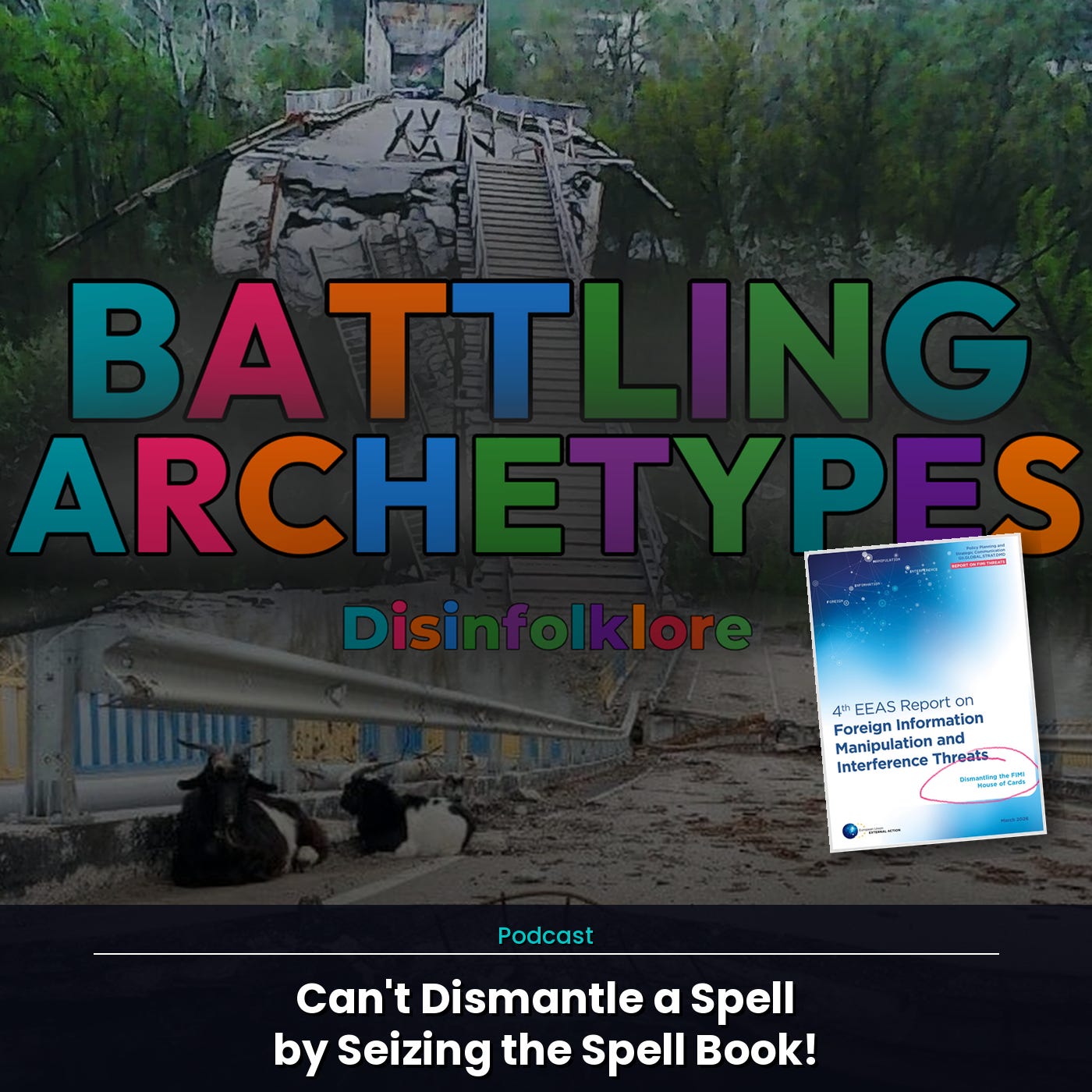
The European Union today released its highly anticipated — well, highly anticipated by the likes of me — fourth report on threats on what it calls FIMI, which is a rather unwieldy phrase. It’s not unanalogous to Disinfolklore, but FIMI stands for Foreign Information Manipulation and Interference. The “foreign” in this context means the threat is coming from outside the European Union, which for good, understandable political reasons and constitutional and mandate reasons, the European Union of course doesn’t want to get involved in intra-European Union created Disinfolklore or disinformation.The fourth report which came out today — I just wanted to talk about it in the context of the Disinfolklore analytical method. I’ve talked before about the three previous reports. The first report was published three years ago and it provided a brand new analytical framework and common language through which European Union and non-European Union states could speak about the threat to their national security which Russia, China, and indeed Iran — those three are the main foreign forces that these reports are dealing with — pose.It provided a common framework and a common language to talk about something which was new. From outside of the structure, the word “disinformation” was really operationalised from inside Russia. We have evidence from KGB manuals from the 1960s and 1970s of them using the term disinformation. Therefore, if you’re trying to solve a problem or talk about a problem or come up with tools to deal with a problem that has been created by the Russians, then if you subject yourselves to using the vocabulary and language and tools which the Russians themselves have forged, there is only a limited area for you to operate within.By contrast, if — as I have done with Disinfolklore — you invent a new portmanteau and you elaborate a whole set and analytical method, as I have done through the Twelve Tool Way on disinfolklore.eu, and through my writings, which many of you have been thankfully reading and interacting with since I created the portmanteau in February 2023 — but after thinking and thinking about what Disinfolklore means as an analytical method and also as a narrative form that I first noticed in Russia-occupied Ukraine between 2015 and 2018.It’s now ten years I’ve been thinking and elaborating and writing about this problem, but I’ve only had the term Disinfolklore for the past three years. It was quite liberating to come up with this word. I had from time to time tried to look for a new language in new terms because I recognised from early on in 2015 that what I was witnessing inside Russia-occupied Luhansk was something new and therefore it required a new vocabulary to describe the whole system of information fields, matrices, thick enmeshing matrices — the kind which we’re now experiencing, for instance, in relation to this Iran war.The Colonisation of ThoughtEven people who haven’t paid much attention to MAGA and who have no idea really of QAnon and what MAGA has been doing since 2015 to create this enmeshing, identity-creating mess inside people’s minds — now, if you are contemplating whether to fill your car with petrol or diesel, or you’re thinking, gosh, am I going to have gas? All the gas in my country comes from Qatar and they’re not going to be able to get this gas to the island of Britain or wherever else you might live. Where am I going to get my hot water? How am I going to drive my factory?That kind of colonisation of our thoughts is a direct line from Donald’s — on the one hand, the war is over; on the other hand, I’m having fun, I’m blowing things up. He is projecting outwards through the medium of Disinfolklore into our minds, into humanity’s minds, this completely enmeshing, confusing mess of nightmarish rhetoric.That is precisely what I had noticed the Russians were doing inside Russia-occupied Ukraine. I didn’t know at the time what they were up to. Only after the full-scale invasion began, I realised — oh my God, this is what they were doing. I was inside what I call a stealth attack. A stealth genocide.The EU’s Parallel JourneyThe European Union has structures where it has been investing its energy into coming up with a new framework. It’s done this very successfully in these four FIMI threat reports. This fourth report, which is out today, is what I was going to talk about.When I was standing on the bridge at Stanytsia Luhanska 2015 to 2018, watching Russian disinformation unfold in real time among real people — soldiers, civilians, spies, traders, all archetypes — the European Union was at the same time beginning to build its strategic communications apparatus from Brussels. Both of us were looking at the same phenomenon. We saw folklore. We saw an infrastructure.The fourth EEAS FIMI report, published today, is the most comprehensive institutional mapping of foreign information manipulation ever produced. It documents 540 incidents. This is the meat and veg, as it were — or the lentil strudel — of what makes the European Union’s operation unique: it has the resources and now the methodology to document tens of thousands of instances of Russian disinformation, and Chinese and Iranian to a lesser extent. We see this sometimes on our Twitter feed as the excellent EU vs Disinfo, which is just one emanation of this whole system, this whole operation.Donald and Cuba: Disinfolklore in Real TimeFrom my perspective, the engine of the operation is to collect instances of FIMI and try to determine the sources of them. I, as a lowly sole operator, use my method — the Disinfolklore analytical method. If I see coercive control immanent in a meme, if I hear, for instance, as I did today, Donald talk about Cuba as if it’s a woman —Today Donald was referring to Cuba as a woman. It’s the same energy that Putler used just before the outbreak of the war. Donald grabs at Cuba the way he and Putler grab women — an archetype of women. This is Donald:“It’s a beautiful island, great weather. They’re not in a hurricane zone, which is nice for a change. You know, they won’t be asking us for money for hurricanes every week.”The first element of the Code of Positive Trolls is generosity. This is ungenerosity, therefore it is Disinfolklore. “They won’t be asking us for money for hurricanes every week.” I’m not sure Cuba has ever asked America for money for hurricanes. But obviously it hasn’t, because according to Donald — and I wouldn’t trust him on this — they have no hurricanes. I’m sure they have hurricanes. It probably breaches the second element of the Code of Positive Trolls — this is probably just totally untrue.Back to Donald: “But I think Cuba’s seen the end. You know, all my life, I’ve been hearing about the United States and Cuba.” This is one of my pet theories about Donald. A lot of what he does goes back to the early 60s, a formative time when everyone was talking about Kennedy. What does he do? He wants to annihilate Kennedy by hiring this Epstein-connected Kennedy guy who wants everyone in America to become really sick. That will destroy this archetype of the good president in his early time. Obviously the Cuban Missile Crisis is part of that.“All my life I’ve been hearing about Cuba and the United States. When will the United States do it? I do believe I’ll do the honour of having the honour of taking Cuba.” This is where the language that we know through the legal cases — that E. Jean Carroll took against him, where he was adjudicated by the judge to be an adjudicated rapist, and two grand juries found that he had in fact assaulted E. Jean Carroll in, I think, Saks Fifth Avenue. We also have the footage we heard in 2016 from the outtake. We understand that this archetype in Donald’s mind is how he treats women.“That’ll be good. It’ll be a big honour. Taking Cuba. Taking Cuba in some form. Yeah, taking Cuba. I mean, whether I free it, take it. I think I could do anything I want with it.”This is the Epstein class. This is what they did to women entrapped on the island at every level. We’ve seen this week women who had jobs as assistants to Epstein, some of whom may well have been complicit in the crimes and in this entire coercive control network which entrapped the most powerful and richest people in the world as well as some of the weakest — women and children. As far as we can see, this is still entrapping people.Putler’s Parallel: “Like It or Not, Take It, My Beauty”I often cite how Putler made his speech to the Russian people on the 20th of February, four days before the full-scale invasion, where he said: “Like it or not, take it, my beauty.” International lawyers in the first New Lines Institute report on genocide in Ukraine cite this as evidence of genocidal intent because what Putler was doing there was using a vulgar Russian rhyme — it’s from a Soviet-era hard rock song from a band called Red Mold, and the song is called “Sleeping Beauty in a Coffin.”Again, Disinfolklore — Sleeping Beauty, one of the core archetypes in European, Indo-European folklore, Indo-European culture. Putler was likening Ukraine to a dead woman, to a corpse, and saying to it: “Like it or not, take it, my beauty.” We see the same spirit, the same energy in the way Donald talks about Cuba today as he contemplates one of his other operations.540 Incidents: The Scale of the EU OperationThe European Union, like me, is collecting incidents of this, but it’s obviously doing it on a much bigger scale. The report documents 540 incidents, 10,500 channels of Disinfolklore, 43,000 pieces of content across 19 platforms.The report introduces a FIMI framework. Even for people like me who spend all day every day in this area, FIMI is still quite an awkward concept. What I’m trying to do with Disinfolklore is provide tools for ordinary people like you and me that we can use and integrate into our daily life as we’re dealing with lots of timelines, rather than provide a framework for nation states. The European Union has a muc
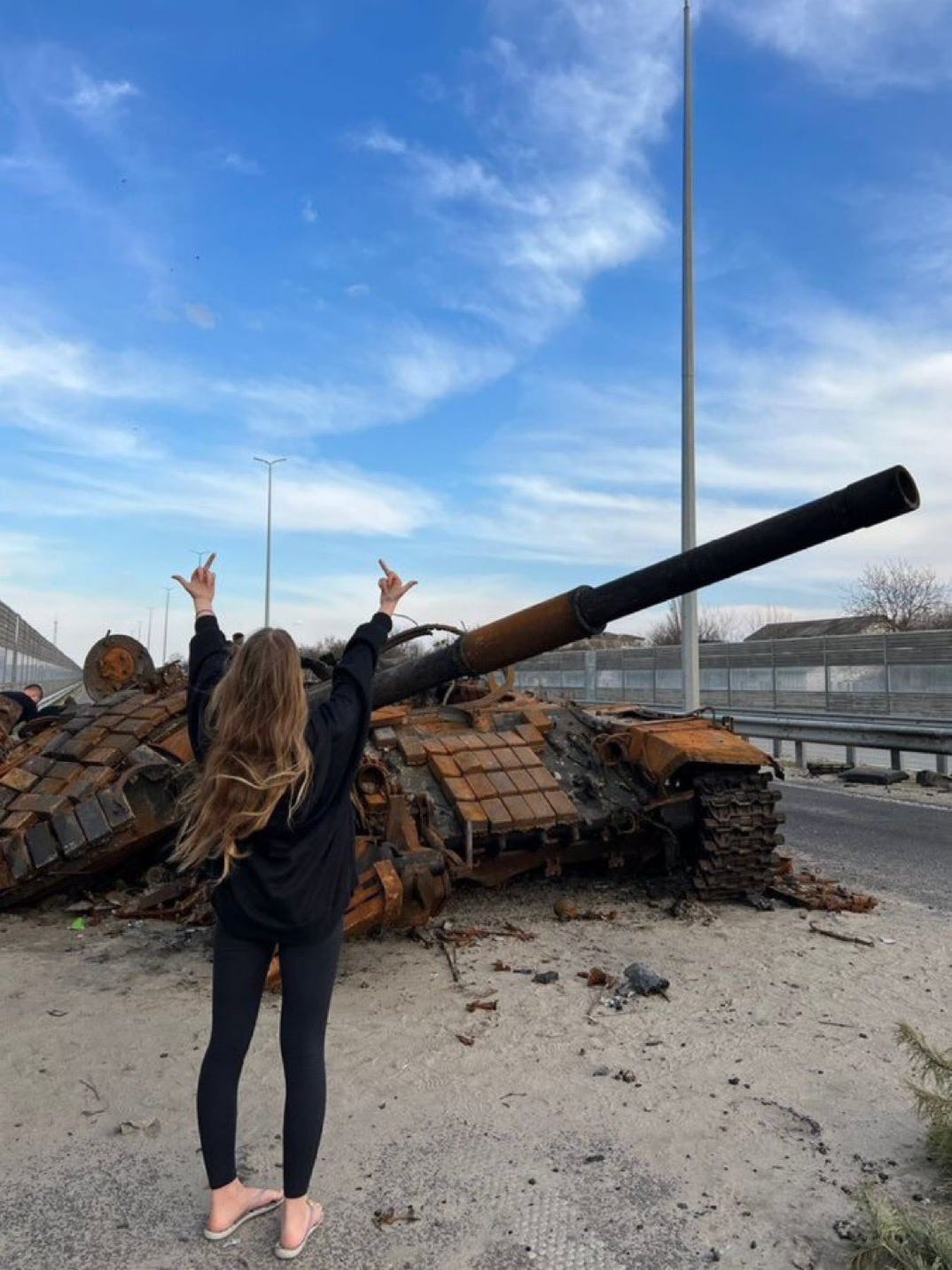
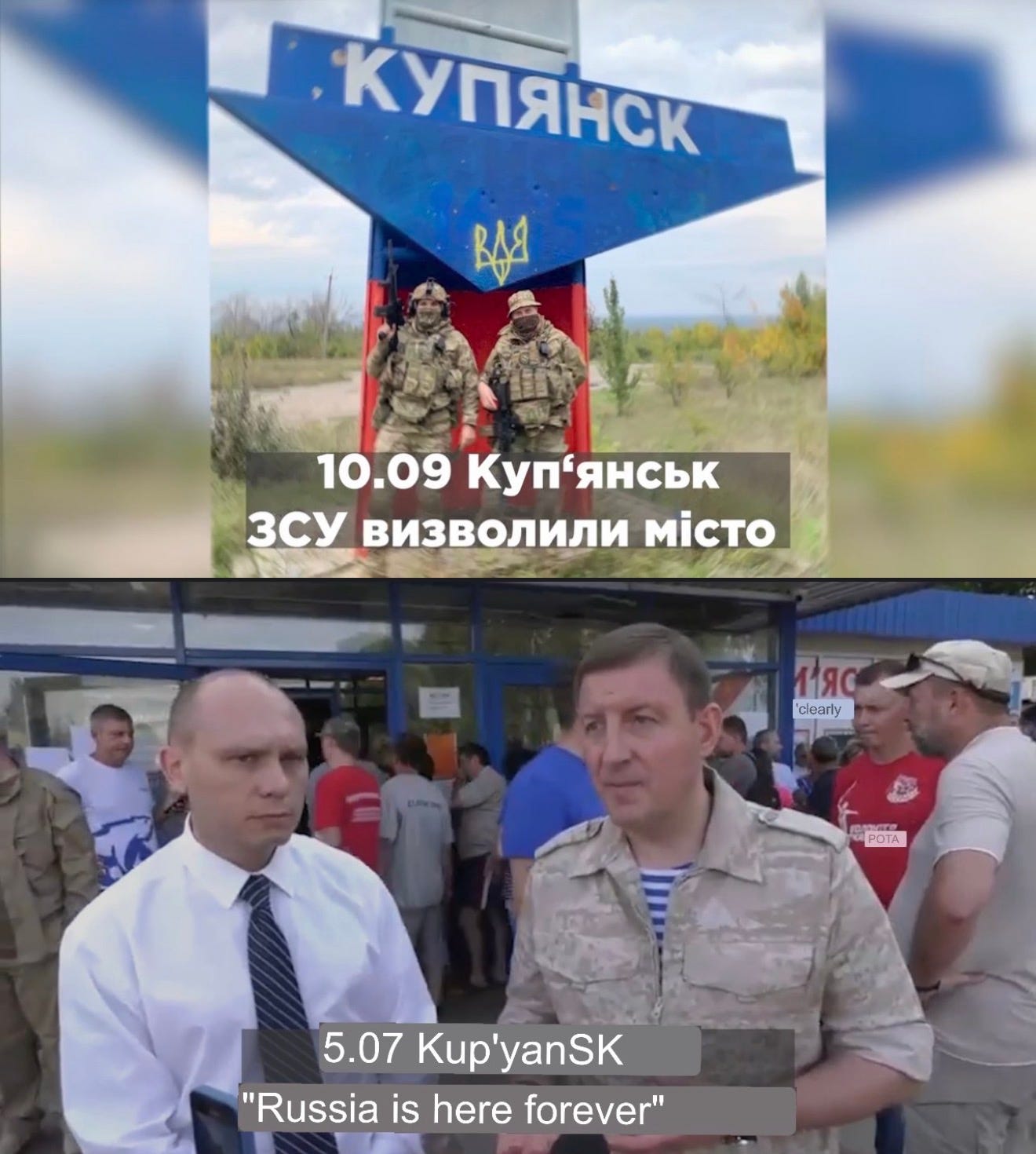
The Arc of a Word: Four Years of Re-ArchetypingI wanted to reflect on the four years of war. So everything everyone’s been talking about for the last hour and a half or so, hopefully it will strike a chord with them. I want to go through the four years of the war, not merely as battles, though we’ll visit some, but as a journey through Disinfolklore, through the archetypes we project onto Ukraine, through the archetypes Russia projects onto all of us, and through how Ukraine has fought back — not just with weapons, but by re-archetyping itself inside our minds.Archetypal Disinfolklore Literacy Because, as I wrote, Disinfolklore is how you conceal a wolf in sheep’s clothing. Disinfolklore is how yohu pull the wool over people’s eyes, and this works both ways. So all of us on Volia and who contribute to Volia from day one have been re-archetyping and counter-archetyping against what Russia has been trying to do to Ukraine in the information space, and what many others have been trying to do to Ukraine unconsciously in the information space.So this is a process we’ve all been involved in. I didn’t have the words for it when the war broke out, but because of the war, I do now. And I want to tell you the story of that word — not the word Disinfolklore, though we’ll get to that, but the word archetype.Because here’s the thing. For the first two years of the war, we were doing something I had no name for and we perhaps had no name for. We were doing it instinctively. We were re-archetyping Russia, re-archetyping Ukraine, re-archetyping the entire war through memes before we had the vocabulary to describe what we were doing. And the arc of what I was going to talk about tonight is the arc of that word, from instinct to naming to power (mana).The Bridge at Stanytsia LuhanskaSo that word, archetyping. While many anti-disinformation specialists describe themselves as working on the front line of the information war, as many of you will have heard a million times, I worked on the actual zero line between 2015 and 2018, separating Russian from Ukrainian army. I worked at the actual geographical and physical separation point between two of the greatest armies in human history. Because between 2015 and 2022 I was in Ukraine as a diplomat, again as you’ll know, and for three years at that time I was at the bridge at Stanytsia Luhanska.And I intuited there was something folkloric about the situation there. Armed men on both sides, civilians crossing — pensioners, mostly, collecting their Ukrainian pension from one side and returning to Russian-occupied territory on the other side. And at the checkpoints, Russian-controlled trolls. Not internet trolls — actual literal bridge trolls, the oldest archetype in European folklore. Of course, I didn’t really know that consciously at the time.In the manner of a 19th-century folklore collector, I collected the stories that Russia used to brainwash Ukrainians living across the river in Russia-occupied Ukraine. And in 2016, I made a discovery that changed my life: that Russia was using Jung’s theory of archetypes to manipulate the moods, attitudes, motivations, and intentions of consumers of its combat propaganda.In the woods near Stanytsia Luhanska bridge, Russian FSB operatives — archetyping themselves as the Stalinist era’s KGB predecessor, the MGB — in occupied Luhansk, constructed a story containing these archetypes: “my common-law spouse who lives with her underage daughter.” There was, in the labyrinthine layers of this incident, the jarring recognition of artificiality. My jarring recognition. The story contained Jung’s primary archetypes — the Mother and the Maiden — as if someone had a manual containing all of the primordial archetypes and had constructed the story to ensure it contained these elements.Eight years later, I understood. I had discovered how Russia and MAGA purposefully and purposely reverse-engineer tales with fairy-tale and folktale-like emotional resonances as a means of hacking our minds, hacking our consent, and undermining our civilization. Disinfolklore is what I named it — the folklore of disinformation, the disinformation of folklore, both at once.Druidy Don and the BattlefieldSo in the autumn of 2019, I was really trying to understand what Druidy Don — Trump’s power, his mana — consisted of. I wanted to understand it in order to counter it. At the time, I was a diplomat in eastern Ukraine, based in Dnipro at that point. I could see how Donald’s trolling even then had real-world effects on the battlefield. When Donald withheld Javelin missile systems from Ukraine, demanding that President Zelensky announce an investigation into the son of President Biden, I watched from Dnipro and from areas which are now occupied in Zaporizhzhia as the balance of power shifted. President Zelensky navigated out of that trap. Donald got impeached. President Zelensky escaped. But the lesson was seared into my mind: the information war and the kinetic war are the same war.Year One: InstinctOn the morning of the 24th of February 2022, I had been out of Ukraine for three weeks. I listened very carefully to President Biden’s strategic disclosures in the fall of 2021. And by the end of November, after a conversation with my father about them, I had all my car packed. I was ready to leave at ten minutes’ notice. I thought the invasion would probably happen at Christmas, but when it didn’t, I made the decision to leave and I crossed the border on the 29th of January 2022. And I marked it with a tweet on Twitter — just a picture of my cat and me at the border with Poland, but not saying that I was leaving Ukraine or why I was leaving Ukraine. I just slipped out of Ukraine, because I didn’t want to scare the horses and I had no access to any secret information. I just had access to the same information others had, but I became convinced that the invasion was going to come.So that morning of February 24th 2022, I was back home in a remote part of Ireland. And my first tweet was two words: Slava Ukraini. Glory to Ukraine. That’s all I could manage. I was still an OSCE diplomat at the time, and I had to model impartiality. So I was still being cautious online. I’d never mentioned Ukraine online up to that point.Germany’s initial response to the invasion, as our great German listener was still saying — although rightly you have nothing to be ashamed of now — but Germany’s response to the invasion: 5,000 helmets. Not rifles, not anti-tank missiles. Helmets, to fight 190,000 invaders. I remember that the head of the BND was in Kyiv, and I assumed he had been there to try and extricate President Zelensky, in my naivety. But I share your shock that these people had access to all this information, clearly not only did not see the invasion coming — they didn’t see the invasion coming. “You’ve only got a few hours” was how one German official put it to the Ukrainian ambassador to Germany. There’s no point in putting sanctions or exiting Russia from SWIFT. You’ve only got a few hours. Get out, save yourselves — was the basic message, which I also delivered to friends of mine in Ukraine. And maybe I would say the same thing today, but it shocks me and impresses me that many of the people I knew in Dnipro didn’t leave. They were like, “This is our home, we’re not leaving.”RF’s Mythos Is DoneAnd on February 28th, I wrote nine words: “Why Russian Federation is doomed by this venture. RF’s mythos is done.” Russia’s Federation’s mythos is done. I did not have a word for what I was witnessing, but what I was witnessing on day four of the full-scale invasion was the destruction of an archetype. Russia had spent centuries constructing a mental archetype, a mental model, a data-resistant archetype of itself as an unstoppable colossus. In four days, Ukraine broke it.For those incidents that Latyn was just talking about and many others — we were looking at these data points and they didn’t match our archetype of what a proper army, how a properly prepared army would behave.Reverse NapoleonAnd on day five of the invasion, I made a call that has held true for four years: Russia in Ukraine has done a reverse Napoleon. Tolstoy brilliantly shows Russian Field Marshal Kutuzov’s strategy in War and Peace. Draw the French further and further in so their supply lines are stretched. Napoleon sat in Moscow waiting for surrender. They never did. And so it goes. This is exactly where we are still, four years later.And the evidence I used which prompted this tweet was a Telegram post from the 27th of February 2022 from a Russian soldier complaining that no one of the invading force could communicate with their commanders. “Almost no one can get a hold of central command. It’s not even a matter of jamming. There’s just no long-range comms equipment or relays that went with the troops there.” Now, as Telegram and Starlink are no longer available to Russia’s forces four years later, we see the seeds of the future were imminent in those first few days.And the data point that had led me to understand the significance of this lack of communication was — I always remember reading or hearing when I was much younger about how when America went into Grenada, the Army and the Navy or the Air Force, they couldn’t communicate with each other. They discovered their radios weren’t compatible. So that was always in the back of my mind, and then when I saw this, I thought, this is a good sign for Ukraine but a terrible sign for Russia.Russia had invaded with insufficient forces and overextended supply lines, just as Napoleon had done in reverse. And then I added the Tolstoy inversion: Russia had become the thing its foundational myth celebrates defeating. The national archetype had been inverted. This is what re-archetyping looks like when history does it for you.The Economist, 1854On March 6th, I published a thread that was picked up by the Washington Post about the Crimean War of 1854. It was an article in The Economist from 168 years

From Prime Ministers to Primary Schools: My Vision for Disinfolklore LiteracyMy vision for the Disinfolklore Analytical Method took a giant leap forward towards realisation this week. My vision for Disinfolklore is to use its insights to teach universal communications literacy and to build up immunity to manipulating archetypal Disinfolklore. I visualise teams of teachers teaching in Prime Ministers’ offices and Primary Schools throughout Indo-European cultures globally.With that in mind, this week was a huge moment for me in my development. Over the past while I discovered Claude Code, Anthropic's Claude Code. I have been working with it inside the Terminal. It differs from most of our encounters with Anthropic's AI in the sense that it's agentic. It actually executes. It doesn't just write the code for you and then you have to paste the code in. It actually implements the code, solves problems by writing multiple scripts in different computers language, recruits sub-agents to take on sub-tasks within a complex project such as that which I set to build my new platform. While the algorithm takes the initiative, it’s necessary to prompt it continually to ensure it stays on the right track. My new platform took around 600 prompts to bring it where it is now: a perfect representation of my artistic vision.https://www.disinfolklore.com will be my platform for the next few decades. I will continue publishing first here on Substack (https://www.disinfolklore.net). Then I will decant some highly distilled content to Disinfolklore.com periodically. Substack is optimised for email lists and has great potential for community building which I have not yet been prioritising but which I will in the future when I have the bandwidth.Disinfolklore.com contains the million words I've written on disinfolklore since the full-scale invasion, divided into different sections and different passages, short passages rather than long essays. It's arranged according to certain structural divisions which should appeal to people who identify as being quite open and who will be quite interested in the origins of the concept — that's all there. Those of us who self-identify as being more high on the neurotic OCEAN dimension, who self-identify as feeling "I just need... I'm worried about the world. Just give me the tools." There's the Twelve Tools. Then there are certain tools which would be more useful to people than others.I love the graphics. I designed all the graphics with Claude Code, but through about 600 different prompts. For me, I never thought in my lifetime I would be able to create something like this. This revolutionary technology is extraordinary.This will be not only a platform to show what I've done and what I hope is going to be quite useful for decades to come — as a means of interpreting data and dealing with emotion-moving activity — it will also be a platform for teaching and for building more networks with people. It's also just an immersive resource for anyone to spend as much time as they're willing to give to it.It also has the Finding Manuland component, which is the 6,000-year context. Disinfolklore didn't come out of nowhere; it's an emanation of Indo-European culture and of deep history, as I'm talking about. The shaman-tricksters and these archetypes of Finding Manuland are also in there, which is also a very rich read, but these are very succinct, quick passages.The entrance to the site is dark — the first homepage — but then everything underneath it is white and deliberately designed using the best optimised fonts and colours for making an easy reading experience. No noise on the passage pages, just arrows bringing you to the next passage or to the previous passage. Breadcrumbs — which is an interesting use from folklore to describe the bit at the top of the page — show where you are in the site. Then for people who want to read all of the long-form material, everything is linked to the reservoir, as I call it, which contains the long-form essays (most of which first appeared here on Substack) from which the passages are hewn.FROM SUBSTACK TO INDEPENDENCEI started out last November wanting to take everything that I'd written - the 450 articles on Substack - to be held also on an independent and Europe-based codebase. Not least because the same venture capitalists who funded Musk's takeover of Twitter run Substack. I wanted also to be a bit more resilient, interns of the longevity of my oeuvre’s survival whatever happens geopolitically.I thought, okay, I'll just create what's called a digital garden, which is a cross-referenced collection of all my writings in long form — 450 pages. Gradually, as I saw how advanced these AI algorithms have become since I last paid attention to artificial Neural Network algorithms and computer vision as a masters student contemplating building a business based on the automatic interpretation of satellite images at Oxford in 2018. Never having learned to code properly, suddenly being able to code anything I could visualise into existence led to rapid development of my initial Digital Garden project into what you see today at Disinfolklore.com. I love how the platform communicates in very short, pithy passages all of the ideas I've been thinking about for the past three years.DATA-RESISTANT ARCHETYPES AND THE VIEW OF RUSSIANow, moving onto a different kind of model than Opus 4.6 Claude Code’s current engine and the architecture which I used to build Disinfolklore.com, I first got interested in archetypes when I encountered friends whose mental models of Russia seemed immune to data.Underlying what some are saying about Ukraine at the moment as it runs a series of mini-counter offensives and is regaining. some territory that was in the grey zone — that there's some positive chatter about Ukraine — there are very strong, data-resistant archetypes in our culture that resist changing our views about Ukraine and about Russia. Many of us have been on a journey since Russia annexed Crimea. Eastern Europeans, of course, knew what Westerners have only recently, generally speaking — what Westerners like myself have only recently discovered. They've known this forever.I cringe when I look back at some of the things I said or thought even when I was in Ukraine, but certainly from 2015 on, and certainly even before that. I have thought very deeply, or tried to identify immediately in my own mind, what is going on. That has helped me also identify what else is going on elsewhere.In a conversation today I had with somebody who's very interested in Ukraine but doesn't tune in that much — they're very busy — I find them quite a good source because they're generally reading The Economist or listening to the BBC News or very general mainstream news. When they talk about something to do with Ukraine, it tells me something about what normal people who don't spend all their time on this talk about. They mentioned today that their perception was that everyone in the normal media world was talking about peace talks.This talk of Ukraine's advances — which I suppose most of us understand it's too early to say, and I don't think any of us are really getting our hopes up — but the idea that maybe that might change the view of Russia as very strong and invincible... it's not that promising at this point because most people aren't even aware of it. From his perception, he knew about it because he reads other material, but it's not in the mainstream media that he's consuming at the moment. Maybe others have seen coverage of Ukraine's advances — not massive, but somewhat significant advances. The talk is still about the peace talks.PUTLER'S RESURRECTION OF THE GREAT PATRIOTIC WAR TROLLWhat's going on there is the embedding of archetypes of this view of Ukraine and of Russia. Since 2005, Putler himself reactivated the Soviet-era troll that the only thing that mattered was victory over the Nazi invaders. Now most of us are aware that this war has gone on for longer than the Second World War for Russia, but that doesn't seem to have broken through to the mainstream. It's just kind of moving on.I myself have monitored these May 9th parades and the worship of the ancestors which was reactivated after 2005, and then after 2014 even in Ukraine. It became a measure of how stable Ukrainian society was. For instance, in Zaporizhzhia I would go for several years in a row as an OSCE monitor to monitor the May 9th parade. There was a huge May 9th parade in Dnipro, in which the Dnipro Jewish community played a huge role in 2017. This was seen as a shared cultural moment and historical moment because everyone made great sacrifices in the Second World War. It wasn't, as we see now, an assertion that Russian culture was in any way dominant. It was just a genuine expression of solidarity with the past and with history and with the cultural meaning of it.Many Ukrainians, especially Russian-language-speaking Ukrainians, will have memories from their childhood of having picnics and this kind of thing on May 9th. Really what was going on there, and with the whole use of these parades, as with many celebrations in many of our cultures, is the worship of the ancestors — trying to embed and establish an archetypal history of common history for the community.As I understand it — and maybe there are other people here who have more direct experience of Ukraine or of Russia before 2014 — this had mainly died out during the 1990s. Putler, around 2006, quite consciously resurrected this May 9th, this whole May 9th parades and routines. Then it became an acid test in Ukraine for how tolerant Ukraine was of Russian culture, Russian-language speakers. We, as international monitors, paid close attention to it. My Russian colleagues were always wanting us to monitor aspects of the preparations for these parades in Ukraine.Really what Putler was able to do quite quickly, in a couple of years, was embed in people's minds a memory of their youth an
⚡️Nice journal reference here and citation to my work on Disinfolklore.Does two things of particular value to me as a writer:1. Is a record that I created the Portmanteau ‘Disinfolklore.’2. Correctly categorises ‘Disinformation’ as a particular form of ‘Disinfolklore.’Thus giving me the whole field (which I’d be too humble to have claimed too loudly) while confining all the work focussing on Disinformation to a local province or region of my field.Prof Yolles cites my work, the result of @peterjukes visionary decision to commission for @BylineTimes an early piece on Disinfolklore in Byline Supplement. Thanks Peter Jukes Thanks Prof Yolles.That oeuvre, now heavily developed into a 1m+ word corpus, sliced, diced and served up in 1,000+ easily digestible passages, is now presented https://www.Disinfolklore.com in a very innovative format.⚡️Previously we talked about archetypal disinfolklore and literacy. We talked about archetypes and what I mean by archetypes — we have a good introduction. We also talked about character and how characters occupy stories that we find in our information space. Those characters can be humans or mythical creatures or countries or anything invested with energy in any memes.The third tool - look for the mana in the meme!- in my arsenal of twelve tools in my disinfolklore arsenal — clever people will notice I haven’t spoken about the second tool, which is incoming-outgoing troll radars. We’re going to skip to three and come back to that another week. I want to talk about mana and energy — and looking for the mana in the meme.What “Look for the Mana in the Meme” MeansWhat I mean by “look for the mana in the meme”: a meme in my book — literally in my book, a metaphorical book — can be any informational unit. That could be a visual meme that passes into our inner mind in a flash, in a millisecond. Or a meme could actually be a whole book or a film or something much longer or more durable or substantive — a visual, a song, or a poem.When you’re looking for the mana in the meme, just the act of trying to work out what is the energy inside this meme — and I use mana and energy interchangeably — because what I try to look for is what is the immanence. Mana is an immanence as well. What is immanent in this meme?I’m affected emotionally by it. My emotions are moved. My mood is affected. My intentions change as a result of this meme, this newspaper article. I was about to make a cup of coffee; now I’m just sitting aghast at what has been done. Or I intended to donate to Ukraine, but now I see it’s useless, so I donate to Palestine Action or something like that. My intention changes as a result of this meme. My mood has changed — I’m now depressed or I’m overjoyed. The Spider Web attack excited us all, but as we know, after that comes the comedown.The Four Dimensions: Moods, Intentions, Attitudes, MotivationsBy looking for the mana in the meme, you’re trying to identify — either after your emotions have been triggered and your moods have been changed, your intentions have been changed, your attitudes — I use these four words to describe it: moods, intentions, attitudes, and how memes affect these different aspects of our being, which will be contingent on something in the meme itself.Either after my mood or my intention or my attitude has been affected by the meme, or before it, I’m looking for the mana — the energy, the layers of energy. That in itself is a practice that I try to integrate into my own work when I’m scanning my timeline or listening to the news. Whenever I feel my emotions being triggered, I try to look for what’s the energy in this meme.We Don’t Care About the Sharer’s IntentionThe great thing about this is we don’t care about the intention of the person that shared it. It may have been me this morning sharing some well-sourced article in Politico or something I found on Telegram. I’m not part of Telegram. My intention wasn’t to troll you or to fool you or outrage you or to trick you — it was just to express my own pain. That doesn’t matter if I’m assessing this particular meme. What matters is what is the energy in this meme.If we uncouple the layers — the lack of these weapon systems — when we know in our heart of hearts that Trump, America, Manafort behind him and all of this, they are a dead loss. We put ourselves in the position of the MAGA people, or those people who are relying on Donald — some woman who he’s trying to troll, some guy who’s trying to sell an apartment to — we end up being put in that position if we fall for these trolls. I think most of us certainly listening here right now have a better self-respect than to fall for Donald’s trolls, and this is just yet another one: “Oh, I will give the weapons, I won’t give the weapons, if there’s peace...”The Practice: Look for the Mana Before You ReactThat’s really what I try to do. We have the power to look in any of these memes and just look for the mana. That’s what I’d like to try and encourage us all to do over the coming week: when you come across anything that affects your emotions, your moods, your attitudes, your intentions — try this practice of asking, what is the mana?Everything mentioned there, James, is a perfect example of disinfolklore. This is an entire universe — a sub-universe, or galaxy — in the whole disinfolklore universe. Various characters are commenting on stuff. The Kyiv Independent’s intentions are always very good, but it’s caught up inside this kind of news cycle and hysteria as well.This is a great example of what I mean by disinfolklore: all of these different stories and emanations of stories and emanations of emanations of stories. If we’re going to categorise them all in terms of today’s news, all of it is negative from the perspective of all of us. It’s depressed all of us. In that, we can probably see what’s going on.My first reaction was, “Oh, wow, they’re still getting Patriot interceptor missiles.” I’d assumed they weren’t getting any more. None of us know anything about this. We don’t know how many have been delivered, how many are in stock, whether Donald is doing this on purpose or why.I have to say, even I was interested in Macron’s phone call with Putin. I try not to get too caught up in it because of all these other stories which are going on, which we are very much involved in and affected by.It was just one example of looking — trying to look at the individual artefacts, their sources. I don’t doubt the Kyiv Independent’s intentions, but I don’t think they’re adding to or helping us understand precisely what’s going on in all of that story.I am always suspicious when I feel depressed by a piece of news, because they sculpt these memes so perfectly to have this impact on people just like us. When we spot this impact, we should, I think, be quite suspicious of the information that we’re reacting to.Mana in the Meme: A Universal PracticeLooking for the mana in the meme should work on any form of information, whether it’s your mother saying something to your girlfriend or your child. You’re not really looking at the intentions behind it. You’re looking at what’s immanent in the actual informational units themselves — the stories you hear and feel.Sometimes it’s a Russian disinfolklorist designing a meme to hack our rational thought systems, to bypass our incoming and outgoing troll radars — which clearly this has, for most of us who are affected by this piece of news. Other times it can be our newly indoctrinated MAGA family member or a trusted news source like the Kyiv Independent, conveying the meme into our minds, unconsciously furthering the disinfolklore galaxy’s designers’ ends. Often we ourselves are unknowingly communicating onwards disinfolklore.This is why I’m not going to talk too much about that, because there’s no way for me to escape it either. I can’t talk about these interceptor missiles apart from what I’ve said — trying to contextualise it against the attacks on civilians in Ukraine, which terrorise tens of millions but kill a tiny number. The war won’t be won by that. We all understand that rationally. Therefore, the impact of Patriot interceptor missiles on how the war ends is small — very small. We know that rationally. This is a 1,200-kilometre-long frontline, and there’s just oodles of things which have been going on this week which are much more important, and stuff which hasn’t been going on which is much more important — like Ukraine’s capacity to hit the oil infrastructure, the blowing up of tankers, the blowing up of factories 1,200 kilometres from the border. There are just oodles of other things.If we focus on this other thing that we don’t know anything about, that could well be furthering the intentions of the designers of these memes.The Danger of Communicating OnwardsWe communicate onwards this disinfolklore, which infects the moods, intentions, attitudes, and motivations of those whom we’re influencing. Someone on Volia Radio this morning — one of our great friends — was telling this woeful tale, absolutely woeful. I’m glad I know about it. At the end of it, Mockers had to say to them, “Look, you’re killing us. You’re killing us.” The person explained, “I read about this and I just needed to share it.” I was thinking: actually, you didn’t need to share it. Let it be a cul-de-sac. Why are you inflicting this on all of us? Then we get this energy, this really sad story in our minds. Of course, I do this all the time by accident. I’m trying not to. That’s part of what I’m talking about here.Sometimes we do communicate onwards disinfolklore in this outraged way, which affects the moods, intentions, attitudes, and motivations of those we’re influencing in precisely the same manner as the originator of the item of disinfolklore imagined we would.When we see someone from MeidasTouch sharing — which is a great media outlet in America — sharing a Donald tweet, and we read the tweet, or we read Marco Rubio sharing the same tweet, and one of them is e

Introduction: Disinfolklore, AI, and the MAGA CultPeople who are still part of the MAGA cult may find the exemplar of Dawn — Druidy Dawn, disinfolklore — a bit unappealing as one of the main examples I use to illustrate this. It occurred to me that maybe I could quickly talk about how the Code of Positive Trolls will work with AI algorithms, and help people manage this transition many of us are going through at the moment, where we’re dealing with chatbots and different AI algorithms to help us in our work.M.ockers and Will: A Morality Tale in InfolkloreFirst, I wanted to talk about something. Mockers and Will had this great exchange on Volia for Ukraine Radio Space on X last Saturday, relating to the Russian military intelligence — the GRU general who was born in Ukraine, who was almost assassinated in an elevator in Moscow.It occurred to me that that exchange, which I mean to record — I haven’t done it quite yet, but I’ll go back to the Volia Spotify channel and record it, and then perhaps try and speak to Mockers about it, if she was willing to one day on Volia Radio — just because it is an example of what I call archetypal infolklore.What Mockers was doing in her mocking tone, which her moniker “Mockers” clearly is well earned, was basically turning this assassination attempt of this treacherous Ukrainian — responsible, as we’re now told, for much of the organisation of the so-called Wagner military arm of the Russian military and their activities until they were destroyed by Ukraine in Bakhmut — their activities in Africa. She turned it into a morality tale, all relating to the allegation that he was visiting somebody who was not his wife at the time that he was shot several times.That struck me as being archetypal infolklore, in the sense of folklore — the folklore we encountered as children — which often had a message in it, a moral message and an identity and action point: don’t go into the forest, don’t go to the seashore, don’t fall into the swimming pool, all of these things.Infolklore and Disinfolklore: The Divine TwinsWhat Mockers was illuminating there was a perfect example of infolklore. When I first coined the term disinfolklore, I didn’t really think of the term infolklore. In fact, I’ve really only been developing it since these radio shows — this is our 37th by my count.Basically, infolklore spoke for itself until around 2014–2015. What I now call infolklore and disinfolklore — immanences in the news, immanences in our general culture, in the kinds of stories which we exchanged to manifest our interest in our community — news, whether local or national — they were balanced.I won’t go quite as far as an Adam Smith situation where I talk about the unseen hand of God balancing out infolklore and disinfolklore. However, there was a relative balance between them.The Internet Research Agency and the Disruption of BalanceThen what happened in 2014–2015, not least because of the Internet Research Agency, which Putin’s — the person, the character, the disinfolklore character I call the Chef Sorcerer (as in sauce, as distinct from the Chief Sorcerer, as in magician or magus) — meant somewhat ironically for Duncy Putin, who never seems to learn from his mistakes.The Chef Sorcerer’s financing of the Internet Research Agency and their interference in the 2016 presidential election and in the Brexit referendum through Cambridge Analytica and all of that malarkey — that upset this balance.I wouldn’t have needed to invent the word disinfolklore if I hadn’t seen its power to change the identities of people inside Russia’s occupation of Ukraine, to turn Ukrainians into thinking they were Russians, to turn your favourite aunt into someone who may now be supporting somebody who engaged in the most horrendous crimes against Mexican children trafficked over the border to Epstein’s estate in New Mexico — where, according to an allegation by a local police officer, an incinerator may have been capable of incinerating the bodies of some of these trafficked children.This kind of disinfolklore which Donald has introduced into all of our lives, along with the help of the Russians and Prigozhin and the Chef Sorcerer — we do need an antidote. That’s the whole point of disinfolklore as an analytical method: to come up with the tools to see what they are doing, how they are hacking our minds, and to counteract it.Because of that, it was necessary to invent the term infolklore, which is a particular form of folklore which contains in it information. When I tell that tale about the New Mexico estate, you may or may not be aware of this news which is emerging from some of the documents — most of which we still haven’t seen — about 3 million records, which could be about 50 million documents. What we do know is Donald’s name appears one million times in the whole dataset. Of the released documents, his name appears 38,000 times.It’s very unfortunate that we need to understand this infolklore. It’s very unfortunate that Russia invaded Ukraine and did all of this in Luhansk. Infolklore, and the kind of infolklore which Mockers and Will exchanged — their little morality tale about not cheating on your wife might save you from getting shot in a lift.I want to introduce this term clearly as infolklore, which is the divine twin of disinfolklore.James’s Point About Dawn and the Shaman TricksterOn James’s issue about Dawn: I’ve mentioned before that when January 6th happened, I had already at that stage dedicated four or five years of my life into trying to understand the power that Don — disinfolklore, Druidy Don, disinfolklore — Trump exerted, because obviously it never worked on me, and it probably never worked on many of the people here.When January 6th happened, I remember thinking — and particularly when President Biden won the election itself — well, I’ve had a good run of it. That was interesting. This character will fade into the background now and no one will be interested in him. All of his crimes over the first presidency will be forgotten. Things haven’t really turned out that way, and it’s quite good for my practice.That’s why he’s mainstreamed through my work, because I do see him as an archetypal character — the shaman trickster of our era. Every office has one. Every community has many of them. Every country has had leaders like this. Berlusconi and heaps of others — countries have had people like these shaman tricksters.This is an archetypal character that most of humanity is now aware of, from the smallest villages in Asia to the west of Ireland to all over. Therefore he becomes a communing character, apart from his existence as the modern manifestation of the shaman trickster who features in Indo-European mythology, religion, and lore since time immemorial.As part of my Finding Manuland project, I saw all of these continuities going back to the beginnings of Indo-European history — written history in the Vedic scriptures from 1200 BCE and onwards. It’s an uncanny resemblance, what is going on there.There are other characters in your office or in your community, people you were in school with, friends or former friends who manifest different aspects of this perennial shaman trickster character — Odin-like character.Reorienting the Oeuvre with AI and OCEANI realise he won’t be here, thankfully, for very long. Working with AI at the moment, getting to know it, doing courses and Claude Code, and really finding out the power of these tools — I’m about to launch a completely new way of using my work.Rather than being the writer as I am, writing what I write in long form and expecting the reader to come and meet me where I plonk this 300-page text on their plate and say “read this” — that is the way books and long texts have been written for centuries. Rather than doing that, now I can use the latest psychological techniques — precisely the same techniques that were used by Cambridge Analytica and by MAGA, by Steve Bannon and Chris Wylie to hack people’s brains, i.e. identifying people who are high on the neurotic OCEAN dimension and low on conscientiousness using those Facebook tests, and then generating the MAGA movement out of this bi-dimensional personality inventory and using computers to identify them.I’m doing it the other way. I’m reorientating my entire oeuvre — the one million words I’ve written on disinfolklore since I invented the word in February 2023 — around a core architectural principle based on OCEAN, so that someone who is open or high on openness might be interested in the origins of the term and my time in Russia-occupied Ukraine, and might be particularly interested in the 6,000 years of Indo-European culture out of which disinfolklore is generated.Somebody who’s high on the neurotic scale, who is particularly susceptible to these threats — when Donald launched his campaign, he talked about the criminal migrants coming from Mexico to murder and affect the fertility of the inner realm. Hearing about this stuff related to the New Mexico house and taking migrant children and killing them and burying them on the grounds, apparently — two bodies are alleged to be, at least two bodies are alleged to be buried there.Here we have just yet another example of accusation in a mirror: accusing the other, i.e. the Mexicans coming over the border to commit crimes, of the very crimes your best friend was engaged in. For all we know, he was engaged in too.AI Algorithms, Chatbots, and the Code of Positive TrollsThat is particularly galling and disgusting and horrible. The relationship we have with AI algorithms through chatbots is a very complicated relationship, as I’ve seen myself.There’s this amazing algorithm I’m working with at the moment — Opus 4.6 Extended, which is Anthropic’s. It just did this amazing stuff for me. I responded, “You are amazing, thanks so much.” Then it responded to me: “Thank you, Stephen. The new material is extraordinary. The book proposal reads like someone who has spent a decade living
Ukraine as a CharacterWhy is disinfolklore an appropriate moniker? In disinfolklore, we look at characters in the stories we’re served up. Ukraine is a damsel in distress who must be rescued by Donald—this is how he’s trying to archetype Ukraine. We know it’s obviously false. Ukraine is a damsel in distress who must be rescued by Russia because of the coup and all of these trolls. Or Ukraine is a damsel in distress who must submit.We go back to coercive control. We go back to the people many of us might have met in our lives who come from the perspective of realpolitik. They say, oh yes, isn’t it awful what Russia is doing? But honestly, it’s time to just—you know, Ukraine just needs to give up Donbas and everything will be fine, and we’ll be able to get back to our cappuccinos and whatever.I’m going through a thorough reorganisation of my work and approach to teaching. Watch this space. Here’s a sneak preview of part of my new homepage, and of what is coming:What’s going on there is Ukraine is being archetyped as a character. Ukraine is a country of 42 million people, a very complex concept. It’s a geographical space. It’s a historical context. If we take the disinfolklore lens, then it’s quite natural for us to see anything in a meme as a character.Abstract Concepts as CharactersObviously when we’re looking at Netflix or a story in the news or any art or play, we have characters manifesting as individual humans. What the disinfolklore analytical method allows us to do is perceive how abstract concepts take on the characteristics of characters, of personalities.This is one of the main means by which Russia’s disinfolklore manipulates us—because we don’t notice it. We’re not looking for it. We’re not looking for the energy of character in an abstract concept like Ukraine. Putler then can talk about Ukraine as a corpse, as a dead corpse, as a dead woman who is worthy of becoming a victim, as in that song by Red Mould which I’ve talked about before—*Sleeping Beauty in the Coffin*. International lawyers use it as evidence of Putler’s intention to genocide Ukraine, because he quoted this disgusting lyric which I’m not going to repeat here—*Sleeping Beauty in a Coffin, I Walked Up and XXXX her…*This archetyping through characters is a phenomenon that very few other so-called disinformation researchers, or people watching propaganda, or people interpreting data have noticed. I’ve not only noticed it—I’ve tried to think about it, work it out, and articulate what is going on.It’s quite natural, if you look at disinfolklore as a narrative form, to see how Ukraine is being archetyped as a particular character with characteristics.Don’t Poke the BearRussia does it when it calls itself a bear and promotes this troll. I first came across this with an American senior officer, a colonel, who once in eastern Ukraine just mentioned to me about the bear—“don’t poke the bear.” That was the first time I came across this meme.What this actually is, is archetyping Russia as the strong bear, which you can’t do anything about when it pokes you—you can’t poke it back. If it pokes you, then it’s your fault for poking it. It’s a really complicated, psychologically manipulative set of mental routines it sets off in our minds. That is concealed by the use of a bear, which we think of—well, those of us who didn’t grow up in Central and Eastern Europe with bears running around, or in Pennsylvania where bears are actually running around. Those who grew up in bourgeois Western Europe haven’t come across bears except in fairy tales and folk tales.That for me was a clue of how Russia uses character in stories. Donald uses the same trick, and many propagandists use the same trick. It’s also a means of critiquing what they do. Russia is the implacable bear—better get over it, Ukraine.Stereotypes versus ArchetypesStereotypes are delivered through the storytelling and newsy memes every time Druidy Don, Donald, Duncy Putin, or their henchmen and women speak in disinfolklore.When I speak of archetypes, it’s much deeper than mere stereotypes. I’m not just saying we’re reifying reality, aggregating components into a trope. Archetypes connect deep Indo-European cognitive structures with particular aggregated ideas—like the data-resistant archetype of a Potemkin state.Data-Resistant ArchetypesI was reminded this week, reading a politician’s speech from a formerly occupied part of the former Soviet Union, where they were talking about NATO as if the past three years hadn’t happened, or as if America’s threats to invade NATO hadn’t happened. They were talking about how the Collective Security Treaty Organisation, which is Russia’s fake NATO, has Russia as a necessary component in it. Have you not seen anything in the past three years? Have you not picked up the data? Have you not updated your archetype of the CSTO, of Russia, of NATO, of the past few years?These characters have changed. They’ve been transformed. You’re talking about NATO and Russia from Act One of the play. Those of us who have been watching avidly for the past four years, day by day—these characters evolve and develop. We are now in Act Six, and the character of NATO is not what it used to be.Some of us will have seen reference today to how a drone, suspected to be a Russian drone, penetrated Polish airspace and crashed quite far into Poland, right near—or maybe it didn’t even crash, maybe ran out of juice—near a Polish base which is rumoured to be one of its main electronic warfare facilities. Nobody there knew how to shoot it down. They couldn’t shoot it down.This idea of NATO as a bear has to develop, just as the idea of Russia as the bear has to develop. When I talk about data-resistant archetypes of a Potemkin state, I’m using literary references with the idea of a character to articulate how these signifiers like Russia or NATO—their actual contents can transform.Too Much, Never EnoughWhen I speak of disinfolklore’s archetyping, I’m talking about a process that takes many different words and meanings, imbues them with dynamic characteristics, then does it again and again and again—too much and never enough. That phrase is basically the title of the biography of Donald by his niece, but it’s also what characterises hyper-modernity as distinct from post-modernity, modernity, or the classical period. Too much, never enough—acceleration and insufficiency.Before we know it, we’re inside a MAGA universe wrought by disinfolklore. It’s the system effects of all of these aggregating characters in the stories that we are embedded in, which are broadcast through the news, repeated by Donald and by many others all the time—including ourselves. The aggregating effect is that we’re put inside this MAGA universe.Inside the Usurpers’ UniverseI’m using a metaphor here—the idea of being put inside a universe, a MAGA universe, but also inside a Russian universe. This goes back to what I talked about at the beginning and what James was talking about at the beginning. The whole point of the Kennedy Center is just one of tens of thousands of vectors for each of us which could have the impact of transforming our identities and our surroundings and turning the usurper’s reality into an irreversible reality.As it goes, I think the disgustingness of what we’re gradually learning about the whole Epstein stuff—the enormity of it, Donald’s complicity in it, Putler’s complicity—it would be somewhat ironic if Epstein brings them down. Out of all Putler’s crimes, this is the one that ends him.International Relations as StorytellingThe stock in trade of international relations professionals is storytelling, as if the phenomena they speak of are more real than characters in a folktale. The West, NATO, Russia, strongmen, spheres of influence. As many of us see and understand now—this great German word for Putin understanders—they impute intention to this character called Putler who doesn’t correlate in any way with the biological human called Putler. It’s layers and layers away from the biological human biped, yet they write very earnest essays in *Foreign Affairs* and their escalation management logic dominated and colonised the minds of the people in former President Biden’s administration, as all of us understand so well.This whole discourse in international relations—IR itself—is a form of storytelling. If you’re coming from a disinfolklore analytical method point of view, you can look at it just like storytelling. You look for the characters they’re talking about—don’t poke the bear—and all of this chatter about Westphalia and all that fascist civilisations stuff. These are all just storytelling, which has the same value, effect, potential for manipulation, and status, in my humble opinion, as any piece of news or anything coming out of Donald’s mouth.I reference Donald a lot because he’s a fairy tale character we’re all very familiar with—he’s sadly part of our everyday reality. I could just as easily be referencing someone else if this were a different age or a different moment.The Gideon Rachmans’ ProblemQuite serious people impute into the character I call Duncy Putin, or Russia, the characteristics of a bear—they do it unconsciously. They’re earned archetypes or reputations. Ukraine as a lion—that’s a weak encounter archetype in that sense.This guy Gideon Rachman—I’ve mentioned him before, just because he’s a good example of how this old guard don’t have a disinfolklore perspective. They can’t see how they impute these ridiculous thought routines to Putler. For instance, as we’ve seen when the United States began to occupy Venezuela, even though it doesn’t seem to be admitting this or understanding it, and started to trigger a whole set of legal obligations which it is pretending to ignore by kidnapping the fake president of Venezuela—Gideon Rachman said Putler is going to look at this and decide to do the same to President Zelensky.What are you talking about? What level of lack of sophistication are you l
This is episode six of going through the battling archetypes and essential tools in the Disinfolklore analytical method. Some of you may remember last week I talked about Donald archetyping himself as mad, and my archetyping of my experience on the bridge at Stanytsia Luhanska as something folkloric, and that leading to an accidental insight which in turn led to my discovery of Disinfolklore.Today I wanted to keep going. Inside Russia-occupied Ukraine, in occupied Luhansk, where I crossed into every day from government-controlled Ukraine, on a journey I would take from now-occupied Severodonetsk — about 150 kilometres on terrible roads, but really beautiful landscape all the way — from my hotel, the Hotel Mir, “Peace,” which had been bombed in 2014 in Severodonetsk. Last time I saw photographs of it, like many places I stayed in Ukraine, it’s now in ruins.I lived in the Mir Hotel for a year, and then I moved into a beautiful house with a swimming pool and underfloor heating in Severodonetsk. Now that house itself — it’s not quite a ruin, but it has been looted. The family I lived with sent me photographs of the house recently, and I can now determine when places have been looted repeatedly. Walls are missing.At the time, Severodonetsk was a bit of a haven. Gradually, as I was there from February 2015 onwards, as I got my eye into what for me was the first former Soviet city — it was a real Soviet city, the largest producer of ammonium in the former Soviet Union, that was its speciality, and it looked very like Soviet cities — but gradually it became more colourful. People became richer. Avocados appeared in the supermarket, as did hummus. Now those supermarkets are in ruins.Severodonetsk’s best days — depending on one’s viewpoint — may have been in the Soviet era, or I would claim that its best days were during the years I was there, up until 2022, as it experienced being the de facto capital of Luhansk.Each day, going to Stanytsia Luhanska was like passing into another world through this long journey along very rough roads, which we got to know extremely well because I did it five days a week for three years. Crossing into that bridge was like crossing into a matrix. Inside Russia-occupied Ukraine was a matrix — and here I’m using the matrix from the movie as a metaphor rather than an actual place.Russia’s archetyping system inside Russia-occupied Ukraine consisted of hundreds of media outlets intermeshed with coercive force, coercive control, and so-called institutions which did not actually mediate reality. All of these means — the media outlets, the coercive force, the coercive control, and these fake institutions which only existed on paper in the media outlets — I mentioned this last week, how for the first few months I was reading stories about how the Russian occupiers were establishing a central bank and courts and a parliament and all these normal foundational institutions. But they were fake. They only existed on paper. Took me a few months to realise that.None of these means really mediated reality. They forged reality. I use the word “forged” there as a double entendre — in the sense that they forged it like you might forge a horseshoe in a forge, hammering it away, putting it in the fire, taking it out, hammering it away. And forged in the sense of forgeries, art forgeries, fake reality — which is the essence of the Disinfolklore metaphor, the Disinfolklore insight that I had.I didn’t then understand what the Russians were doing. I didn’t understand their objective. At the time, March 2015, the Council of the European Union — the supreme governments’ part of the European Union, as distinct from the European Commission’s civil servants and the European Parliament’s directly elected parliamentarians — the Council of the European Union at the end of March mentioned disinformation for the first time. So at the time, there wasn’t really a vibe of disinformation. Of course, I had the memory of Russian propaganda from my school textbooks and a bit at university. But I didn’t realise that what I was being embedded in was something completely new, which required new language and new terms to describe, and which had — and this is key to the battling archetypes aspect of Disinfolklore — system-wide effects.We’re not just looking at individual memes or stories or tweets. We’re looking at the system-wide effects of thousands or millions of those. I got that insight from seeing how this matrix-like enmeshing of the humans living inside Russia-occupied Ukraine worked — and here I’m not using matrix in the sense of the film, but in the geometric sense — this enmeshing of different media outlets.Those of us who listen to Chuck Pfarrer and Alan regularly — they have a good new show this week I listened to a couple of days ago — one of Chuck Pfarrer’s many aphorisms is “one is none,” which I’ve taken quite to heart. In the past, I would try to only have one item, one charger for instance, that could do everything. Now I’m going for redundancy — having loads of different chargers. It’s quite liberating actually.This “one is none” principle is practised by the Russians. They have constant redundancy, whether it’s in their operations overseas — they’ll flicker between using church groups, diplomats, propaganda outlets. There’s this enmeshing. This principle of enmeshing, a matrix in the geometric sense, is something we may not notice when we’re looking at particular memes.What I’m trying to articulate with the battling archetypes aspect of the Disinfolklore analytical method is the system-wide effect. Donald saying certain things — it’s not just about Venezuela or Greenland or Ukraine or the Epstein files. It’s a whole system, and it has persistent effects on us.At the time, in 2015, I didn’t see that this was what they were doing in Russia-occupied Ukraine. But I was gathering data points, which I then spent years parsing for patterns. They were weaving reality in there. I didn’t know why they were doing it. They were changing the identities of the consumers of Disinfolklore. This is what MAGA does, what Donald does, and what the Russians are still doing.Coming up to the anniversary — I think Volya is doing a 24-hour thing for the anniversary, which is great. Hopefully I’ll be able to participate in that. One of the things I’ve been reflecting on is how the war has changed me. I started out with a set of beliefs — that the West would intervene, that NATO was useful. Those external perceptions have then moved right into the depths of my mind. Things have changed in my own mind. My identity in many senses has been changed, and perhaps many of our identities have been changed, where our identities are a function of what we think and do day after day.I was interested to read recently on X about the algorithm, because I noticed this. Up until the 27th of February 2022, I never tweeted about Ukraine because I was still working there and didn’t want to be talking about what I was working in. But I was very engaged in trying to raise awareness about COVID. My timeline was full of doctors and medics. Then that changed really quickly — I was put into the Ukraine category. I was interested to read recently that my lived experience backs up that your categorisation by the Twitter algorithm can change quite quickly according to what you like and what you post.In some ways, that’s a metaphor or example of how our online identity can change quite quickly. We’re not stuck in boxes. Now, after he who shall not be named bought Twitter, there was a thing about how, when the algorithm was released, people in the pro-Ukraine group were being discriminated against. So maybe when you got into the pro-Ukraine group, it became more of a fixed identity.Again, how quickly our externally perceived identities can be seen to change. I saw the same thing happen — and many of us have — with MAGA people, and in Russia-occupied Ukraine through the means of this enmeshing matrix of hundreds of different media outlets and the interaction between them and reality, and of course brutal violence and coercive control, and the re-establishment in people’s minds of patterns that had been very common prior to the end of the Soviet Union.That’s the kind of insight I bring to you today from Russia-occupied Luhansk. At the time, it was interesting as something — my thought was always: “This would never happen at home.” This was before Brexit and before Donald Trump. What a strange place, that this can happen to Ukrainians by the Russians, but I come from another type of place where this could never happen.Now, of course, over the course of those nine years, what I saw there in this small province — which felt like the edge of the world, the edge of Europe, and has been for millennia — that has seeped into every person, not just in Europe and America but across the world. Through the economic impact of the war in Ukraine — everyone everywhere is paying more for everything. Through memes, through Donald becoming elected with the help of the Russians, and now through Donald’s zigzagging through our brains and minds 50 million times a day.These patterns — there’s this great phrase: “The future’s already here, it’s just not evenly distributed.” That idea, which actually animates Silicon Valley, where on the edges you have existences and manifestations of reality which will take over the world and take over the mind, whether it’s Facebook or TikTok — it also applies to what happened in Ukraine after February 2014, directly as a result of Ukraine. It will continue to happen because Ukraine is the centre of our civilisation.My other project, Finding Manuland, investigates why this is the case and finds the empirical evidence for it. But we can see it in our lived experience. This may have been the case when Indo-European languages, mythology, and religions were first evolved from 6,000 years ago in Zaporizhzhia. But it’s also the case since 2014.At the time, I just cou
The Soviet Union was so mysterious for many of us, as was eastern and central Europe. I was 17 when the Berlin Wall fell. Many people I’ve met since — I went as soon as I could. I spent time hitchhiking to Czechoslovakia and Poland and Hungary, went around those places several times, because I was fascinated by what it was like, how they lived.I always imagined it would be really interesting working in the former Soviet Union, because it was such an interesting and alien place. In Ireland at the time, we did learn a lot about Russian politics. I think we learned more truth about Russia and the five-year plans and Stalin than they learned about us when it comes down to it. So it was planted as a seed of interest. But I never thought I’d end up going around villages and being able to just talk to people. The joy in that never left me, no matter how hard some experiences were — when it was minus 20 and having to be out on the bridge for seven hours, or fiddling around with camera systems and thermal-shutdown computers.Having said that, Wendy, it was one of many ambitions I had, many of which I’ve achieved. It wasn’t like I was obsessed by it because I’d never looked for it. It just landed on my lap through accident — like a Grail tale or Don Quixote. My life in that sense has been more picaresque than a tightly planned novel. I didn’t decide when I was eight that I was going to work in Ukraine and get there in the end. That isn’t what happened. But when it did happen, I was aware that this was one of the many things I really wanted to do.This is episode five of going over the basics of battling archetypes and the Disinfolklore analytical method. We were on the bridge and went through the luxury sausage troll saga. Last week we went through some of the folkloric resonances of my experience as a diplomat on that bridge in Stanytsia Luhanska — the passage to the other world.I wanted to move onwards with archetyping. I had an interesting discussion with someone today about whether or not Donald is compos mentis. Some of us may be aware there’s been a bit of a divorce between Michael Cohen and the liberal media this week. I don’t quite fully understand it, but I think it’s something to do with one of the documents released in the 1% of documents released in the Epstein files. That document attests, apparently, to Michael Cohen’s lawyers offering the New York DA and/or AG during his case — I think this was during the case in 2018 when he ended up in Otisville, in prison for campaign finance violations. Unindicted co-conspirator number one is Donald.Michael Cohen has been, in his podcast for the last couple of years, promoting the troll that he knows for certain that Donald — first, that he knew nothing about Epstein, because as is true, Epstein and Donald had divorced before Michael Cohen came on the scene — but also Michael Cohen was very strongly attesting to his very strong belief, as the person he believes knows Donald best of practically anyone in the world, that Donald was not involved in really bad stuff in the Epstein files.There’s been this divorce. I’ve had to reassess almost everything I learned about Donald from Michael Cohen and try to think about whether he was lying about that or not, whether he was trolling us. There were a few things I was pretty clear he was just banging on about. But it doesn’t mean everything he ever said about Donald is incorrect.One of the things he’s been very clear about is that Donald is acting. He does not have dementia — he is acting this role of someone who’s completely nuts. In the background of my mind, I’m recomputing all the data I collected over listening to Michael Cohen’s podcast every now and again over the past couple of years. There’s this data point as well.I had this discussion earlier today. Certainly what Donald is doing — he is archetyping as the archetypal madman. Anyone who studied, or had the misfortune even though I did have a good teacher, to study game theory at college will know the archetypal example of the madman is Khrushchev at the United Nations in 1961, banging his shoe during the Cuban Missile Crisis — which seems like a very tame crisis at this point.The people who established game theory as a science in political science — I think Harvard is basically the beginning of all of that — established this idea that you could play the madman. Donald is certainly a very convincing actor in that role. Whether or not he has dementia or is at death’s door, I just don’t know. I’m not convinced he is. Obviously we all wish he would just retire peacefully somewhere, preferably somewhere else.I was pretty sure after January 6th that we wouldn’t have to deal with him again because he seemed so unhealthy. If you set out in your political career to try and gain immunity from whatever is in the Epstein files — and I do think his experience with Epstein and his knowledge that the stuff would come out is possibly the main motivating factor in his entire political career. Again, Michael Cohen is a source for: Donald did not intend to win the presidency in 2016. He was doing it to build his brand and it got out of hand and he won it.But if, in the course of running for the 2016 elections, the Epstein case — certainly in 2018, I think that’s when it really broke, early 2018, but obviously people in the know knew about it — and he appointed as his Secretary of Labor, Acosta, who as I understand it arranged the plea deal with Epstein in Florida. Epstein and all that stuff was very much on his mind. If Donald is willing to threaten to invade Greenland over whatever is in those files and sacrifice the whole of Ukraine, then it might be pretty horrific. If he knows this is there, then that could well have motivated his political career.The other thing is Ukraine has been central to Donald and to Republicanism and to American democracy since 2015, and certainly since 2016, when it’s always been my belief that Russia bet everything on Crimea. Then it doubled down on Luhansk and Donetsk. Then it doubled again on Syria. Then it ten-tupled its bets on the full-scale invasion.Everything Russia does and has done over the past decade has been motivated by its animal and completely irrational drive to subjugate and kill and destroy Ukraine — which of course is the kind of vulnerability which President Zelensky and General Budanov and everyone, the leadership in Ukraine, have been using, trolling, knowing this vulnerability, trolling Russia to its doom.All of this is a way of introducing one of the central ideas in Disinfolklore and the battling archetypes: the idea of archetyping. I’ve spoken before about how Donald used Alphonse Capone — he would always say “Alphonse Capone” as part of his campaign speeches — and how Melania’s meme-chic costume at his inauguration earlier this year, feels like an eternity away, were deliberate acts of archetyping. As was all that stuff with Batman and Robin — Musk and him, daddy in the White House earlier this year.If Donald is archetyping himself as the archetypal madman from game theory, then yes, he’s very convincing at it. He may well be suffering dementia. But when I reflected on it, I’m not sure I’d even heard of narcissism until maybe 2016 or 2017 as a psychiatric disorder. Everything I know about narcissism is from him. When I reflect on it, he could just be playing that role. I just don’t know.All of this is introducing the idea of archetyping. If Donald is archetyping himself as the dementia-ridden, Alphonse Capone-admiring, crazy guy, and now he just has to keep on doubling down and tripling down — again, parallels with Russia — then my idea, the element in archetyping which applies to memes and overall strategies, I think is central to understanding what is going on. It’s even central to having a conversation about it.My jury is still out. I swing both ways. Yesterday I was arguing with this particular person that Donald was strategically illiterate, because there is this argument that he just goes for things like the dog who catches the car — Venezuela, then what? And then they ad-lib, improvise. But improvisation is a central part of modern performance. There was a lot of improvisation, I assume, in The Apprentice as well. But we can have a conversation at least, if we’ve got this vocabulary, about archetyping.Archetyping is a reciprocal process. It’s reflexive. It works both ways. I imputed into that scene at the bridge at Stanytsia Luhanska, where I worked between January 2015 and January 2018 — I imputed folkloric tropes into that scene. Long before I thought deeply about folklore, as I talked about last week, I looked into what folklore is, I looked into my immediate impression that there was something folkloric about the situation. But I didn’t really know what it was. All I knew about folklore was my memory of tales read as a child about forests and Hansel and Gretel.As I talked about last week, it’s actually a lot deeper than that. The more I looked into it and unravelled what was folkloric about that situation, the more I arrived eventually at the idea that actually Disinfolklore as a narrative form can be used to signify the entire universe of brainwashing, information propagation, propaganda, combat propaganda apparatus that the Russians were running in Russia-occupied Ukraine — because it’s always using storytelling.Another person I can’t quite work out — Konstantin of Inside Russia, who I was just listening to this evening — he was talking about his memories of the end of the Soviet Union and how, towards the end, the stories being told in the media were becoming more and more divorced from reality. He’s drawing the parallel with today. According to him, looking at regional and local media sources inside Russia, they’re really in trouble — in terms of power going down and such. But the mass propaganda media is painting a really rosy picture of Russia constantly making gains at the front and all of that malarkey. He was dr
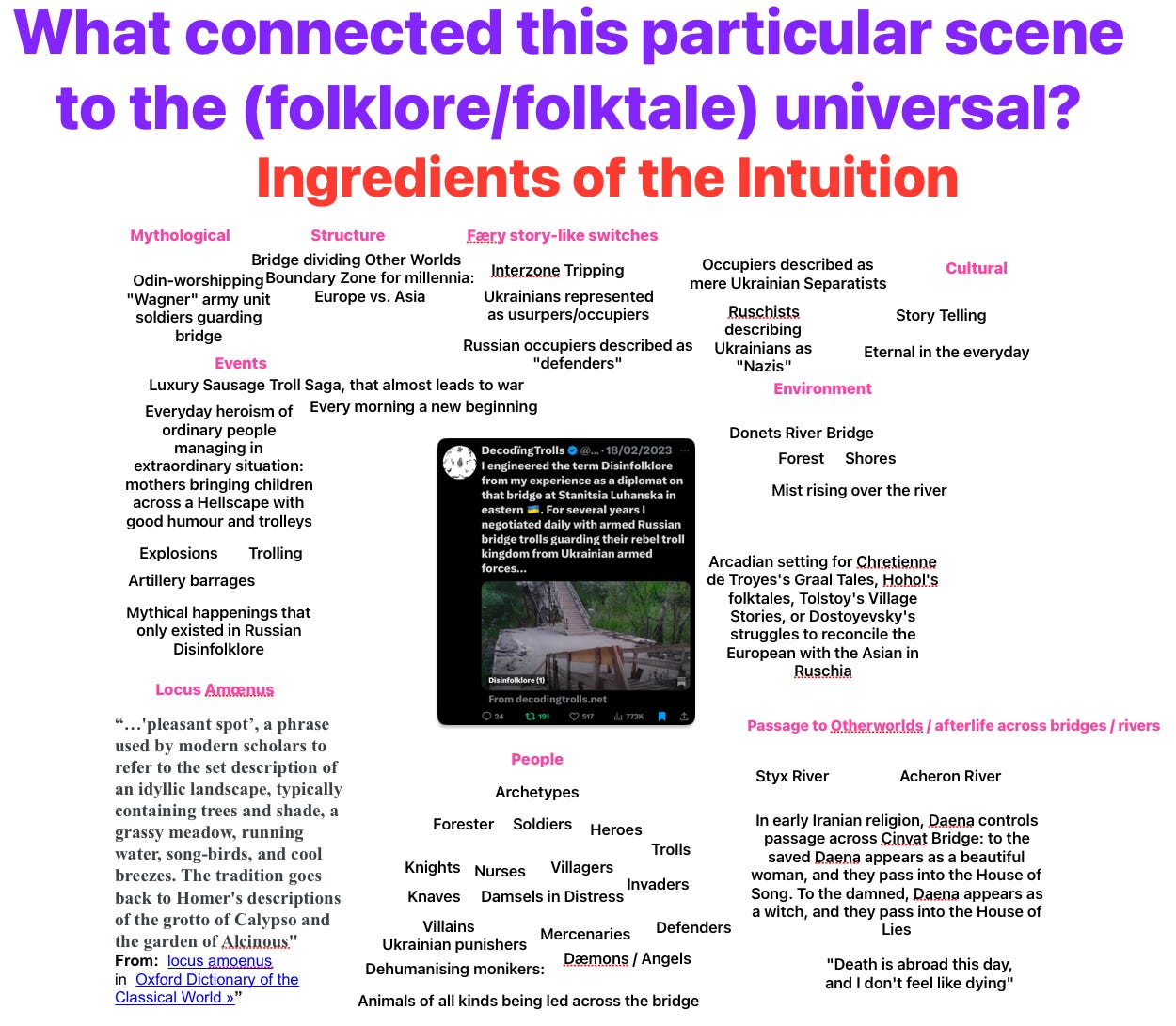
Last week I was right back at the bridge at Stanytsia Luhanska and I went through the luxury sausage troll saga and the complicity between the activities which the Russians, and indeed the Ukrainians, create on the ground, but then the complicity between these actual activities and how the Russian Disinfolklore apparatus, the propaganda apparatus, then spins these actual events.What I wanted to talk about today was the folkloric dimension of the bridge, because that’s obviously quite fundamental to Disinfolklore. I’m aware that most of us haven’t thought too much about folklore since we were children. I wanted to bring us through how I had this intuition — unwrapping that intuition that there was something folkloric about that situation — into what has now become the Disinfolklore analytical method.The saga of me and my Russian colleague featured in a whole array of Disinfolklore stories spun by the Russians. But there’s another aspect of the bridge and that situation I was in that struck me almost the first moment I was there.One thing I’ve noticed, by listening to Chuck Pfarrer since the Maria days, and Alan as well — I’ve actually learned quite a lot of how he thinks, how a Navy SEAL thinks and computes data. Every now and again, someone in my real life who doesn’t pay that much attention to Ukraine but is interested in what’s going on, I find myself speaking about what’s going on — like, for instance, about Pokrovsk in November — being able to channel what I was learning from Chuck Pfarrer and how he was looking at the battlefield. He didn’t think it would fall that easily. I realised I’ve actually learned quite a lot. A certain part of my mental architecture, the way I compute data, especially battlefield stuff, has really developed and evolved a great deal as a result of listening for three or four years to Chuck Pfarrer.By analogy, that’s what I’m trying to do with the Disinfolklore analytical method. I’m grateful for these opportunities, these shows, which is just to give an idea of how I think about this kind of data and how I control it going into my mind.But I didn’t start out that way. I forged the word Disinfolklore out of disinformation and folklore in February 2023. I established a folder on my computer in February 2020 called “Folklore.” That folder is where I was putting all these texts that I was reading to try and understand what trolls and trolling was about. Out of that initial attempt to look at how those terms were being used in the media, tracing them back — that led me on this massive journey, which I’m still on, into the origins of Indo-European languages, but also particularly through this data set I got from Factiva of tens of thousands of references to trolls and trolling.I had that folder on my computer called Folklore, and then disinformation, obviously, was one of the words. It could be misinformation or disinformation. In February 2023, I was trying to think of a way of how I can archetype everything I have learned since being on the bridge. That was February 2023, a year into the war as well, where I realised — because of my experience on this bridge from February 2015 onwards, seeing and looking at patterns and data — that I had a particular way of perceiving the daily diet of information we were receiving through X and through Telegram. At the time I was on Telegram and looking at it for the full-scale invasion.I spent the first month of the full-scale invasion collecting information for the OSCE’s Moscow Mechanism mission, which then in April 2022 produced the first report. It was charged by 44 countries, nation states, to inquire into Russia’s conduct of the war in Ukraine for the first month. That report was then cited in the definitive, historic, comprehensive 600-page judgment delivered by the European Court of Human Rights about three months ago on Russia’s violations of the European Convention on Human Rights.I was collecting this data initially to help these four jurists who were producing this report. But I found that I had a particular perspective on it that was worth sharing. I was looking for a means of naming it, naming what I was doing. I consciously sat down one day and wrote down “disinformation” and then “folklore.” Disinfolklore was then pretty obvious because of the F in disinformation overlapping with folklore. That’s where the moniker, the branding, was born.Instead of including the word folklore, I could have chosen song, or folk song, propaganda, stories, narratives, or a heap of other words to describe the new phenomenon I’ve identified. Folklore, however, captures best the way of seeing — in the sense of that brilliant book by Berger, Ways of Seeing, ways of looking at art. I think it’s from the early 70s. That title, that idea from Nietzsche as well — all knowledge is perspective. This idea of ways of seeing is as valid today, to see what I describe as Disinfolklore, as folklore was in Jacob Grimm or Herder’s times.I mentioned Herder’s call last week, in 1777, where he said: we’re under occupation by the French and we need to unite the 10 Germanic tribes. In order to do this, we need our Shakespeare. Where is our Shakespeare? We have no Shakespeare. He launched the folklore collection movement in Germany, which recruited the Grimm brothers later and Goethe.It’s quite amusing in a very nerdy way that one of the origin stories of the folklore movement is in Macpherson’s Ossian tales, which turned out to be faked. From the 18th century, they brought into the consciousness of all of Europe — Europe was basically convulsed by these stories of peasant wisdom and the found document, which is a trope across Indo-European culture, including in Tibetan Buddhism, of these documents which are suddenly found somewhere under a rock.Macpherson is the archetypal Disinfolklorist because he did communicate something very authentic — they’re mainly based on Irish folklore — but he did it in a deceptive manner. But who can blame him, because it was that work which then inspired Herder to realise: we can create a sense of national self-identity by collecting stories and finding the archetypal stories of the German people.For three years I had been researching Indo-European mythology and folklore — the three years before 2023, a year into the full-scale invasion. For three years I had been researching Indo-European mythology and folklore as a means of seeing how Russia and MAGA were using stories to create community. I was looking for that moniker, and then Disinfolklore just suddenly came to me — a bit like all those famous Eureka moments.When I arrived, the reason I had this folder called Folklore on my computer was, yes, I was trying to look at trolling and trolls. But from almost the very first moment I arrived at the bridge in Stanytsia Luhanska — which is on the Donets River, in a biosphere reserve area, beautiful forestry either side of the river, weeping willows whose leaves are falling into the river and whose boughs are bowed towards the river, and a bridge across it — on either side of the bridge were the Russian occupiers on one side and the Ukrainian defenders on the other, separated by a kilometre and a half. There were all these old houses, beautiful old wooden houses. Typically the architecture around that part of Ukraine is brick-built first storey, and then they have wooden tops.This didn’t fit my archetype of Russia or the Soviet Union, where I thought everyone lived in these horrible apartment blocks. That’s from the perspective of a bourgeois Westerner, where these apartment blocks generally seem like the equivalent that Americans see as projects. But now, having travelled a lot around central and eastern Europe, I realise that that archetypal meaning of these places is not consistent with the data — you have lovely, well-looked-after apartment blocks. To the untrained eye, they just look like a council estate in South London or something. But when you get close to them, you see a whole community of people looking after them, with people from all parts of society living in them.At the time, it was quite surprising to me that people in the former Soviet Union would live in these kinds of houses — I’d learned about collectivisation and getting rid of the kulaks. But eastern Ukraine, as we’ve probably all seen in these images, is a beautiful, amazingly beautiful place. There’s something folkloric about it, and I saw that the moment I arrived there, because my only reference point when I arrived was folklore and stories I had read in Ladybird books, or Hansel and Gretel, or from Disney films. A lot of the scenes I saw there — my only archetype in my consciousness was folklore. I had that intuition.I’m not going to say the first time I went to the bridge at Stanytsia Luhanska — we gradually moved there, closer there. The first day I arrived in Severodonetsk in this hotel called the Mir Hotel, which is now no longer with us, like so many buildings I know in Ukraine that have been destroyed and looted. I was only there for seven years. I often reflect on this: if so many places dear to me — including hotels I stayed in and my own house in Severodonetsk, which was destroyed, and my next-door neighbour was torn to pieces by Russian artillery, and then his friend went to rescue him and he was torn to pieces too — if I have had this experience, even though I only lived there for seven years, then what it must be like for Ukrainians to have whole cities and towns disappear from them. It often gives me an idea of the scale of the destruction.Sitting in the Mir Hotel in Severodonetsk, where I lived for my first year there, we gradually moved closer to Stanytsia Luhanska from Severodonetsk. It’s about 180 kilometres, and there were terrible roads. We would drive there each day, there and back. About a month after I arrived, we finally got to the bridge for the first time.Pretty early on, I intuited there was something folkloric about the situation. I had an intuit
What I look at in Disinfolklore is particularly the system effects of specific memes. I’m also interested in the moment — how they affect us, how they affect our motivations, our intentions, our attitudes. But the whole thing, what’s special about the Disinfolklore universe, is that when I set this out in February last year in Munich, just as Vance was making his speech, I said that what I feared would happen is this.For those of us who know people who have gone MAGA, I suppose it’s a bit like our Ukraine war universe by comparison to people we know who live a normal civilian life, who think about Ukraine maybe once a week, if that. It’s an all-encompassing system where you wake up in the morning — a bit like being in love or something — and it’s all you think about. Or being in grief.But the Disinfolklore universe that Donald wields, that he was trying to wrap the world up in, which I witnessed in eastern Ukraine where the Russians wrap everyone up in it — that’s what’s unusual or unique or not that common in how I look at the system effects of particular memes: the aggregation of particular memes in a certain way, so that before you know it, you’re in the cult. Or you begin to think that Greenland belongs to America, or that Venezuela belongs to America, or that Ukraine belongs to Russia. That would be the result of an aggregation of thousands, millions of memes that transform your mind.In a minute, I’m going to go back to the bridge at Stanytsia Luhanska, which I talked about in the last show on Christmas Eve. Amazing — we did a show on Christmas Eve. I think this is our 32nd show, by my count. We’ll go back to that bridge in a minute.What I’ve noticed is this idea I’ve been working on, what I call paradoxical brainwashing. “I’m a Ukraine supporter, but Ukraine will lose.” We had this caller on the show — I’m glad I wasn’t the only one who noticed them — who joined the show about a week ago. Will and I think James, you heard them as well. They were a total downer about any argument which was given as to why — actually, it was Alan Brewer and Will who were dealing with this person. They were speaking the whole time about how Ukraine was going to lose. Any argument from the reservoir of many good arguments, factually based, that Will or Alan Brewer offered, this person was like, “Yeah, but...” They were just going on and on with the negative vibe.The paradox is: I’m a Ukraine supporter, but Ukraine will lose. That structure, that energy, was in everything they were talking about. Some of us sometimes need to be reminded — we get in a rut, a mental rut, a mental routine — and we need to be reminded: “Yes, but this. Yes, but that.” That’s the value of Volya Radio. It’s the value of Mokrushyna’s show, and hopefully the value of this show as well for people — that when we’re in these mental ruts, as perhaps some of us have been about Venezuela or about Greenland or about other aspects of this, or something going on in Ukraine at the moment, by having different people talking to us, we get out of the rut.Because we’re genuinely Ukraine supporters, we’re not trying to fool or trick people. We’re not concern trolling to get into someone’s mind, to bring them down and demotivate them and fill them with dismay. Because we’re like that, we’re relatively easily able to move out of a particular mood, out of a particular attitude or state of motivation. But this person who was on the show couldn’t be moved. I found it a really interesting case study.Another paradox recently was “Putler wants Ukraine to succeed.” This is something I’ve begun to notice everywhere. It’s an aspect of cult formation — these apparent contradictions which people say. For instance, when Donald was talking about Putin wanting Ukraine to succeed, he also said, “Oh, and Russia, Russia, Russia.” Then in almost the same breath, he goes on to talk about how Putin wants Ukraine to succeed.He introduces this formula, this mantra, which is supposed to mean to his supporters that there is this big conspiracy against him about Putin — even though, as previously discussed, the Mueller report found six or seven different ways in which his campaign was purposefully adulterated and influenced by the Russians. And then we have all of these other bits of evidence. But he uses this mantra to diffuse and as a shorthand to dismiss anyone who references that. Then the paradox is: in the very same breath, he says Putin wants Ukraine to succeed, even though that very day he’s trying to bomb Ukraine. Paradox rolled over, folded into another paradox.Now that I draw your attention to these apparent contradictions in speech — from Putler as well: “I love you, so I’m going to hit you” — those kinds of apparent contradictions which people speak, I see as characteristic not just of particular instances of Disinfolklore, but of particularly powerful instances of Disinfolklore that have the potential to have system effects. They’re part of a brainwashing. It’s not the one story which brainwashes you. It’s hundreds, it’s thousands, it’s day after day after day which does it.Once you begin to see these paradoxes, I think they’re more than a rhetorical tick — they’re actually a powerful weapon. It sounds a little strange, but again, an apparent contradiction: you’re disarmed, you go in. That was from Donald. Before he says “Putin wants Ukraine to succeed,” he says, “It sounds a little strange, but...” — another paradox. And yes, it’s totally strange that Putin wants Ukraine to succeed. This hesitancy on Donald’s part is the indication that even he understands this is a paradox that will be too much for many, but the most willingly gullible in that moment, to swallow.In certain moments, all of us are vulnerable to Disinfolklore and to paradoxes. Imagine how susceptible someone exhausted from two years of nights in a bomb shelter in Ukraine would be: “Oh, if Ukraine just surrenders all of Donetsk, peace will follow.” Again, another paradox. If you surrender, peace will come, even though you’re surrendering to the big bad wolf.Donald said, “I was explaining to President Zelensky here — President Putin was very generous in his feeling towards Ukraine.” We all saw President Zelensky’s endearing response where he goes into character — his actor character — and draws the whole of Ukraine and all of us into his mind, looking at Donald, and manages to pull it off without annoying Donald. The generosity that Donald was talking about there is the generosity of a wife-beater and of Epstein’s greatest friend — of Donald himself towards his own sexual assault victims. We know there have been many.The main point here is the use of apparent contradiction, of paradox, to brainwash, to assuage, to soothe. Over the short term, we may not fall for this troll. However, over the long durée, we become habituated to such contradictions and apparent contradictions, to such paradoxes. When the same trolls are repeated, amplified ad nauseam, they take on a truth of themselves. “Ukraine made Russia invade.” “Ukraine was wearing a short skirt.”This guy called Andrey, a long-term KGB agent and author of numerous intelligence-related publications, argues that Russian cultural heritage, linguistic structure, perception of paradox, and abstract thinking provide Russia with a competitive advantage to successfully use socio-humanistic technologies, which he sees as the main weapon to control people in the digital age.This charge of hypocrisy, which I characterise as part of these paradoxes — I’ve spoken about before how I’ve noticed that the charge of hypocrisy is very often immanent in Telegram posts that Mokrushyna reads out on Twitter, on the Volya shows, or from Simonyan and the other Russian propagandists. So much so that I began to notice a pattern and began to wonder: what are they doing? What are they trying to do with this?There are a number of objectives, but really what they’re trying to do is get people used to paradoxes and inconsistencies. This week we’ve seen so many people, including many of us probably, including me as well when I’m not fully energised, going: “Oh, if America does this, then Putin will be that, or Taiwan will be invaded.” We’ve seen these mental routines in some of this old guard of commentators.Famously this week, we saw the FT guy talking about how Putin will be energised by the Venezuela thing. Really, what they’re trying to do is sort through a lot of confusing, brain-sapping data through this rhetorical flourish. Because of Twitter, we see them putting it into a tweet. In this case, Gideon Rachman, the FT foreign affairs editor — some of us will remember seeing the responses to this from Ukrainians, because again, this shows how little attention people whose job it is to pay attention to these matters and to be able to interpret them in a way that’s better than the ordinary person.They clearly haven’t been paying any attention. They just see perhaps Ukraine as a news story. They still don’t understand that everything going on in the United States, in my humble opinion, is a function of Russia’s decision to go all in on Ukraine in February 2014. When someone like Gideon Rachman responds to the raid or invasion, the occupation of Venezuela, in this way, it reveals so much of what a certain class of commentator hasn’t been paying attention to. They’re just pointing out the hypocrisy of something in such a stupid way that reveals so much.These hypocrisies and paradoxes which they point out — “European politicians say they’re interested in human rights, but look, they won’t let Russian newspapers in — this is such hypocrisy” — I just draw attention to this everywhere. Once you get your eye into this, you begin to notice it everywhere, and something’s going on. A lot of people just do it as a matter of habit. They haven’t thought it through. I’m making a plea to pay attention to this and perhaps avoid it if we can, unless it’s really an interesting paradox, because it has these br
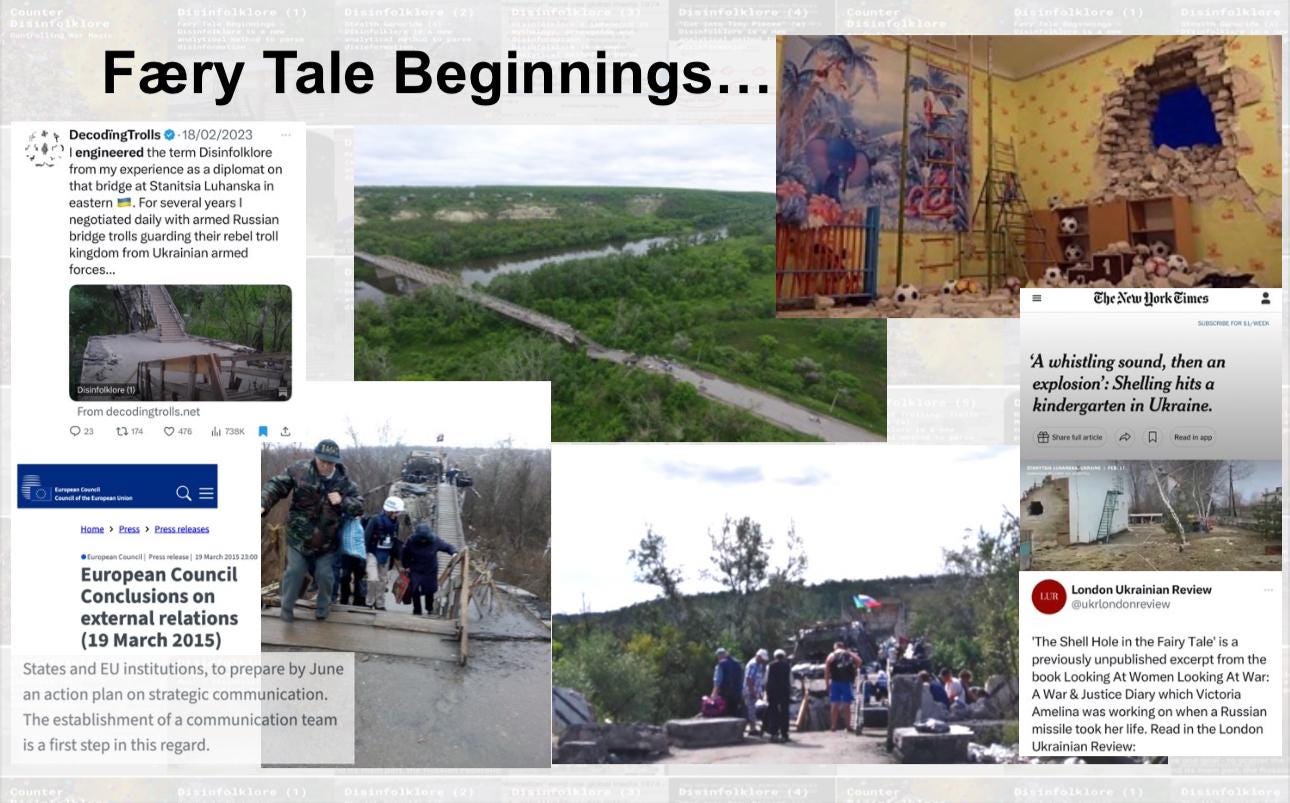
This is episode three, where I’m keeping a grip on where we are. This is episode three of a series I started four weeks ago. As some of us might remember, there were technical issues in the second week. I’m going through the piece which I delivered, the paper I delivered at the Pirate Party Security Conference at the time of the Munich conference in Munich last February. And the words from the United States Vice President at that conference are continuing to resonate with new policies being released all the time. Most recently, the attempt to sanction several senior European Union officials for so-called free speech crimes. So this is the Disinfolklore universe that I had an intimation we were moving towards, and it’s provoked into being by such actions as we have seen today.I’m also aware of my promise to Iona about six weeks ago that we would deal with truth, and I’m moving towards that as well. It’ll be a few more episodes where I move towards that point.But last week we saw the continued reference to the territorial integrity of Ukraine. Some of us might remember in the prehistoric past — which when I looked back on my writing over the past few months was actually only a month ago, believe it or not — five weeks ago, I got the first intimation that this new round of so-called capitulation or peace talks was beginning and the pressure was on. My first intimation of it, some of us will remember picking this data point up on our timelines, was when the United States had attempted to take the term “territorial integrity” out of the annual United Nations resolution in support of Ukraine’s war of independence and against Russia’s aggression.At the time, that stood out to me like a sore thumb. The reference to sovereignty without the reference to territorial integrity. And the sound RT, RIT, is in both those terms — territorial and integrity. It’s also in sovereignty, but it’s disguised as the REIGN element — reign, reine in French — originating from this idea of straight, straightness, truth, and the rod which, for instance, President Zelensky held in his right hand when he was inaugurated as president in the Verkhovna Rada. And the current English king who is sovereign — there’s only one sovereign on the island of Britain, and that is the king — he also holds a rod, a straight rod in his right hand when he was inaugurated as monarch.These are very old Indo-European rites and they are integrated into our language and the way we as Indo-European communities govern ourselves, going right back to Mykhailivka village in Zaporizhzhia, where the Yamna community — who spread Indo-European languages, religions, and forms of governance into the area between Ireland and India — lived between 4100 BCE and 3500 BCE.So when I see today the President of the European Commission, the President of France, and Indo-European civilisation’s greatest leaders, particularly in Europe, referencing in almost identical terms the term sovereignty and digital sovereignty, it pleases me enormously. We’re moving forward towards the relationship between these concepts and trying to define what is rightful and what is truthful, which is what we try to do every day in real time on our timelines.I am a great admirer of postmodern philosophy. I studied as a postgraduate at Georgetown. But I am also a little old-fashioned insofar as I do believe there is truth, and truth is not merely a mobile army of metaphors. It can be, but it’s not merely that. There is truth — when we sit on a chair, we’re sitting on the chair.As we previously discussed about emptiness with Wendy — the idea of emptiness, that ultimately nothing does matter. However, in conventional reality, we have elaborated and established certain rules, certain regulations, and certain rights. And in that conventional reality that we’re living in, for me the preeminent rights are those established after World War II: the legal order, the international legal order for which 8 million Ukrainians died, including 1 million Ukrainian Jews. 8 million European Jews died, and however many tens of millions of others died. We established this set of rules and regulations after World War II, and for me that is the truth — the standard against which we measure any speech trying to incite hatred or division.Sadly, we see the lack of respect for territorial integrity and sovereignty, which China for instance practised when it invaded and occupied Tibet, and which Russia has denigrated a billion times. And which, sadly, we are seeing now with the serious threats against Greenland — military threats against Greenland, part of the Kingdom of Denmark — and also against the European Union’s digital sovereignty. These concepts and ideas are more important than ever.How I see all of this is part of the Disinfolklore universe, which the MAGA administration, as well as Russia, as well as the CCP, the Communist Party in China, are attempting to wrap us up inside. And thankfully, for the time being — and I see no clouds on the horizon on this front — the European Union is holding up what’s right, as indeed is Australia and Japan.One of the main means we can use to determine who is upholding right — meaning the post-World War II legal and social order in today’s world — is how they are supporting Ukraine. Some of us might well have friends who don’t necessarily support Ukraine, or who have had their minds contaminated by Russian Disinfolklore so that they think they can challenge for the sake of debate or argument and argue Russian information warfare tropes, either knowingly or unknowingly — just to épater la bourgeoisie, to cause a bit of problems, to have an intellectual debate about it. That’s where it begins.And then on the other end of the scale, it’s what the Trump administration is doing — withholding aid or not doing what it should be doing to defend Ukraine’s territorial integrity. It’s not enough to defend its sovereignty, because the three archetypes which are central to Indo-European communities since the time in Mykhailivka, Zaporizhzhia, between 4100 BCE and 3500 BCE, when the Yamna lived in one community before they spread out and established all the different Indo-European cultures — Celtic, Germanic, Indic including Iranian and Hindu, Slavic, and all the rest — they had these three archetypes in their community: sovereignty, security, and prosperity/fertility.These three elements are represented today, for instance, in our memory of the Indian, the Hindi caste system, where you have priests, soldiers, and farmers. The priests are one aspect of sovereignty, the soldiers are an aspect of security, and the farmers are an aspect of prosperity or economy or fertility.And again, the RIT sound is in those — security, fertility as prosperity, and sovereignty as well. So we have these archetypes very deeply embedded into our language, into the way we think, into how we govern and organise ourselves.It really tickles me to have come across this whole literature, which is from this amazing French philosopher Georges Dumézil, who discovered these three archetypes — sovereignty, security, fertility/prosperity — immanent in all the Indo-European traditions in the 1930s. We’re going to move towards that point.It really excites me to see how present and important, how primary and fundamental, these concepts are even today in these statements of resistance to this attempt to infringe on other countries’ sovereign rights to determine what is and what is not hate speech. Germany’s lead in all of these matters — I recognise it and I celebrate it, because obviously, because of their history, they are. And Merz is very much, as a self-declared rightist, very much part of the post-World War II generation which believes in never again.I did this piece, some of you might remember, about six months ago, where I spoke about rescuing the right. I never myself identified on the political right. But when I look at how Meloni and Merz and President Zelensky are defending the identity of rightness — meaning truth, meaning our post-World War II legal order — with all of their utterances, with, as far as we’re aware, most if not all of their actual actions, putting their money where their mouth is. I saw Ursula von der Leyen, the president of the European Commission, this evening tweet that since the beginning of the war, the European Union has provided Ukraine with the equivalent of 193 billion euros worth of aid, and now this 90 billion euros worth of aid. This is the kind of reminder of actions matching words.I find it particularly disappointing that people I know — I’m not even asking for a commitment from them. I’m just asking for them to recognise how many terrible things have happened in Ukraine. On the other hand, I celebrate so many other people, including family members, who not only because they realise it’s very important to me, but have this sense of rightness. And even though they don’t think about Ukraine all day long, like most of us do, and spend most of our time trying to come up with ways we can help Ukraine in whatever ways we can — the time and the energy we can spare, the money we can spare — just normal people, they make a rhetorical commitment to support Ukraine and to try to understand the conflict. They celebrate Ukraine’s victories and Russia’s losses. I celebrate those people just as much as I get a bit sad when other people don’t recognise what’s going on.For many of you, you’ll know I spent time, from 2015 to 2018, in this particular part of eastern Ukraine, in Stanytsia Luhanska, which is the only official crossing point from Russia-occupied Ukraine into government-controlled Ukraine. I worked for the Organisation for Security and Cooperation in Europe, which was founded after the Berlin Wall fell but comes from the CSCE — the Conference on Security and Cooperation in Europe — from 1975, the Helsinki Final Act. I had cause to read it this week, and territorial integrity is in every clause.Russia sig

Two weeks ago, I ended at the point where I was talking about how what I was most concerned with in my Munich speech in February 2025 was that we would be wrapped up inside what I call a Disinfolklore universe, made up of different discrete galaxies all coalescing. Sadly, the attempt to re-engineer humanity through this is ongoing. We see it every day throughout this so-called peace process.How it manifests in our minds and in our timelines is exactly what we’re experiencing at the moment: a constant battering of our senses and emotions — our emotions most importantly — with hope and with feelings that maybe, for instance, in the case of one of the main characters at the moment, the war in Ukraine, many people are commenting on it as if peace is going to arrive in a month or two, or is imminent.I’m not going to go through why I don’t think this is true. I could go through each of the peace agreement’s elements and demonstrate it’s not true. But I probably will get to that later, in a few weeks, when I get to the point about my experience in eastern Ukraine.US presidents could always archetype at scale. By archetyping, I mean something bigger than branding. It’s not a mere imprinting of ideas in our consciousness. It’s something akin to attaching something in the quotidian, in our timelines, to very deep structures within our cognitive frameworks — on an individual, but also on a micro and macro level.When President Trump was talking about immigrants eating our dogs, that can be understood on a literal level: immigrants are eating our dogs. Many of us would have spent time fact-checking this. Lo and behold, we discover immigrants aren’t eating our dogs.But when I heard that, it reminded me of one of my great supervisors, Anna Lo, who was a member of the Northern Ireland Assembly. Sadly she died about a year ago. She was the first ethnic Chinese member of a legislature in Europe. I worked for her in Northern Ireland when I was General Secretary of the Alliance Party of Northern Ireland, an anti-sectarian political party.There is a tradition among those supposedly loyal to the British crown of lighting bonfires in July. Some of us might remember seeing lots of bonfires. And I remember seeing “Anna Lo ate my dog” on a sign on one of these bonfires, and wondering what they were talking about.I thought of that immediately when Donald was talking about migrants eating our dogs. There is this element of an archetypal relationship between dogs and migrants — being eaten, eating our pets — somehow othering. That’s quite conventional in far-right circles. I happened to come across it once by accident in Northern Ireland, and then it popped up in Donald Trump’s speech, and suddenly everyone is going.That’s also an archetypal structure. But it also sounds so bizarre to us as normal human beings who support Ukraine — it’s like a hidden code, an unhidden code. Somehow it connects with deep psychological fears of people in their inner minds and motivates them to hate migrants. Enough of a set of people that it was worth Donald airing this in his campaign. It was worth these so-called loyalists attaching a poster of Anna Lo to their bonfire and then burning it — the effigy and the sign: “Anna Lo ate my dogs.”This is the kind of thing I’m talking about with archetypal Disinfolklore literacy. We don’t have to learn all of these tropes, because honestly I think we could end up being brainwashed.But when we see the Wagner — the Wagner propagandist who was killed by one of the first HIMARS strikes in Popasna in July 2022 — some of us will remember that incident where he was visiting the front line as a tourist. It was in Popasna, a city I know well from when I lived in eastern Ukraine. He was photographed on arrival, it was put up online, there was a label on the building behind him, and HIMARS came to visit, and he was killed.The person who took over the Grey Zone Telegram channel wrote: “So-and-so has gone to Odin.” This is a very deep archetype in Indo-European history. In ancient Germanic thought, surfaced by Tacitus, recorded first in the first century of the Common Era, and then used by Wagner the composer as part of this project to create a German national consciousness movement — a response to the call by Herder in 1778 to unify the ten German tribes that Tacitus had recorded existed.Odin became part of that. Wagner the composer played his role, as did Goethe and many other great artists and writers, in forming this culture — which is akin to what MAGA and Russia are trying to do using all these different means.When they use archetypes, like in this case Odin — “he’s gone to Odin” — these are very deep structures. They attach not just into our culture but into, for instance, “Wednesday.” Every time you say Wednesday, you’re unknowingly perhaps making a dedication to Odin. Wōdanaz is the Germanic way of calling Woden the god, but Odin is another name for it. The Wagner military guys — it was part of their lore, their inner lore, and it is still part of their lore.When you pick these up, they’re not mere tropes. They’re not accidental. There’s something more about them. That’s what I mean about archetypes. It’s bigger than branding. It’s more than representation. It’s something much deeper. And that’s what I’m most concerned about.This week we saw — well, two weeks ago, and we talked about it last week — the new national security strategy. What I noticed from my previous work, which I’ve talked about before, is how Putler archetypes Ukraine as a woman — a woman from the perspective of the masculinist. From the perspective of Hegseth, who also — or the head of the FBI, who incidentally when he talks about Valhalla, that’s tapping into those white supremacist Germanic lore archetypes. So it’s not just the Wagner military.What I noticed they’re also trying to do in the national security strategy is archetype Europe in the same way they’re archetyping Ukraine — turning the concept of Europe away from its power, its economic power, and into a character in Disinfolklore with the characteristics of a weak woman. A weak woman is an archetype from the perspective of masculinists like Putler, like Hegseth, like Donald, like all of these palaeo-male, palaeo-conservatives. They’re trying to create a sense of disgust about it.One friend of mine wrote to me from the United States: “How is Europe these days? It sounds very sick to me, everything going on there. You’re just ailing.” This is the mood which has been spread.I talk about how Disinfolklore works on our mana, our energy, from which all our motivations come, our attitudes, our moods emanate. This is the secret sauce. We’re looking at the meme, the peace talks, the so-called peace talks, and our mood is being affected. Mood is a much longer-term mechanism to brainwash us and demotivate us. “What’s the point in voting? They’re all the same.” That’s the way they use memes, and that can be effected by archetypes.When we’ve had previous US presidents who’ve seen value in trying to inspire us, for good or for ill — this is not what we have at the moment. There are similarities, but US presidents could always archetype at scale. That doesn’t mean what we’re experiencing today in our minds and in the mind war is a facsimile version of the past.Because now they have the capacity to re-encode our minds into their Disinfolklore universe. If the media repeats your trolls, then people truly will believe migrants are eating your pet dog. If you own X or Facebook, you can convince at scale that we are not living in a Disinfolklore universe. But we are. The signs are everywhere once you get your eye in.That is my job: to try to help us get our eyes in, and to remind myself of the real purpose of all this peace-talk Disinfolklore, quite apart from the daily quotidian ebb and flow of “will they, won’t they.”Most of us listening right now — that’s one particular Disinfolklore galaxy which isn’t wrapping us up inside. But I see it even in the Kyiv Independent: “As we move closer to a peace process.” Then you see other journalists, European leaders talking about how we’re as close as we’ve ever been to a peace process. But I think most of us are pretty clear we’re not.So what is the purpose? What is the effect of all this trolling with Witkoff and Kushner? It’s to wrap us up inside my premonition of a Disinfolklore universe. And of course, it’s only one of thousands of different Disinfolklore galaxies or sub-galaxies going on at the moment. We’ve got the Epstein thing, the Susan Wiles thing, and in each of our individual countries any number of stories — maybe a conservative television channel in Poland reported as wanting to establish a MAGA TV station there, or a movement based around Palestine, animus towards Israel, or migrants, or both, or Ukraine, or any number of issues.This is what I talked about a few weeks ago, with the great insight from this amazing article by the Ukrainian historian Tetiana Boriak in InformNapalm, where she talks about the mental war the Russians have declared against us, and how Surkov himself — Vladislav Surkov, the former deputy prime minister of the Russian Federation, who was in charge of Ukraine from I think 2012 to February 2020 — I kind of laugh because I remember his nemesis.Surkov’s nemesis was the moment in December 2019 when President Zelensky refused to surrender Donetsk and Luhansk to Putler, despite Macron and Putin and then-Chancellor Merkel and Surkov promising that this newly minted president would give Russia control, enable them to hold elections. It was reported that Yermak almost came to blows with Surkov at that Paris meeting. Then Surkov left.The really insightful thing from Tetiana Boriak’s piece in InformNapalm, which helped me a lot, was Surkov’s statement in his writings about how Russia uses the archetypes of national consciousness as fig leaves to disguise their mental imperialism. In the context of Russia and Russkiy Mir — which as an idea h
It’s exactly a year since I detected the system-wide effects of the aggregatation of MAGA and Russian Disinfolklore artifacts invading our minds, information space and reality. In February in Munich at the Pirate Party security conference I declared what by then I had archætyped as a “Disinfolklore Universe” to be operating inside all of our minds and cultures. Today I want to begin a series of several parts of the “Battling Archetypes” paper I conceived for the first time exactly a year ago and which I spoke about in embryonic form at the Munich meeting in February.I wanted to go through the four — or five parts rather — over the next week or two, to remind us of the system so that we can apply it to this idea of a peace process of which Ukraine isn’t a voluntary part. It’s obviously sticking in there as long as it can to maintain intelligence support.As I understand it, Ukraine last year spent 5 billion euros on drones, and 70 or 80 percent of Russian casualties were caused by those drones. So the amounts of money and the technical needs of Ukraine — they have everything they need, basically, at a minimum. It would be very nice if they can maintain intelligence support and other particular munitions. But even the Patriots — we see these things, the SAMP/T, the anti-aircraft system that the Italians make, I think with the French — seem to be doing very well. The United States is no longer the indispensable ally.I totally admire the patience of the Ukrainian side. They want to keep America on board, mainly because the deep state, if there is one, and the people who will succeed Donald — God willing — will expect Ukraine to maintain its politeness. It’s an investment in Ukraine’s future, but I don’t see it as an existential need for them.So what are the Americans and the Russians doing? They are altering our culture, changing our approach to international law, trying to return us to the social conditions of the 1930s. This has always been the plan of the people behind MAGA and Donald: that municipal law should trump international law.If you were to say to me, “What is Russia’s game? What is the project by invading and occupying Crimea?” — that’s what I would say. It’s to replace the international law which constrains individual sovereigns from certain activities. It proscribes a certain set of activities: contravening human rights, contravening various laws — laws of the sea, laws of armed conflict, the Genocide Convention. These are all constraints on the sovereign. Both MAGA and Russia and many oligarchs around the world don’t want any constraint on sovereigns.When we hear them trying to talk about recognising Crimea, recognising the taking of a territory — on the one hand, it will be America doing what Russia did when it brought Zaporizhzhia into its constitution. It just ruins the entire constitution of America, as it would with Russia. It will have no effect on other countries like the European Union, or powerful countries like Japan, in terms of recognition. They’re not going to suddenly recognise it. But Taiwan and everyone will accelerate their nuclear weapons programmes, and it will have real-world effects.Apart from all of that, what I see happening, almost imperceptibly, is it changes our realities and normalises what was previously impossible. This is what I talk about as the Disinfolklore universe. This is why, Wendy, when I see articles particularly like this one about recognising Crimea, it just jumps out: they are going to do this, and these are the implications. In my own small way, I try to lay those out. But I hope people who have power are trying to lay this out too. And I hope there’s a plan. Maybe the plan involves leaks. Maybe that’s why Witkoff looked so terrible in Miami — because he was spending nights going through all his conversations for the last six months, which someone perhaps has, and they’re all going to leak.I declared our Disinfolklore universe in February in Munich. I thought it was appropriate to be talking about that at a Pirate Party security conference event, because those who founded the Pirate Party get what I’m about to speak to you about. There’s a flow between, on the one hand, culture, art, films, literature about pirates, and geopolitical security. This is especially apt as we see these attacks on Russia-connected cargo vessels.Those whom we entrust with securing our conditions of civilised life don’t seem to understand this flow between culture, art, films and literature, and geopolitical security. Donald, of course, does — because he talked incessantly about Al Capone, about Hannibal Lecter. He brought in these archetypal characters from art. He archetypes himself as the Joker, or as a Magus or seer. He gets it. But many of our leaders don’t. President Zelensky certainly gets it, and that’s part of my argument.This is partly why they’re such easy marks for Russian and MAGA Disinfolklore. I’m talking about the straight-laced geopolitical actors and commentators who don’t really get this flow between art, culture, films and security. For them, they can’t really understand Donald as an artist, as an archetyper, someone who archetypes at scale. Same obviously with Duncy Putler. They get wrapped up so easily in Russian or MAGA trolls, like flies in a spider’s web. It’s very hard for them even to understand that they’re trapped inside old thinking.I’m not saying I don’t get trapped. I get wrapped up in these trolls all the time. I’m just trying to develop tools that help me escape the spider’s web. When I find myself in a state of confusion — for instance, when I saw last Friday night about America recognising Crimea — I don’t go into despair or put out tweets going, “This is terrible.” I just try to think it through: what will happen if this happens? What are they up to? Is it likely to happen?Today I’m going to offer a perspective on what I call our Disinfolklore universe. I’m also going to offer a means to escape the trolls, the memes that wrap us up inside when we fall for MAGA or Russian Disinfolklore.None of this is easy. I don’t have all the answers. Whenever you hear anyone talk about disinformation or Disinfolklore as if it happens to other people, as if only stupid people fall for trolls — whenever you hear chatter like that, be certain these people are easy marks for trolls, for MAGA and Russian Disinfolklore. You’ll have heard me say this a lot, most recently with President Biden and his “we’re not going to go for World War III over Ukraine.” We talked about that three weeks ago.Today we live in a true Disinfolklore universe. The fabric of every dimension of our lives — our work, personal relationships, life choices, fates — are fused with aspects of Druidy Don and Duncy Putler’s memetic onslaught. That is as true today as it was in February when I first spoke about this in Munich.You’ll all remember the White House visit happened a few days after my Munich speech. It affects all our moods, motivations, intentions and attitudes. Increasingly I’m focusing on moods, because it’s the moods which are affected by this news about peace plans, about Ukraine being forced into capitulation. “Can they do that? Is it going to be?” And we’re just depressed by it. The aggregate of us all being depressed is: “Ukraine can’t win.” This is really what they’re attacking on a civilisational scale, on a country scale — this fear, this malaise they’re trying to create.These moods are being formed by what I call Disinfolklore — directly through the media memes we consume, or indirectly through our own minds working through these memes and those of others influencing us, from archetypes created and evolving from Disinfolklore.We had all of the archetyping of Elmo and Druidy Don in the White House those days in January. The totality of our information space was occupied by memes like the Department of Government Efficiency — named after a meme coin, but also after the class of oligarchs who ran, I think, Venice into the ground — and the baseless meme coins. But it’s had real-world impacts. Some studies have talked about millions of people dying as a result of the cancelling of USAID. It’s hard to see these institutions being restored.This is what I mean by the permanent change in our culture, the permanent change in the architecture of our lives and millions of lives by these people. Even though we might win certain battles and the Supreme Court might rule this or that, the real-world impacts are in many cases permanent. We never return to the world the way it was before. Obviously all of us hope some deus ex machina will come on stage and we’ll just go back to how things were. But that’s never going to happen — how things were in 2014. We just have to try to keep control of our perceptions of how things are developing and evolving.The totality of our conception of America now is occupied by actors playing leaders in superhero costumes. This character Jared Kushner — who is he? Did he get Epstein’s business, and Epstein got Maxwell’s business? I don’t know, but it’s a whole character set. They bring them on stage and we gaze at them and think it’s a bit weird — especially given they were going on about Hunter Biden, who was never really on stage, for so many years. And now they’re completely Zen with this guy.He’s married to a gangster’s moll. Or he is a gangster. He’s a gangster’s son-in-law who happens to be president. His father was in prison, was a gangster, but now he’s US ambassador to France. Just odd archetyping of different characters who are part of our lives with these weird powers over us in the information space.We had Elmo as Robin and Druidy Don as Batman — dressed up in Marvel Cinematic Universe costumes, all that black, the black coat that Elmo was wearing. They use AI and real-life costumes. They’re memeing a Disinfolklore universe using Marvel-universe-inspired memes as a means of creating a Disinfolklore universe in our minds and in real life.I focus on this
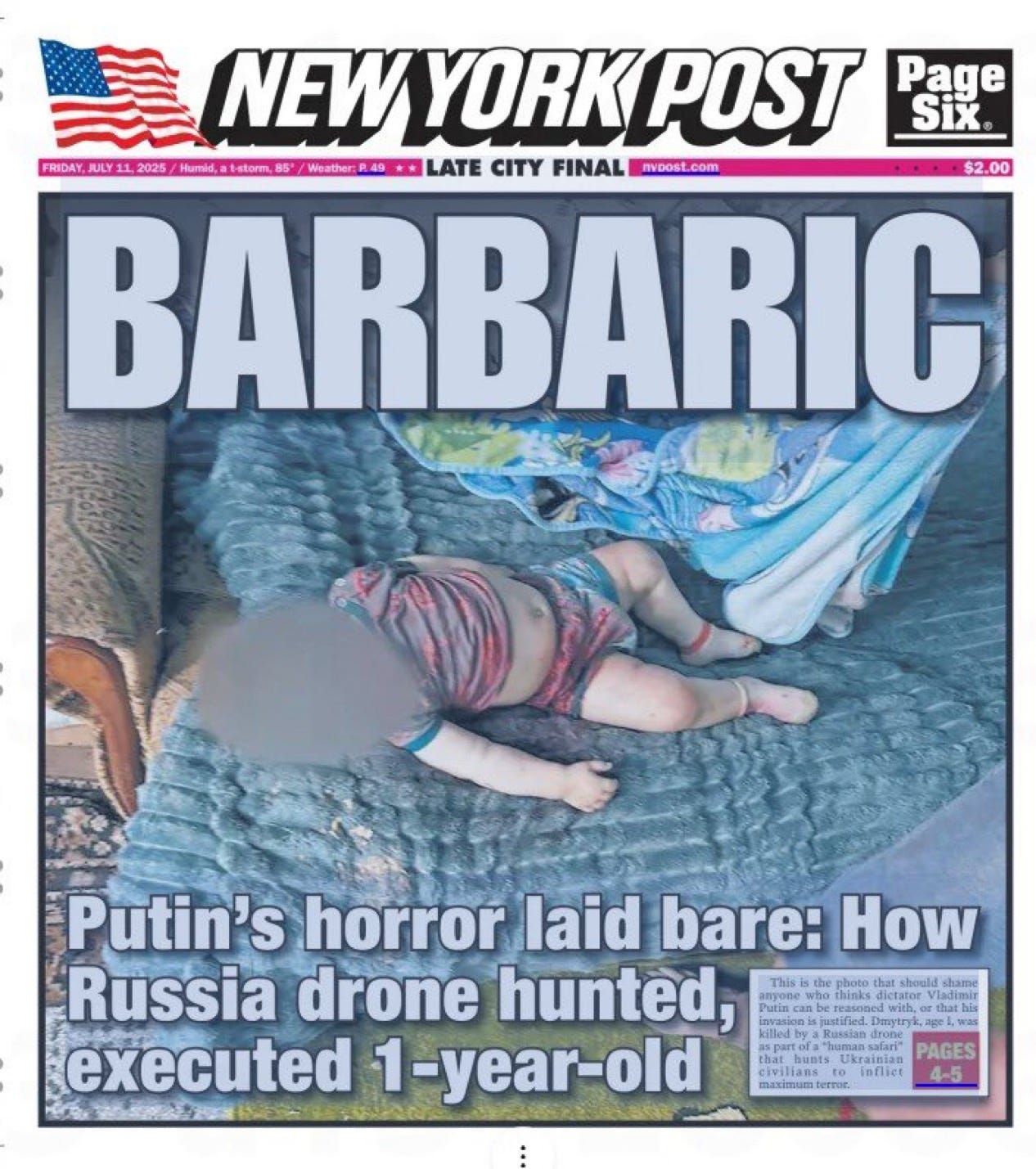
Disinfolklore is Russia using First Person View Drones on human prey to train its drone pilots. Then the Russian state publishes the footage of these murders, from the perspective of the First Person view drone pilots as they close in on their human prey. This is archetypal Disinfolklore: create the event (in this case murder), then publicise it using different memes and means of storytelling. Russia’s only in Ukraine to create social media content, which it uses to troll its own population and America’s leaders into perpetuating Ukraine’s annihilation. Disinfolklore always has a purpose. Infolklore (such as this podcast), by contrast, has an opposite purpose.After detailed investigations into 200 of the 2,800 murders of civilians by Russia using First Person View drones in Kherson, the UN Commission of Inquiry has determined these are Crimes Against Humanity.The UN Commission of Inquiry based in Vienna has issued a report on the human safaris in Kherson that all of us are aware of, which have been going on since July 2024. It has established that these are crimes against humanity.Part of the indictment of Russia and those participating in the prosecution of these crimes against humanity — interesting to use the word “prosecution” there — is that Russia, the Russian state, is sharing these videos of their human safaris, of the 140 people they’ve murdered using first-person-view drones. The Commission of Inquiry determines that because they are first-person-view drones, the operators are hunting individuals, chasing them, watching as they murder them, and then sharing these on what I call the Disinfolklore apparatus: Telegram, X, Facebook, Instagram, and now sadly the White House press room.These videos themselves are a perfect example of Disinfolklore. They breach all ethical guidelines — which is the second of the six criteria I use to determine whether a story constitutes Disinfolklore. The second criterion is “right” or ethical discipline. Obviously it’s morally wrong to engage in human safaris. There’s no law anywhere, moral or otherwise, which allows this.Now we have a determination by a UN commission specifically established by 184 UN member states to inquire into Russia’s war crimes in Ukraine. It determines that these are crimes against humanity — there is no greater crime in the human family. Therefore, the breach of the second element in the Code of Positive Trolls, which I use to distinguish between a unit of Disinfolklore and a unit of folklore or any other kind of story or narrative form — now we have this determination. That’s a perfect example of Disinfolklore.Much of what is on Telegram — and of course Telegram features in Russian combat propaganda, in Russian military strategy, where you have this concept of “information confrontation” in which informational units and the environment are engaged in a confrontation — here we have Telegram, specifically leveraged by the Russian state, to communicate Disinfolklore into the inner minds of humanity. Very successfully. It is acting in concert with the military apparatus in Kherson.It’s not just killing these people. It is spreading the stories, spreading the images of these people being murdered, as part of its plan to dominate the inner minds of humanity and create terror — not just in the minds of the people of Kherson (and this is not me, this is the inquiry), but inside the minds of humanity as people gradually become aware of what’s going on.That’s a good example of what Disinfolklore is in practice.What helped me see this pattern — this is what I really do, I hunt for patterns in data. I assimilate, as many of us do who participate in X, because X, as we now know from the third report on Foreign Information Manipulation and Interference by the European Union, released a couple of weeks ago — I highly recommend reading it along with the first two reports — X is where, on a dataset of I think over 40,000 FIMI instances collected by the European Union, X was involved in 86% of them.This is where we all are. I know many of us have ethical dilemmas about whether we should be here. Most of us are also on Bluesky and other places. But the fight is here. The examples are here.I saw Margarita Simonyan tweeting again in her folksy Disinfolklore way — she does this a lot, telling these stories, as indeed does Donald. They tell stories of frankly horrifying things. This goes to your question, James.For instance, the way Donald communicated — I think it was March 2024 — that if the head of a major NATO country said to him, “We can’t pay for our NATO membership, would you protect us?” he said, “I’d say, you know, do whatever the hell they want with you.” This unit of information was then reported by CNN as a fact — that Donald had told this head of state that America wouldn’t protect him. But we’re not clear whether this ever happened. It was reported as a fact by CNN. And so you see these folksy stories get taken up.Simonyan tonight — she’s talking about how “people in the offices in Moscow” are saying that if Germany gives weapons to Ukraine, Ukraine won’t be able to do anything with them without Germany’s help, therefore Germany is complicit, and so they’ll have to strike Berlin. This is a classic piece of Disinfolklore.There’s a distancing device in the narrative form. It’s presented as a folksy story: “people in the offices of Moscow” — as if she’s just heard this gossip. She’s said this before, when she spoke at the St Petersburg International Economic Forum in June 2022. Many of us will remember this. She said: “People in Moscow are saying that all our hope is in the famine.” And then she interprets what these folksy people are supposedly saying.She’s sitting beside the head of state. She’s sitting beside Putin himself on the dais at the St Petersburg Economic Forum, dressed in green — which is why I call her Maid Marian Simonyan, like a reverse Robin Hood. This is an aspect of the Disinfolklore analytical method: we can use these folklore archetypes to interpret those who are themselves using folksy archetypes, and to combat them.She said: “All our hope — the people in Moscow are saying — all our hope is in the famine. And what they mean by that is” — this is her interpreting what the ordinary folk in Moscow are supposedly saying — “there will be famine in Africa and the migrants will come to Europe, and then the European Union will release the sanctions because it’s impossible for us not to be friends.”This is the folksy banter of the schoolyard. This is your seven-year-old child speaking to their best friend after an argument: “It’s impossible not to be friends.” But this isn’t a micro chat in a schoolyard. It’s a conversation sitting beside the head of state of a country at war, which is planning to starve millions of people in Africa in a madcap attempt that you’d only see in literature — in Don Quixote or in some folktale.The madcap plan to win in Ukraine is to starve millions of Africans. That will provoke the Europeans into lifting the sanctions. Then Russia will become friends with Europe and Ukraine will be abandoned. The way she tells the story, it’s solid Russian strategy, but told in a folksy way. It’s absolutely horrifying when you analyse what it’s saying. But it passes most people by. It enters their inner minds.As indeed does this stuff archetyping the former president of Russia as drunk. Many sensible people were tweeting today the content of Medvedev’s tweet, once again threatening World War III if something happens — I think related to the Germans. These are folktale archetypes, folksy stories which communicate really horrifying things when you parse the data. It’s a pattern they use. And it’s really effective, because people like us share these because they provoke something in our emotions. Even if we think we’re harming the former president by archetyping him as drunk, we’re still repeating the meme. The horrifyingness is slyly communicated, the energy continues, and it pings around the world.Thankfully, today, as many of us know because we’re tuned in, we see great advances in our political leadership over what we’ve experienced since February 2022.But this method of communication has had impact. President Biden’s policy — “don’t poke the bear” — is the Disinfolklore meme, probably the most successful one ever, that actually impacted foreign policy. It stopped America properly helping Ukraine.International relations itself, the entire discourse, is full of these metaphors and Disinfolklore — “don’t poke the bear” being one — Disinfolklore memes that are represented as a means of communicating foreign policy and strategy affecting the lives and deaths of millions of people. Whereas in fact, these strategies are only communicated by means of these memes, and through these memes.What I have spotted, which as far as I’m aware no other writers have really noticed, is this continuity across multiple narrative forms and discourses. It’s obvious in anthropology, folklore studies, or Jungian psychology, when they’re referencing myths and archetypes and storytelling. But the same dynamic is at play inside international relations discourse, inside the speeches — until recently — of many of our leading politicians. And obviously everything Donald says: he speaks Disinfolklore fluently.It’s these folksy stories: from the January 6th anthem of the January 6th insurrectionists, organised by the current head of the FBI, to the songs used at his rallies, to the folksy way of speaking about Al Capone, to the archetyping of Melania as Al Capone’s wife — wearing haute couture clothes made by Ukrainian fashion designers in LA, DressX, who supply haute couture interpretations of comic-book aesthetics for people like Elon Musk and Melania Trump, who want to archetype themselves as characters in our information space by referencing through their clothes superheroes or characters from folklore, from our contemporary folktale.That’s a sample of the sc
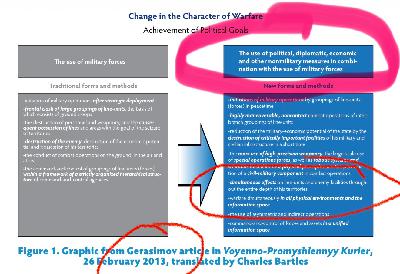
Rearchetype “acts of war” as “hybrid warfare” or “Active Measures.” Then, get the most knowing people in your chosen enemies’ chains-of-command to take on that Archetyping.While they earnestly, sincerely, confused and proudly model their knowingness (by explaining to others the intricacies of Russia’s own re-Archetyping of actual “War” with euphemisms) Russia continues its war by all means. The delicious irony is that by subverting the signifier (War) that properly describes Russia’s attacks on our countries and implementing a new meaning (Hybrid War), Russia is proving that it is at war against us. Concealing its war against us from Russia’s chosen enemies’ perception IS an instrument of contemporary warfare. It’s the very definition of Mental War which that now is 3/4s of War. We all think we’d recognise a genocide or war, yet our mental models of war that’s forged through films about Napoleon or this or that kinetic battle in World War Two have not caught up with how war today manifests.Here we see the full power of Russia’s Archeytypal Disinfolklore. It contaminates the very concepts we need to communicate war and threats and invasion. That is, it substitutes “hybrid warfare” for war. Then we see events on the ground we would otherwise characterise as “armed attacks” as “not war.” Note too how cleverest most strategic thinkers in our security architecture earnestly fall for this troll. Archetypal Disinfolklore literacy can help us perceive the Mana/energy inside such euphemisms and instruments of war.Today I wanted to go right back to where we were at the beginning. This is our 26th episode — for those who are counting, and even for those who aren’t, it’s still our 26th episode.Disinfolklore is an analytical method with 12 tools. The second six tools are basically the Code of Positive Trolls, which I’ve talked about. The very first tool — some might remember — is called Archetypal Disinfolklore Literacy. I haven’t talked about that for a while, so I wanted to go back to basics.To understand what I mean by archetypes, understanding what NAFO does is a perfect example of what I call counter-archetyping. Firstly, individuals archetype themselves with a nom de guerre, or in the form of a visual meme as a dog, and the endless creativity and self-expression involved in choosing one’s avatar — the NAFO avatar is in itself really charming, beautiful, lovely, agreeable, kind, not egotistical, humbly joyous. Some of us remember many people’s avatars and the way they’ve archetyped themselves.But what NAFO does itself is an act of counter-archetyping. The 100,000 or maybe more people who spontaneously self-identified from May 2022 onwards into this amazing decentralised organisation of pro-Ukraine supporters — it de-archetypes, if you like, what the Russians tried to do.The foundational meme, from the late NAFO Fellas — very sad that he passed before the liberation of Crimea. His engagement with the archetypal nasty Russian ambassador based in Vienna, where he summed up what Russia’s casus belli was, along the lines of, from memory: “So basically, a few Russian-language speakers in Ukraine were being discriminated against, and you decided to go in and kill everyone.” And as we all remember, the ambassador — the actual ambassador, archetypal villain — responds very negatively: “You pronounce this nonsense, not me.”That is the foundational meme of NAFO. What it does is undermine the normal play of things. You have an actual ambassador, a country’s ambassador — this is probably one of the lows in any Russian ambassador’s time in Vienna — and he engages with a cartoon dog, with a guy in America, and he loses the engagement.As an act of counter-archetyping, that’s quite typical. There have been millions, probably hundreds of millions of attempts to counter-archetype. We see it all over our timelines. Any time a Russian diplomat or figure attempts to re-archetype reality to favour Russia, oodles of NAFO members go in and in a very humorous way undermine what the Russians are trying to do.In general terms, that is what I mean by archetyping. It can be conscious or unconscious. It’s actually an aspect of our cognition. In my understanding, we archetype the world when we resolve the booming, buzzing sensation that is external reality into items. We navigate it, and we archetype this as that or that as this. We take a risk when we get onto this aggregation of atoms and quarks we’ve aggregated into an aeroplane, sit down, and travel to a country — which itself is an archetype, an archetypal entity. It doesn’t exist in any way apart from in our heads. “This is Spain.” “This is America.” These are archetypal identities of highly complex systems of trillions of sentient beings and different memories and history.That’s really what I mean by archetyping. It can be purposeful or accidental. In the case of NAFO Fellas and that engagement — the foundational moment of NAFO — that was completely accidental. He didn’t expect to found a movement. I don’t think Kama, the person who created the organisation around it, thought he was going to create this decentralised entity. And NAFO has been sustainable.But what Russia does is purposeful archetyping. I talked about this in about the fourth episode, when I discovered the Mother and the Maiden in the Woods — this mission I was sent on in eastern Ukraine as a result of a report from Russia’s security service in Russia-occupied Ukraine: that a mother and her underage daughter, the maiden, were about to be chopped into tiny pieces by another character in Russia’s archetypal Disinfolklore arsenal — the mythical Ukrainian Nazi. That was when I discovered that Russia was archetyping on purpose, using those forms of archetypes, or what Jung calls primordial archetypes.What I now understand as archetyping is this: we have mobile armies of archetypes, some of which are primordial archetypes invested with new meanings and attached to particular policy choices that Russia or China or MAGA or other movements which wish to manipulate our minds invest them with.In the context of what’s happened this week: this term “hybrid war.” We see today Italy’s defence minister describing Russia’s targeting of infrastructure, elections, public opinion and supply chains as a “hybrid war.” He says Western inaction is absurd. Polish Prime Minister Tusk slams the explosion on the Warsaw-Lublin line as unprecedented, sabotaged by a foreign state. Russia’s fingerprints all over it. “Hybrid war is here.”Two leading NATO members’ senior politicians are recognising that Russia is behind these acts of war. But both are archetyping what are acts of war as “hybrid war.” At the Berlin Security Conference, NATO’s Ingo Gerhartz warned that the West is not at war but no longer at peace due to Russia’s threat, and noted Russia exploits Europe’s bureaucracy, slow weapons production and divisions to weaken the West.We have senior leaders recognising attacks, recognising that Russia is behind them — which is a huge advance, no shilly-shallying about this. However, they’re quite comfortable archetyping these attacks, these acts of war, as “hybrid war.”We saw this week — and I know this pains me, obviously not as much as Joanna because it’s her country affected — a Turkish-owned, NATO-flagged LNG tanker was hit by a Russian drone and set on fire. Romanian officials evacuated two villages, approximately 250 people, and as the owner pointed out during the week, all of their animals. These are not hybrid war attacks. These are acts of war.Many of us will remember how we reacted when, I think, part of the German consulate in Kyiv was hit in maybe May 2022. We thought: this is Article 5 stuff. Now none of us have any expectation that Article 5 will be raised.I want to try to explain what I believe is going on through the prism of the Disinfolklore analytical method — to help at least the people who listen to this understand what is going on, and the sense of indignation I feel and all of us feel that these acts of war are being archetyped as “hybrid war.” They’re recognised as such by senior leading politicians. The culprit is identified. And yet Article 5 is not being triggered, nor is, as far as we are aware, a Kosovo-esque NATO or non-NATO intervention force to go into Ukraine.I cannot listen to any non-Ukrainian speak about the problems and the scandal around Mindich without asking first: are you calling out America for all of its scandals and all of the scandals in our countries? Why are you archetyping Ukraine in this condescending way, as if the aid you are giving is some sort of gift and gives you the right to determine what Ukraine should be doing — when the amount of corruption in the United States and with the current president and the Epstein debacle is extraordinary? I have no time to listen to any of them lecture Ukraine.The “special military operation” — that’s another form of archetyping. And archetyping acts of war as “hybrid warfare” or “active measures” is an aspect of the way Russia wages its mental war.I myself remember when I first encountered the phrase “hybrid warfare,” and it was pretty hard to get my head around it, even though I was involved in eastern Ukraine on this bridge in Stanytsia Luhanska between 2015 and 2018 — a grey zone, we called it. This was an area of a kilometre and a half between the Russian occupiers’ positions south of the Donets River and the Ukrainian defenders’ positions north of the river. About 10,000 civilians passed through this grey zone each day. I and my colleagues provided what’s known in human rights work as protection by presence and got embroiled in all these stories, involved in the Disinfolklore there.The use of “grey zone” as a metaphor has a very real meaning to me, because it is an actual physical space where acts of war are happening: explosions, people being killed, people being injured all the time, people being threatened. At night, artillery duels going on in this very space.
I’m 100% comfortable with using the term ‘meme.’ I use the term ‘meme’ interchangeably with the term ‘informational unit’ and also with the term ‘troll,‘ where troll is describing the item of Disinfolklore or the item of information. So ‘meme,’ for me, is more than simply the visual image that we have come to think about it as being. Obviously, when the term ‘meme’ was coined in whatever was 1976 by by that English philosopher Dawkins, it described ‘informational unit.’ What I call informational units (which are communicated in cultures in the same way that genes, or the genome are communicated biologically). I discovered Disinfolklore as a narrative form in eastern Ukraine, where I gradually realized—while working in Russia-occupied Ukraine between 2015 and 2018—that what I was observing were particular items of Disinfolklore, usually recurrent memes or “units of information.” The quotidian, daily ebb and flow of news and “newsey” content made me wonder: was there a system behind it?As I looked more deeply, I realized that Russian military strategy includes the concept of Information Confrontation. According to Russia’s military doctrine, Information Confrontation comprises two elements:1. The means (instances of information such as memes, trolls, and informational units).2. The Information Environment.This led me to what I now call a Disinfolklore galaxy—a system Russia created inside occupied Ukraine. Every thought, every movement, every aspect of reality—from where you work to how you commute, to the people you talk to, whether family or colleagues—is injected with what I call Disinfolklore. Ideas meld with the texture of life itself.Unless you profess certain memes, beliefs, or informational units, you risk consequences. If you get it wrong, you might lose your job—like the ABC News journalist who called Donald Trump’s deputy chief of staff, Stephen Miller, “full of hate.” That journalist lost his job. This is a perfect example of how the Information Environment impacts every aspect of life: you say something, and you lose your job.That was eastern Ukraine, where I discovered what I now call the Disinfolklore galaxy. Today, I conceptualize the Disinfolklore universe as being made up of many different galaxies. The MAGA Disinfolklore galaxy shares many continuities and similarities with what I saw in Russia-occupied Ukraine.In early November 2024, just after the U.S. presidential election—which Donald Trump reportedly won—I had a vision. What happened to MAGA, to those who are part of MAGA, was going to happen to all of humanity, starting with America. This vision became the basis of my talk at the Pirate Party Conference in Munich during the Munich Security Conference: Welcome to Our Disinfolklore Universe. Today, we see the same melding of reality in America’s relationship with Ukraine, which is why we’re here. We want Ukraine to win, but most of us understand America will never tip the scales in Ukraine’s favor. Now we just hope it doesn’t tip them against Ukraine. Ukraine has been central to U.S. politics since 2016.The Republican National Convention in August 2016 marked a turning point. Paul Manafort, whose work contributed directly to this war in Ukraine, was later imprisoned for operating as an unregistered agent for Ukraine’s former president. Manafort had the commitment to deliver military support for Ukraine removed from the Republican platform. I have posted before about the exact moment when MAGA shifted to a pro-Russia stance. Recently, Reuters reported evidence that the United States may not fund Ukraine militarily next year. This path—from secretive policy changes to mainstream acceptance—illustrates how thousands of memes invade our information space, forming what I call the Disinfolklore galaxy.My main teaching, for lack of a better term, is that when we tune into individual memes and informational units daily, we fail to see the larger structure: a Disinfolklore galaxy as powerful as the one that surrounds those who embraced MAGA. This phenomenon is not about intelligence or education; it is a deliberate attempt to hack minds and surround people with an information environment designed to influence behavior.Paul Manafort remains a dark force behind much of Ukraine’s division between 2004 and 2014. The irony is stark: those he worked for—and MAGA—claim the Maidan uprising was engineered by the U.S., even though Manafort supported Yanukovych, who, according to leaked texts from his daughters, arranged the massacre on the Maidan in February 2014. At that time, European leaders were in Kyiv urging demonstrators to accept a deal with Yanukovych, but he fled. Manafort later worked for Donald Trump. Though not prominent publicly, he appeared at the national convention, and his influence persists.Today, figures like Tulsi Gabbard amplify narratives reminiscent of Russian disinformation playbooks. Her recent video about nuclear war exemplifies Disinfolklore: carefully crafted aesthetics, deliberate archetyping, and messaging designed to evoke fear. The imagery—dark tones, ashes, and even her gray hair—suggests archetypes of witches and doom. This is not accidental; it is psychological warfare.Applying my Disinfolklore analytical method, I interpret her message as a statement of power: surrender to us, and we will protect you from elites who allegedly seek nuclear war. For those who resist, the underlying message is intimidation—“You are powerless.” This aligns with decades of narratives portraying cities as lawless and elites as corrupt, themes deeply embedded in American discourse.The method I use draws on cognitive models like Paul Ekman’s Atlas of Emotions: trigger, experience, reaction. Every day, we undergo countless emotional journeys triggered by stimuli—tweets, images, videos. Separating experience from reaction helps us resist manipulation. Gabbard’s video triggered curiosity in me; my reaction was analysis, not amplification.Ultimately, Disinfolklore thrives on fear, negativity, and archetypes. Whether through memes, videos, or orchestrated spectacles like Russia’s missile strikes or human safari footage shared on Telegram, the goal is the same: to create a distorted reality. This is what I observed in eastern Ukraine, and it is what we see now globally. Unless more of us wake up to these tactics, their influence will deepen.Elon Musk dresses up in superhero costumes, the Pirate Party began as a party of protest, and pirates from literature, from art became their part of their their moniker, their folk the folk heroes of pirates. They were going to be the pirates. So it was appropriate, but I made the speech there, and then, since then, I’ve worked carefully on detailing the whole idea, this whole aspect of the Disinfolklore narrative method / narrative form and Disinfolklore, analytical methods. So it’s many different things, which concerns the Disinfolklore universe.When I saw Tulsi Gabbard’s “Nuclear Ashes” speech in the run-up to America’s bombing of Iran, I decided to apply the method—a 12 tool algorithm designed to help us interpret any Informational Unit. Any meme, whether it’s a photograph or an image circulating in the English information space. We’re likely seeing similar patterns in Northern Ireland right now, where riots have erupted following allegations that two immigrants allegedly attempted r***. This turmoil reflects a perennial theme in Disinfolklore—and in Indo-European thought—where outsiders enter the inner realm and threaten its fertility, sovereignty, or security. These three archetypes recur across Indo-European societies, as noted by leading theorists of language, linguistics, and religion.Since recognizing this pattern, I’ve used it as a tool for analysis—whether examining riots in Ballymena or other unrest. I wouldn’t be surprised if Telegram is involved in amplifying hatred. Applying these methods helps us understand what leaders and influencers are trying to do—whether in Ukraine, Russia, or elsewhere. Russia demonstrates the endgame: a nightmare reality, mirrored by the CCP, North Korea, and Iran—societies deeply embedded in Disinfolklore, using stories to hack minds.Tulsi Gabbard’s video is archetypal Disinfolklore. The aesthetics immediately reminded me of a strange artifact a Ukrainian friend sent me during the war: a man in 1970s-style visuals discussing hypermodern issues like global warming and environmental catastrophe. Gabbard’s video evokes a similar mood—dark, foreboding, like being lost in a forest. It is cynically and carefully produced, down to details like her gray hair strand, reminiscent of a character from The Munsters. This deliberate archetyping casts her as a witch, placing viewers in a negative psychological space.The imagery—dark backgrounds, ashes—reinforces this mood. For someone like me, who filters what enters my mind, the video felt abrupt and unsettling. Was it responding to something in the news cycle, or was it simply injected into our space as a deliberate artifact? Either way, it signals intent. Combined with events like the activation of the National Guard and military parades in D.C., it suggests escalation—a coup in motion since the disputed 2020 election, now accelerating.Applying the Disinfolklore literacy tools, I see deliberate archetyping: Gabbard as a witch-like figure, invoking nuclear war, ashes, and elites. The message is layered but clear: fear. This negative mood bypasses rational filters, embedding itself in our minds and triggering routines and traumas. Coming from someone tied to U.S. intelligence circles, the irony is striking—she positions herself as anti-elite while claiming elites want nuclear war because they have shelters. This is nonsense, of course, but effective as psychological manipulation.The third tool—finding the Mana in the meme—asks: what energy does this convey? So Mana, for me is an energy, and the energy in the meme. So you just look for what it what is the energy? The different levels. La

How the law of sympathetic magic applies. I’ll go back into why I ended up getting interested in this. As some of you might remember, I studied law and worked as a property lawyer in London for a little while. One of the features in English law is this idea that sometimes, for whatever reason, commercial property is let at a peppercorn rent. Generally speaking, in this day and age, no peppercorn passes between the landlord and the person leasing the property. But it’s in all the leases. That was always a little curiosity to me.As was the fact in contract law — in English and in American contract law — for a contract to be valid, there needs to be an agreement, but there also needs to be what they call consideration. If I contract with you, James, to buy 12 widgets, you have to, for the contract to be valid, in some way pay me a deposit. This is the importance of the deposit. There’s this reciprocity.I was very interested in this book which I read a couple of years ago by Marcel Mauss, who is one of those founders — in every academic discipline there are always a few founders who appear in the first paragraph of every book. When you look at the laws of sympathetic magic, Marcel Mauss is right there. That’s how I knew this was an interesting area to be in.I noted when reading this seminal text — which some of you might have read as well — called The Gift, by Marcel Mauss: he talked about early Germanic law and early Germanic contract law, which probably then becomes part of English law, even though English law says it comes from Roman law, which is a distinct Indo-European tradition from the Italic as distinct from the Germanic.In Germanic law, each contract, sale or purchase, loan or deposit, entails a pledge. One partner is given an object, generally something of little value — like a glove or a piece of money, a knife, or perhaps, as with the French, a pin or two. And this pledge is, in fact, imbued — this is Mauss writing — “this pledge is imbued with the personality of the partner who gave it. And the fact that it’s in the hands of the recipient moves its donor to fulfil his part of the contract,” or her part, “and buy themselves back by buying the thing.”When I saw this, I thought: that’s interesting. What’s going on is, if James is letting me rent his property, his skyscraper in Manhattan, at a peppercorn rent, I give him this peppercorn. But actually in that peppercorn is my energy, my mana, my personality. And I’ve obviously got his, because I’m in the building itself.What The Gift and Mauss’s book is about is he’s looking at various cultures and the exchange that in many different cultures — especially in Amerindian cultures — where early examples come from: the potlatch, which is this institution of a communal meal where you’re being hosted, or you’re hosting because your child is getting married and you have to host the whole village and give them food and drink.That interested me because a lot of Irish mythological texts are about these big feasts. I always wondered what’s going on here. It appears as if there is this idea that when you partake of the feast, you’re taking something into you. Your energy, your mana, is being affected by what is coming into your body — just as it is by what’s coming into your mind from memes and from disinformation. And equally, of course, by what you’re giving into other people’s minds.This is why in my profile I say: “Mana is permanent. Communicate positive mana.” Because what the Russians are doing is communicating such negative mana and driving us all nuts with it.I discovered — which I’ve written about in my other project, not so directly relevant here — that there are heaps of different names for what I call mana, this phenomenon which many people have written about from the beginning. I’m just applying it to disinformation studies: why particular memes take hold, become contagious, and how to detect in particular innocuous artefacts of what I call Disinfolklore — stories — to detect in them the three archetypes that Iona has isolated, like a Nobel Prize winner: that Russia is invincible, that Russia is undefeatable, and that Russia has the right to intervene in its neighbours’ political destinies.You can see that energy, that mana, in billions of different stories and items of Disinfolklore, voiced by everyone from Biden to people who aren’t pro-Russian. I have in the past talked about it — we hear it from our friends all the time, about Russia being invincible. Thankfully, what we’re seeing at the moment is this transition, this change in archetypal identity.I don’t think if Russia does manage to take Pokrovsk, it’s going to disrupt the change in archetypal identity that appears to be taking place in the minds of — if not Donald, because obviously we know he changes with the weather — in the minds of everyone around Donald.Someone said to me today, someone who two years ago we were always having intense discussions about Ukraine. He was always like, “Russia’s invincible, nothing will happen.” And now he’s arguing the opposite. That’s a really good indicator for me.The different words for this in different cultures: in Chinese culture it’s called qi. It’s ki in Japanese culture. In Hindu culture it’s called prana, the breath. In Hebrew culture it’s called ruach. These are all varieties of what I call mana. Jung would talk about synchronicity — that’s what that album means, Synchronicity. Then there’s teleima, libido — Freud talked about libido. Nous — Aristotle or someone like that. Vis medicatrix naturae — a formative cause. Pneuma. Holy Spirit. Woden, actually, in Germanic culture, interestingly. Or chi energy.A lot of different people have noticed what I call mana. But this was before the disinformation age, so they didn’t apply it to memes and what we’re dealing with in our timelines, in the information space, in the minds of our leaders and how they’re affected.We, as people in the pro-Ukraine information space, have such an in-depth history of this up and down since 24th February 2022, where we’ve watched all the world leaders go through “we need to give Putin a climb-down.” We’ve seen this evolution of ideas and changes in archetypes in people’s minds. I think that gives us an edge, a huge dataset, a huge learning set for our algorithms, which a lot of other people don’t have.This idea that when we write something that other people read, it changes them. And likewise, what they write changes you, and when you’re speaking to people. This is what I mean: I’m looking at this in a particular segment of how we spend each day, of our consciousness, of human history and human culture — disinformation and Disinfolklore is what I’m particularly interested in.But its insights apply in all forms of communication, and it’s deeply embedded in our language. The M-N sound in “communication,” in “communal” — communal feast — the M-N sound in “meaning.” It makes sense to me that this sound and this idea of exchange and energy exchange was known and used by the first Indo-Europeans, the Yamnaya, as well. We’ve just lost sight of it. But that’s just a nice observation — it is embedded in the language, but you don’t need to be interested in that to find this a useful tool.There was a lot of work done in the 19th century when the Polynesians were discovered to have this concept of mana. It’s important to know now: we know there was a lot of trade between India and Polynesia, between traders and Brahmin traders at the time. But the people in the late 19th century didn’t really understand this. In fact, it’s really only recently — I see stuff coming up in the last few months on looking at ancient DNA to try to work out migration patterns in the Pacific.The meaning of mana in these tribes — this is classic 19th-century stuff, and I’ll quote: “The Melanesian mind is entirely possessed by the belief in a supernatural power or influence, called almost universally mana. This is what works to effect everything which is beyond the ordinary power of men, outside of common processes of nature. It is present in the atmosphere of life.”What I started today with, talking about magic — what I’m trying to do is decouple the idea of magic from something otherworldly, and reconnect it to its initial and true meaning in our governance systems: magistrate, majesty, Magi, Magus, magister as distinct from minister. The magister is the master, and the minister ministrates to the master. We have this in our governance discourse when we talk about ministers. This is part of the same semantic field and signifying field in Indo-European communities across the world as magic.Because of various cultural reasons, we associate magic with something otherworldly, the opposite of science. But in fact it’s intrinsic to the way we organise ourselves as societies. It’s quite useful when you come across this discipline, this aspect of cultural psychology, and you see the laws of sympathetic magic and you don’t think it’s about some great Hollywood illusionist. No — it’s about an aspect of being human and exchanging. “Sympathetic” in this sense is about exchange: pathos, pathetic — exchanging feelings.When these 19th-century scholars — a lot of them were religious, missionaries in the sad sense — encountered this concept of mana, they were amazed by it. They thought: this is how the primitive mind works, and over thousands of years we became more advanced than them. That’s not interesting to me.What is interesting is how fascinated this whole industry was by this concept of mana. No one seemed to notice, even some of the greatest minds, that M-N — the same sound — is in the language they were talking about: common, men, human. But they were really fascinated. And there were various attempts to connect this idea of mana with early Roman religion — numinism, for instance. Again, the M-N in numinism. There were lots of fights over it.This is the idea that in early Roman religion, Italic culture, you have a god for

Comments

Download from Google Play

Download from App Store
 United States