


ECH Institute Podcast
Subscribed: 8Played: 273
Subscribe

© ECH Institute Inc.
Description
🐱 Your go-to educational podcast on the Ethereum ecosystem. Hosted by the ECH Institute Inc.,
it covers:
🔹 PEEPanEIP – Deep dives into Ethereum Improvement Proposals (EIPs).
🔹 Ethereum Core Devs Calls – Key insights from core client development discussions.
🔹 Ecosystem Project Demos – Showcasing Web3 public goods projects.
🔹 In-Depth Interviews – Conversations with builders shaping Ethereum and beyond.
Stay informed, stay decentralized—tune in now!
Listen on Spotify - https://creators.spotify.com/pod/show/ethcatherders
it covers:
🔹 PEEPanEIP – Deep dives into Ethereum Improvement Proposals (EIPs).
🔹 Ethereum Core Devs Calls – Key insights from core client development discussions.
🔹 Ecosystem Project Demos – Showcasing Web3 public goods projects.
🔹 In-Depth Interviews – Conversations with builders shaping Ethereum and beyond.
Stay informed, stay decentralized—tune in now!
Listen on Spotify - https://creators.spotify.com/pod/show/ethcatherders
193 Episodes
Reverse

Meet the Herders is a new series where we talk to the people who make the Ethereum Cat Herders work.

Meet the Herders is a series of interviews with members of Ethereum Cat Herders (ECH).In this episode we speak to Pooja Ranjan who is the Herder-In-Chief. We discuss the history, motivations , workings of ECH & much more.

Today we're going to be talking to Octant. Octant is a decentralized governance platform that awards participation with ETH. It is a project by the Golem Foundation and Octant's mission is to streamline the funding for public goods and to ensure they receive the support that they deserve. Octant is doing this by taking a portion of their staking rewards and using that to distribute to the community, who can give it to public goods projects.
We're here with James and we're going to be learning about their app today.

What can you expect from the Merge? What are the challenges and opportunities presented to smaller client developers? What impact will new technologies like Bonsai and Snapsync have for client operators?
Learn about all this and more in this Merge special episode of PEEPanEIP.

Do blockchains help with privacy or hinder it? Why do we need transactional privacy? Roman Semenov, creator and builder at Tornado Cash joins us to discuss privacy on blockchains and how Tornado strives to improve it. We also discuss the differences between the original version of Tornado and Nova, the new version of Tornado which is rolling out now.

One of the pillars of the ideology around web3 is that of decentralization. Are we delivering on our promises to create decentralized ledgers, or are we falling into the same snares that gave us the highly centralized internet we see around us? Kristy Leigh Minehan, noted consultant and blockchain hardware specialist joins the podcast to talk about decentralization from a number of different potential centralization vectors.

What could be hard about building a crypto wallet? Taylor Monahan, founder of MyCryto (recently acquired by ConsenSys) and currently at MetaMask, joins the podcast to discuss the intricacies of wallets, the challenges in presenting something decentralized and yet user-friendly to a spectrum of users, and more.

We've all heard of DAOs, but what are they practically? How can you contribute to one if you wanted to? What different challenges do DAOs and those contributing to them face? Chase Chapman, a DAO researcher and contributor joins the podcast to talk about all things DAOs.

Running nodes on the Ethereum network (and other blockchain networks) can be hard. The client software can update frequently and be hard to work with. In addition, they need monitoring and maintenance. The data provided as specified can be difficult to work with too. Yet, nodes are necessary to connect applications with the blockchain. The difficulties and need have led to the rise of providers running nodes as a service and providing an API for app builders to use to connect their application to the blockchain. Alchemy is one such provider. Deric Chang and Omar Ceja of Alchemy join to discuss running node infrastructure at scale, and providing useful data to users.

Building apps that aggregate blockchain data opens up new paradigms in application development. Lefteris Karapetsas, a longtime contributor to the Ethereum ecosystem, joins the podcast to discuss his current project, Rotki, a crypto asset accounting app. We discuss the difficulties of obtaining event data from nodes, the benefits and challenges of developing in the open, and more.

Smart Contracts can hold immense amounts of value in an ecosystem that makes them accessible to anyone. As a result, exploits in smart contracts can have catastrophic results. samczsun, a researcher at Paradigm and famous white-hat hacker, joins us to talk about finding vulnerabilities in smart contracts. Among the topics, we talk about his preferred setup for analyzing contracts, how he picks what to look at, and how he goes about looking at code once he's picked something. We also talk about anonymity in the space and his work at Paradigm and previous.

Nethermind is an execution client for EVM-compatible blockchains. Tomasz Stańczak discusses what motivated him to begin working on creating a new execution client and the specific challenges (and joys) of building and maintaining one. We also discuss some of Nethermind's specific features as a client, and future directions for both the larger Nethermind company and the client specifically.

Smart contracts have opened up new opportunities, and we are still exploring what we are able to build with them. Andre Cronje is the creator of Yearn Finance, Keep3r, and more, and joins us in this episode to talk about building innovative platforms with smart contracts, and the various pressures that can come from being a recognized builder in the space.
![Execution Layer Meeting 229 [2026-01-29] | ACDE 229](https://s3.castbox.fm/ad/de/b7/bf555e5a1cf4659c11b61591b0ef9f5fb2_scaled_v1_400.jpg "Execution Layer Meeting 229 [2026-01-29] | ACDE 229")
Agenda: https://github.com/ethereum/pm/issues/1883
![Consensus Layer Meeting 173[2026-01-22] | ACDC173](https://s3.castbox.fm/fd/20/68/477d1f418d6ef8dce9c5f65b819f7accbd_scaled_v1_400.jpg "Consensus Layer Meeting 173[2026-01-22] | ACDC173")
Agenda: https://github.com/ethereum/pm/issues/1874
![Execution Layer Meeting 228 [2026-01-15] | ACDE 228](https://s3.castbox.fm/11/0b/85/a0979e61db4551a6334b4c09d5e2cdb8ad_scaled_v1_400.jpg "Execution Layer Meeting 228 [2026-01-15] | ACDE 228")
Agenda: https://github.com/ethereum/pm/issues/1867
![Consensus Layer Meeting 172 [2026-01-08] | ACDC 172](https://s3.castbox.fm/3d/a1/2d/a74134116ccfed3b5da69e3bf57dc23bf5_scaled_v1_400.jpg "Consensus Layer Meeting 172 [2026-01-08] | ACDC 172")
Join us for a deep dive into All Core Devs - Consensus (ACDC) #227. This meeting focuses on the technical coordination for Ethereum upgrades: Glamsterdam and Hegotá. Resources Agenda & Issues: https://github.com/ethereum/pm/issues/1844
![Execution Layer Meeting 227 [2026-01-05] | ACDE 227](https://s3.castbox.fm/60/15/6b/91e71940dfe383c92c43aeb32fc03eb7b9_scaled_v1_400.jpg "Execution Layer Meeting 227 [2026-01-05] | ACDE 227")
Join us for a deep dive into All Core Devs - Execution (ACDE) #227. This off-cycle meeting focuses on the technical coordination for 2026’s primary execution upgrades: Glamsterdam and Hegotá. Resources Agenda & Issues: GitHub Issue #1854 Community Discussion: Ethereum Magicians Forum
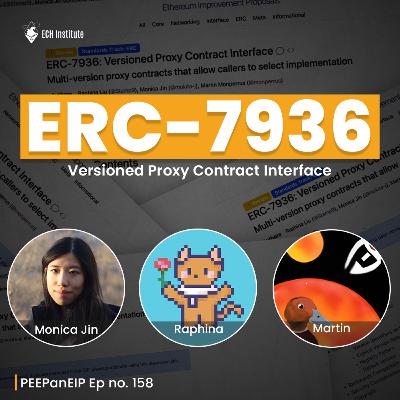
PEEPanEIP – ERC 7936 Episode Overview In this episode of PEEPanEIP, host Pooja Ranjan discusses ERC 7936, a proposal aimed at improving versioning in Ethereum smart contracts. Co-authors Martin Monperrus, Raphina Liu, and Monica Jin explain the challenges of current proxy contracts and how their proposal addresses issues of security, flexibility, and enterprise adoption. They delve into the technical aspects of the implementation, the importance of community engagement, and the future implications of their work in the Ethereum ecosystem. 📄 ERC Reference ERC-7936 Discussion Thread: 🎬 Related Content Presentation: PEEPanEIP Playlist Episodes of EIPs mentioned in this episode: EIP-2535 EIP-1967 EIP-1822 💸 Support ECH Institute Donate Here 👥 Featuring Guest Speakers: Martin Monperrus Monica Jin Raphina Liu ECH Institute Team Host: Pooja Ranjan Coordinator: Vaelyn Podcast Production: Akash 🕒 Chapters 00:00 – Introduction to ERC 7936 11:30 – Understanding Proxy Contracts and Versioning 15:24 – Implementation Challenges and Solutions 19:51 – Security Considerations and Trade-offs 23:50 – Enterprise Adoption and Future Prospects 28:06 – Community Engagement and Call to Action 32:39 – Exploring the Ethereum Ecosystem 33:10 – Concluding Remarks and Future Engagements 🔗 Follow ECH Institute X/Twitter Warpcast Medium Discord #ERC7936 #Ethereum #PEEPanEIP #Proxy
![Execution Layer Meeting 226 [2025-12-18] | ACDE 226](https://s3.castbox.fm/d7/95/d9/54b3ce7f327c47709ed8e07f0e18a93c3f_scaled_v1_400.jpg "Execution Layer Meeting 226 [2025-12-18] | ACDE 226")
Agenda: https://github.com/ethereum/pm/issues/1837

Comments

Download from Google Play

Download from App Store
 United States