


 Claim Ownership
ESchultheiss
Subscribed: 1Played: 7
Subscribe

© All rights reserved
Description
Eric Schultheiss stands at the vanguard of contemporary composition, forging a unique path that bridges the rhythmic drive of global percussion with the infinite possibilities of digital sound. As a composer, percussionist, and educator, Schultheiss is acclaimed for his hybrid electro-acoustic works—pieces that fuse the organic pulse of drums with orchestral richness and the sonic innovation of modern electronics.
Rooted in a Southern California upbringing steeped in progressive rock, classical discipline, and the improvisational freedom of jazz, Schultheiss draws on a vast tapestry of influences. His music channels the off-kilter accents of Stewart Copeland, the lyrical intensity of Neil Peart, the storytelling depth of Peter Gabriel and Sting, and the progressive artistry of Genesis, Dream Theater, and Spock’s Beard. This synthesis results in compositions that are as intellectually rigorous as they are emotionally evocative.
Currently, as Head of Percussion Studies and Electro-Acoustic Composition at the Middle Tennessee Conservatory of Music, Schultheiss is an outspoken advocate for the DAW as a true instrument. In his hands, digital workstations become canvases for sonic experimentation, allowing for real-time orchestration, microscopic precision, and the layering of polyrhythms and timbres that would be impossible with traditional notation alone. He champions technology not as a shortcut, but as an authentic extension of the composer’s voice.
Signature works such as Lights Twinkle—a Christmas percussion-ensemble piece blending Japanese Taiko, harp, and haiku-inspired vocal textures—showcase his ability to unite tradition with innovation. Airidea’s Journal explores the dialogue between structure and freedom through dance-driven percussion and atmospheric synths, while As You Sleep and Terminal Memory reveal Schultheiss’ penchant for ambient soundscapes, introspective melodies, and cross-media collaborations. His compositions have been commissioned for film, dance, and multimedia productions, performed by leading ensembles, and praised for their intricate interplay of rhythm and resonance.
As an educator, Schultheiss is dedicated to shaping musicians who are not only technically skilled but also creatively fluent in both acoustic and digital modalities. At the Middle Tennessee Conservatory, he mentors young composers in hybrid techniques, polyrhythmic structures, and DAW-based workflows, encouraging them to embrace technology as a creative partner. His influence extends beyond the classroom, as he helps students gain visibility in the digital era and equips them to thrive in an evolving musical landscape.
Through his relentless curiosity, innovative spirit, and commitment to artistic growth, Eric Schultheiss is redefining what it means to be a composer in the 21st century. His work is a testament to the power of bridging tradition and technology, and to the limitless frontiers that await those willing to explore them.
47 Episodes
Reverse

Four Seasons by Eric Schultheiss

Four Seasons moves through fear, anger, grief, and hope as four distinct musical worlds within one continuous hybrid instrumental-vocal journey. Extended interludes reshape each emotion into the next, while a recurring doorway image traces the passage from guarded survival to open-hearted release. By the end, the house has not changed—the person inside it has. And morning enters in.

Dealer's Choice by Eric Schultheiss
Cinnamon Stars
A Personal Reflection on Memory, Drums, and Dust
This piece started with a poem. Well—half a poem. The phrase “cinnamon stars” dropped out of my pen one morning and just… stuck. I wasn’t planning on writing music that day, but that phrase opened something—a fissure, a portal, a spice-laced memory chamber—and suddenly, I wasn’t at my desk anymore. I was walking inside the pages of Dune. Not in a literal, fan-art way. More like: emotionally wandering through the book’s residue. Echoes. Dust.
There’s no clear timeline in Cinnamon Stars. No beginning, middle, or crescendo. It’s not that kind of piece. This is closer to remembering something you never lived—an abstract recollection. The sounds came the way desert winds move: nonlinear, patterned only by something ancient and unknowable.
Sound as a Memory Map
The instrumentation came together slowly, but instinctively:
Taiko drums for their elemental weight—like the slow heart of a sandworm or a tribal rite you’re not meant to witness.
PVC pipe drums—hollow and reverberant. They remind me of wind howling through a Fremen sietch, or what bone might sound like if it dreamt.
A modified kalimba, twisted just enough to lose its sweetness. I wanted something that sparkled but wasn’t friendly.
Synths, of course—droning, gliding, breathing. They’re the thread, the mist, the mechanical sand.
There’s no narrative to hold onto here. Just emotions, in layers:
Mystery. Distance. Stillness. Pressure. Curiosity.
I didn’t write this to be followed. I wrote it to be entered.
Sometimes, when I listen back, I slip into a meditative state. Not on purpose. I just fade in, as if some part of me remembers a past I’ve never had. Maybe it's the spice. Maybe it's just the rhythm of forgetting.
A Visual Echo
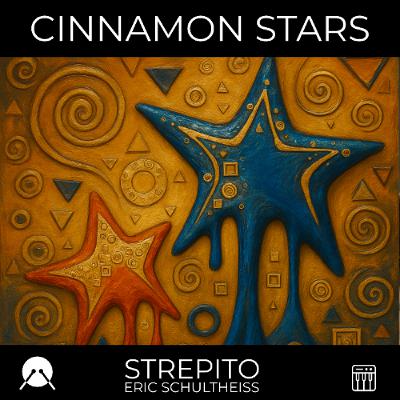
The visual element came later, but it’s integral. I had Sora build a 3D wall-hanging sculpture—somewhere between Klimt’s glimmering mosaics and Dalí’s warped dreaming. Texture is everything. I wanted golds and shadows, sharp edges that curl, things that feel aged but alive. I didn’t want to illustrate the music—I wanted the art to vibrate with it, mirror its emotional logic.
It’s not a moving image in the traditional sense, but there’s movement inside it.
Like dust suspended in light. Like an altar in a dream.
Who Might Hear This?
I imagine this resonating with:
Film producers searching for ambient cinematic atmospheres with edges.
Choreographers who like music that breathes but doesn’t beg for attention.
Percussionists curious about unconventional forms—who know that rhythm doesn’t always mean tempo.
But really, it’s for anyone drawn to sonic meditation. For listeners who appreciate uncertainty, who can sit inside mood without asking it to resolve.
What Sets It Apart?
This isn’t ambient as background. It’s ambient as portal.
What sets this piece apart is the combination of tactile percussion and spacious electronics—that soft tension between grounded and drifting.
It doesn’t offer resolution. It offers reflection.
A sense that maybe… just maybe… you’ve heard this before.
Not in this life. Not on this planet. But somewhere.
“When I listen to this piece, I drop into a meditative state... perhaps it’s spice-influenced?”
—me, to myself, more than once
Acknowledgments
As always, my deepest gratitude to the Strepito group. They turned these weird textures and pulse-ideas into something real, playable, resonant. They understood the emotional logic of the piece before I had words for it.
I didn’t write 4 Minute Bake to say anything profound. I wrote it because I wanted to burn through four minutes with nothing but power, drive, and rhythm. This piece is about being loud, fast, and unapologetically physical. It doesn’t build toward some grand emotional payoff—it is the payoff. Right from the first strike.
The heartbeat of the piece is taiko drums—relentless and chest-pounding. I built around that core using air gamelans, a synth pad for a bit of sustained color, and both bowed and struck gongs to stretch and smash the space in between. It’s what I imagine if Mike Portnoy was dropped into a taiko drum circle and told to go full Dream Theater mode—no restraint, just propulsion.
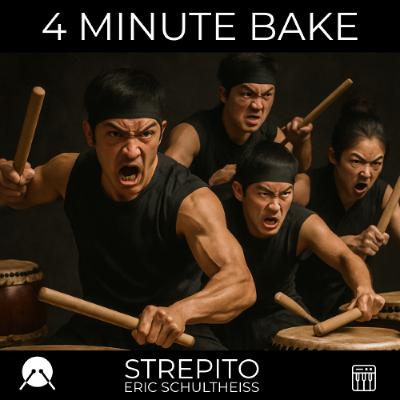
I see it visually as a kind of drum fever dream—a room full of percussionists in reds and browns, all motion, no stillness, everything sweating and shaking with intention. It’s cinematic. It’s experimental. It doesn’t need to explain itself. Just hit play.
This isn’t for everyone—but it’s definitely for:
• Percussion enthusiasts who live for the beat
• Choreographers looking for sound that pushes bodies into action
• Film directors who need something that surges forward like a train with no brakes
Big thanks to the Strepito group for bringing this to life—your energy is all over this recording.
One last thing I try to remember when I write:
Have a focus—and go after it with everything you've got.
This piece is that mindset, turned into sound.

Comments

Download from Google Play

Download from App Store
 United States