


 Claim Ownership
Environmentally Speaking
Subscribed: 6Played: 43
Subscribe

© 2025 Desautel Browning Law
Description
Podcast host Clarice Parsons interviews Kerin Browning and Marisa Desautel, managing partners of Desautel Browning Law. They will leave you cracking up while discussing some serious topics around state / federal environmental law, utility / energy statutory and regulatory compliance, civil litigation, and municipal and regulatory zoning and permitting.
138 Episodes
Reverse

Clarice brings Marisa a hot take from Denmark.
Researchers at Aarhus University are testing whether the open water between offshore wind turbines, which is now treated as a mostly unusable zone, could be used to grow seaweed.
The article describes it as a reuse story. The seaweed could help absorb nutrient pollution (nitrogen and phosphorus, the drivers of harmful algal blooms), and it could be sold as a food crop, such as sugar kelp.
Marisa hears a warning in that framing. Rhode Island and Virginia fishermen were told they could keep fishing between turbines, with about one nautical mile of spacing. So if Denmark treats those areas as unfit for regular vessel traffic, what does that say about the promises made here?
From there the conversation widens:
Is the space between turbines becoming the ocean's version of Route 66, a corridor we're scrambling to find a use for?
Does every leftover space have to become production space, or could rewilding be an option?
Why do we accept cell antennas on rooftops but resist solar panels there, and push energy infrastructure into deserts and open ocean instead?
Marisa's central point: "NIMBY" is only ever used as an insult, and it's now used to shut down legitimate conservation objections. If every objection is written off as NIMBYism, the ocean gets industrialized, and people will eventually ask where the conservationists were.
Mentioned in this episode
Article on the Aarhus University seaweed farming project: [LINK — needed from Clarice]
Contact
Questions or want to keep the conversation going?
Desautel Browning Law: 401-477-0023 | desautelbrowning.com
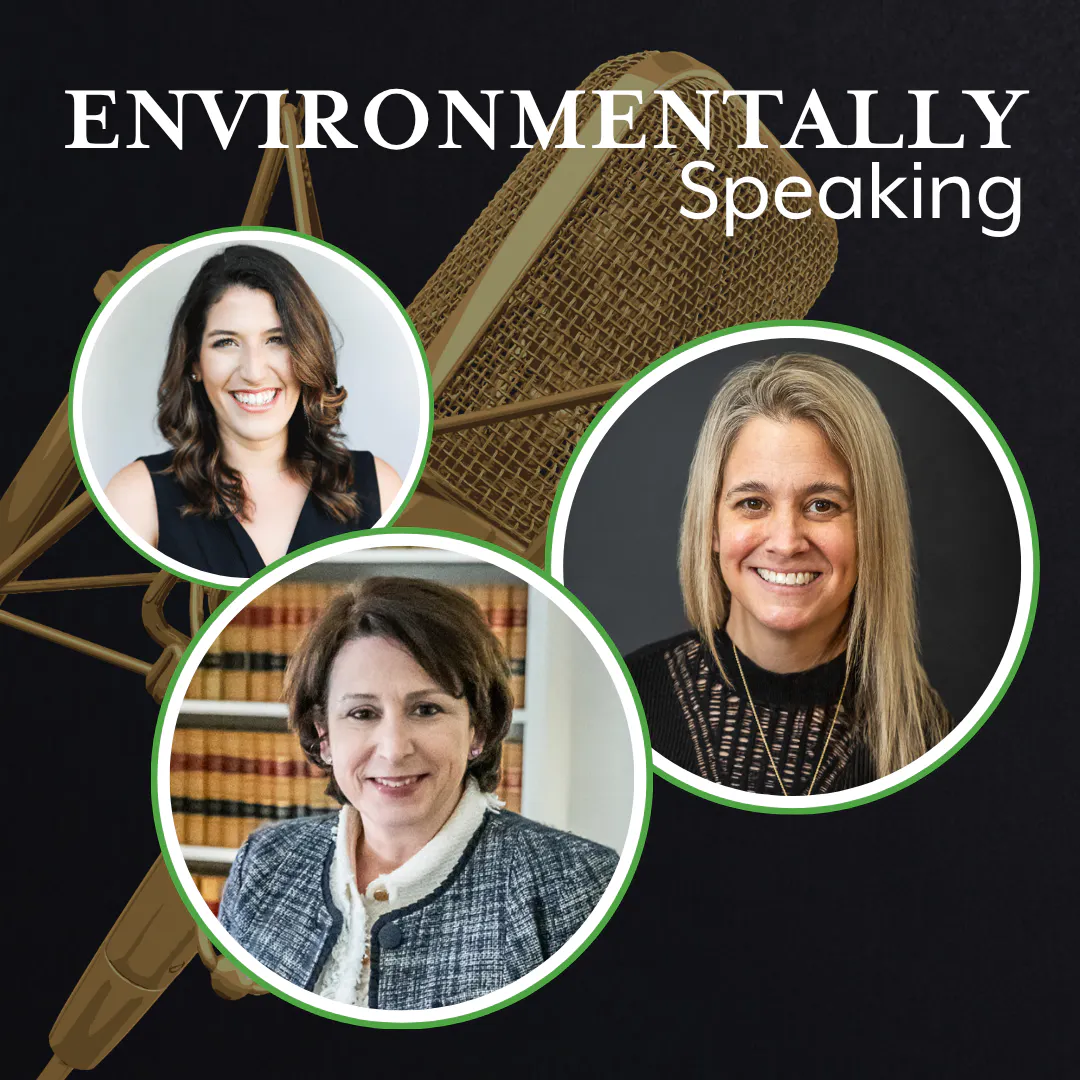
Hosts: Marisa Desautel and Clarice Parsons
What happens when courts stop deferring to agency expertise?
In this episode of Environmentally Speaking, hosts Marisa Desautel and Clarice Parsons unpack the impact of the U.S. Supreme Court’s decision to overturn Chevron deference and what it means for environmental law today. Marisa explains how Chevron shaped administrative law for nearly four decades before being replaced by the Loper Bright standard, while Clarice brings the perspective of a mediator to the discussion, exploring how these legal changes may influence dispute resolution and settlement strategies.
Together, they compare what they’re seeing in federal practice versus state practice, discuss why environmental agencies are facing greater uncertainty, and examine whether the shift away from agency deference will fundamentally change how environmental disputes are resolved.
Clarice also revisits last week’s discussion on mediation confidentiality, sharing insights from a recent conversation with an environmental law mediator about why confidentiality works differently when public agencies are involved.
This is Part 1 of a two-part series on Chevron and administrative law. In the next episode, Marisa and Clarice will discuss the more recent Chevron-related case and its broader implications.
Understanding Chevron deference and why it became a foundational principle of administrative law
How Loper Bright Enterprises v. Raimondo changed judicial review of agency decisions
The role of scientific expertise in environmental regulation
Why federal agencies are experiencing greater legal uncertainty
How Rhode Island and Massachusetts courts have responded so far
The importance of exhausting administrative remedies—and whether that doctrine may evolve
Why more environmental disputes may be resolved through settlement rather than litigation
The growing role of mediation and arbitration in environmental conflicts
Clarifying confidentiality in public-sector environmental mediation
Chevron deference required courts to give weight to reasonable agency interpretations supported by the administrative record.
The Loper Bright decision eliminated that federal standard, placing greater responsibility on judges to interpret agency authority.
Federal environmental litigation has become more uncertain, encouraging earlier settlement discussions.
Many state courts have not yet seen the same practical shift.
The long-term effects on environmental regulation and administrative law are still developing.
Chevron U.S.A., Inc. v. Natural Resources Defense Council
Loper Bright Enterprises v. Raimondo
Have a question or topic suggestion for a future episode? Connect with Desautel Browning through their website or follow the firm on LinkedIn, Instagram, Facebook, and X.

In this episode of Environmentally Speaking, Marisa Desautel and Clarice Parsons explore attorney-client confidentiality and how it applies across the many types of clients encountered in environmental law practice.
Marisa explains the differences between representing individuals, municipalities, state agencies, nonprofits, and other organizations, and discusses a key legal question: when the client is a group, who does the attorney actually represent?
The conversation covers attorney-client privilege, legal ethics, executive sessions, public transparency requirements, municipal boards, and the challenges of balancing confidentiality with accountability in government settings. Marisa also explains when privilege applies, how it can be waived, and why not every conversation with an attorney is automatically protected.
Clarice contributes insights from the mediation world, highlighting similarities between legal confidentiality and mediation agreements, including common exceptions and reporting requirements.
Topics Covered:
Attorney-client confidentiality
Environmental and municipal law
Organizational versus individual clients
Planning boards and zoning boards
State agencies and local government
Executive sessions and open meetings laws
Attorney-client privilege and waiver
Mediation confidentiality
Legal ethics and professional responsibility
Join Marisa and Clarice for an engaging discussion on one of the most important—and often misunderstood—principles in legal practice.

In this episode of Environmentally Speaking, hosts Marisa Desautel and Clarice Parsons unpack one of the most misunderstood aspects of environmental and municipal permitting: site control, property interests, and why some projects fail before they even truly begin.
What started as a social media reel and a “hot take” quickly turned into a deeper conversation about accountability in zoning and permitting.
Marisa explains why permitting delays and denials are not always the fault of municipalities or regulatory agencies — and how applicants often overlook critical foundational requirements before submitting a project.
Using real-world examples from environmental law and Rhode Island permitting processes, the episode explores:
What “site custody and control” actually means
Why property ownership and consent matter in permitting
How easements, rights-of-way, condo associations, and shared property interests can complicate approvals
The role of municipal boards and state agencies like DEM
What happens when objections are filed against an application
Why agencies often require disputes to be resolved in court before moving forward
Clarice brings the perspective of someone outside the legal world, asking the questions many property owners, developers, and applicants may not think to ask until it’s too late. Together, she and Marisa break down the legal concepts in a practical and approachable way.
If you’ve ever wondered why projects stall, why permits get denied, or how zoning and environmental approvals really work behind the scenes, this episode offers an informative look into the process — and the importance of doing your homework before filing an application.
Have a reel or environmental topic you’d like discussed on the podcast? Reach out and let the hosts know what you’d like covered in a future episode.
Hosted by:
Marisa Desautel & Clarice Parsons
Happy Memorial Day weekend, and thanks for listening to Environmentally Speaking!

In this week’s episode of Environmentally Speaking, Marisa and Clarice dive into the unexpected environmental recovery happening in and around the Chernobyl exclusion zone nearly 40 years after the nuclear disaster.
The conversation explores recent research showing that wetlands, peatlands, microbes, and even wildlife are not only returning to the region, but in some cases appear to be thriving despite ongoing radioactive contamination. The hosts discuss the critical role wetlands play as natural filtration systems, carbon sinks, and biodiversity hubs — and why these ecosystems may be central to the area’s long-term recovery.
They also unpack fascinating early-stage studies examining how bacteria and microbiomes within the Chernobyl wetlands may be adapting to, or surviving despite, ionizing radiation exposure. Along the way, the episode touches on ecosystem resilience, nature-based restoration, the cultural fascination surrounding Chernobyl, and the surprising ways the planet continues to adapt in extreme conditions.
Plus: mutant daisies, bog body science, and an important reminder that nature is often far more resilient than we expect.
If you have expertise in microbiology, recombinant DNA, radiation impacts, or ecosystem restoration, the hosts would love to hear from you — and maybe even have you join the podcast for a future episode.

Comments

Download from Google Play

Download from App Store
 United States