


 Claim Ownership
Foojay.io, the Friends Of OpenJDK!
Subscribed: 28Played: 575
Subscribe

© Foojay.io
Description
The podcast of foojay.io, a central resource for the Java community’s daily information needs, a place for friends of OpenJDK, and a community platform for the Java ecosystem — bringing together and helping Java professionals everywhere.
86 Episodes
Reverse
What if work-life balance is a myth, and the real secret is just... life?In this Foojay Podcast we're stepping away from pure code and diving into something equally important: how we live our lives as developers. Because let's be honest, being a great programmer isn't just about mastering Java or the latest framework. It's about managing your career, your health, your family, and finding purpose in all of it.Four incredible guests are all tackling different pieces of this puzzle. First up, Bruno Souza, the Brazilian Java Man, is back to challenge our thinking about work-life balance and share his philosophy on taking control of your career. Then Patricia Lenten talks about the real challenges of hacking parenting while being an engineer, and how we can inspire the next generation of developers. Georgios Diamantopoulos brings the hard data on why sitting is literally killing us and what we can actually do about it. And finally, April Schuppel shares lessons from Apryse's journey through 15 acquisitions in five years—and why people, not AI, are still the most important part of building great products.00:00 Introduction of topic and guests01:20 Bruno Souzahttps://www.linkedin.com/in/brjavaman/Grow your career podcast: https://foojay.io/today/foojay-podcast-72/Bruno's YouTube channel: https://www.youtube.com/@brjavamanWork-life balance doesn't exist, we only have life12:52 Patricia Lenten https://www.linkedin.com/in/patricialenten/Hacking your parentingTechnology is fun18:37 Georgios Diamantopouloshttps://www.linkedin.com/in/georgiosd/Staying HealthyThe importance of getting out of your chairhttps://stateofhealth.tech/22:58 April Schuppelhttps://www.linkedin.com/in/aprilschuppel/Pull, Push, and Merge: Lessons from a Journey of Growth Through AcquisitionsThe people are the most crucial part to build a team, product, and company30:26 Outro
The AI revolution isn't replacing Java developers. No, it's forcing us to think harder.Welcome to another episode of the Foojay Podcast! Today, we're talking about AI and Java, how it's changing the way we work, what we need to watch out for, and why understanding what's really happening matters more than ever.I recorded interviews at Devoxx and JFall and spoke with people who build and use this technology every day.Marianne Hoornenborg opened my eyes to something important: every time an AI generates a token, there's a massive amount of computation happening behind the scenes.Viktor Gamov and Baruch Sadogursky did something really cool: they tested six different AI coding tools live on stage with the same task. The results were all over the place! But they found that the tools with access to good documentation performed much better.Stephen Chin showed me how graph databases can make AI responses more reliable by providing a solid source of truth rather than relying on vector search.Mario Fusco works on LangChain4J, a leading Java framework for AI. He explained that breaking down large tasks into smaller ones and using specialized agents can help reduce errors—hallucinations, as they're called.Jeroen Benckhuijsen and Martijn Dashorst shared their experiences working with enterprise Java. Even as frameworks are becoming lighter and we're running everything in containers, there are still complex problems that require real developer expertise.Maarten Mulders reminds us that AI is a tool, not a replacement—especially when you're solving problems no one has tackled before. You still need to know what you're doing.And finally, Simon Maple from Tessel discussed moving beyond vibe coding towards a more reliable, production-ready approach, using specifications to guide AI tools.00:00 Introduction of topics and guests02:12 Marianne Hoornenborg https://www.linkedin.com/in/mhoornenborg/The Simple Math behind AI The cost of tokens when using LLMs06:54 Viktor Gamov and Baruch Sadogursky https://www.linkedin.com/in/vikgamov/ https://www.linkedin.com/in/jbaruch/ Robocoders, about the many agentic tools that can be used for vibe coding https://context7.com/16:24 Stephen Chin https://www.linkedin.com/in/steveonjava/ Graph versus relational databases Explaining MCP and Agents23:09 Mario Fusco https://www.linkedin.com/in/mario-fusco-3467213/ AI and LangChain4j in Quarkus Coding tools with AI35:43 Jeroen Benckhuijsen https://www.linkedin.com/in/jeroenbenckhuijsen/ Java in business, Evolutions in Java Making use of containers and Kubernetes Learning from the community41:44 Martijn Dashorst https://www.linkedin.com/in/dashorst/ Investigating an OOM-killer in Kubernetes with the help of AI49:37 Maarten Mulders https://www.linkedin.com/in/mthmulders/How AI may impact our jobs How to improve your Maven builds 56:13 Simon Maple https://www.linkedin.com/in/simonmaple/ AI developer tool Tessl Spec-driven vibe coding Secure AI development01:02:12 Conclusion
Episode 85 of the Foojay Podcast. All info, show notes, and links are available at https://foojay.io/today/category/podcast/.What if the future of Java depends on who we invite to learn it today?In this Foojay Podcast, we're diving into something that affects all of us in the Java community: How can we inspire the next generation of developers, and how do we make the developer world more inclusive?You'll hear four incredible guests who are actively working to make tech more accessible and inclusive. First, Daniel De Luca talks about Devoxx for Kids and how they support underprivileged students in IT education. Then Kenny Schwegler shares his insights on how we can actively promote diversity and inclusion in tech. Cassandra Chin, the youngest Java Champion and author, talks about inspiring young coders through hands-on projects and making technology fun. And finally, Igor De Souza discusses his mission to bring Java into Raspberry Pi education and bring more Java into coding clubs worldwide.These conversations share one message: Talent is everywhere, but opportunity isn't. And we have the power to change that!01:19 Daniel De Luca https://www.linkedin.com/in/danieldeluca/ Founder Devoxx4Kids Activities of Devoxx4Kids How to inspire children of all ages to get interested in technology14:24 Kenny Schwegler https://www.linkedin.com/in/kenny-baas/ How to build inclusive, diverse teams How the IT industry became male-focused because of IBM marketing Books: https://www.manning.com/books/collaborative-software-design https://learningsystemsthinking.com/26:07 Cassandra Chin https://www.linkedin.com/in/cassandra-chin-developer/ Inspiring children and parents into technology Fun projects to introduce engineering to children Book: https://www.amazon.nl/Raising-Young-Coders-Teaching-Programming/dp/B0DVBQZ483 20% Discount code on the Springer website "APAUT" https://link.springer.com/book/10.1007/979-8-8688-1393-132:45 Igor De Souza https://www.linkedin.com/in/igfasouza/ Java in code clubs like CoderDojo Java in space Collecting Java tutorials and courses for children Java Catalog on Foojay GitHub https://github.com/foojayio/java-education-catalog Pi4J library https://www.pi4j.com/ HelloWorld magazine: https://downloads.ctfassets.net/oshmmv7kdjgm/6jGvFLH86Ems5AJR84Krsk/3888c571ddc1543c9cdb01ce5eff616d/HelloWorld28.pdf55:27 Conclusions
In this Foojay Podcast, we're exploring a critical topic that's becoming increasingly important in our industry: developing sustainable software that is both performant and environmentally friendly.At the Devoxx and JFall conferences, I had fascinating conversations about how we as Java developers can make a real impact on both our cloud costs and our carbon footprint. And it's interesting to learn how these two goals are often perfectly aligned: what's good for your budget is usually good for the planet too.We start with Daniel Witkowski. He published an article on Foojay that takes us on a deep dive into performance tuning. He explains why optimizing your code can have a thousand times more impact than saving 30% on cloud costs, and walks us through his journey of turning a simple integer validation challenge into a masterclass on Java performance optimization.Next, I caught up with Ko Turk, who shares his passion for sustainable engineering and space exploration. He introduces us to Kepler, a tool for monitoring the energy consumption of your applications, and explains how performance optimization naturally leads to sustainability improvements.Then Ronald Dehuysser, founder of JobRunr, reveals how his open-source job-scheduling library now enables carbon-aware job processing. He explains how JobRunr can automatically schedule non-time-critical jobs to run when renewable energy is most available.And finally, Jan Ouwens joins us to discuss practical strategies for reducing both costs and CO2 emissions in your applications. He explains why cloud spending is actually a good proxy for your carbon footprint.00:00 Introduction of topic and guests02:07 Daniel Witkowskihttps://www.linkedin.com/in/danielwitkowskihttps://foojay.io/today/the-art-of-performance-tuning-why-saving-30-in-the-cloud-means-nothing-if-your-code-wastes-1000x-more/https://foojay.io/today/foojay-podcast-83/Why Saving 30% in the Cloud Means Nothing if Your Code Wastes 1000× MorePerformance tuning is less about syntax and more about craftsmanship.29:46 Ko Turkhttps://www.linkedin.com/in/ko-turk-b271b929/https://github.com/sustainable-computing-io/keplerSustainable engineeringKubernetes Efficient Power Level Exporter (Kepler)32:46 Ronald Dehuysserhttps://www.linkedin.com/in/ronalddehuysser/https://www.jobrunr.io/en/Carbon-aware job processing with JobRunrGrowing from an open-source project to a company37:36 Jan Ouwenshttps://www.linkedin.com/in/janouwens/https://jqno.nl/Reducing the cost and CO2-emissions of your applicationPrivate cloud versus cloud providers45:14 Outro
Welcome to another episode of the Foojay Podcast! Just like in the previous episode, I bring you conversations from two of Europe's premier Java conferences - Devoxx in Belgium and JFall in the Netherlands.At these conferences, I had the opportunity to speak with members of the Java community about topics ranging from the evolution of Java itself to mobile development, performance optimization, and even automotive security.My first guest is Johan Vos, a Java Champion who takes us on a journey through Java's history - from porting Java to Linux in 1995 to his current work on bringing Java and JavaFX to mobile and embedded devices through the Java On Mobile project.Then we'll hear from Stephen Chin, author of "The Definitive Guide to Modern Java Clients with JavaFX," who shares insights on building cross-platform client applications and reflects on how his daughter has followed in his footsteps to become a published author and technology educator.From JFall, Joseph Phillips joins us to discuss Java's evolution, the differences between REST and gRPC, and whether virtual threads have replaced the need for async implementations in modern Java applications.Next, François Martin walks us through the world of Java performance benchmarking with JMH - the Java Microbenchmark Harness - and explains why it's so valuable for comparing different implementations and optimizing code.Wouter De Geus shares his inspiring journey from finance and mathematics into Java development, and how his employer, the Dutch Tax Authority, supports open-source contributions and the Java community.And finally, Roald Nefs demonstrates something truly unique - using Java and the Foreign Function & Memory API to hack into automotive systems, revealing important security considerations for both hardware and software.Content00:00 Introduction of topics and guests02:11 Johan Voshttps://www.linkedin.com/in/johanvos/History of Java on LinuxHow the Java language and runtime are stable and evolving at the same timeLooking at the future of Write-Once-Run-Everywhere with Java(FX) on Mobilehttps://openjdk-mobile.github.io/19:04 Stephen Chinhttps://www.linkedin.com/in/steveonjava/Author of "The Definitive Guide to Modern Java Clients with JavaFX"Cassandra Chin: https://www.linkedin.com/in/cassandra-chin-developer/ Her book: https://www.amazon.nl/Raising-Young-Coders-Teaching-Programming/dp/B0DVBQZ48323:22 Joseph Phillipshttps://foojay.social/deck/@infosec812Java evolutions, communityREST versus gRPCDo we still need async or are virtual threads a better solution?27:49 François Martinhttps://www.linkedin.com/in/fran%C3%A7oismartinJava performance micro benchmarks with jmhhttps://github.com/openjdk/jmh33:30 Wouter De Geushttps://www.linkedin.com/in/wadegeus/Moved from finance to software developmentContributing back to the open-source community39:33 Roald Nefshttps://www.linkedin.com/in/roaldnefs/Hacking cars with the FFM APIHardware and software security concernsWhat you can learn from the Java community46:29 Outro
In this Foojay Podcast, we're diving deep into some of the most exciting developments happening within the OpenJDK and TornadoVM projects.At the Devoxx and JFall conferences, we spoke with several speakers and visitors about some of the major themes that are shaping the future of Java development. The first guest is Moritz Halbritter from the Spring Engineering team. He provides us with more insights into Project Leyden and how it's improving Java startup times through ahead-of-time compilation and profiling. We'll learn how Spring Boot developers can already take advantage of these improvements today.Next, we'll hear from John Cecerralli at Azul about performance optimizations, the evolution from x86 to ARM64 architectures, and how OpenJDK Projects bring improvements to the JVM itself at levels we couldn't achieve before.Then, Balkrishna Rawool will guide us through the world of vector databases and explain how Java's Vector API from Project Panama is perfectly positioned for AI use cases, despite its development beginning years before the current AI boom.And finally, we'll meet some of the team members behind TornadoVM - Christos Kotselidis and Michalis Papadimitriou from the University of Manchester - who will explain to us how Java developers can now harness the power of GPUs for AI workloads, running large language models in pure Java without leaving the Java ecosystem. They also explain the connection between TornadoVM and the OpenJDK Project Babylon.00:00 Introduction of topics and guests01:58 Moritz Halbritter* https://www.linkedin.com/in/moritz-halbritter-9301a1b1/* Project Leyden and how it can already be used with Spring* Difference between the approach of Project Leyden and CRaC11:02 John Cecerralli* https://www.linkedin.com/in/john-ceccarelli-95b7041/* OpenJDK evolutions in Project Leyden* Startup time improvements in Azul Prime* Java performance* ARM Graviton17:08 Balkrishna Rawool* https://www.linkedin.com/in/balkrishnarawool/* Vector API, project Panama22:44 Christos Kotselidis, Michalis Papadimitriou* https://www.linkedin.com/in/michalis-papadimitriou/* https://www.linkedin.com/in/kotselidis/* https://www.tornadovm.org/* https://www.tornadovm.org/gpullama3* https://github.com/beehive-lab/TornadoVM* TornadoVM status update, Java on GPU* How TornadoVM relates to Project Babylon and Project Panama33:42 Outro
Maven 4 is approaching its release, bringing many improvements to the build tool powering millions of Java projects.In this Foojay Podcast episode, we talk about Apache Maven 4, a significant milestone that has been years in the making. Maven has been the backbone of Java dependency management and build automation since the early 2000s; however, the road to version 4 has been a long and deliberate one. With significant performance improvements, a modernized API for plugin developers, and changes that affect how we think about project structure, Maven 4 represents both an evolution and a revolution. What does this mean for the millions of developers who depend on Maven daily? How should teams prepare for the transition? And what's the story behind the Maven Central Repository changes that have been making headlines? To answer these questions and more, we're joined by a few of the many contributors who are actually building Maven 4 and stewarding its ecosystem.Guests Hervé Boutemy https://www.linkedin.com/in/hboutemy/ Guillaume Nodet https://www.linkedin.com/in/guillaumenodet/ Maarten Mulders https://www.linkedin.com/in/mthmulders/ Content00:00 Introduction of the topic and guests04:23 Status of Maven 4 release https://maven.apache.org/whatsnewinmaven4.html https://maven.apache.org/guides/mini/guide-migration-to-mvn4.html 07:57 Why we needed a new Maven version https://maarten.mulders.it/2020/11/whats-new-in-maven-4/ https://maarten.mulders.it/2021/03/introduction-to-maven-toolchains/ https://www.javaadvent.com/2021/12/from-maven-3-to-maven-5.html 12:37 You can already start using Maven 414:35 Some benefits of switching to Maven 418:52 Changes in the pom file, and yes, still XML20:30 Changes for Maven plugin developers and integrators22:24 Changes for Maven users, for instance, the need for Java 1728:34 Maven The Tool versus Maven The Repository34:51 Reasons for the change in authentication for uploads to Maven Central36:01 The one and only Maven Central URL to use https://central.sonatype.com/ 38:04 About the very first "server" hosting the Maven repository40:32 The importance of setting up your own caching repository https://www.sonatype.com/blog/maven-central-and-the-tragedy-of-the-commons https://openssf.org/blog/2025/09/23/open-infrastructure-is-not-free-a-joint-statement-on-sustainable-stewardship/ https://www.youtube.com/watch?v=t74ClffSUW0 44:04 The relationship between POM, BOM, BOM-POM , and SBOM49:43 Gradle versus Maven57:54 How to contribute to Maven or any other open-source project, and how to get the support of your company to do so01:05:23 How to upgrade your projects from Maven 3 to 4 https://maven.apache.org/tools/mvnup.html
This is part 2 of the interviews recorded on September 19th, 2025, at the first AI4Devs Conference (https://amsterdam.ai4devs.io/) in Amsterdam. In Part 1, we explored many AI-related topics as libraries, security, infrastructure, use cases, and more. In this second part, we'll dive into data science, tools for better AI development, Java in the cloud, and get a behind-the-scenes look at how the conference came together. I also asked these guests the same opening question: 'What's your name, and what brings you to this conference?'00:00 Introduction00:43 Eileen Kapel Data Scientist, building an evaluating a model, taking the enduser into account https://www.linkedin.com/in/eileenkapel/ 06:13 Jonathan Ellis and Ryan Svihla Coding with AI with Brokk, AI-native code platform, Java language improvements while keeping stability https://www.linkedin.com/in/jbellis/ https://www.linkedin.com/in/ryan-svihla-096752182/ https://brokk.ai/ https://foojay.io/today/indexing-all-of-wikipedia-on-a-laptop/ 16:24 David Parry Qodo, AI developer tools, empowering engineering teams to standardize code quality and move fast with AI https://www.linkedin.com/in/daviddryparry/ https://www.qodo.ai/ 28:46 Alessandro Stefouli-Vozza Java in the cloud, Impact of our job on the environment and our future, Green Software Foundation, Dutch Cloud Native meetup and conference https://www.linkedin.com/in/alessandrovozza/ https://cloudnative.amsterdam/ https://greensoftware.foundation/ Article by Miro about energy usage: https://foojay.io/today/research-measuring-energy-consumption-in-programming-languages-for-ai-applications/ 35:02 Sushant Shekhar Using Java and AI, Moved from Java to other languages and back, Building your own models versus tweaking https://www.linkedin.com/in/sushant-shekhar-2b43ba17/ 39:09 Arno Koehler Organisator, Ai code experiments versus production use, Schiphol POC, Kotlin versus Java versus Scala, The power of the JVM https://www.linkedin.com/in/arnokoehler/ 45:37 Joost Kaan About organizing the conference, Python and Java driving AI forward https://www.linkedin.com/in/joost-kaan/ 50:45 Coen de Waal, Samantha Burattini, and Luis San Martin Conference sponsor, Use of AI in a banking environment https://www.linkedin.com/in/coen-de-waal/ https://www.linkedin.com/in/samantha-burattini/ 54:51 Nahir Vila Student, How the youth is using AI 57:33 Jonathan Vila AI4Devs Organizer, How the conference started and a lookback at the end of the day, How AI can be used when writing articles https://www.linkedin.com/in/jonathanvila/ 01:05:58 Outro
On September 19th, 2025, the first AI4Devs conference (https://amsterdam.ai4devs.io/) took place in Amsterdam. I grabbed my camera and microphone to talk with speakers and attendees about the revolution in AI-powered coding and application development. In this first part, we'll explore Spring libraries, security, infrastructure and scaling, real-world use cases, event streaming, JetBrains tools, and more...I asked all my guests the same opening question: 'What's your name, and what brings you to this conference?' Let's get started!00:00 Introduction00:44 Christian Tzolov and Josh Long Spring AI, Spring MCP, Spring Security https://www.linkedin.com/in/joshlong/ https://www.linkedin.com/in/tzolov/ 17:07 Brian Vermeer AI and security and the responsibility of the developer https://www.linkedin.com/in/brianvermeer/ 27:57 Camille Nigon and Maarten Vandeperre Quarkus, Scaling AI applications, the cost of using LLMs https://www.linkedin.com/in/camille-nigon/ https://www.linkedin.com/in/maarten-vandeperre/ 36:15 Luca Berton Infrastructure for AI applications https://www.linkedin.com/in/lucaberton/ https://www.youtube.com/@BertonLuca 41:15 Soham Dasgupta Real life AI use cases https://www.linkedin.com/in/dasguptasoham/ https://github.com/marketplace?type=models 48:03 Mary Grygleski Event driven agents to handle complex flows https://www.linkedin.com/in/mary-grygleski/ 55:04 Anton Arhipov Java and Kotlin at JetBrains, Junie AI https://www.linkedin.com/in/antonarhipov/ 01:06:07 Outro
Episode 78 of the Foojay Podcast. All info, show notes, and links are available at https://foojay.io/today/category/podcast/.We're excited to present the first episode of the Foojay Podcast's fifth season, marking the release of OpenJDK 25!For the first time, an OpenJDK release is aligned with the year, and we can welcome release 25 in 2025. As usual in the release podcast, I have my regular guest, Simon Ritter. And in this episode, we are joined by Balkrishna Rawool to talk about all the new features in this new OpenJDK version.Guests Simon Ritter https://www.linkedin.com/in/siritter/ Balkrishna Rawool https://www.linkedin.com/in/balkrishnarawool/Content00:00 Introduction of topic and guests01:21 How important is release 25 and upgrading your runtimes? https://jdk.java.net/25/06:00 Process of releasing a new OpenJDK version and looking forward to version 2608:16 What are JEPs and OpenJDK projects09:20 Project Leyden https://openjdk.org/projects/leyden/ JEP 514: Ahead-of-Time Command-Line Ergonomics https://openjdk.org/jeps/514 JEP 515: Ahead-of-Time Method Profiling https://openjdk.org/jeps/51511:28 Leyden compared to other solutions16:21 Project Valhalla https://openjdk.org/projects/valhalla/17:06 JEP 519: Compact Object Headers https://openjdk.org/jeps/51917:40 JEP 508: Vector API (Tenth Incubator) https://openjdk.org/jeps/50818:58 Why Vector API is taking a long time to get finalized21:04 JEP 502: Stable (Immutable) Values https://openjdk.org/jeps/50223:17 Project Loom https://openjdk.org/projects/loom/23:30 JEP 506: Scoped Values https://openjdk.org/jeps/50624:13 JEP 505: Structured Concurrency (Fifth Preview) https://openjdk.org/jeps/50529:22 How Java evolved over 30 years33:34 Project Amber https://openjdk.org/projects/amber/34:28 JEP 507: Primitive Types in Patterns, instanceof, and switch (Third Preview) https://openjdk.org/jeps/50735:59 JEP 512: Compact Source Files and Instance Main Methods https://openjdk.org/jeps/51237:36 JEP 511: Module Import Declarations https://openjdk.org/jeps/51138:36 JEP 513: Flexible Constructor Bodies https://openjdk.org/jeps/51339:12 What's next in Project Amber43:25 What you can learn from JEPs, OpenJDK projects, and mailing lists44:21 JEP 521: Generational Shenandoah https://openjdk.org/jeps/521 Trash Talk by Gerrit Grunwald https://www.youtube.com/watch?v=xlwDe-hlSdI48:16 JEP 510: Key Derivation Function API https://openjdk.org/jeps/51049:30 JEP 470: PEM Encodings of Cryptographic Objects (Preview) https://openjdk.org/jeps/47051:28 About Java Flight Recorder52:27 JEP 509: JFR CPU-Time Profiling (Experimental) https://openjdk.org/jeps/50952:44 JEP 518: JFR Cooperative Sampling https://openjdk.org/jeps/51853:15 JEP 520: JFR Method Timing & Tracing https://openjdk.org/jeps/52053:38 More about JFR and comparing with GC logs57:04 JEP 503: Remove the 32-bit x86 Port https://openjdk.org/jeps/50358:54 Looking forward to the following versions01:00:58 Conclusion
This is the first Foojay podcast in Spanish. It's also the shortest one and the final of season 4 ;-) Jonathan Vila "highjacked" the microphone from Geertjan Wielenga (See episode 76, https://foojay.io/today/foojay-podcast-76-devbcn-report-part-1-learn-from-the-community/) during the DevBcn conference in Barcelona and interviewed a few of the participants for this first Spanish-only edition of the podcast.Stay tuned and subscribe to the podcast in your favorite app or on YouTube. We're taking a short break and will be back in September with the launch of Java 25!00:00 Introduction00:39 Marlene Maldonado, DevBcn Organization https://www.linkedin.com/in/marlene-maldonado-de-s%C3%A1 02:10 Barbara Teruggi, Speaker, Threat Modelling https://www.linkedin.com/in/barbara-teruggi/ 05:04 Santiago Rincon, CFP Member and Attendee https://www.linkedin.com/in/santiago-rincon-martinez 07:56 Marlene Maldonado, Vicente Soriano, Volunteers https://www.linkedin.com/in/visomar https://www.linkedin.com/in/marlene-maldonado-de-s%C3%A1 10:25 Alvaro Navarro, Speaker, API Design https://www.linkedin.com/in/anavarro 12:37 Vicente Cabanes, Sponsor, Grupo Castilla https://www.linkedin.com/in/vicente-cabanes/
In early July, the DevBcn conference in Barcelona featured a diverse lineup of speakers, covering topics across multiple technology domains. Geertjan Wielenga took the camera and microphone with him to Spain. Together with Nacho Cougil and Jonathan Vila, two of the organizers, he spoke with many visitors about what they like most in Java, how AI influences their work, and what is important to them in the work they do.We have more than 20 people who are passionate about the Java community and are eager to share their knowledge with you. 00:00 Introduction00:45 Nacho Cougil and Jakub Marchwicki talk about the history of the DevBcn conference. https://www.linkedin.com/in/icougil https://www.linkedin.com/in/kubamarchwicki 02:45 Bert Jan Schrijver is excited about the people in the Java community. https://www.linkedin.com/in/bjschrijver/ 03:06 Ricardo Romero Benítez has a Spanish YouTube challenge about Java and is surprised by the experience of junior developers. https://www.linkedin.com/in/ricardo-romero-ben%C3%ADtez-b4a4048a/ https://www.youtube.com/@programando_en_java 05:43 Christoph Neumann discusses closure and a database created using it. https://www.linkedin.com/in/christoph-neumann-6089438/ 08:03 Victor Rentea gives Java workshops about architecture, performance, maintainable code, etc. https://www.linkedin.com/in/victor-rentea-trainer/ 09:46 Justin Reock measures developer productivity and talks about improving the development experience. https://www.linkedin.com/in/justinreock 17:44 Will Fleury accelerates coding by integrating AI in IDEs and compares different solutions. https://www.linkedin.com/in/willfleury 23:38 Kamesh Sampath handles big amounts of data for AI and other processing. https://www.linkedin.com/in/kameshsampath 26:19 Cedric Clyburn shares his experience with Linux and Kubernetes and is fascinated by open-source AI. https://www.linkedin.com/in/cedricclyburn 28:33 Brian Vermeer helps to make Java applications and AI tools secure. https://www.linkedin.com/in/brianvermeer 31:53 Andrey Sitnik promotes local-first privacy versus the user-data-selling approach. https://www.linkedin.com/in/sinik 35:59 Isabel Garrido Cardenas about cognitive load when working with a lot of microservices and the right way of testing with AI. https://www.linkedin.com/in/isabelgarridocardenas 38:59 Isabella Sohlman is a student, joining the conference to learn how she can grow her career and to meet people from the Java community. https://www.linkedin.com/in/isabellasohlman 40:13 Ruben Cordeiro shares his experience with volunteering at the conference and what he learned from the talks. https://www.linkedin.com/in/rubencordeiro 42:36 Horacio Gonzalez about simple to use cloud services by developers for developers. https://www.linkedin.com/in/horaciogonzalez 44:46 Jonatan Sempere about communication and network APIs to prevent fraud for banking. https://www.linkedin.com/in/jsempere95 47:36 Luis Majano and Cris Escobar talk about BoxLang, a new dynamic JVM language. https://www.linkedin.com/in/lmajano https://www.linkedin.com/in/cristobalescobarh https://www.boxlang.io 59:42 Miguel Xoel García Balsa about observability and the difference with monitoring. https://www.linkedin.com/in/miguelxoel 01:03:32 Silvia Bellmunt shares her experience with the Java community, the DevBcn conference, and data science. https://www.linkedin.com/in/silvia-bellmunt-36220aa3 01:06:15 Rijo Sam talks about framework- agnostic development, using plain Java as much as possible. https://www.linkedin.com/in/rijosam19 01:09:37 Nacho Cougil and Jonathan Vila invite you to the DevBcn conference next year. https://www.linkedin.com/in/icougil https://www.linkedin.com/in/jonathanvila 01:11:33 Outro
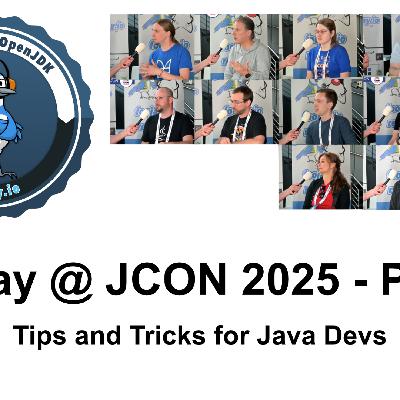
This is the final part of the JCON 2025 interviews with a lot of tips and tricks!In the three previous podcasts, we featured interviews from the JCON conference on "Being a better Java developer," "Evolutions in Java," and "How to use AI with Java." However, we talked to many more people during the conference, so this podcast focuses on tips and tricks. Let's learn from the many other experienced visitors of JCON.00:00 Introduction00:34 Merlin Bögershausen - OpenRewrite and Azul Intelligence Cloud https://www.linkedin.com/in/merlin-boegershausen 07:08 Eberhard Wolff - Measure developer productivity https://www.linkedin.com/in/eberhardwolff 12:28 Annelore Egger - Dealing with bad code, it's not your fault https://www.linkedin.com/in/anneloredev 15:21 Michael Vitz - Unexpected things you can do with Java https://www.linkedin.com/in/michaelvitz 18:40 Michael Simons - Neo4J database models https://www.linkedin.com/in/michael-simons-196712139 https://motherduck.com/duckdb-book-brief 23:13 Stefan Böhringer - Building a project for education from scratch with Quarkus https://www.linkedin.com/in/datenschauer 28:14 Johannes Rabauer - Learned from earlier projects https://www.linkedin.com/in/johannes-rabauer 30:33 Roland Weisleder - ArchUnit, testing architecture with unit tests https://www.linkedin.com/in/roland-weisleder 34:26 Simon Martinelli - htmx, full stack, Vaadin, JOOQ https://www.linkedin.com/in/simonmartinelli 37:02 Loïc Magnette - Web development, Angular, React, Java community versus others https://www.linkedin.com/in/lomagnette 40:41 Tanja Obradovic - Eclipse Foundation, JakartaEE https://www.linkedin.com/in/tanja-obradovic-095604 49:19 Syed Usman Ahmad - Grafana, Prometheus, monitoring tools, OpenTelemetry https://www.linkedin.com/in/usmanlinux 55:38 François Martin - Tools, chaos testing, Toxyproxy https://www.linkedin.com/in/fran%C3%A7oismartin 01:01:31 Conclusion
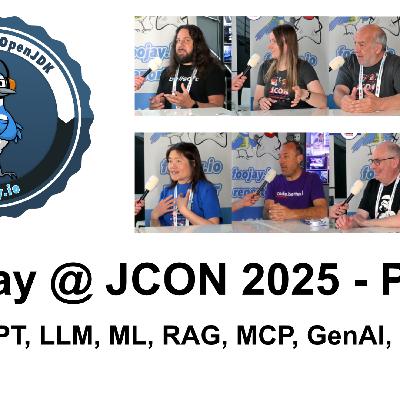
Let's have an AI Bingo and talk about ChatGPT, LLM, ML, RAG, MCP, GenAI, and more!This is part 3 of the interviews recorded at the JCON conference in May. In the previous parts, you learned more about how to be a better Java developer and how Java has evolved and continues to evolve. Of course, Artificial Intelligence and large language models were hot topics at the conference.This episode collects all the interviews on the AI topic. You will learn more about the different technologies we can use in our Java projects. We also checked with our guests to see how they compare Java to Python for AI-related development.00:00 Introduction00:46 Pasha Finkelshteyn - RAG, MCP https://www.linkedin.com/in/asm0dey 06:17 Simone de Gijt - LLM https://www.linkedin.com/in/simonedegijt 12:30 Steve Poole - AI challenges and dangers https://www.linkedin.com/in/noregressions 18:01 Sandra Ahlgrimm - LangChain4J and Microsoft tools https://www.linkedin.com/in/sandraahlgrimm 21:06 Mary Grygleski - Spring AI, Langchain4J, Quarkus https://www.linkedin.com/in/mary-grygleski 30:25 Jonathan Vila - Sonar, Infrastructure As Code, AI dangers https://www.linkedin.com/in/jonathanvila 35:56 Simon Martinelli - Influence of chat interfaces on UI development + MCP explanation https://www.linkedin.com/in/simonmartinelli 42:13 Emily Jiang - LLM https://www.linkedin.com/in/emilyfhjiang 49:59 Conclusion
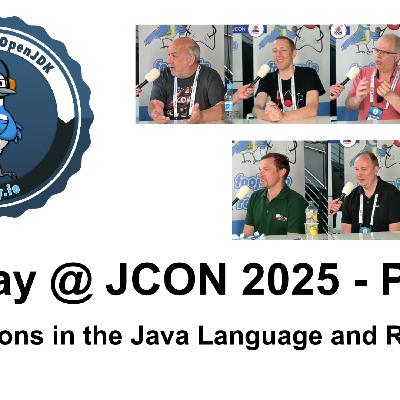
In the second part of our JCON interviews, recorded at the conference in May, we focuses on general evolutions within the Java world and how they influence how we write code and develop applications. We take a look back at the history of Java, discuss new features in the latest release, how Java evolves with OpenJDK projects and JEPS, how Java is used in education, and much more...00:00 Introduction00:19 Steve Poole – Java APIs in a modern way, History of Java https://www.linkedin.com/in/noregressions 06:42 Hanno Embregts - Java 24, Java in education https://www.linkedin.com/in/hannotify/ 12:20 Karl Heinz Marbaise - Stream gatherers, Java evolutions, JEPs, Java stability https://www.linkedin.com/in/khmarbaise/ 26:19 Cay Horstmann - Project Valhalla, Project Loom, JEPs, OpenJDK projects https://www.linkedin.com/in/cay-horstmann-659a4b/ 34:20 Miro Wengner - Java modules, Robo4J https://www.linkedin.com/in/mwengner/ 37:52 Dmitry Chuyko – Improve startup and performance of Java applications in containers https://www.linkedin.com/in/dchuyko/ 42:26 Jens Knipper - Receiving emails with Java, Java improvements over time, writing on Foojay https://www.linkedin.com/in/jens-knipper-87b4a717b/ https://foojay.io/today/receiving-mails-in-java-with-imap-or-pop3/ 46:55 Conclusion
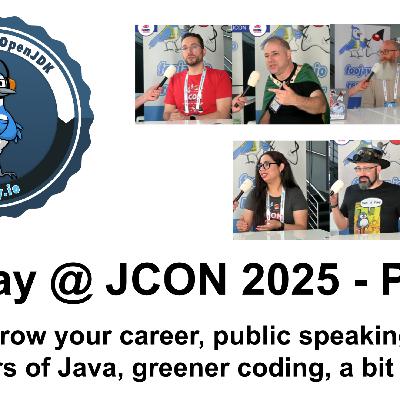
On May 13th and 14th, Foojay attended the JCON conference in Köln, Germany, where we did over 30 live-stream interviews. In this episode, we present to you the first set of these interviews, in which we focus on celebrating 30 years of Java, how you can grow your career, become a public speaker and writer, make your code more green, a bit of AI (of course...), and how the connections between open-source contributors can be visualized.00:00 Introduction00:37 Richard Fichtner: About JCON https://www.linkedin.com/in/richardfichtner/ https://jcon.one/ 03:27 Bruno Souza: Building your career https://www.linkedin.com/in/brjavaman/ https://careermasterplan.dev 17:09 Markus Westergren: Mentoring and growing to become a senior engineer https://www.linkedin.com/in/markuswestergren/ 21:56 Brian Vermeer: Public speaking, NLJUG, the importance of writing https://www.linkedin.com/in/brianvermeer/ 30:08 Aicha Laafia: Green coding https://www.linkedin.com/in/aicha-laafia-0266a6126/ 36:33 Baruch Sadogursky: History of Java, job changes because of AI https://www.linkedin.com/in/jbaruch/ 44:40 Dmitry Yanter: Connections in open-source projects https://www.linkedin.com/in/dmitry-yanter/ 53:43 Conclusion

We are celebrating Java's 30th anniversary this May!This is a very special anniversary episode of the Foojay Podcast! As we approach May 23rd, marking exactly 30 years since Java's first beta release in 1995, we're honored to present our first-ever single-guest format. But we have a very special guest for you: James Gosling, the creator of Java! Join us for this exclusive conversation as we explore Java's beginnings, its revolutionary impact on the programming world, its continuous evolution over three decades, and James's insights on where the language is heading. From that groundbreaking beta release over "Write Once, Run Anywhere" to powering billions of devices worldwide, this is the story of Java, told by the man who started it all, the father of Java.Content00:00 Introduction01:06 How did it start 35 years ago?06:21 Java evolved from device controllers to server applications10:30 How does it feel that so many people use Java?12:12 Looking back at the Y2K problem and how it triggered more Java adoption14:58 Does James regret any decisions in Java?18:44 Comparing early-day Java development versus now20:55 About the stability of Java24:14 JavaFX is one of James' favorites of all time25:20 Frustrations about Android and iOS versus Java Phones28:16 How "Write Once, Run Anywhere" was needed for Sun29:23 Windows versus macOS versus Linux for laptops31:32 The very first Java web service in 1994 turned into a dark story33:17 Java in Docker and startup challenges36:59 Garbage Collectors are amazing in many ways39:18 Java-haters didn't use recent versions of Java ...41:51 How Java became much more performant but lost embedded43:08 Developers must be aware of which and how many libraries they use47:40 James loves Kotlin, Scala, and Closure49:42 Ethical responsibility for developers in a challenging job market54:16 AI influence on jobs01:00:20 Advice for junior developers01:02:27 A few of the most remarkable moments in Java history01:07:52 Why James is not a benevolent dictator for life01:09:17 How Java will keep evolving01:12:55 How much is James still involved in Java?01:13:54 Conclusion
On April 25, 2020, Geertjan Wielenga published the first Foojay post. Yes, we are celebrating 5 years since the Friends Of OpenJDK website launch! Today, more than 1,600 posts are on the site, written by over 250 authors. And there is much more to discover within the Foojay world...In this podcast, we look at how Foojay started with founder Geertjan Wielenga. We'll also hear from Gerrit Grunwald about how Foojay's Disco API has become part of your daily work without you realizing it. We also have several of our regular authors and podcast guests who share how Foojay has influenced them (and vice versa).Thank you all for being part of the Foojay community, whether as a listener of this podcast, a visitor to the website, a user of the Disco API, or through any other touchpoint!00:00 Introduction00:58 Grace Jansen https://foojay.io/today/author/grace-jansen 02:44 Geertjan Wielenga about the start and evolution of Foojay https://foojay.io/today/author/geertjan-wielenga/ Foojay on Mastodon: https://foojay.io/today/foojay-mastodon-service-here-it-is/ Java Quick Start Course on Foojay: https://foojay.io/java-quick-start/ JDoodle on Foojay: https://foojay.io/today/integrate-executable-java-code-in-your-blog-posts-part-2-how-to-use-dependencies/ Foojay Slack: https://foojay.io/today/join-slack-com-t-foojay-signup/ Contribute to Foojay: https://foojay.io/today/how-to-submit-your-next-article-on-foojay-io/ 12:24 Richard Fichtner https://foojay.io/today/author/r-fichtner Free JCon tickets: https://pretix.eu/impuls/europe2025/redeem?voucher=FOOJAY-COMMUNITY 13:19 Mary Grygleski https://foojay.io/today/author/mgrygles 15:01 Shai Almog https://foojay.io/today/author/shai-almog 16:59 Gerrit Grunwald about the Disco API https://foojay.io/today/author/gerrit-grunwald/ Disco API Blog: https://foojay.io/today/disco-api-helping-you-to-find-any-openjdk-distribution/ Disco API Swagger UI: https://api.foojay.io/swagger-ui 24:38 Simon Ritter https://foojay.io/today/author/simonritter 25:10 Marit van Dijk https://foojay.io/today/author/marit-van-dijk 25:47 Hanno Embregts https://foojay.io/today/author/hanno-embregts 26:42 Bazlur Rahman https://foojay.io/today/author/bazlur-rahman 29:10 Artur Skowroński JVM weekly: https://www.linkedin.com/newsletters/jvm-weekly-7097859802881540096 30:22 Conclusion and looking forward to 30 years of Java with James Gosling

On April 3rd, the first VoxxedDays event in Amsterdam took place. VoxxedDays are tech events organized by local community groups, with support from the Devoxx team. Geertjan Wielenga brought along a camera and microphone and spoke with many of the attendees.This is the first Foojay podcast ever to feature more than 20 guests! Geertjan asked the same two questions to many of conference visitors: “Tell us who you are and what excites you about the technology landscape?” and “What are two tips or insights you’d like to share?”As you might expect, there's a lot of talk about AI and machine learning, but you’ll also hear about new Java features, profiling, open source, security, code reviews, and much more!00:00 Introduction00:33 Ko Turk: VoxxedDays organizationhttps://www.linkedin.com/in/ko-turk-b271b929/ 01:34 Stephan Janssen: F ounder of Devoxx and VoxxedDayshttps://www.linkedin.com/in/stephanjanssen/ 05:27 Lutske de Leeuw: Important new features in Javahttps://www.linkedin.com/in/lutske/ 06:25 Johannes Bechberger: Profiling and instrumentationhttps://www.linkedin.com/in/johannes-bechberger/ 07:03 Christian Tzolov: Spring AI and MCPhttps://www.linkedin.com/in/tzolov/ 09:01 Tom Cools: AI, machine learning, mathematical optimization, and all the opportunities in this field.https://www.linkedin.com/in/tom-cools-17547548/ 11:30 Eric-Wubbo Lameijer: Automated code analysishttps://www.linkedin.com/in/eric-wubbo-lameijer-64303013/ 13:02 Abraham van de Vyver: GenAI, impact on job and opensource projectshttps://www.linkedin.com/in/a5r/ 15:01 Soham Dasgupta: Combining cloud native applications with AI, GenAIhttps://www.linkedin.com/in/dasguptasoham/ 17:05 Josh Long: AI and its impact, MCP, role of junior developershttps://www.linkedin.com/in/joshlong/ 21:33 Susanne Pieterse: RAG and AI, vector search, VoxxedDays community reviewerhttps://www.linkedin.com/in/susannepieterse/ 23:22 Brian Vermeer: Security on using LLMs and what can possibly go wrong?https://www.linkedin.com/in/brianvermeer/ 24:47 Anton de Ruiter: Migrating the Dutch tax system to microservices and containershttps://www.linkedin.com/in/antonderuiter/ 25:32 Rafael de Lio: Redis, real-time databaseshttps://www.linkedin.com/in/raphaeldelio/ 27:55 Jonathan Stronkhorst: Spring AIhttps://www.linkedin.com/in/jonathan-stronkhorst/ 28:29 Jos Roseboom: Encapsulation with Spring Modulithhttps://www.linkedin.com/in/jos-roseboom-75508b11/ 29:18 Soroosh Khodami: Software supply chain securityhttps://www.linkedin.com/in/sorooshkhodami/ 30:33 Artem Makarov: Applied AI, real use cases after the hypehttps://www.linkedin.com/in/artemy/ 31:46 Kaya Weers: Learning thanks to the communityhttps://www.linkedin.com/in/kayaweers/ 35:27 Eddy Vos: Devoxx4Kids Foundation, volunteers learning children to codehttps://www.linkedin.com/in/eddyvos/ 38:00 Paco van Beckhoven: Improving the code review and pull request process with errorprone and openrewritehttps://www.linkedin.com/in/pacovanbeckhoven/ 39:30 Hanno Embregts: Using AI and GenAI in a good wayhttps://www.linkedin.com/in/hannotify/ 41:14 Martijn van Iersel: Learning through gamification, internationalization of code, unicodehttps://www.linkedin.com/in/martijn-van-iersel-2314464/ 43:54 Charl Fasching: Impact of AI on Dev and DevOpshttps://www.linkedin.com/in/charl-fasching-77843288/ 47:43 Joris Kuipers: Experimenting with AI to integrate in applications, learning at conferenceshttps://www.linkedin.com/in/jkuipers/ 48:48 Conclusion
We serve you a podcast about the new Java version every six months.Our regular guest, Simon Ritter, Deputy CTO of Azul, is known on social media as "speakjava." He is part of the OpenJDK vulnerability group, JCP executive committee, and expert group for the Java SE specification request so that he can share a lot of inside information with us. In this episode, we are joined by Hanno Embregts, a Java Developer by day and musician by night. He publishes a post on Foojay with all the details of every new Java release and prepared a long description of all the new features included in Java 24. Let's see what this new release brings us...Guests Simon Ritter https://www.linkedin.com/in/siritter/ https://bsky.app/profile/speakjava.bsky.social Hanno Embregts https://www.linkedin.com/in/hannotify/ https://bsky.app/profile/hanno.codes Content00:00 Introduction of the topic and guests00:58 Why 24 JEPs in release 24?02:16 Overview of the changes in Java 2403:37 The changes in Hotspot and GC JEP 404: Generational Shenandoah (Experimental) https://openjdk.org/jeps/404 JEP 450: Compact Object Headers (Experimental) https://openjdk.org/jeps/450 JEP 475: Late Barrier Expansion for G1 https://openjdk.org/jeps/475 04:46 JEP 483: Ahead-of-Time Class Loading & Linking https://openjdk.org/jeps/483 07:30 JEP 491: Synchronize Virtual Threads without Pinning https://openjdk.org/jeps/491 10:27 Security JEPs and Quantum resistance JEP 478: Key Derivation Function API (Preview) https://openjdk.org/jeps/478 JEP 496: Quantum-Resistant Module-Lattice-Based Key Encapsulation Mechanism https://openjdk.org/jeps/496 JEP 497: Quantum-Resistant Module-Lattice-Based Digital Signature Algorithm https://openjdk.org/jeps/497 13:00 Tools JEP 493: Linking Run-Time Images without JMODs https://openjdk.org/jeps/493 16:47 Repreviews and finalizations JEP 489: Vector API (Ninth Incubator) https://openjdk.org/jeps/489 18:27 JEP 484: Class-File API https://openjdk.org/jeps/484 19:13 JEP 485: Stream Gatherers https://openjdk.org/jeps/485 21:22 JEP 487: Scoped Values (Fourth Preview) https://openjdk.org/jeps/487 22:15 JEP 488: Primitive Types in Patterns, instanceof, and switch (Second Preview) https://openjdk.org/jeps/488 22:30 How JEPs get finalized and included23:44 JEP 492: Flexible Constructor Bodies (Third Preview) https://openjdk.org/jeps/492 24:09 JEP 494: Module Import Declarations (Second Preview) https://openjdk.org/jeps/494 25:07 JEP 495: Simple Source Files and Instance Main Methods (Fourth Preview) https://openjdk.org/jeps/495 29:24 JEP 499: Structured Concurrency (Fourth Preview) https://openjdk.org/jeps/499 34:04 Deprecations & Restrictions34:46 JEP 472: Prepare to Restrict the Use of JNI https://openjdk.org/jeps/472 37:15 JEP 486: Permanently Disable the Security Manager https://openjdk.org/jeps/486 38:53 JEP 490: ZGC: Remove the Non-Generational Mode https://openjdk.org/jeps/490 Trash Talk - Exploring the JVM memory management by Gerrit Grunwald https://www.youtube.com/watch?v=Jh79ojcror0 42:09 JEP 498: Warn upon Use of Memory-Access Methods in sun.misc.Unsafe https://openjdk.org/jeps/498 45:43 Removal of 32-bit support JEP 479: Remove the Windows 32-bit x86 Port https://openjdk.org/jeps/479 JEP 501: Deprecate the 32-bit x86 Port for Removal https://openjdk.org/jeps/501 47:37 Should we use Java 24 in production?51:09 Looking forward to the next LTS in September54:14 Conclusion

Comments

Download from Google Play

Download from App Store
 United States