


 Claim Ownership
Foojay.io | Friends of OpenJDK and Java Programming
Subscribed: 31Played: 820
Subscribe

© Foojay.io | Java and Programming Community
Description
Foojay.io is your go-to programming community podcast, connecting developers with the latest in Java, OpenJDK, JVM, and open source tools. We bring together Java professionals worldwide to share insights, tools, and news in the vibrant Java programming ecosystem.
105 Episodes
Reverse

Are we still writing code, or are we mostly reviewing it? For many developers the answer changed within a year: the editor is no longer the center of the universe, the chat or the agent session is.At the JFall conference in the Netherlands, four developers told me how AI changes their way of working. In this episode I play those interviews and discuss them with Anton Arhipov, Developer Advocate at JetBrains and my guest in episode 91 about 25 years of IntelliJ IDEA.Topics include:Why code quality and structure still matter when an agent writes the code, and how the compiler, static analysis and ArchUnit act as guardrailsWhen ugly, tested, throwaway code is fine and when it is notHow fast an AI proof of concept can go to production, and why curiosity about what is under the hood still mattersWhere the next senior developers come from if juniors get less of the work that makes you oneThe cost of AI for society, your wallet and the planet, and whether local models are the answerWhy one or two focused AI sessions beat ten in parallel, and how asking the AI to explain its changes keeps you learningWhere IDEs and developer workflows may be headingGuests:Anton Arhipov, Developer Advocate at JetBrains - Anton on LinkedInAdam Bien, independent consultant - AI RailsMaaike van Putten, co-founder of Java District - Maaike on LinkedInSayf Jawad, Stichting Duurzaam AI - Sayf on LinkedInStéphane Philippart, Developer Advocate at OVHcloud - Stéphane on LinkedInLinks:Full show notes with all linksFoojay Podcast #91: 25 Years of IntelliJ IDEAStichting Duurzaam AIPassion Project ContestTimestamps:00:00 Introduction of the topic and main guest00:54 What has changed most in workflows because of AI03:04 The current "relationship" with code04:45 Interview with Adam Bien10:34 The importance of code quality and setting the guardrails19:15 Interview with Maaike van Putten26:04 How fast can we go from an AI Proof-of-concept to production29:40 How to still start as a junior and continue to become a senior31:10 Interview with Sayf Jawad37:00 AI and sustainability39:07 Use of AI tools will become more expensive. Or should we all use local models?45:12 Interview with Stephane Philippart49:05 How to use parallel AI sessions in a good way51:22 Ask the AI to explain changes or other parts of the code to learn more53:48 Career advice in AI times56:10 Tips to get started with AI and how to (not) use it58:13 Trying to predict the AI and IDE future...01:04:38 Conclusions
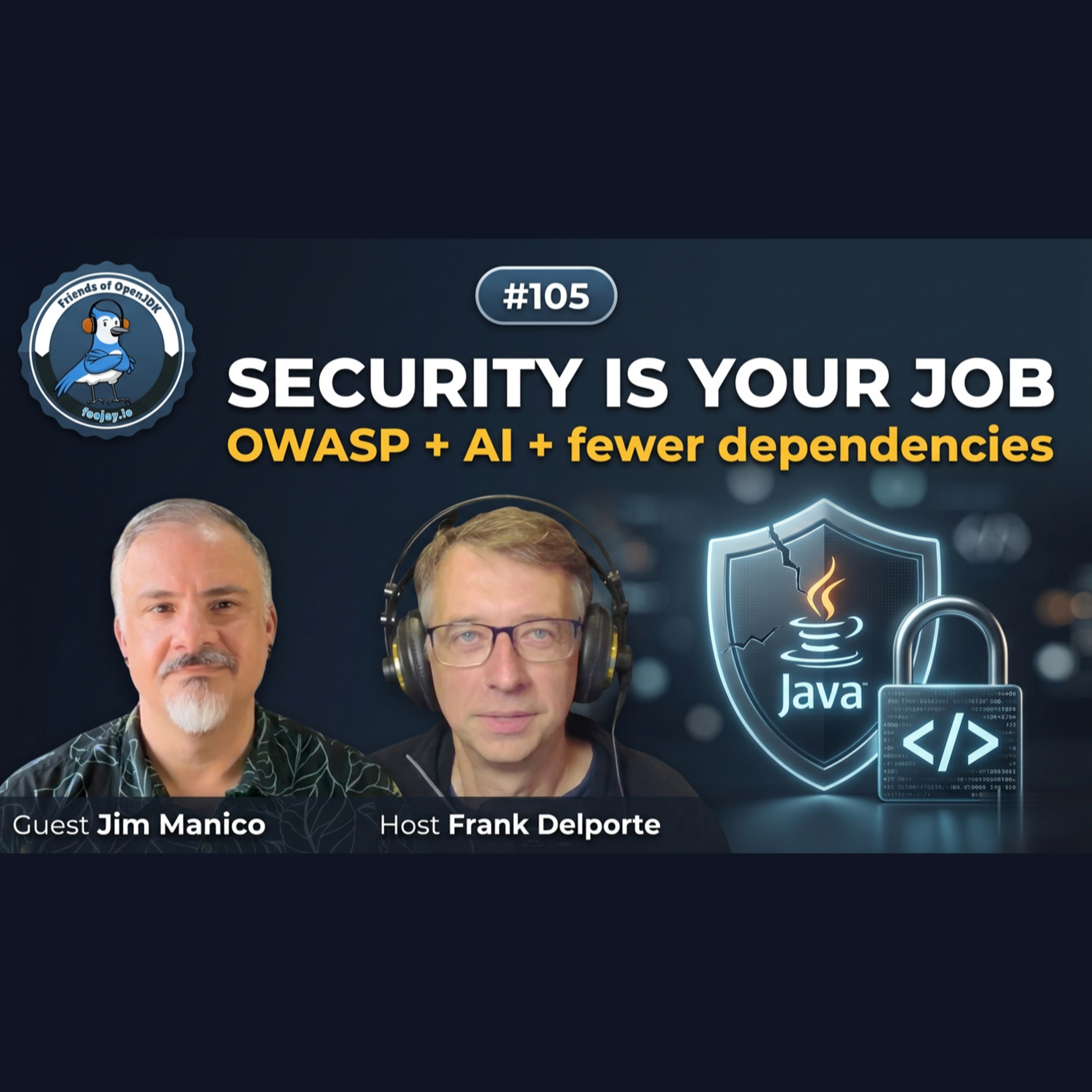
How safe is your Java application, and how safe are the dependencies it ships with? If you build software that handles sensitive data and you have no security process, OWASP's Jim Manico has a blunt word for it: negligent.In this episode, Jim Manico, founder of Manicode Security, Java Champion and OWASP project leader, explains what OWASP is and which of its projects matter to Java developers. He brought the OWASP Java Encoder, Java HTML Sanitizer and JSON Sanitizer back to life with AI-assisted workflows, and tells us what he learned along the way.Topics include:When to use the OWASP Java Encoder versus the Java HTML SanitizerWhy untrusted input must be checked on both the client and the serverHow a few kilobytes of nested CSS can cause a denial-of-serviceWhy chained small vulnerabilities become a major one in the age of AIWhy Jim wants far fewer third-party libraries, and how to keep the rest up to dateWhat to do first when your team has no security processGuest: Jim ManicoFounder of Manicode Security, Java Champion and OWASP project leaderJim on LinkedInLinks:Full show notes with all linksOWASP Java Security Libraries: Please UpdateOWASP Java EncoderOWASP Java HTML Sanitizertrim-reaper on GitHubTimestamps:00:00 Introduction of topic and guest02:11 What is OWASP?04:10 How AI influences the speed of OWASP changes. Who contributes.06:30 Which OWASP projects you should know as a Java developer07:30 How Jim uses AI to evolve his libraries08:28 When to use OWASP Java Encoder and OWASP Java HTML Sanitizer13:58 User input needs to be checked in all steps (UI and backend)16:07 Man-in-the-middle attacks (eMuhdra)17:17 How to keep your systems up-to-date + minimize your dependencies22:34 How CSS can cause a denial-of-service problem24:52 How multiple small security issues can be combined into a major issue26:36 How to handle the growing number of discovered vulnerabilities29:13 The era of coding is coming to an end but you can still be a master developer32:45 How to automate upgrading with Maven, Gradle, and other tools36:42 What Java developers can learn from recent security problems (like PHP and eMuhdra)38:42 You must have a security process! Make your managers aware...43:53 How to get involved in OWASP46:08 What to remember from this podcast: security is your responsibility!
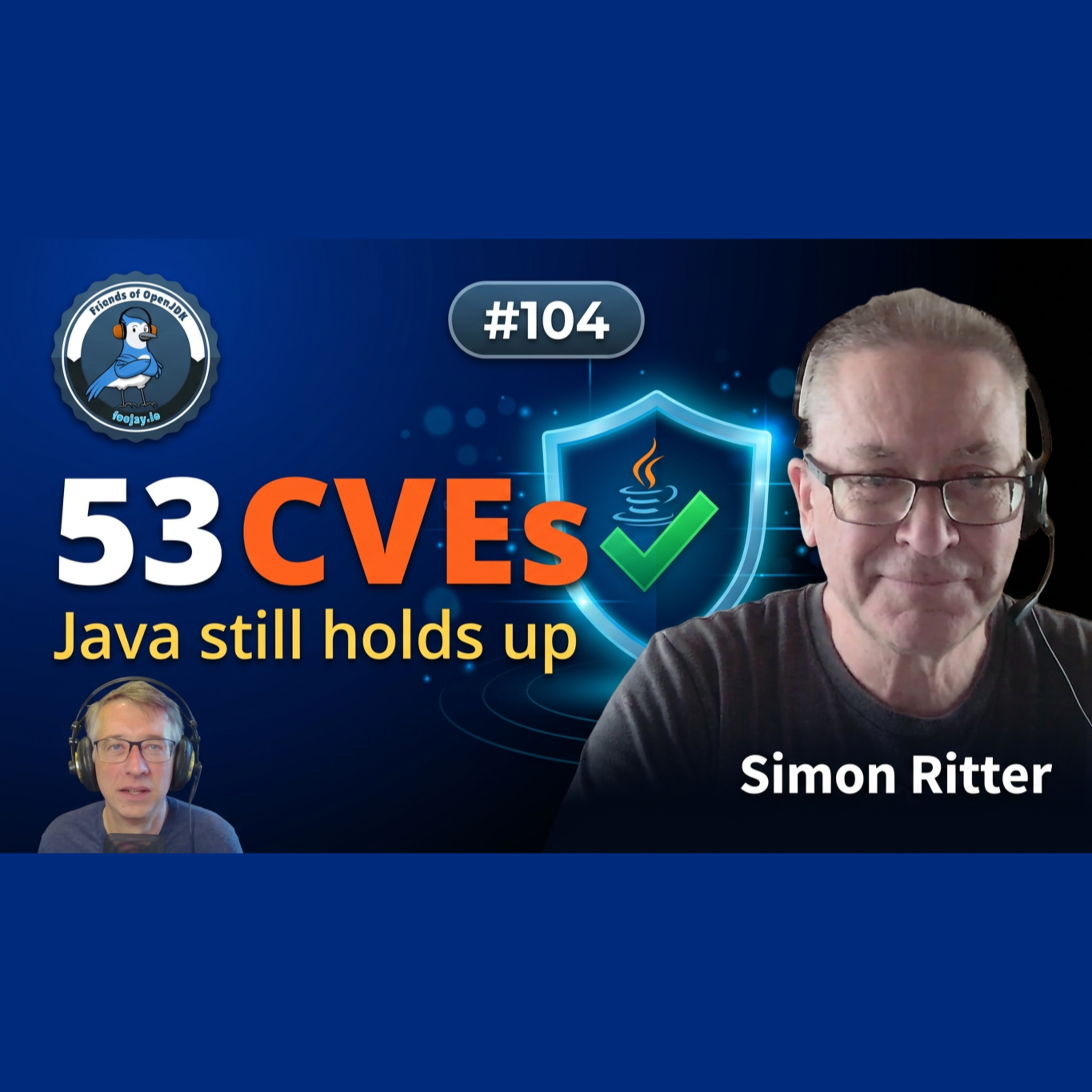
A record 53 CVEs in one Java update, followed by two emergency releases within days. Yes, a lot of issues are being found, but Java is still strong: a whole community and the commercial distributors are behind every fix.In this episode, Simon Ritter, Deputy CTO at Azul, Java Champion and member of the OpenJDK Vulnerability Group, explains what happened over the past weeks and what it means for your applications. We cover how a vulnerability travels from a report to a patch, why AI is changing the number of fixes, and why you should be ready to update at any moment. If you want to understand how CVEs are handled behind the scenes and what the different types of security updates mean, this episode explains it.Topics include:What a CVE and a CVSS score really tell you, and why low scores can be chained into serious attacksHow vulnerabilities are kept secret and encrypted in the OpenJDK Vulnerability Group until a patch existsWhy the average of 7.6 CVEs per quarter jumped to 53, and the move toward monthly security updatesThe eMudhra certificate problem and the two out-of-cycle releases that followedThe backporting workload behind every supported Java version, from 27 down to 6CPU, PSU and CSPU explained, and what free versus paid OpenJDK builds mean for your patchingGuest: Simon RitterDeputy CTO at Azul and Java ChampionSimon on LinkedInLinks:Full show notes with all linksFree Java, Real Risk: Why Unsupported OpenJDK Is Now a Security GambleAzul Zulu October 2026 Quarterly Update and Out-of-Cycle ReleaseTimestamps:00:00 Introduction of topic and guest01:59 What is a CVE and how are they reported and handled?08:45 How the Java security release cycle is changing and each have more CVEs11:48 How AI impacts the discovery of CVEs14:09 What was the eMudhra problem causing two out-of-cycle security updates?21:49 The impact of creating an out-of-cycle update (and backports)26:05 How safe will OpenJDK builds be in the future? And dependencies?29:06 Free versus paid versions of OpenJDK builds32:40 CPU vs PSU vs CSPU: the names used for different types of security updates (security only versus including patches)35:52 What will happen with old Java versions like 6, 7, 837:05 Why would you pay for a supported OpenJDK build?41:50 Conclusion: check your Java version and be ready to update at any moment!

Runtime reflection is a quiet tax on the JVM. It is flexible, it is everywhere, and it is easy to stop noticing it until you go looking for where your CPU is actually going. Two teams did exactly that, in completely different corners of the ecosystem, and arrived at the same answer: move the work to build time.In this episode, Dmitry Moskalyuk explains the model layer behind his Foojay article on reflection-free serialization, where JSON, XML, YAML and TOML all end up as Avro. Shai Almog explains the build-time codegen pipeline of Codename One, which aims for no reflection, no service loader and no Class.forName. We compare the two and ask whether generated code is really something to avoid.Topics include:Where Jackson's reflection cost really lives, and what Blackbird does about itJackson versus kotlinx.serialization, and why a missing feature sent the team back to JacksonWhy a UI framework bans reflection, and how that differs from the backendIs generated code bad? Lombok, Manifold and jOOQWhat Records and Project Leyden change for reflectionBuild time cost versus runtime cost, and a single source of truth for your data modelShould you still use reflection in a new project?Guests:Dmitry Moskalyuk, Senior Backend EngineerDmitry on LinkedInShai Almog, Author, DevRel and open source developer working on Codename OneShai on LinkedInLinks:Dmitry's article on FoojayShai's article on FoojayJackson BlackbirdApache AvroProject LeydenFull show notes with every linkTimestamps:00:00 Introduction of topic and guests01:50 About the new Foojay, contributing with GitHub pull requests03:17 What is Apache Avro04:26 What is Codename One06:31 What is Blackbird in Jackson and compared to kotlinx mechanisms for different content parsers10:01 Why Codename One focuses on "no reflection, no service loader, no Class.forName"14:23 Is automatically generated code bad (Lombok, Manifold, JOOQ)?17:47 Java evolutions that bring improvements into the system (Records, Project Leyden)21:31 Is reflection changing through Java versions?24:29 Build time cost versus runtime, Project Leyden28:41 Use of reflection in UI versus backend32:16 Benefit of your data model in a (Java) object, having one source of truth, good debugging35:35 Should you worry about serialization in a small project37:38 Serialization and security38:57 Should I still use reflection/serialization in a new project?43:22 Conclusion

Foojay.io quietly moved off WordPress and onto Hugo. No more CMS login, no database, no admin panel — just Markdown and AsciiDoc files, built and deployed straight from GitHub. So is a traditional CMS still the right way to run a content site in 2026, or has static tooling caught up?In this episode, Andy Damevin and Holly Cummins from the Red Hat Quarkus team join to talk through it. Andy created code.quarkus.io and Roq, Quarkus's own Java-based static site framework; Holly led the migration of quarkus.io itself from Jekyll to Roq. We go through the real security numbers behind WordPress's plugin ecosystem, and put very different static site generators head to head: Hugo and Jekyll, the veterans, versus Roq, the newcomer.Topics include:Why WordPress core is usually fine, and the plugins are where the trouble is — over 10,000 plugin vulnerabilities found since 2025What "recovery" means for a static site versus a CMS after a hack or defacementJekyll, Hugo, Roq and JBake compared, and why staying in Java matters (or doesn't)How to extend Roq as a Java developer, from a small PR to writing your own pluginWhat an actual WordPress-to-Roq migration looks like in practiceWhere a CMS still earns its keep despite all of thisGuests:Andy Damevin on LinkedIn - Principal Software Engineer at Red Hat, Quarkus core team, creator of code.quarkus.io and RoqHolly Cummins on LinkedIn - Senior Principal Software Engineer, Red Hat Quarkus team, led the quarkus.io migration from Jekyll to RoqLinks:Migrate from WordPress to RoqRoqHugoFull show notesTimestamps:00:00 Introduction of topic and guests03:29 Why WordPress is not the best choice for most sites04:36 Difference between CMS-driven websites and static websites07:02 Jekyll versus Roq and other systems11:04 How to extend Roq12:59 Moving from WordPress to Roq14:43 Pulling data with JBang or Roq from external sources into your publication process16:09 Why should I use Roq instead of Jekyll or Hugo?24:33 Static websites can be created with a small team and are much cheaper (or even free) to host26:52 How many WordPress websites have a backup to recover after getting hacked? And the advantage of having your content sources on Git.33:04 Is there still a use case for WordPress-like systems?37:09 Conclusions

Comments

Download from Google Play

Download from App Store
 United States