


 Claim Ownership
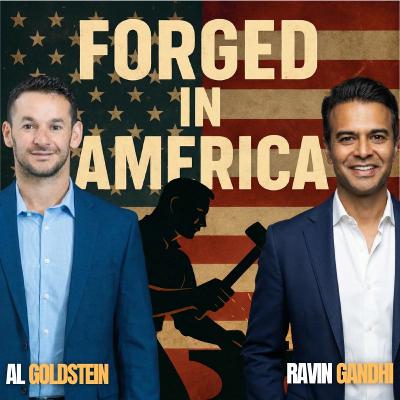
Forged in America
Subscribed: 3Played: 62
Subscribe

© Ravin Gandhi and Al Goldstein
Description
Forged in America is a conversation between longtime friends & entrepreneurs Ravin Gandhi (GMM Nonstick Coatings) and Al Goldstein (Avant, Stoic Lane, Pangea) who have founded, built, and exited numerous businesses in addition to investing in dozens of successful startups. This podcast is about how consequential decisions actually get made under pressure—across business, investing, and the institutions shaping the USA. We break down how capital gets allocated, how leaders think in moments of uncertainty, and where smart systems—markets, companies, or political movements—develop blind spots.
55 Episodes
Reverse
What if the biggest lie we tell young Americans is that a college degree is automatically worth the price?Andreas Stamatakis is one of the country’s leading Ivy League admissions advisors—and his advice is surprisingly contrarian: “Go Ivy or go free.”In this episode of Forged in America, Ravin Gandhi and Al Goldstein sit down with Andreas for a provocative conversation about what elite colleges actually select for, whether the admissions game rewards real talent or manufactured résumés, and why paying hundreds of thousands of dollars for the wrong degree may be a terrible investment.Andreas explains why he believes students should optimize for talent rather than passion, why math and technical competence are becoming increasingly valuable in an AI-driven economy, and why combining hard skills with social intelligence may be the ultimate career advantage.The conversation then expands far beyond college.Are Gen Z kids really entitled—or are they inheriting an economic system stacked against them? Will AI create a new class of extraordinary winners while eliminating millions of traditional white-collar jobs? Is entrepreneurship becoming a necessity rather than a choice? And could large parts of the traditional college system eventually disappear?They also debate disability accommodations and standardized testing, the value of Ivy League prestige, vocational careers, UBI, wealth inequality, philanthropy, parenting, and what young people should actually be doing to prepare for the next 20 years.Andreas also faces the Forged in America lightning round: Stanford vs. Harvard, valedictorian vs. class president, varsity athlete vs. Model UN, perfect grades vs. one insane extracurricular, Goldman Sachs internship vs. McDonald’s, and the ultimate choice—Harvard admission, $10 million at age 30, or a happy marriage.Topics include: Ivy League admissions • “Go Ivy or Go Free” • the $400,000 college problem • SATs and test prep • manufactured extracurriculars • math vs. passion • AI and the future of work • technical skills + EQ • Gen Z economics • entrepreneurship • wealth inequality • UBI • parenting • vocational careers • the future of universities • happiness and success
United States District Judge Roy K. Altman joins Ravin Gandhi and Al Goldstein for a wide-ranging conversation about immigration, American exceptionalism, the legal system, Israel, antisemitism, and why he remains extraordinarily optimistic about America.Born in Venezuela, Altman came to the United States as a child speaking Spanish and Hebrew but no English. Decades later, after becoming a U.S. citizen, a Division I athlete at Columbia, a Yale Law School graduate, a decorated federal prosecutor, and one of the youngest federal judges in the country, he now has the privilege of swearing in new American citizens himself.Altman explains why playing high-level sports helped prepare him for the pressure of the courtroom, why juries of ordinary Americans can be remarkably good at finding the truth, and why lifetime tenure for federal judges may actually protect judicial independence rather than undermine it. He also explains a principle of judging that many Americans misunderstand: a judge's job isn't necessarily to reach the outcome he thinks is morally "right"—it's to follow the law.The conversation then turns to Altman's new book, Israel on Trial, in which he applies the tools of a courtroom—evidence, history, standards of proof, and logic—to some of the most serious accusations made against Israel. Altman discusses the genocide allegation, the distinction between criticism of Israeli government policy and anti-Zionism, and why he believes facts can still change people's minds.Altman also explains why he is bullish on the emerging relationship between Israel and India and why, despite the pessimism dominating much of American culture, he believes the American Dream remains very much alive.Finally, Ravin and Al try unsuccessfully to convince Judge Altman that his future belongs in elected office.In this episode:• Why Altman's immigrant parents took their children to Civil War battlefields• Going from speaking no English to becoming a federal judge• What Division I football teaches that elite schools can't• Why 12 ordinary jurors can be better at finding truth than experts• The case for lifetime judicial appointments• Whether America's legal system encourages too many lawsuits• Why judges sometimes must enforce laws they personally disagree with• Putting Israel "on trial" using evidence rather than ideology• Altman's argument against the genocide accusation• Criticism of Israel vs. antisemitism and anti-Zionism• Why the India–Israel relationship could become increasingly important• Why Altman remains optimistic about young Americans• Is the American Dream still alive?• And: Will Judge Roy Altman ever run for office?This is a conversation about what America asks of its citizens—and what can happen when immigrants embrace the opportunity to contribute, compete, serve, and give something back to the country that gave them a chance.Disclaimer: The Forged in America podcast features personal stories, experiences, and opinions from hosts Al Goldstein and Ravin Gandhi. This content is for informational and entertainment purposes only and is not investment advice, financial advice, solicitation of investments, or any form of professional recommendation.We strive for accuracy, but mistakes can happen and are unintentional. Nothing discussed should be relied upon for making financial, business, or personal decisions. Always consult qualified professionals before acting on anything you hear.Past performance or results mentioned do not guarantee future outcomes. Listeners are responsible for their own choices.
What if everything you’ve been taught about happiness is wrong?Tal Tsfany is the President and CEO of the Ayn Rand Institute, a former technology entrepreneur and executive, and the author of Secrets of a Passionate Life. In this episode, Tal joins Ravin and Al for a provocative conversation about Ayn Rand, Objectivism, ambition, parenting, capitalism—and why so many successful people are still deeply unhappy.Tal argues that money, status, and achievement are poor substitutes for knowing who you actually are and what you value. He explains why many business leaders become “janitors” of their own lives rather than CEOs, why he believes rational self-interest is moral, and how his concept of “value density”—the amount of meaning packed into your time—offers a different way to measure a successful life.The conversation turns to America’s growing unhappiness, particularly among young people. Tal challenges conventional thinking about education, equality, altruism, welfare, and universal basic income, while Ravin and Al push him on whether Objectivism can adequately account for empathy, people with limited abilities, and those who simply cannot compete economically.They also debate Elon Musk and Steve Jobs as potential real-world Howard Roarks, whether billionaires have a moral obligation to give their money away, whether Americans have a right to healthcare, whether taxation is theft, and what Ayn Rand would make of Donald Trump and Kamala Harris.Finally, Tal explains why he is optimistic about AI, how parents can help children develop their own identities rather than imposing their values on them, and why the ultimate scarce resource isn't money—it's time.In this episode:Why extraordinarily successful people can still be miserableThe difference between achievement and genuine happinessWhat Ayn Rand actually meant by “selfishness”Why Tal believes altruism can be destructiveThe “rich uncle” test for discovering what you really valueElon Musk vs. Steve Jobs through an Objectivist lensWhy American teenagers are increasingly unhappyParenting without turning your children into versions of yourselfWhy equality isn't necessarily the proper objectiveTal’s concept of “value density”The case against universal basic incomeDo billionaires owe society charity?Is taxation theft?Is healthcare a human right?Can religion and Objectivism coexist?What Ayn Rand would think of Trump—and Kamala HarrisWhy AI should be viewed as an opportunity rather than a threatThe one resource even billionaires can't buy more ofTal's central challenge is simple: stop measuring your life by somebody else's scoreboard. Figure out what you genuinely value, organize your life around it, and maximize the amount of meaning you extract from the limited time you have.Disclaimer: The Forged in America podcast features personal stories, experiences, and opinions from hosts Al Goldstein and Ravin Gandhi. This content is for informational and entertainment purposes only and is not investment advice, financial advice, solicitation of investments, or any form of professional recommendation.We strive for accuracy, but mistakes can happen and are unintentional. Nothing discussed should be relied upon for making financial, business, or personal decisions. Always consult qualified professionals before acting on anything you hear.Past performance or results mentioned do not guarantee future outcomes. Listeners are responsible for their own choices.
Is the American Dream dead—or are we looking at it the wrong way?In this episode of Forged in America, Ravin Gandhi and Al Goldstein compare two radically different paths to success.Al was a top student and athlete who turned one seemingly ordinary opportunity into an internship after discovering he was the only person who actually made the call. That relationship ultimately helped launch an entrepreneurial career that produced multiple billion-dollar companies.Ravin's path looked nothing like it. He reveals his actual high-school report cards—filled with C's, D's and F's—and explains what it felt like to grow up being viewed as a chronic underachiever. Then, at 17, after another mediocre semester at the University of Illinois, one brutally honest realization changed the trajectory of his life.Together, they examine what their stories have in common: small decisions that compound, intellectual curiosity, internal motivation, resilience, relationships, proximity to talented people, and the willingness to keep learning and building.But they also confront the harder question: What does any of this mean to a 24-year-old struggling with housing costs, inflation, AI disruption and a sense that previous generations had it easier? Ravin and Al distinguish between America's legitimate structural problems and the actions individuals can still control.Ravin also shares how he's using AI to navigate his father's serious health challenges—and why his 86-year-old father's optimism, resilience and entrepreneurial journey may be the best example of the American Dream.The central question: America isn't perfect, and success is never guaranteed. But if opportunity still exists, knowledge is more accessible than ever, and individual decisions still compound—how much of your future remains in your own hands?Disclaimer: The Forged in America podcast features personal stories, experiences, and opinions from hosts Al Goldstein and Ravin Gandhi. This content is for informational and entertainment purposes only and is not investment advice, financial advice, solicitation of investments, or any form of professional recommendation.We strive for accuracy, but mistakes can happen and are unintentional. Nothing discussed should be relied upon for making financial, business, or personal decisions. Always consult qualified professionals before acting on anything you hear.Past performance or results mentioned do not guarantee future outcomes. Listeners are responsible for their own choices.
Investor Tom Hayes, founder of Great Hill Capital and better known as “Turnaround Tom,” joins Ravin Gandhi and Al Goldstein to explain why some of the best investments are hiding in the companies everyone else has already written off.Tom breaks down the framework behind his contrarian investing strategy: finding high-quality businesses trading at distressed prices, identifying catalysts for a turnaround, and having the conviction to buy when everyone else is running for the exits. He walks through past bets on ExxonMobil, Wells Fargo, Amazon, Alphabet, Intel and Range Resources—and explains why PayPal is one of his highest-conviction ideas today. The conversation then turns to the other side of the market. Tom explains why he believes parts of the AI, semiconductor and private-market boom are priced for perfection, why the companies spending the most on AI infrastructure may not ultimately capture the greatest economic value, and why even extraordinary companies like SpaceX can still be bad investments at the wrong valuation. Tom also makes some provocative market calls: China and international equities could outperform the U.S.; small caps and value could beat large-cap growth; retail investors should be extremely careful with options; and the biggest winner from AI may be a company most investors haven't even heard of yet. And perhaps his boldest prediction: Berkshire Hathaway will not outperform the S&P 500 over the next decade. Tom explains why Buffett's eventual absence, Berkshire's enormous scale and its capital-allocation challenge fundamentally change the investment case. Beyond markets, Tom discusses raising high-performing kids, why sports teach lessons that translate into adulthood, how he accidentally built a billion-dollar investment firm from a podcast, and why Warren Buffett's philosophy of getting rich slowly remains one of the most important lessons for young investors. Tom's central message: The market rewards independent thinking, patience and discipline. The biggest opportunities often appear precisely when conventional wisdom says there is nothing worth buying.Disclaimer: The Forged in America podcast features personal stories, experiences, and opinions from hosts Al Goldstein and Ravin Gandhi. This content is for informational and entertainment purposes only and is not investment advice, financial advice, solicitation of investments, or any form of professional recommendation.We strive for accuracy, but mistakes can happen and are unintentional. Nothing discussed should be relied upon for making financial, business, or personal decisions. Always consult qualified professionals before acting on anything you hear.Past performance or results mentioned do not guarantee future outcomes. Listeners are responsible for their own choices.

Comments

Download from Google Play

Download from App Store
 United States