


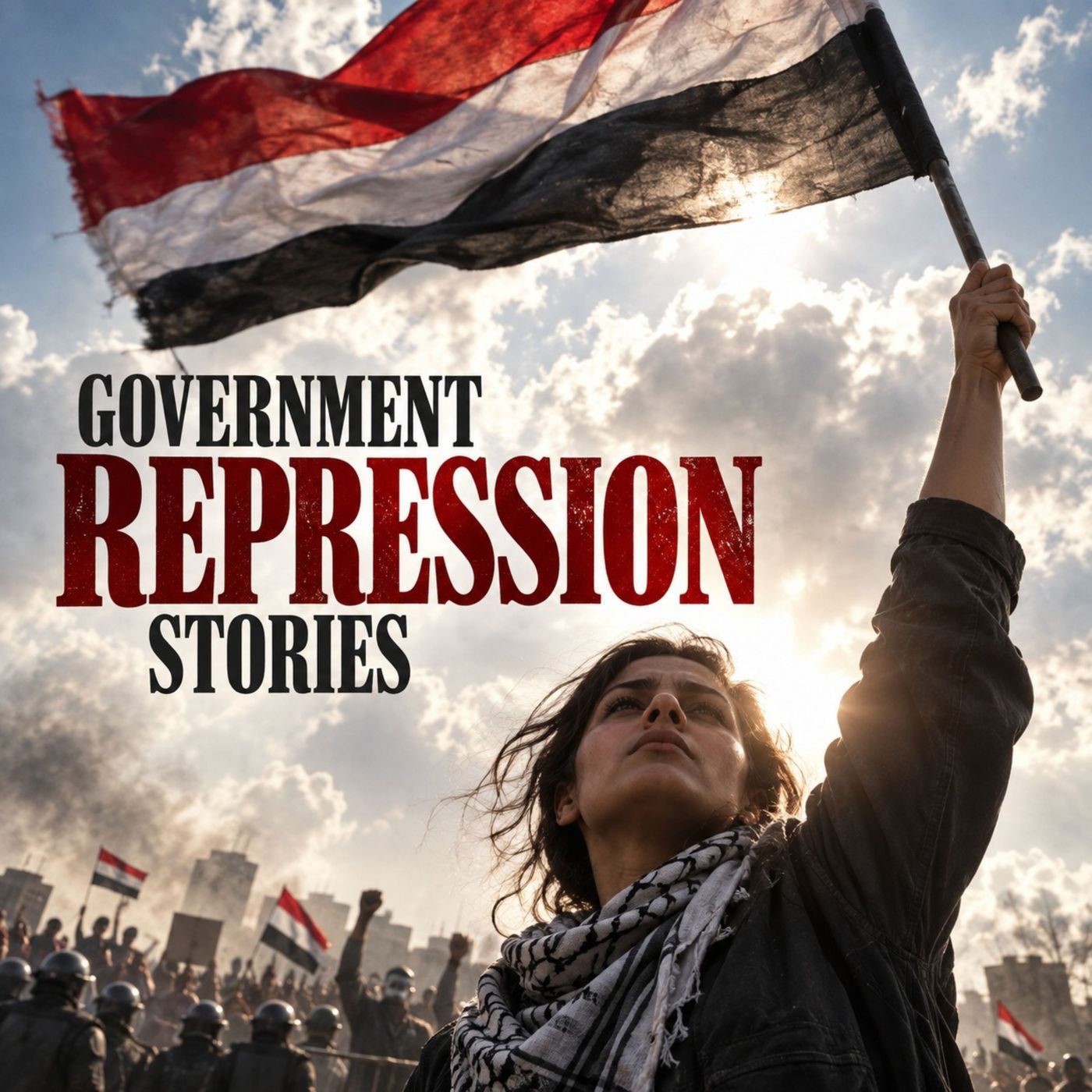
Government Repression Stories
Subscribed: 0Played: 5
Subscribe

© Copyright OBOMEDIA ENTERTAINMENT
Description
Martyr stories all reach the same crossroads: a person, a belief, and an authority demanding they abandon it. Everything before that moment is a life; everything after is legend. This show tells true martyr stories, the stories of people burned, broken, or buried for an idea.
Each episode reconstructs one story in full, cinematic detail: the conviction that set them apart, the machinery of power that closed around them, the offer of mercy in exchange for surrender, and the choice that made them martyrs. No host chatting between clips, no panel debating doctrine. Just one complete story, narrated start to finish, built from trial records, letters, and eyewitness accounts.
You will meet martyrs who sang while the flames rose, prisoners who converted their own jailers, and quiet believers whose deaths did more damage to their persecutors than any army could. Some episodes follow the final week of a single martyr hour by hour; others trace how one execution lit a movement that outlived the empire that ordered it. All of them treat martyr stories as what they are: the most extreme test of what a human being will pay for a belief.
If you are drawn to stories of conviction pushed to the absolute limit, this is built for you. New episodes drop regularly, each one a self-contained martyr story. Subscribe now so the next one lands the moment it goes live.
174 Episodes
Reverse
An Iranian journalist's three-word idea for nationalizing oil puts him in the crosshairs of global powers. What would you sacrifice for a belief?The Three Words That Cost Him EverythingThis episode explores the life of Hossein Fatemi, a journalist and politician whose unwavering belief in Iran's right to its own oil led him to confront powerful forces. It asks what it means to stand by an idea when the cost is everything.Person: Hossein FatemiDate of Birth: February 10, 1917Location of Birth: Nain, IranProfession: Journalist, Foreign MinisterPolitical Affiliation: Iranian National Front- Hossein Fatemi began writing editorials against the reigning Shah, Reza Shah Pahlavi, as a teenager.- He studied journalism and law in France, returning to Iran in 1948 to found the daily newspaper Bākhtar.- Fatemi was instrumental in initiating the oil nationalization movement in Iran, working with Mohammad Mosaddegh.- In 1952, while delivering a speech, Fatemi was shot and seriously wounded, injuries that never fully healed.- After a failed coup in 1953, Fatemi published an editorial denouncing the Shah and advocating for an Iranian republic.Tired of ads? Listen to this podcast and 200+ more ad-free on OBOMEDIA.Try it free for 7 days, cancel anytime: https://obomedia.com/en/gratis?ref=desc-7276310© 2026 Created by an independent creator of the OBOMEDIA Network. All rights reserved.This episode and its content (audio, text, and related materials) are the property of their respective creator, who is solely responsible for them, and are distributed by the OBOMEDIA Network on platforms such as Apple Podcasts, Spotify, Amazon Music, and Pocket Casts. Reproduction, distribution, editing, or commercial use, in whole or in part, without the creator's prior written permission is prohibited. For permissions, licensing, and business inquiries: [email protected].
A small, dark man from a kingdom no map can find arrives in Rome with a single vision and asks European powers to arm him - what would you do?The Unfound Kingdom and the Man Who Burned For ItIn this episode, we follow the journey of David Reubeni and the claims, performances, and negotiations that carried him from Khaybar to royal courts in Europe. We cover how his identity-shifts opened doors in 1520s geopolitics and ask what it takes to be believed when your whole story cannot be verified.Person: David ReubeniDate: 1522-1525Location: Khaybar → Jeddah → Suakin → Cairo → Jerusalem → Venice → Rome → Almeirim (Portugal)Event: Reubeni requests an alliance and military support against the OttomansStatus: Claims of a Jewish kingdom called Ḥabor unverified- Leaves Khaybar in December 1522 claiming royal descent and travels toward the Red Sea.- Adopts Muslim robes and a Prophet-descendant identity to cross the Nubian Desert and reach Cairo.- Arrives in Jerusalem in 1523 after multiple performances of self and layered disguises.- Receives audiences with Pope Clement VII and Cardinal Giles in Rome and rides a white horse through the city.- In November 1525, King John III of Portugal initially promises eight ships and four thousand cannons for an alliance Reubeni proposes.Tired of ads? Listen to this podcast and 200+ more ad-free on OBOMEDIA.Try it free for 7 days, cancel anytime: https://obomedia.com/en/gratis?ref=desc-7276310© 2026 Created by an independent creator of the OBOMEDIA Network. All rights reserved.This episode and its content (audio, text, and related materials) are the property of their respective creator, who is solely responsible for them, and are distributed by the OBOMEDIA Network on platforms such as Apple Podcasts, Spotify, Amazon Music, and Pocket Casts. Reproduction, distribution, editing, or commercial use, in whole or in part, without the creator's prior written permission is prohibited. For permissions, licensing, and business inquiries: [email protected].
In 1552, a former imperial chaplain returns to Spain and joins a secret Protestant gathering, risking the Spanish Inquisition and a capital crime.You say "cazuela" at the door - do you step inside and risk being burned?This episode explores the story of Agustín de Cazalla, a man of influence who chose to participate in a clandestine religious group in Valladolid. It delves into the motivations of individuals who risked everything for their beliefs during a time of intense religious scrutiny.Person: Agustín de CazallaDate: After 1552Location: Valladolid, CastileStatus: Former chaplain to Emperor Charles VEvent: Secret Protestant gathering- Agustín de Cazalla, born in 1510, was a canon of Salamanca cathedral and had served as Emperor Charles V's chaplain.- He had witnessed the Reformation firsthand, traveling with the Emperor across Germany and the Low Countries.- Upon his return to Valladolid in 1552, Cazalla began attending secret meetings in a private house.- The password to enter these gatherings was the ordinary Spanish word "cazuela," meaning casserole dish.- The conventicle, held in the home of Cazalla's mother, consisted of ecclesiastical and civic elites who engaged in discussions and Protestant worship.Tired of ads? Listen to this podcast and 200+ more ad-free on OBOMEDIA.Try it free for 7 days, cancel anytime: https://obomedia.com/en/gratis?ref=desc-7276310© 2026 Created by an independent creator of the OBOMEDIA Network. All rights reserved.This episode and its content (audio, text, and related materials) are the property of their respective creator, who is solely responsible for them, and are distributed by the OBOMEDIA Network on platforms such as Apple Podcasts, Spotify, Amazon Music, and Pocket Casts. Reproduction, distribution, editing, or commercial use, in whole or in part, without the creator's prior written permission is prohibited. For permissions, licensing, and business inquiries: [email protected].
A man walks to his execution whistling, a sound so out of place it echoes through history. What does it mean to face the end without fear?The Whistle That Silenced Your FearThis episode explores the life of Thomas MacDonagh, a poet, teacher, and revolutionary, who signed a document proclaiming an Irish republic and was executed days later. It asks what drives a person to commit so completely to an idea that it transcends the fear of death.Person: Thomas MacDonaghDate: May 3, 1916Location: Kilmainham Gaol, IrelandEvent: Execution of a revolutionary leader- Thomas MacDonagh was a 38-year-old man with a wife and two young children when he was led to his execution.- He was one of seven men who signed a document proclaiming a republic that did not yet exist.- MacDonagh was born in 1878 in Cloughjordan, County Tipperary, to parents who were both teachers, instilling in him a belief in education as resistance.- He co-founded the Association of Secondary Teachers in Ireland (ASTI) and joined Patrick Pearse's St. Enda's school as Assistant Headmaster.- By 1912, MacDonagh was married with a son and a daughter, and was deeply involved in Irish literary and cultural circles.Tired of ads? Listen to this podcast and 200+ more ad-free on OBOMEDIA.Try it free for 7 days, cancel anytime: https://obomedia.com/en/gratis?ref=desc-7276310© 2026 Created by an independent creator of the OBOMEDIA Network. All rights reserved.This episode and its content (audio, text, and related materials) are the property of their respective creator, who is solely responsible for them, and are distributed by the OBOMEDIA Network on platforms such as Apple Podcasts, Spotify, Amazon Music, and Pocket Casts. Reproduction, distribution, editing, or commercial use, in whole or in part, without the creator's prior written permission is prohibited. For permissions, licensing, and business inquiries: [email protected].
A priest returns to Elizabethan England knowing the law makes his mere existence a capital crime - would you risk forty-one days for what you believe?You chose a law that killed priests - would you return anyway?In this episode we follow the choices that led one man back into danger and the world he re-entered. The narrative traces his training, the law aimed at men like him, and the moment he decided to come home despite the penalty; what does that decision cost, and what does it demand of a conscience?Person: Robert SouthwellDate: 21 February 1595Location: Tyburn Hill, LondonLaw: any English-born priest ordained in Rome remaining in England forty days or more faced deathEducation: English College at Douai; Sant' Andrea; ordained 1584- He left England at about fifteen to study at Douai, a college set up to train exiled English College.- He walked to Rome, petitioned the Society of Jesus after initial refusal, and was admitted in October 1578.- Parliament passed a law in 1584 targeting priests ordained abroad, prescribing execution after forty days on English soil.- In 1586 Southwell knowingly sailed back to England under an assumed name, fully aware of the statute and its consequences.- He spent three years in the Tower, recorded being tortured multiple times, and published poetry and prose before his public execution.Tired of ads? Listen to this podcast and 200+ more ad-free on OBOMEDIA.Try it free for 7 days, cancel anytime: https://obomedia.com/en/gratis?ref=desc-7276310© 2026 Created by an independent creator of the OBOMEDIA Network. All rights reserved.This episode and its content (audio, text, and related materials) are the property of their respective creator, who is solely responsible for them, and are distributed by the OBOMEDIA Network on platforms such as Apple Podcasts, Spotify, Amazon Music, and Pocket Casts. Reproduction, distribution, editing, or commercial use, in whole or in part, without the creator's prior written permission is prohibited. For permissions, licensing, and business inquiries: [email protected].

Comments

Download from Google Play

Download from App Store
 United States