


 Claim Ownership
GreenPill
Subscribed: 85Played: 5,793
Subscribe

© 2022
Description
GreenPill is about crypto-economic systems that create positive externalities for their neighbors & for the world.
We explore the intersection of programmable money, game theory, & mechanism design. We search for powerful new ways to fund, design, develop, & market regenerative web3-era applications and digital assets. We launch the meme of regenerative crypto-economics into the world.
Ethereum is the ultimate substrate for human coordination. Learn about the web3 builders who are solving coordination failures and creating a more regenerative infrastructure for the world using Ethereum.
Take the Green Pill!
We explore the intersection of programmable money, game theory, & mechanism design. We search for powerful new ways to fund, design, develop, & market regenerative web3-era applications and digital assets. We launch the meme of regenerative crypto-economics into the world.
Ethereum is the ultimate substrate for human coordination. Learn about the web3 builders who are solving coordination failures and creating a more regenerative infrastructure for the world using Ethereum.
Take the Green Pill!
277 Episodes
Reverse
New @greenpillnet pod out today! 🌐 In this episode of the VDAO × Greenpill Anti-Fragile Network States mini-series, host Kris Miller talks with Steph Curdy — Bitcoin early adopter, Wolfram researcher, and real-world resilience builder who traded city life for a hands-in-the-soil permaculture experiment. Steph shares how Bitcoin shaped his understanding of asymmetry, how COVID exposed the fragility of urban systems, and why he decided to buy land, build food and energy resilience, and grow a local community around it. They explore anti-fragility, decentralized systems, gradients, permaculture design, skepticism, community trust, and why people — not tomatoes — are the real value in any resilient ecosystem. A grounded, practical and inspiring look at how digital builders can become real-world resilience builders. 🌱 greenpill.network 🌐 vdao.org 🐦 https://x.com/JoinVDAO 🐦 https://x.com/Steph_Curdy 🐦 https://x.com/greenpillnet ⏱️ Timestamps 00:00 – Cold open: "The real value is community, not tomatoes." 01:24 – Welcome to the VDAO Anti-Fragile Network State season 02:19 – Steph Curdy joins the show 02:44 – Steph's "why" as a builder 03:50 – Bitcoin, energy & curiosity 05:48 – What anti-fragility means to Steph 07:30 – Bitcoin as asymmetric exposure 08:55 – COVID revealing urban fragility 09:38 – Searching for land & building resilience 11:35 – Bitcoin as a "Cambrian explosion" of economic primitives 13:32 – Returning to foundational systems: food & nature 15:46 – Steph's background: Tesla → finance → Wolfram 17:31 – Discovering permaculture 19:11 – Emergence: crypto, permaculture & meta-crisis spaces 20:56 – Sensemaking through energy gradients 22:52 – History & first-principles thinking 25:05 – Using gradients to understand Bitcoin 26:55 – How Steph thinks about skeptics 28:51 – Money as information & coordination 30:27 – Listening as a core civic skill 32:25 – Crypto insecurity & ecosystem overwhelm 34:44 – Quality-of-life benefits of resilience 36:24 – Buying land: the practical journey 38:46 – Turning a junk site into regenerative opportunity 41:10 – Building trust with neighbors 42:58 – Year-by-year development of the land 45:02 – Insight: community is the real value 47:29 – Mushroom systems, events & collaborative building 49:28 – Crypto × permaculture: bridging the worlds 51:51 – Polarization & public perception 54:30 – Digital + physical sovereignty 57:03 – What Steph learned building in real life 59:49 – Closing thoughts 01:00:32 – Outro

New @greenpillnet pod out today! 🌐 In this episode of the VDAO × Greenpill Antifragile Network States mini-series, host Kris Miller talks with Chance McAllister, one of the early builders shaping the pop-up village movement and researching how global communities form identity, belonging, and support systems. Chance McAllister shares how a simple Discord link created a high-talent online community, how pop-up cities exploded from one experiment to dozens worldwide, and why digital nomads are searching for deeper social infrastructure. They explore informal safety nets, civil society history, global "dark talent," and what we can learn from groups like the Mennonites as we design the next generation of network societies. A thoughtful, human-centered conversation for anyone exploring community, belonging, and new models of membership across borders. 🌱 greenpill.network 🌐 vdao.org https://x.com/JoinVDAO https://x.com/chancecollabs?s=20 https://x.com/0xkrisv https://x.com/greenpillnet 🌐 Timestamps 00:00 – Cold open 00:24 – What "network state" means to Chance 01:14 – Chance's personal "why" 02:40 – Network societies as an umbrella concept 04:22 – The diversity inside the movement 05:49 – How Chance entered the space 07:27 – Accidentally creating a high-talent Discord 09:27 – Formal vs informal safety nets 12:11 – Unlocking global talent 14:19 – Origins of pop-up villages 16:22 – Zuzalu & the first big experiment 18:19 – Why Chance started researching pop-up cities 20:22 – Civil society & mutual aid history 22:42 – "Summer camps for nomads?" critique 24:52 – Permanent hubs vs pop-ups 28:59 – Demand for new communities 30:59 – The Mennonite example 35:08 – Why jurisdictions welcomed them 37:33 – Lessons for network builders 41:54 – Building identity & membership 48:39 – The future of membership models 55:35 – Designing new societal structures 58:51 – Closing thoughts
New @greenpillnet pod out today! 🌐 In this episode of the VDAO x Greenpill Antifragile Network States mini-series, host Kris Miller talks with Rob Avis, a permaculture educator, systems thinker, and co-founder of Fifth World. Rob shares his journey from industrial food and oil & gas to regenerative design, and explains how nature, decentralization, and appropriate technology can help humanity build antifragile food, energy, and water systems. They explore regeneration, feedback loops, digital tools, beaver-built ecosystems, community resilience, and how to inspire the next generation of earth stewards. A deeply optimistic, practical, and inspiring conversation for anyone building toward a resilient future. 🌱 greenpill.network 🌐 fifthworld.io vdao.org https://x.com/JoinVDAO https://x.com/rob_5thworld https://x.com/greenpillnet 🌐 Timestamps 00:00 – Cold Start 01:15 – Rob Avis joins the show 01:38 – Childhood roots: seeing the Amazon rainforest destroyed 04:01 – Cutting down forests in oil & gas the turning point 06:20 – Traveling the world to study energy, food & water systems 08:04 – Cheesecake factories, industrial food & system awareness 09:45 – What antifragility really means 12:06 – The three states: fragile, resilient, antifragile 13:43 – Human body as an antifragile system 16:08 – Ecosystems as antifragile, syntropic systems 18:18 – Why "sustainability" is not enough 20:07 – Regeneration: leaving systems better than we found them 22:17 – The beaver example; disturbance as healing 24:00 – Humans as positive ecological disruptors 25:42 – The "woo-woo" critique of regenerative movements 28:04 – Pragmatic regen: examples from large-scale farmers 30:28 – Using appropriate tools not dogma 32:51 – Global regeneration examples (Saudi, India, China) 35:09 – Land vs tech: bridging permaculture and crypto cultures 36:58 – 10,000 years of "deforest, plow, desertify" 39:24 – How digital tools enable better ecological feedback 41:51 – Tech vs nature: design the right balance 44:00 – Vitalik's techno-optimism & defensive accelerationism 45:19 – Decentralization as a natural principle 47:01 – From activist to humanist 49:00 – Everything gardens — humans included 51:18 – The biggest challenge: changing mindsets 53:29 – Fifth World: decentralized food, energy & water systems 55:48 – Case study: regenerating a desert property into abundance 58:14 – Why people crave reconnection with land & nature 59:57 – How urban renters can start (the Apple Harvest story) 01:02:37 – Community orchards & urban abundance 01:04:41 – Inspiration vs fear: how to steer the canoe 01:06:48 – Healing ourselves to heal ecosystems 01:09:09 – Bridging crypto + nature: governance & invisible structures 01:11:33 – A call for collaboration (real-world builders hackathon?) 01:13:22 – Regeneration as enlightened self-interest 01:14:40 – Final thoughts: do we want to be on the extinction list?
New @greenpillnet pod out today! 🌐 In this episode of the VDAO x Greenpill Antifragile Network States mini-series, hosts Marc Ziade & Kris Miller sit down with Simon Brown longtime Ethereum builder and lead of the ConsenSys Network State initiative. They explore how digital coordination tools like MetaMask, Infura, Linea, DAOs, token networks, and on-chain identity form the operational software layer for future antifragile societies. Simon breaks down what network states really are, why the concept predates crypto, how Ethereum enables global community formation, and how capital formation, shared values, and founder networks could power the next generation of sovereign digital communities. This episode is essential listening for anyone building toward self-sovereign, decentralized, resilient civilizational systems. 🐦 @owocki @greenpillnet https://x.com/0xkrisv https://x.com/ZiadeMarc https://x.com/orbmis https://x.com/joinvdao 🌐 Timestamps 00:00 – Welcome to the VDAO Antifragile Network States mini-series 00:32 – From fragility to antifragility: why digital tools matter 01:40 – Introducing guest Simon Brown (ConsenSys Network State) 02:09 – What is a network state? Why no one agrees on a definition Origins & Influences 03:10 – Network states before crypto: McLuhan, global villages & sovereign individual 04:28 – The lineage of the network state idea 06:04 – Builders looking beyond the limits of nation-states 07:15 – Simon's motivation: from Ethereum hacker to network-state thinker Ethereum as the Root Layer 08:30 – Ethereum as sociotechnology, not just technology 09:57 – Why the ecosystem keeps innovators engaged 12:05 – How "network states" entered mainstream crypto conversations 14:04 – Network-state momentum over the last year Motivations & Narratives 15:38 – Are builders really searching for post-nation-state models? 16:22 – Why the idea must translate into real-world benefits 18:17 – Ethereum + network states = practical sociopolitical tooling 20:31 – Dapps today as institutions of tomorrow Successful Experiments 22:14 – Permanent hubs: Zuzalu, Prospera, Esmeralda, Frontier Tower 23:55 – Why permaculture & commons movements align with network states 24:28 – Inspiring real-world examples outside crypto Nation-States vs Digital Nations 26:56 – How online communities form identity without geography 28:47 – Feeling "more digital than national" 30:51 – The role of values, narratives & legitimacy 32:45 – Network states can be utopian… or dystopian 34:22 – Google, Tesla, Meta as proto-network states Crypto, Power & Sovereignty 36:29 – How Ethereum can level the playing field 38:11 – Institutional adoption vs the deeper purpose 40:32 – Using crypto to replace outdated financial infrastructure 42:25 – Ethereum as the only truly decentralized base layer Physical Infrastructure & Sovereignty 44:39 – Do network states need land? The IRL question 46:48 – When physical hubs strengthen diplomacy & bargaining power 48:44 – Why territory is optional—not essential 50:30 – Cloud dependence, AWS outages & infrastructure sovereignty Diplomatic Recognition 52:34 – Is recognition by states important? Simon's answer: "Not really." 54:12 – VDOW's position: political sovereignty is optional Capital Formation & Founder Networks 57:45 – Disintermediation from finance → to every layer of society 59:55 – Why building must come before defining 01:01:56 – Crypto's capital problem: broken incentives, extraction, toxicity 01:03:59 – Why Linea sees itself as a digital economic network 01:06:20 – ConsenSys Network State & aligned values 01:07:29 – Toward a tokenized, decentralized future What's Coming Next 01:09:18 – Founder networks: new capital formation infrastructure 01:11:38 – Rewriting the playbook for funding, ownership & governance 01:13:39 – Thoughts on the Coinbase acquisition & market signals 01:15:31 – Innovation returning to early Web3 roots Values & Collective Identity 01:17:47 – Why defining values matters more than definitions 01:20:05 – DAO-like equity swaps & polycentric governance 01:21:30 – The Ethereum Values experiment with Intuition Protocol 01:23:55 – Community-generated values as a "moral commandment" Final Section 01:25:39 – Bottom-up values as the core of digital nations 01:27:31 – Prediction markets, TCRs, and future coordination tools 01:29:19 – How to follow CNS Labs & the upcoming founder network launch 01:31:00 – Closing thoughts: the work ahead
New @greenpillnet pod out today! 🌐 In this episode of the VDAO x Greenpill mini-series, hosts Marc Ziade & Kris Miller talk with Joseph Lubin co-founder of Ethereum and founder of ConsenSys about the Next Supercycle and how decentralized trust can power a more antifragile, post-scarcity civilization. They explore how Trustware, AI, and network states are reshaping the foundations of society from financial systems to energy, data, and governance. Lubin also shares how ConsenSys, Linea, and decentralized protocols can help humanity transition toward resilient, self-sovereign systems that thrive through stress and change. 🎧 Learn more → greenpill.network 🐦 @owocki @greenpillnet https://x.com/0xkrisv https://x.com/ZiadeMarc https://x.com/joinvdao https://x.com/ethereumJoseph 🌐 Timestamps 00:00 – Welcome to the VDAO x Greenpill mini-series: Antifragile Network States 01:00 – Introducing guest Joseph Lubin co-founder of Ethereum & founder of ConsenSys 02:20 – How Joseph discovered Bitcoin and the origins of Ethereum 04:00 – Early doubts about global finance and the rise of decentralized trust 06:00 – What is a Supercycle and how it defines global transitions 08:30 – The Fourth Turning: cyclical history and economic reset theory 10:40 – Why we're at the midpoint of the fourth turning a new system emerging 12:10 – From top-down control to decentralized horizontal coordination 14:30 – How decentralized trust enables a sturdier social fabric 16:00 – The end of scarcity and the rise of post-scarcity creativity 17:40 – Collapse as evolution: why breakdowns create progress 19:10 – The birth of Trustware replacing Big Tech with transparent coordination 21:00 – Software ate the world, now Trustware will heal it 22:40 – Ethereum as the foundation for global decentralized trust 25:00 – Trust as a new global commodity and economic layer 27:20 – AI vs decentralization why they must coexist 29:10 – The hybrid human–machine intelligence future 31:30 – Decentralized AI training and tokenized incentives 33:00 – Trustware beyond code: decentralizing physical infrastructure 35:00 – Building antifragile systems for food, energy, and housing 37:00 – Learning from nature: decentralization as evolution 38:20 – The meaning of antifragility in the context of network states 39:30 – What are Network States and how they evolve beyond nation-states 42:00 – The coming overlay of 200+ nation states with thousands of network states 43:40 – The economic potential of digital sovereign territories 45:00 – The rise of tokenized economies stablecoins, commodities, and local tokens 47:30 – Monetary diversity as financial biodiversity 49:00 – The Consensus Network State & Linea ecosystem 51:30 – DeCorporatizing infrastructure: crypto meets physical resilience 53:00 – The role of VDAO and Fifth World in building antifragile communities 54:30 – Why personal sovereignty matters in a digital world 56:00 – Decentralized social graphs and tokenized communities 57:30 – How AI agents will power new governance and coordination 59:10 – The energy bottleneck and the path toward abundance 01:01:00 – Revisiting the 2047 Ethereum Vision speech 01:03:00 – Prediction markets, futarchy, and decentralized governance 01:05:00 – The next decade for ConsenSys: token economies & infrastructure 01:07:00 – Ethereum's convergence: scaling and interoperability 01:09:00 – Network States, AI, and the next phase of collective intelligence 01:11:30 – Closing reflections: hybrid intelligence and antifragile coordination
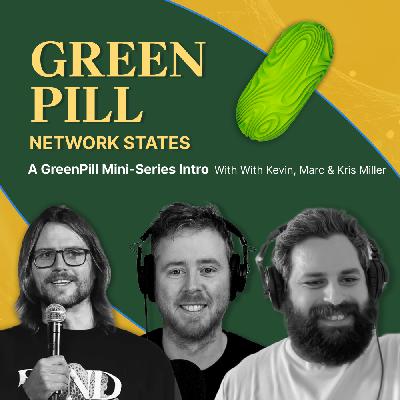
New @greenpillnet pod out today! 🌍 Kicking off a brand new Green Pill mini-series on Mondays hosted by VDAO (Marc Ziade & Kris Miller) — exploring how we can design antifragile network states that thrive through stress, decentralize sovereignty, and build regenerative communities. For Episode 1, Kevin Owocki joins them to introduce the season's theme — bridging crypto coordination and permaculture resilience — and discuss how antifragility offers a blueprint for building local, autonomous systems that survive disruption and grow stronger under pressure. This season features guests like Joseph Lubin, Simon Brown, and Rob Avis, diving into real-world experiments in energy, food, governance, and community sovereignty. Subscribe so you don't miss any of the conversations! 🎧 Learn more → greenpill.network 🐦 @owocki @greenpillnet https://x.com/0xkrisv https://x.com/ZiadeMarc https://x.com/joinvdao 🌐 Timestamps 00:00 – Welcome to a new Greenpill mini-series hosted by VDAO 00:40 – Introducing Marc Rydon & Kris Miller: bridging crypto and permaculture 01:20 – What is VDAO and how it connects digital and physical sovereignty 02:10 – Defining the Antifragile Network State concept 03:00 – From regenerative to antifragile: systems that get stronger under stress 04:10 – Why centralized systems create fragility — and how to move beyond them 05:00 – Building resilient communities through autonomy and self-sufficiency 06:10 – Examples: local food production as a form of antifragility 07:00 – Resilience as the foundation for thriving through disruption 07:50 – Why antifragility is the right response to our era of accelerating change 08:30 – The vision for this new Greenpill season 09:00 – Season roadmap: from theory to practical examples 09:40 – Episode preview: Joseph Lubin on history, supercycles, and resilience 10:30 – Future episodes: real-world applications with Rob Avis and Simon Brown 11:00 – Exploring how crypto enables local and global sovereignty 11:50 – Network states beyond crypto: lessons from alternative nation movements 12:30 – How to combine localism and global coordination through Web3 tools 13:00 – What to expect from the VDAO mini-series 13:40 – Hosts' final thoughts: making antifragility tangible for everyone 14:00 – Kevin passes the mic: new voices, same Greenpill spirit 14:30 – Closing: building communities that thrive in chaos
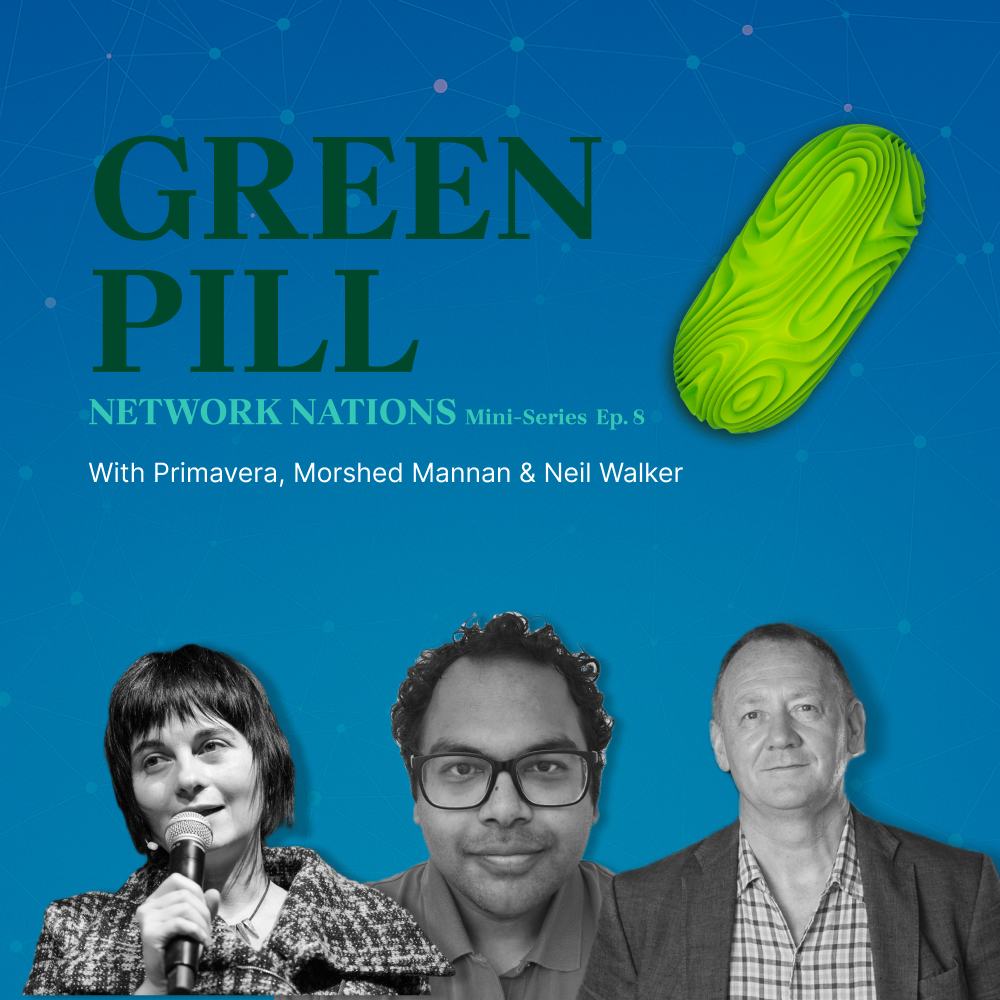
New @greenpillnet pod out today! 🌐 In this episode of the Network Nations mini-series, host Primavera De Filippi speak with Morchette Mannan (European University Institute) and Neil Walker (author of Sovereignty in Transition) to explore one of the most challenging ideas in political theory today: Functional Sovereignty. They discuss whether sovereignty can be unbundled into separate functions like identity, finance, and dispute resolution — and what it means when digital communities begin exercising these powers without controlling land. Together they examine historical precedents, overlapping authorities, private platform power (Amazon, Meta), self-determination, legitimacy, polycentric governance, and how decentralized infrastructure may enable network nations to achieve real autonomy. A foundational conversation for understanding how communities can self-govern in the networked age. 🌱 greenpill.network 🌐 networknations.network 🐦 @owocki @greenpillnet https://x.com/MannanMorshed ⏱️ Timestamps 00:00 – Cold open: "Functional sovereignty is an oxymoron. 01:34 – What is functional sovereignty? 02:18 – Introducing guests: Morchette Mannan & Neil Walker 03:48 – Traditional sovereignty vs non-territorial sovereignty 06:14 – How communities govern identity, finance & dispute systems 07:20 – Unbundling sovereignty into multiple functions 08:25 – Historical evolution of sovereignty (dynastic → modern state) 10:50 – Early cracks: EU autonomy without exclusivity 13:09 – Examples of functional sovereignty (EU, monetary union, etc.) 16:42 – Guild socialism & industrial self-governance 18:20 – Decentralized constitutionalism in Yugoslavia 19:08 – Citizens as the sovereign, not territory 20:44 – Are Big Tech platforms (Amazon/Facebook) functional sovereigns? 23:24 – Digital proximity & affinity in network communities 25:29 – Declarative vs constitutive sovereignty 27:18 – Corporate sovereignty vs democratic sovereignty 29:33 – Power vs authority: who is the real sovereign? 31:58 – Sovereignty as a discursive claim 33:48 – Why Network Nations seek functional, not declarative, sovereignty 35:50 – Self-determination vs sovereignty 37:00 – The paradox of self-constitution 39:24 – How multiple sovereigns overlap (polycentricity) 41:34 – Managing conflict in overlapping jurisdictions 43:15 – Constitutions and polycentric coordination 45:21 – Who decides who decides? 47:42 – Multi-level governance & territorial scaffolding 49:36 – Functional domains: art, science, data, digital systems 51:38 – How functional sovereignty works in practice 53:22 – Cooperatives as real examples of mutual self-governance 55:43 – Cross-border recognition & legal frameworks 58:05 – What law can and cannot do in digital governance 01:00:06 – Why Network Nations require hybrid (digital + physical) presence 01:02:29 – Decentralized infrastructure as sovereign infrastructure 01:04:08 – Can network nations coexist peacefully with states? 01:06:20 – States' anxiety about digital communities 01:08:42 – Politics, culture & technological migration 01:10:00 – Closing
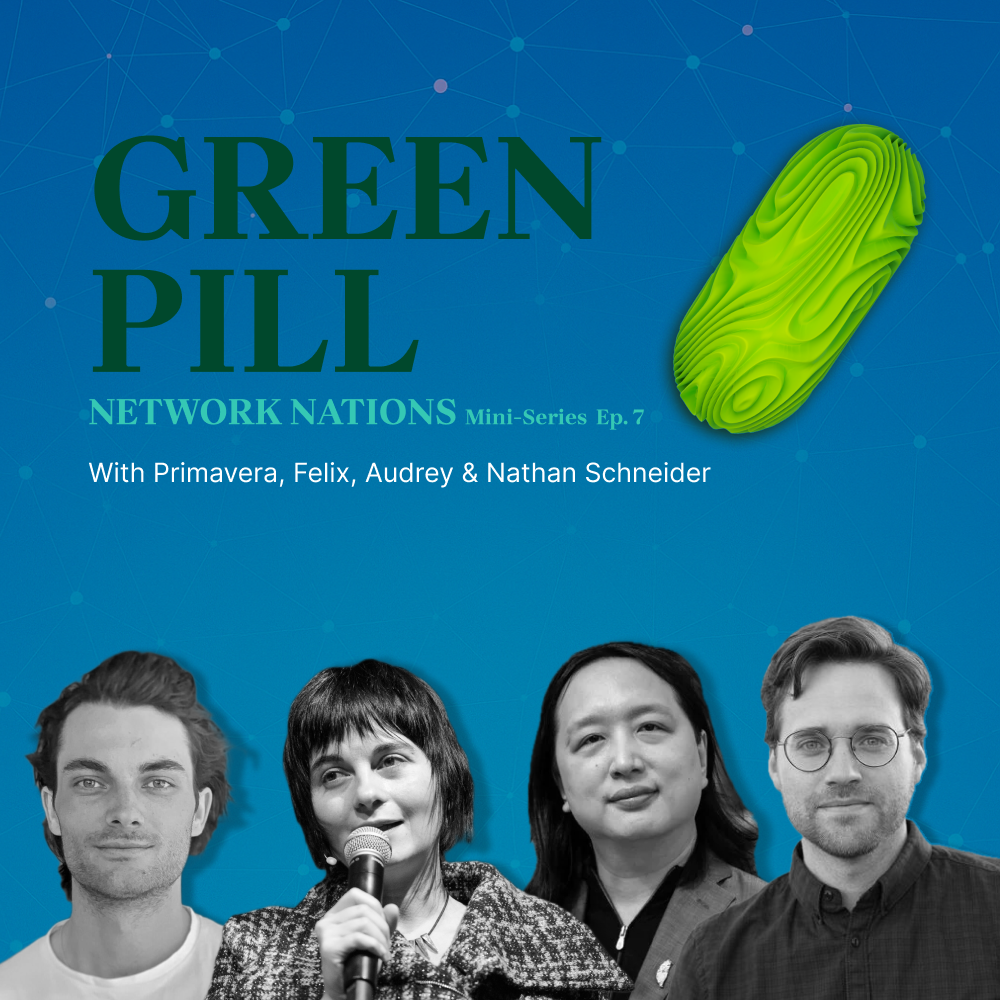
New @greenpillnet pod out today! 🌐 In this episode of the Network Nations mini-series, Primavera De Filippi & Felix Beer speak with Audrey Tang, former Digital Minister of Taiwan, and Nathan Schneider, professor and author of Governable Spaces. Together they explore Meta-Politics — the foundational design of digital infrastructures that shape how civil society governs itself online. Audrey and Nathan discuss how platforms today constrain collective action, how democratic protocols like alignment assemblies can counter online harms, and why new governance substrates must embed values such as plurality, civic care, interoperability, and entanglement. They also examine decentralized identities, freedom of movement, DAOs, religion as governance, and how network-native communities can evolve into political actors. A powerful conversation about the next layer of digital democracy — and what it takes to build civic technologies that empower global communities. 🌱 greenpill.network 🌐 networknations.network @owocki @greenpillnet @audreyt @ntnsndr 00:00 – Cold start 02:18 – Introducing Audrey Tang & Nathan Schneider 03:07 – Nathan: "Why I worry about the word meta" 05:10 – Nation-states as fragile historical accidents 06:15 – Self-governing online networks as new politics 08:16 – How today's platforms limit civic life 10:22 – Blockchains break the server–client power structure 12:17 – Nation-states reacting to decentralized governance 14:33 – Audrey: Democracy as a "social technology" 16:37 – Deepfakes, alignment assemblies & Taiwan's model 18:33 – Crowdsourced policymaking at national scale 20:49 – Freedom of movement & interoperability design 22:48 – What Network Nation aims to build 24:52 – Audrey's "Six-Pack of Care" 27:13 – Embedding civic care into protocols 29:21 – Bridging systems & depolarization 31:33 – What values can — and cannot — be encoded 33:28 – Forking, polycentric governance & metastability 35:52 – Norms vs code: where power really lives 37:41 – How decentralized tech forces governance innovation 39:51 – Why cooperatives aren't enough for politics 42:13 – Religion as a governance model for network nations 45:17 – Open movements & global political power 47:15 – Civil society as a political actor 49:40 – Verifiable credentials & protecting deliberation 51:52 – Avoiding dystopia & VC-dominated "network states" 54:17 – Funding, incentives & getting there first 56:43 – Poison pills & preventing bad governance 58:39 – Scaling across vs scaling up 01:00:44 – Fractal scaling & mutualization 01:02:53 – Naming as the first political act 01:05:59 – Different starting points for network nations 01:08:15 – Diversity, plurality & collective action 01:10:29 – Making conflict fun through bridging 01:12:41 – Innovation amnesia & protecting past wins 01:14:42 – Values vs opinions in political communities 01:16:37 – Civic care vs individual virtue ethics 01:19:00 – Entanglement as cohesion 01:21:11 – Building a narrative that reaches real people 01:23:25 – Applying meta-politics to global crises 01:25:46 – Everyday tools already enabling the future 01:26:51 – Closing
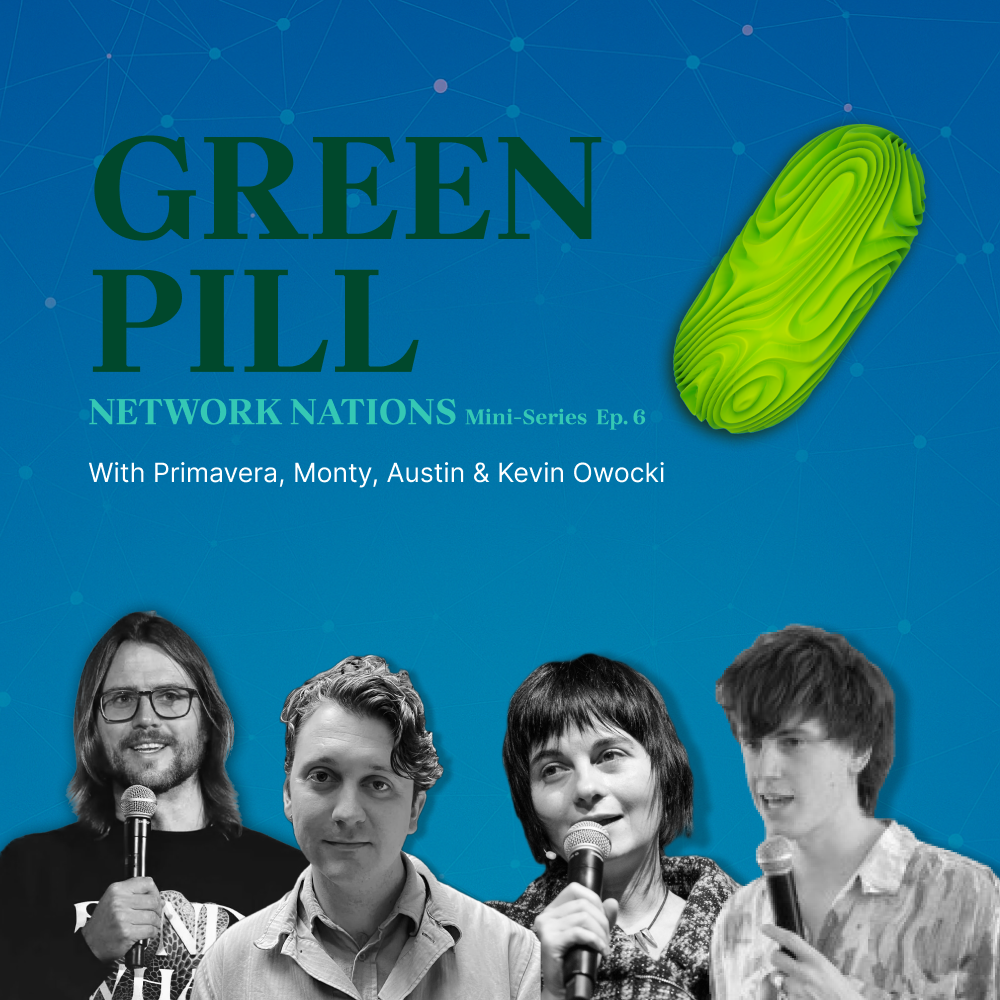
New @greenpillnet pod out today! 🌐 In this episode of the Network Nations mini-series, host Primavera De Filippi brings together Kevin Owocki (Greenpill / Gitcoin), Austin Wade Smith(Regen Network), and Monty Merlin (ReFi DAO) to explore whether the global Regen movement is evolving into a proto–Network Nation. They discuss Regen's shared identity, the rise of ecological state protocols, DAO-of-DAOs coordination, distributed governance, bioregional + digital hybrid communities, and how entanglement, values, and collective purpose shape the next civic era. This is a foundational conversation for anyone interested in how ecological stewardship, Web3 coordination, and cultural identity can weave into a new form of civil society. 🌐 networknations.network 🌱 greenpill.network @owocki @_newcubes_ @MontyMerlin_ @greenpillnet Timestamps 00:00 – Cold open 00:59 – Welcome to the Network Nations mini-series 02:20 – Meet the guests: Kevin, Austin & Monty 03:22 – Is the Regen movement a proto–Network Nation? 05:13 – Austin: How Regen Network began 09:25 – Kevin: Gitcoin, Greenpill & regenerative culture 13:40 – Monty: The origins of ReFi DAO 17:31 – Are Regen communities forming a "network of networks"? 19:10 – Shared Regen identity & culture 21:32 – Holding digital and bioregional worlds together 23:46 – Activism vs community-driven identity 26:09 – What makes someone a "Regen"? 29:07 – Mission-driven vs identity-driven motivation 32:45 – Is Regen becoming a nation-like identity? 38:17 – What "nation" means for Greenpill 40:33 – Toward Ethereum localism & civic public goods 42:00 – How the Regen groups collaborate today 47:12 – DAO of DAOs: emerging interwoven coordination 49:32 – What is "entanglement" between communities? 51:30 – Structural vs economic entanglement 54:40 – Reputation as a binding force 56:30 – Co-living & real-world Regen communities 58:23 – The next step: unlocking capital flows 01:00:35 – How a Regen Network Nation might emerge 01:04:16 – Closing thoughts from guests
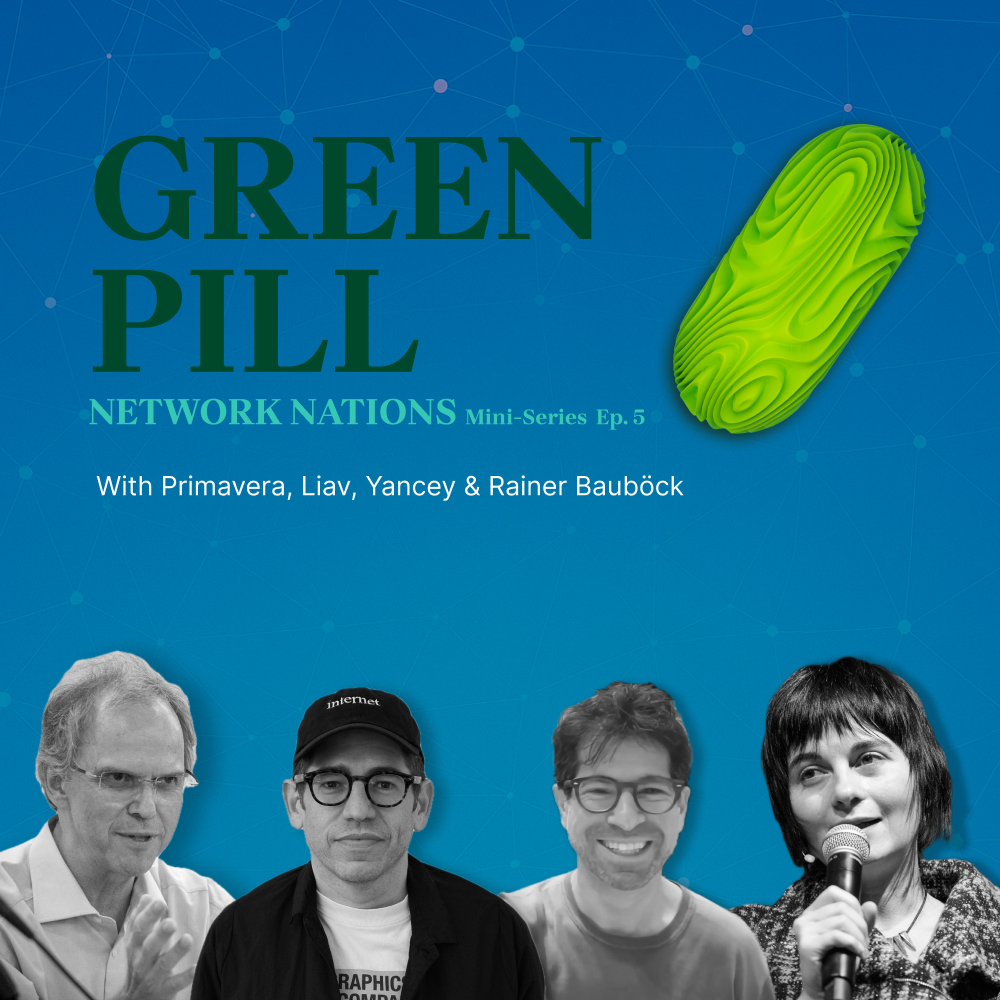
New @greenpillnet pod out today! 🌐 In this episode of the Network Nations mini-series, host Primavera De Filippi sits down with Liav Orgad, Rainer Bauböck, and Yancey Strickler to explore one of the biggest questions of the digital age: Can communities built online become real political communities or even nations? They discuss how digital proximity, shared identity, translocal culture, and decentralized governance may lead to new forms of belonging beyond borders. The conversation dives into nationhood, coercion vs. voluntary membership, diaspora models, digital tribes, "dark forests," and what political agency looks like when communities coordinate across the world without territory. 🎧 Learn more → networknations.network 🌱 greenpill.network 🐦 @owocki @greenpillnet x.com/OrgadLiav x.com/ystrickler https://www.ystrickler.com/ 🌐 Timestamps 00:00 – Cold Start 00:29 – Welcome to the Network Nations mini-series 01:31 – What are network nations? A new space for civil society 03:53 – Introducing today's guests 05:22 – Are translocal digital communities forming new identities? 07:42 – Digital proximity vs territorial proximity 09:52 – Are these real political communities or just civil society? 12:13 – Coercion, birthright, and the nature of political membership 13:41 – Cloud communities vs nation-states 15:57 – Crisis of governance and the need for new models 17:58 – Internet culture reshaping society 20:21 – Will digital communities become private states? 22:36 – Intrinsic purpose vs instrumental communities 24:46 – Can network nations scale without becoming homogeneous tribes? 27:08 – Internet power, dark forests & new kinds of institutions 29:27 – How culture emerges in online spaces 31:31 – Are we witnessing a new form of governance? 33:35 – What's actually "new" about network nations? 38:00 – Identity, ethnicity & digital self-government 40:15 – Diaspora parallels and non-territorial belonging 42:34 – Overlapping sovereignties & cross-border kinship 44:56 – Religion & non-territorial governance analogies 46:23 – Redistributing political power beyond the state 48:37 – Tribalism vs human flourishing 50:38 – Closing reflections + where to follow the guests
New @greenpillnet pod out today! 🌐 In this episode of the Network Nations mini-series, hosts Primavera De Filippi explore the idea of entanglement the voluntary interdependencies that turn loose networks into cohesive, resilient communities. They're joined by Jon Hillis (Cabin / Neighborhood Village Project) and Timour Kosters (EdgeCity), two builders experimenting with new forms of communal life. Together they discuss how DAOs, pop-up cities, shared rituals, physical infrastructure, and collective work can create the deeper social ties needed for future network nations. If you're curious how civil society can organize beyond states and startups through kinship, cooperation, and shared purpose this conversation is foundational. 🌐 networknations.network 🌱 greenpill.network 🐦 @owocki @timourxyz @JonathanHillis @greenpillnet 🌐 Timestamps 00:00 – Cold Start 01:02 – What are Network Nations? Communities as shared commons 02:20 – Theme of the episode: entanglement as voluntary interdependence 03:26 – Introducing guests: Jon Hillis (Cabin) & Timour Kosters (EdgeCity) Origins & Stories 05:08 – John's story: leaving Instacart to build a village in Texas 07:15 – The Cabin experiment and why the DAO eventually shut down 09:00 – Governance stalemate: misaligned token-holder incentives 10:39 – Timur's story: Zuzalu, EdgeCity & pop-up civic experiments 12:56 – Why pop-up villages unlock deeper, experimental governance Community, Infrastructure & Entanglement 14:55 – Community vs infrastructure: which comes first? 17:19 – Why communities deepen through building things together 19:15 – Doing as a means to the end: community itself 20:40 – Co-creation at EdgeCity: rituals, workshops, shared work Citizens vs Users 23:04 – The identity question: are members users, consumers, or citizens? 25:05 – Why financial incentives conflict with community values 27:26 – The tension between startups, DAOs & community networks 29:46 – Events create more value than the event business model The Commons & Institutional Dualities 31:29 – Government vs startups: opposite systems, opposite incentives 33:41 – Entanglement as an alternative to monitoring & sanctions 35:42 – Why scale changes everything in community coordination 38:04 – Social debt & reciprocity as natural entanglement Examples of Entanglement in Practice 40:01 – Why people volunteer without financial incentives 42:23 – Imagined communities: identity across thousands 44:31 – Social entanglement vs economic & structural entanglement Levels of Entanglement 46:38 – The four layers: social → cultural → economic → structural 48:35 – Why "forced entanglement" risks cult dynamics 50:55 – Healthy communities rely on voluntary exit 53:05 – Entanglement as a continuum: user → participant → citizen Future Mechanisms 54:58 – What future entanglement systems might look like 57:04 – Missing pieces: identity layers, governance, shared resources 59:02 – Why place is the strongest form of entanglement Closing 01:00:16 – Explaining entanglement to a 5-year-old: interdependence 01:01:42 – Final words from John & Timour
New @greenpillnet pod out today! 🌐 Hosted by Primavera De Filippi & Felix Beer, this episode of the Network Nations mini-series explores how commons, mutualism, and entanglement form the backbone of resilient, self-organizing communities. Joined by Sara Horowitz (founder of the Mutualist Society & Freelancers Union) and Michel Bauwens (founder of the P2P Foundation), they discuss how collective ownership, cooperative economies, and peer-to-peer networks can transform civil society into interconnected network nations. Together, they unpack the difference between commoning and mutualism, the importance of trust and solidarity, and how local cooperation can scale into a global fabric of shared governance. 🎧 Learn more → networknations.network 🌐 greenpill.network Mutualistsociety.net https://p2pfoundation.net/ https://4thgenerationcivilization.substack.com/ 🐦 @owocki @Sara_Horowitz @mbauwens | @greenpillnet | 🌐 Timestamps 00:00 – Welcome to the Network Nations mini-series with Primavera De Filippi & Felix Beer 01:30 – Introducing guests: Sarah Horowitz (Mutualist Society) & Michel Bauwens (P2P Foundation) 03:30 – What are the commons and how communities organize through shared resources 05:30 – Michel on the evolution from free software to Web3 and local commons 07:40 – How open collaboration shifted toward community self-reliance 09:30 – From cooperation to solidarity: why communities need mutual care 10:40 – When institutions fail, communities must organize for themselves 12:00 – Sarah's work with freelancers and the rise of mutualist organizing 13:40 – The three principles of mutualism: solidarity, economic mechanism, and longevity 15:00 – How commoning and mutualism interconnect historically 17:00 – The role of capital and appropriate funding for mutualist systems 18:40 – Scaling solidarity: from patchworks of local groups to federated networks 20:20 – Michel on cosmopolies and non-territorial governance throughout history 22:00 – The blockchain paradox: ideology as glue for coordination 23:30 – Why transcendent values or shared myths matter for collaboration 25:00 – Defining entanglement the bonds between communities and shared kinship 27:40 – Michel's "archipelago of regenerative villages" model 30:00 – How regenerative projects can attract capital and resilience 31:30 – Bioregional and cosmolocal models of solidarity 33:00 – Sarah on federations, unions, and historical models of coordination 35:00 – Rethinking "exit": from isolation to interdependence 37:20 – Why interdependence is strength, not weakness 38:30 – The lost baton of institutional knowledge in Web3 governance 39:50 – Delegation, iteration, and the relearning of organizational design 42:00 – Network Nations as additive systems, not exit systems 43:20 – Building power through the commons and mutualism 45:30 – From individual sovereignty to collective agency 47:10 – Building mutualist tech infrastructure for self-financing communities 49:20 – The disconnect between coders and communities — and how to bridge it 51:10 – Learning from what works: local experiments that can scale 53:00 – The role of "deep dives" in connecting commons, co-ops, and Web3 builders 55:00 – Why sensemaking and learning infrastructures are key for coordination 56:30 – Sarah on the "pods" model — ecosystems for mutual learning 57:40 – Network Nations as a convergence point for adjacent movements 59:10 – Building open, kind, and politically diverse collaboration cultures 01:01:20 – Avoiding the tragedy of the commons through entanglement and shared trust 01:05:00 – The SMART Co-op model for freelancers as a transnational example 01:07:00 – Low-hanging fruit: building local capital pools for community resilience 01:08:40 – Closing thoughts and invitations to join the movement
New @greenpillnet / Network Nations pod out today! 🌐 Hosted by Primavera De Filippi & Felix Beer, this episode dives deep into the power of narratives and memes in shaping our political and digital realities. Joined by Douglas Rushkoff (author of Team Human) and Jordan Hall, the conversation explores how memes, culture, and technology can either reinforce control or unlock bottom-up coordination for the next evolution of civil society — the Network Nation. 🎧 Learn more → networknations.network 🌐 greenpill.network 🐦 @owocki @jgreenhall @DoRushkoff12280 @greenpillnet 🌐 Timestamps 00:00 – Welcome to the Network Nations mini-series 00:40 – What are Network Nations and how do they differ from Network States 02:10 – Guests introduction: Douglas Rushkoff & Jordan Hall 03:00 – The collapse of old narratives and rise of new civic imagination 05:00 – Why digital culture is in a "Cambrian explosion" of governance ideas 06:40 – The weirding of the internet: from utopia to techno-feudalism 08:30 – Distrust in institutions and the survivalist mindset of elites 10:10 – Early internet libertarianism vs modern corporate libertarianism 12:00 – How early digital culture valued autonomy, play, and exploration 13:40 – The internet's shift from freedom to corporate control 15:20 – Reclaiming autonomy from both state and corporate systems 17:00 – Narratives of scarcity, power, and the post-collapse mindset 19:00 – Reflections on the early hacker ethos and DIY digital communities 21:00 – How the internet once embodied kinship, trust, and shared purpose 23:00 – From open networks to centralized control — lessons learned 25:20 – Autonomy through interdependence: power of collective networks 27:40 – Natural metaphors for networks — mycelium, rhizomes, and fractals 29:00 – The self-organizing optimism of early digital movements 30:20 – Why Network Nations need stronger bonds than online affinities 32:00 – Kinship vs affinity: building trust beyond algorithms 33:50 – How corporate platforms hijacked online social energy 35:20 – The challenge: reviving thick relationships in digital culture 37:00 – Why the commons struggle to produce visible leaders 39:20 – Leadership, ontology, and rediscovering stewardship of the commons 41:00 – What real leadership looks like in post-capitalist communities 43:00 – The myth of the heroic individual vs networked leadership 45:00 – Designing a new coordination environment: culture as protocol 47:00 – Crafting memes that attract the right minds and builders 49:30 – The tension between exclusivity and scale in movement-building 51:30 – How to create viral narratives that promote civic health 53:30 – Building memes around shared human needs, not resentment 55:10 – The recipe for powerful memes: sticky form + transformative code 57:20 – From broadcast politics to interactive, personalized virality 59:20 – Designing "anti-rivalrous" memes that make participants stronger 01:02:00 – Closing thoughts: crafting narratives for the network age
New @greenpillnet season out now! 🌐 Hosted by Primavera De Filippi and Felix Beer, this episode kicks off a new Greenpill Mini-Series exploring Network Nations — translocal communities that use technology, shared culture, and bottom-up governance to organize beyond borders. They discuss how Network Nations differ from Network States, the roots of this idea in commons-based governance, and how digital sovereignty, culture, and Web3 tools can empower civil society to act collectively across the world. 🎧 Learn more → https://networknations.network 🌐 https://blockchaingov.eu | https://greenpill.network 🐦 @owocki @greenpillnet 🌐 Timestamps 00:00 – Cold start 01:05 – Welcome to the new season hosted by Primavera De Filippi & Felix Beer 02:30 – What are Network Nations and why they matter 03:50 – Network Nations vs Network States: key differences 05:00 – Season formats: Deep Dives and Community Spotlights 06:00 – Origins of the Network Nations concept 07:40 – Early gatherings: Zuzalu, EdgeCity, and Emerge Lakefront 09:30 – Bridging theory and practice: researchers meet practitioners 11:30 – Defining Network Nations: translocal and interconnected communities 12:30 – The meaning of translocality: networks that empower local nodes 14:00 – From online groups to shared culture and identity 15:20 – Networks of networks: building community at scale 16:50 – Internal vs external purpose: culture and collective impact 18:00 – Collective action as a way to strengthen community 19:10 – Balancing scale and trust: connecting networks and communities 20:50 – Building trust-rich relationships across global networks 23:00 – Case study 1: Burning Man as a translocal culture 25:00 – Case study 2: Regen Network and regenerative coordination 27:00 – Comparing cultural and infrastructural approaches 28:30 – Cross-pollination between Web3 and social movements 29:15 – Why use the word "Nation" instead of "Community"? 30:40 – Reclaiming the term "Nation" beyond nationalism 32:00 – Detaching nations from states: a new political lens 33:20 – Functional sovereignty: autonomy without territory 34:00 – Balaji's Network State model and its limitations 36:00 – The Network Nation's non-territorial approach to governance 38:00 – Communities coexisting with states through functional sovereignty 40:00 – Sovereignty as a collective good, not a product 42:00 – The commons as a third path beyond market and state 44:00 – Overlapping sovereignties vs exit-based systems 46:00 – How Web3 enables distributed governance infrastructures 48:00 – Independence from big tech and value-biased algorithms 50:20 – Empowering civil society through translocal coordination 52:00 – Network Nations as a meta-political framework 54:00 – Diversifying global governance and emerging experiments 55:00 – Building the Network Nations Alliance and community platform 57:00 – Beyond Web3: connecting bioregional and intentional communities 59:00 – How to get involved: calls, Telegram, and collaboration 01:00:20 – Closing reflections: building the next generation of network-native institutions
In this episode of the Green Pill Podcast, Kevin Owocki and co-host Devansh Mehta sit down with Vitalik Buterin for their annual deep dive into the future of public goods funding in the Ethereum ecosystem. They explore where funding will come from in 2026, how the landscape has shifted from "vibes-based" funding to verifiable, dependency-driven mechanisms, and why this is the best moment to reform PGF using new tools like programmable cryptography, AI-assisted evaluation, and deep funding models. Vitalik also shares how he thinks about dependencies, credible neutrality, open-source licensing, pluralism, accountability, and what builders should prioritize in the coming year. A must-listen for anyone designing mechanisms, funding public goods, or building the next era of Ethereum governance. 🌱 https://greenpill.network https://x.com/owocki https://x.com/greenpillnet https://x.com/VitalikButerin https://x.com/TheDevanshMehta 🌐 Timestamps 00:00 – Welcome to the Green Pill Podcast 01:50 – Vitalik joins: why public goods funding matters 02:19 – Why PGF is essential for decentralization 04:18 – The crypto spirit: censorship resistance, institutional design & funding 06:42 – The shift from vibes-era PGF to verifiable mechanisms 08:25 – Why 2026 is the best moment to reform PGF 10:19 – Where does PGF money actually come from? 12:45 – Open-source licensing, taxes & funding dependencies 17:34 – "Fund your dependencies" as a stable mechanism 19:35 – Why general-purpose QF doesn't work in a chaotic world 21:59 – Bottom-up vs top-down: polycentric PGF 25:29 – How to create accountability loops in public goods 27:22 – Funding open-source as an Ethereum priority 29:31 – Privacy as a public good & why it's upstream of PGF 31:54 – What OSS developers really think about crypto 33:52 – Mixing social outreach with financial support 35:56 – What should PGF builders focus on in 2026? 38:13 – Work with new projects, not legacy ones 39:44 – Ecosystem cycles & "layers of sediment" 41:39 – Yield-based funding (Octant) & treasury strategies 43:40 – Accountability: from vibes to rigorous mechanisms 47:35 – Motivation, feedback & the psychology of public goods 50:43 – Profit sharing licenses & sustainable PGF pools 53:46 – Security, issuance & public goods 56:12 – Technology, democracy & long-term risks 58:31 – How PGF relates to DIAC (Defensive/Decentralized Acceleration) 01:00:05 – Solving the free-rider problem without coercion 01:02:12 – Mechanisms vs coercion: credible neutrality 01:04:16 – Institutions, power & capture risks 01:06:16 – Individuals vs institutions in PGF 01:08:41 – Why PGF is more error-tolerant than governance 01:11:01 – Pluralism: many funders, many mechanisms 01:13:14 – Why diversity of funders is healthy 01:15:17 – What Vitalik wants built next 01:17:12 – Ethereum localism & real-world experiments 01:19:28 – What success in PGF looks like by end of 2026 01:24:28 – Closing thoughts

New pod and a *NEW BOOK* out today! Kevin sits down with Daniel Ospina and Daniel Stringer from RnDAO to introduce their new book:The Network Firm: How Capital Allocation Changes in the Age of Blockchain and AI. They explore how the traditional theory of the firm is being transformed by lower coordination costs, AI-driven cognition, and blockchain-powered trust enabling a new era of open, fluid, network-native organizations. Together they break down how legacy bureaucratic structures dissolve when work becomes legible, global, and composable and why the next century of coordination will be shaped by networks, not firms. 🎧 Download the book → https://allocapital.metalabel.com Timestamps 00:00 – Welcome to the new Green Pill season 00:40 – Introducing the book: The Network Firm 01:39 – Meet Daniel Ospina & Daniel Stringer (RnDAO) 03:37 – What is a "network firm"? 04:57 – How blockchain & AI lower coordination costs 07:05 – Why traditional firms are slow & rigid 09:22 – Milestones, grants & broken incentives 11:19 – Freelancing vs companies: real coordination friction 12:39 – Case study: GainForest 14:05 – Using AI to verify real-world work 15:03 – Blockchain for global capital distribution 16:07 – Web2 lowered some costs, Web3 lowers all 18:33 – Turning passive scrolling into active co-creation 19:40 – Who should own the networks we build? 20:28 – Utopia, dystopia nothing is guaranteed 22:45 – Why design choices matter 23:13 – Invitation: help build new organizational forms 24:40 – Legitimacy vs speed in new systems 25:23 – Final thoughts from the authors 26:40 – Where to get the book
New @greenpillnet pod out today! 🌍 Kevin chats with Ellie Hain writer, facilitator, and co-founder of the Meaning Alignment Institute (MAI) about how we can rediscover meaning, presence, and purpose in the 21st century. Ellie explores why so many people across modern society, tech, and culture feel disconnected, and how re-attunement to life, community, and ritual can help us restore the sacred in our everyday lives. Together, they discuss the meaning crisis, why it's emerging now, and how new institutions might integrate purpose, beauty, and values into the systems we're building for the future. 🎧 Links: 🌐 greenpill.network 🐦 @ellie_hain | @owocki | @greenpillnet 🎥 Exit the Void: by Ellie Hain https://www.youtube.com/watch?v=BqB-1ABZJSM 🌿 Timestamps 00:00 – Welcome to a new Greenpill season: exploring technology, coordination & Protopia 01:00 – Introducing guest Ellie Hain, co-founder of the Meaning Alignment Institute 02:20 – How Ellie began her journey into meaning, mysticism, and systems 04:30 – The tension between inner experience and societal expectations 05:30 – Exploring meaning as attunement to life 07:00 – Sovereignty and interdependence: dancing between individuality and the web of life 09:40 – What attunement feels like presence as a lived experience 11:00 – Exercise: reconnecting to meaningful moments 13:00 – Embodiment, resonance, and listening to life's signals 15:00 – Why meaning is our birthright, not something to earn 17:10 – The "meaning crisis" why so many feel disconnected today 19:00 – From numbness to re-sensitization: healing modern disconnection 21:00 – How modern systems desensitize us to what's sacred 22:40 – The resilience and strength in seeking meaning 25:00 – Designing extitutions: new systems that embed meaning and purpose 27:30 – Moving beyond homo economicus: building for homo sapiens 30:00 – Institutions as reflections of human nature and sensitivity 32:40 – The concept of containers for meaning and how they become corrupted 34:10 – What new containers for meaning look like in the 21st century 36:00 – Community, ritual, and story as ancient technologies for belonging 38:30 – Raves, festivals, and modern rites of passage 40:10 – The search for a new unifying narrative in the digital age 41:30 – Why the quest for meaning is the defining work of this century 43:00 – Facing pain and shadow as part of transformation 44:20 – Allocating meaning and capital together through rituals & community 46:00 – Meaning alignment as the next frontier of institutional design 47:00 – Closing reflections: finding beauty, purpose, and connection in everyday life
New @greenpillnet pod out today! Kevin talks with Akseli Virtanen, co-founder of the Economic Space Agency (ECSA), along with co-authors Dick Bryan and Jorge Lopez, about their groundbreaking book Protocols for Post-Capitalist Expression. They explore how capital is itself a protocol, how post-capitalism can emerge through new economic grammars, and why distributed finance and programmable accounting could redefine value beyond markets and the state. If you've ever wondered how economics, coordination, and code might come together to create new forms of collective value, this episode is for you. 🌐 Links https://greenpill.network/ https://economicspace.agency 📘 Protocols for Post-Capitalist Expression (Book) https://postcapitalist.agency/# 🐦 @owocki @greenpillnet @econaut6 🌐 Timestamps 00:00 – Intro: Welcome to the new Greenpill season — exploring tech, coordination & Protopia 00:40 – Introducing guest Akseli Virtanen and co-authors Dick Bryan & Jorge Lopez 02:00 – What is Protocols for Post-Capitalist Expression about? 03:20 – Computational networks as new economic media 04:00 – The problem: today's systems run on outdated economic logic 05:10 – Why we need new economic languages to express ecological and social value 06:20 – Viewing the economy as a networking protocol 07:00 – Capital as a coordination protocol, not a natural law 08:40 – How protocol politics define power and participation 09:40 – Why political change must happen at the level of infrastructure 11:20 – Understanding capital as an accounting protocol 12:10 – The interdisciplinary process of co-authoring the book 13:30 – Why protocols are the new unit of economic intervention 14:50 – How distributed protocols can re-engineer value systems 16:00 – Multiple logics of measurement: beyond price and profit 17:40 – How new metrics of "use value" redefine what counts as surplus 19:20 – Defining post-capitalism: new grammars for value creation 20:00 – Living "in the spread" between capitalism and post-capitalism 21:30 – The shift from exchange value to use value 23:00 – Distributed economic agency: moving power to the network edge 25:30 – Defining the Economic Space Agency — what it means to co-author economies 27:30 – Surplus logic: from profit to utility 29:00 – Designing programmable economic spaces for collective value 30:50 – How post-capitalism can interoperate with existing markets 33:10 – Why public goods need new accounting categories 35:00 – Coordination beyond the state: self-sustaining networks of value 37:00 – The liquidity problem: bootstrapping new economic systems 38:30 – Designing a bridge between capital and post-capital 40:20 – Respecting both systems' internal logics for sustainable coexistence 42:30 – Innovation: the bridge as a design breakthrough 44:00 – Formalizing economics in programmable code 45:40 – How distributed systems expand what's economically possible 47:30 – How to get involved: joining ECSA's newsletter & Economic Media Lab 48:30 – Final reflections: multiple metrics of value and economic imagination 49:10 – Closing remarks: keep building, experimenting, and coordinating
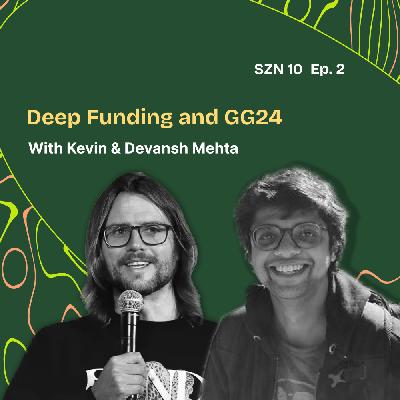
New @greenpillnet pod out today! 🌱 Kevin chats with Devansh Mehta about Deep Funding — an AI-powered mechanism combining human judgment and prediction markets to fund open-source projects. They dive into how it scales evaluations, prevents Sybil attacks, and builds a fair "price feed" for public goods ahead of Gitcoin Grants 24 (GG24). Links: 🌐grants.gitcoin.co 🌐 deepfunding.org 🌐 deep.seer.pm 🌐 greenpill.network 🐦 @owocki @greenpillnet ⏱️ Timestamps 00:00 – Intro: Welcome to the Greenpill Podcast – exploring tech, coordination & Protopia 00:45 – Introducing guest Devansh Mehta, AI & Public Goods Lead at the Ethereum Foundation 01:20 – What is Deep Funding and why it matters 02:00 – How Deep Funding scales human evaluations with AI models 02:45 – Overview of the pilot run and what was tested 03:20 – How the mechanism works: human jurors + model builders 04:30 – The White Hat Sybil attack and what it revealed 05:40 – How Deep Funding integrates data science competitions and prediction markets 06:50 – Results of the pilot: weighted funding for 45 open-source repos 07:30 – Creating a credibly neutral funding system with unequal weights 08:40 – Comparing Deep Funding with Protocol Guild and other mechanisms 09:20 – Building a strong community of AI developers and human jurors 10:30 – The role of jurors and models in fair evaluation 11:10 – What's next: expanding to 90 repos in Gitcoin Grants 24 (GG24) 11:50 – Funding pool: $350K from Ethereum Foundation & Gitcoin 12:30 – Challenges of distributing capital efficiently and fairly 13:20 – Moving to GitHub repo-level governance: who controls the funds? 14:40 – Two models of spending: splits contracts vs counterfactual wallets 15:40 – Lessons from past Gitcoin funding rounds 16:20 – Why Deep Funding focuses on units of work, not organizations 17:20 – Avoiding distortions and improving fairness in funding 18:10 – The vision: creating a live price feed for public goods 19:10 – How prediction markets price open-source value 20:30 – Self-correcting market behavior and real-time adjustments 21:20 – Subsidies and liquidity: bootstrapping active participation 22:10 – Balancing liquidity levels to prevent manipulation 23:00 – What's next for Deep Funding: refining future iterations 23:40 – Shoutout to the model builders and competition winners 24:20 – Where to learn more: deepfunding.org & deep.seer.pm 25:00 – Closing: the future of AI, governance, and funding what matters
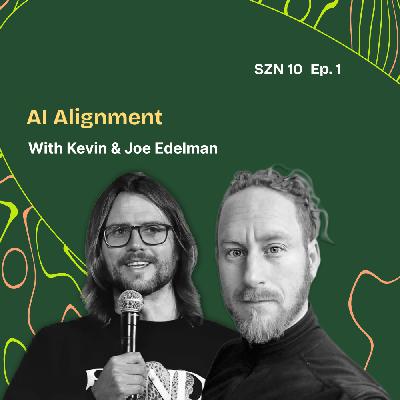
New @greenpillnet pod! Kevin chats with Joe Edelman, founder of the Meaning Alignment Institute, about his Full Stack Alignment paper. They dive into why current AI alignment methods fall short, explore richer "thick" models of value, lessons from social media, and four bold moonshots for AI and institutions that support human flourishing. Links: https://meaningalignment.substack.com/p/introducing-full-stack-alignment https://meaninglabs.notion.site/The-Full-Stack-Alignment-Project-List-21cc5bada1d08016a496ca729476d970 @edelwax @greenpillnet @owocki Timestamps: 00:00 – Introduction to Green Pill's new season and Joe Edelman 01:59 – Joe's background and the Meaning Alignment Institute 03:43 – Why alignment matters for AI and institutions 05:46 – Lessons from social media and the attention economy 09:06 – Critique of shallow AI alignment approaches (RLHF, values-as-text) 13:20 – Thick models of value: going deeper than abstract ideals 15:11 – Full stack alignment across models, metrics, and institutions 17:00 – Reconciling values with capitalist incentive structures 19:17 – Avoiding dystopian economies and building value-driven markets 21:32 – Four moonshots: super negotiators, public resource regulators, market intermediaries, value stewardship agents 27:32 – Intermediaries vs. value stewardship agents explained 29:09 – How builders and academics can get involved in full stack alignment projects 31:10 – Why cross-institutional collaboration is critical 32:46 – Joe's vision of the world in 10 years with full stack alignment 34:51 – Food system analogy: from "sugar" to nourishing AI 36:40 – Long-term vs. short-term incentives in markets 38:25 – Hopeful outlook: building integrity into AI and institutions 39:04 – Closing remarks and links to Joe's work

Comments

Download from Google Play

Download from App Store
 United States