


 Claim Ownership
GreenTruth
Subscribed: 0Played: 14
Subscribe

© TiiQu
Description
Calendar: https://tiiqu.com/greentruth
The GreenTruth Podcast, is dedicated to fostering honest and transparent conversations about critical environmental and sustainability issues. By seeking and speaking the truth, GreenTruth aims to build trust and collaboration, essential for a sustainable future. TiiQu supports this initiative to promote the values of truth and trust, which are fundamental to their mission of developing technologies for a better world.
GREENTRUTH SLACK: https://join.slack.com/t/greentruth/shared_invite/zt-2dlrstc0h-wXAQ2RdgiGj6ga7b5Oz1lQ
ABOUT TIIQU : https://tiiqu.com
28 Episodes
Reverse
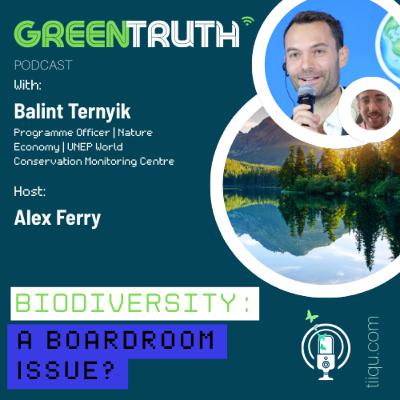
Nature is not a side issue. It is the foundation of the global economy, and its silent risk.In this GreenTruth episode, Alex Ferry speaks with the Balint Ternyik - Programme Officer at UNEP-WCMCabout why over half of global GDP depends on nature, how tech infrastructure quietly relies on water and climate stability, and why biodiversity loss is now a boardroom issue. We explore tools like IBAT and ENCORE, TNFD adoption, and the shift toward making “every job a nature job.”This conversation reframes nature from externality to infrastructure , and challenges leaders to redesign growth before ecological risk becomes economic instability.🎧 What Listeners Will Take AwayBy the end of this episode, listeners will:✔ Understand how deeply modern economies, especially tech , depend on natural systems✔ Recognize biodiversity loss as a material business and financial risk✔ Learn how companies can identify exposure through spatial screening and value-chain analysis✔ Gain insight into actionable frameworks like TNFD LEAP✔ See how integrating nature into everyday roles - from procurement to strategy - drives real change✔ Walk away with a clearer roadmap for embedding nature-positive decision-making into enterprise operationsGreenTruth podcast is a TiiQu initiative to support reliable information sharing . Learn more about TiiQu at https://tiiqu.com
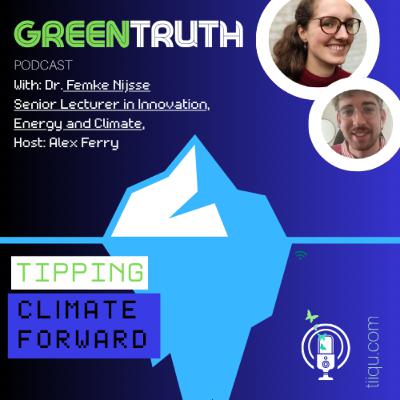
In this episode, climate researcher Dr. Femke Nijsse interviewed by Alex Ferry, explains how positive tipping points—self-reinforcing shifts in technology, policy, and behavior—can accelerate global decarbonisation. From electric vehicles to solar energy and urban cycling, she explores how small changes can lead to irreversible and desirable transformations, and what individuals and governments can do to help trigger them.✅ Three Major TakeawaysPositive Tipping Points Are Real and ReachableStrategic changes—like subsidies or mandates for EVs—can spark self-reinforcing feedback loops that drive rapid adoption and cost reductions in clean technologies.Cascading Effects Multiply ImpactOne tipping point (e.g. cheaper EV batteries) can trigger others across sectors—from energy storage to transport—amplifying progress toward net zero.Policy and Public Perception Must AlignPolitical courage is needed: even unpopular policies (like banning cars in city centers) can become widely supported once people experience their benefits. Strong mandates and cheaper electricity are key enablers.Follow GreenTruth https://tiiqu.com/greentruthLearn about TiiQu and TruthTechhttps://tiiqu.com
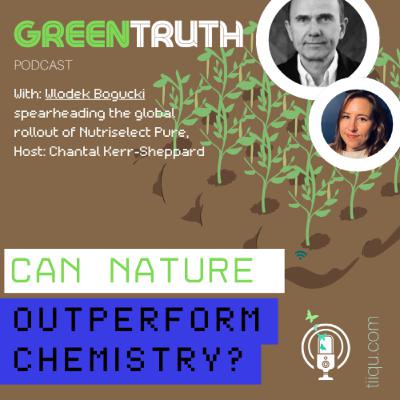
In this episode of GreenTruth, Chantal Kerr-Sheppard sits down with Wlodek Bogucki—a man whose life journey spans from fighting for freedom in Poland’s Solidarity movement to shaping global finance, and now, revolutionizing sustainable agriculture. Wlodek is spearheading the global rollout of Nutriselect Pure, a new organic mineral fertilizer that just might outperform its synthetic counterparts. We explore whether nature can not only compete—but actually win—and why it's still so hard to scale green tech that works.From Rebel to Regenerator: Wlodek's personal journey—from political exile to private banking and back to agriculture.A Breakthrough Fertilizer: Why Nutriselect Pure could be the first natural product to outperform synthetic fertilizers by 20–30%.The Fertilizer Dilemma: Organic = low yield. Synthetic = soil degradation. Is there a third way?Natural Turbocharge: How activating soil bacteria supercharges nitrogen absorption—without pollution.Precision Meets Organic: For the first time, a measurable, consistent, and scalable natural fertilizer.The 120-Year Stalemate: Why innovation in agriculture has been so slow—and why this might be the game-changer we’ve been waiting for.A Third Way for FarmingNutriselect Pure promises to be more organic than traditional fertilizers and more effective than synthetics — a proposition that’s shaking up assumptions in the agricultural world.Winning Over the ScepticsWhile early adopters (mainly farmers in Poland and Turkey) report 20–30% yield boosts, institutional testing is now a key focus to silence doubts and earn scientific validation globally.Global Green Yield Discovery VoyageA bold initiative to distribute free fertilizer to universities, institutes, and ag leaders across all continents — asking only one thing in return: "Test and measure."Systemic Barriers to InnovationDespite EU claims of prioritizing green innovation, Wlodek has encountered silence from regulators and institutional gatekeepers — even with certified organic status in hand.Economic UpsideNutriselect Pure competes with premium synthetics on price, but can boost farm profitability by 40% through improved yields and soil health — reshaping ROI for farmers.Lowest Carbon Footprint FertilizerThe product isn't just good for soil and plants — it also reduces emissions, offering a win for climate-focused industries from textiles to food production.Unscalable Good IntentionsEU green farming funds are currently focused on local, non-scalable projects. Wlodek makes the case: “We can green the entire continent — if someone just picks up the phone.”Private Funding, Public IronyWithout public sector support, Ticuna must rely on private capital — ironically risking monopolization of the very innovation that could democratize ecological farming.Advice to Changemakers“Don’t expect applause. Budget more time. Expect resistance. And never give up.” Wlodek’s hard-earned advice for innovators facing institutional inertia.________________________________________________All GreenTruth episodes here supported by TiiQu , part of the TruthTech ecosystem
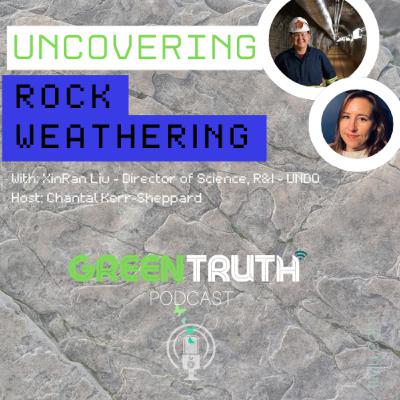
The IPCC has stated that by 2050, we must remove 10 to 17 billion tonnes of CO₂ every year to stay on track with climate goals. Enhanced Rock Weathering (ERW) has the potential to contribute a significant share toward that target — and 2050 isn’t far away.In this episode, we invited XinRan Liu from UNDO — one of the four global winners of the $5 million XPRIZE Carbon Removal competition — to help us explore how Enhanced Rock Weathering works. ERW is a natural process where rainwater interacts with silicate rocks, locking away CO₂ permanently over geological timescales.Enhanced Rock Weathering taps into these natural mechanisms, but boosts their efficiency. XinRan explains how existing global industries, like construction aggregates, already crush massive amounts of silicate rock — making it more energy- and cost-efficient to repurpose these byproducts for scalable carbon removal.In this conversation, we’ll answer key questions:🔹 How did UNDO prove Enhanced Rock Weathering actually works?🔹 How are unintended negative consequences monitored?🔹 What incentives are there for farmers to participate?🔹 What are the biggest barriers to adoption?🔹 How can governments support the growth of Enhanced Weathering?Host: Chantal Kerr-Sheppard______________Learn about GreenTruth at https://tiiqu.com/greentruth
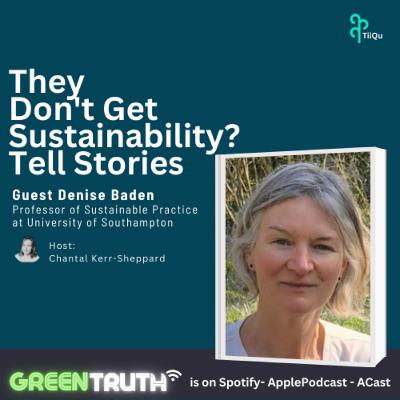
In this episode, host Chantal Kerr-Sheppard is joined by Professor Denise Baden from the University of Southampton, who shares her approach to communicating climate change and sustainability beyond the "green echo chambers." Professor Baden explains how she transitioned from academia to public-facing work through the Green Stories Project, which aims to integrate sustainable behaviors into mainstream fiction, such as romance novels or thrillers. By subtly embedding sustainability in relatable contexts, she seeks to normalize eco-friendly choices, like opting for second-hand fashion or reducing food waste. What you’ll take away from this episode:The key role of transparency in driving sustainability efforts.How data and technology can help track and reduce environmental impact.Practical steps that businesses can take to create positive environmental change.Real-life examples of successful eco-conscious practices.How individuals can contribute to sustainability in their everyday lives.The future of environmental responsibility in an increasingly tech-driven world.Connect with Prof. Denise Baden and the Green Stories project: https://www.dabaden.com/linkedin.com/in/denise-baden-3742793https://bsky.app/profile/dabaden.bsky.socialhttps://x.com/DABadenauthor(20+) Facebook Green Storieshttps://www.greenstories.org.uk/https://habitatpress.com/@greenstories.bsky.socialhttps://x.com/GreenstoriesUKhttps://www.facebook.com/Greenstoriessoton/https://instagram.com/greenstoriessotonhttps://www.youtube.com/@greenstoriesukAt the time we are writing, Denise Baden is launching a new novel via the crowdfunding platform, Kickstarter: https://www.kickstarter.com/projects/dabaden/murder-in-the-climate-assembly. It sets out a roadmap to a sustainable future in fiction form. Additional funds will go towards funding a new free Green Stories competition.__________________________________________________Follow GreenTruth on Spotify: https://open.spotify.com/show/6WupQ4LSqYOcecaXw95u3S?si=9878716832874a3aACast: https://shows.acast.com/667063433968d9a26ba962d6Apple Podcast: https://podcasts.apple.com/us/podcast/greentruth/id1752520471Browse truthful environmental information: https://qutii.orgLearn about TruthTech: https://tiiqu.com

Comments

Download from Google Play

Download from App Store
 United States