


 Claim Ownership
Heads and Tails
Subscribed: 21Played: 190
Subscribe

© Copyright 2025
Description
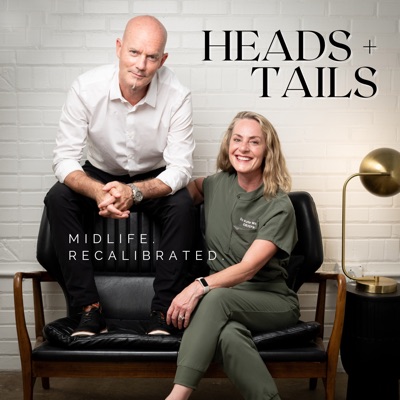
Heads and Tails is a candid, heartfelt and often humorous podcast hosted by longtime couple Jay and Kate White..
...a psychologist and an OB/GYN who've been married for 26 years. Named for their dual perspectives on the mind and body, this show dives into the real challenges of midlife with warmth, wisdom, and occasional glass of wine.
From navigating midlife dating or keeping the spark alive in long-term relationships, to launching kids, caring for aging parents, maintaining friendships, and even changing careers — Heads and Tails covers it all. With Jay's insight into the psychological and Kate's expertise in the physical, each episode offers practical, relatable advice in a tone that feels more like a conversation in your living room than a lecture.
Real talk. Real laughs. Real life. Because midlife isn't a crisis—it's a recalibration.
...a psychologist and an OB/GYN who've been married for 26 years. Named for their dual perspectives on the mind and body, this show dives into the real challenges of midlife with warmth, wisdom, and occasional glass of wine.
From navigating midlife dating or keeping the spark alive in long-term relationships, to launching kids, caring for aging parents, maintaining friendships, and even changing careers — Heads and Tails covers it all. With Jay's insight into the psychological and Kate's expertise in the physical, each episode offers practical, relatable advice in a tone that feels more like a conversation in your living room than a lecture.
Real talk. Real laughs. Real life. Because midlife isn't a crisis—it's a recalibration.
34 Episodes
Reverse
Grief isn't only what happens when someone dies. In midlife, we can find ourselves grieving parents, friendships, careers, our health, children leaving home, changing relationships, the bodies we used to have—and even futures we assumed we would have. In this episode of Heads & Tails, Dr. Kate White and marriage and family therapist Jay White explore grief from both sides of the equation: what happens in your head emotionally and psychologically, and what happens in your body when loss becomes acute or chronic stress. Kate explains why the phrase "dying of a broken heart" has some medical truth behind it, including Takotsubo cardiomyopathy—also called broken heart syndrome—which disproportionately affects postmenopausal women. They also discuss the physical effects of grief, including changes in stress hormones, cardiovascular health, sleep, nutrition, social connection, and overall health. Jay explores why grief doesn't follow a predictable timeline, why the familiar "five stages of grief" aren't a checklist, and why two people can experience the same loss in completely different ways. Kate and Jay also tackle some of the feelings people are often afraid to admit: relief after the death of someone who has been sick for a long time, guilt when you laugh or enjoy yourself again, delayed grief when life doesn't give you time to process a loss, and the tension that can develop when partners grieve at different speeds. They also talk about the losses that receive no funeral and often little recognition: retirement, an empty nest, changing identity, losing a career, losing the role of caregiver—and realizing that the people you love no longer need you in quite the same way. In this episode: • Why grief is ultimately connected to love • Disenfranchised grief and the losses we don't always acknowledge • Why the five stages of grief don't occur neatly or in order • The physical effects of acute and chronic grief • Takotsubo cardiomyopathy and "broken heart syndrome" • Why men and women may experience grief differently • Anticipatory grief and why relief after a death can be normal • Why grief, sadness, and depression are not the same thing • Delayed grief and what happens when life forces you to postpone mourning • When grief may warrant professional support • Why spouses and family members often grieve at different speeds • What not to say to someone who is grieving • How to support someone without trying to fix their pain • Finding new purpose and meaning after loss One of the biggest lessons from this conversation: different grief doesn't mean different love. And the goal isn't necessarily closure. It isn't forgetting. It is gradually learning how to remember without constantly reliving the pain—and eventually making enough room around the grief to begin living again. If this episode reminds you of someone who is grieving, consider sharing it with them. Heads & Tails is hosted by Dr. Kate White, gynecologist, menopause and sexual medicine specialist, and Jay White, marriage and family therapist. Together, they explore the biology and psychology of midlife—from your head to your tail.
What if menopause care didn't have to be a choice between conventional medicine and "natural" medicine? In this episode of Heads & Tails, Dr. Kate White and Jay White sit down with Dr. Suzanne Gilberg-Lenz, board-certified OB/GYN, integrative medicine physician, clinical Ayurvedic specialist, herbalist, breast cancer survivor, and author of Menopause Boot Camp. Together, they explore what menopause care can look like when we stop treating it as a one-size-fits-all problem. Dr. Suzanne reframes menopause as a developmental and physiologic transition—not simply a collection of symptoms to eliminate. She shares how she integrates conventional medicine with lifestyle interventions, botanicals, Ayurveda, mindfulness, and individualized hormone and nonhormonal options. They discuss: • Why perimenopause can leave women saying, "I just don't feel like myself." • Menopause as transformation rather than simply loss • What Ayurveda can teach us about individualized health and lifestyle • The difference between "natural" and automatically "safe" • Botanicals commonly discussed in menopause care, including chasteberry/Vitex, Siberian rhubarb, black cohosh, ashwagandha, and berberine • Why supplement quality, dosing, interactions, and sourcing matter • Hormone therapy—and why it should not be framed as the only tool available • Options for women who cannot or do not want to use systemic hormone therapy • Why sleep, exercise, resistance training, mental health, and stress regulation still matter even when using hormones • The changing gut microbiome in midlife • Why treatment sometimes requires experimentation, adjustment, and patience • How to find a clinician willing to listen, learn, and partner with you • Why trusting your own body can sometimes be lifesaving One of the biggest messages from this conversation: you do not have to choose a camp. Good menopause care can include evidence-based medicine, lifestyle, appropriate complementary therapies, curiosity, and shared decision-making. And perhaps most importantly: if something feels different in your body, keep asking questions. Heads & Tails — where midlife gets a reframe. Share this episode with a friend who is trying to figure out her own menopause toolkit, and send your questions to the Heads & Tails team. This podcast is for education and entertainment and does not substitute for individualized medical or mental health care.
In this episode of Heads & Tails, Dr. Kate White and Jay White unpack the difference between being disagreed with, dismissed, invalidated, misunderstood, and simply not listened to. Kate explores why dismissal can become particularly consequential for midlife women—in the doctor's office, at work, at home, and during the menopause transition. Jay explains why repeated dismissal breeds resentment and how couples can recognize when "I heard you" isn't the same as actually making someone feel heard. They discuss medical dismissal, menopause rage, the "Karen" stereotype, changing executive function, invisible workload, and why needing something different in midlife doesn't mean something is wrong with you. In this episode: • The five ways we can feel unheard • Dismissal vs. disagreement • Why "that's normal for your age" isn't always an adequate answer • Kate's own experience of having symptoms attributed to stress • Why resentment often points to an unspoken need • Menopause, mood, executive function, and "losing your filter" • Passive vs. aggressive vs. assertive communication • How to make specific requests at home, work, and in healthcare • Three powerful words: "Tell me more." The takeaway: Anger can be information. Instead of simply asking, "Why am I so angry?" ask, "What am I trying to say that isn't being heard?" Send us your questions at mailto:[email protected].
You planned the finances. You picked the date. But have you planned the life you want after retirement? Retirement can reshape your identity, marriage, health, intimacy, friendships, and sense of purpose—and being together all the time isn't always as easy as it sounds. In this episode, Dr. Kate White and Jay White explore how to make retirement not just an ending, but an intentional and fulfilling next chapter. In this episode: → The 3 phases of retirement—from honeymoon to reinvention → Finding purpose after leaving your career → What happens when one partner retires first → Balancing togetherness and independence → Asking your partner questions with curiosity, not judgment → Why more time together doesn't automatically mean more intimacy → Menopause, sexual health, and changing desire → Protecting your brain, bones, muscle, balance, and longevity → Friendships, community, downsizing, and where you choose to live → Creating a retirement based on your values—not someone else's checklist ❤️ The takeaway Don't just ask: "Can we afford to retire?" Ask: "How do we want to live?" Retirement isn't the finish line. It may be the beginning of your best next chapter. 🎙️ Follow Heads & Tails for conversations about marriage, menopause, intimacy, relationships, and the midlife recalibration. Share this episode with someone who's starting to think about what comes next.
When Is It Really Time to Retire? Everyone asks the same first question about retirement: "Do I have enough money?" But Dr. Kate White and marriage and family therapist Jay White think there are several questions you should ask before that—or at least alongside it. Will you be healthy enough to enjoy the retirement you've spent decades saving for? What will give you purpose when your career no longer structures your days? If you're married, are you and your partner imagining the same retirement? And perhaps the most important question of all: What are you retiring TO? In Part 1 of this two-part Heads & Tails retirement series, Kate and Jay explore the biology, psychology, finances, identity, health, and relationships behind one of life's biggest transitions. They discuss how health problems, caregiving responsibilities and burnout can push someone toward retirement before they planned—and why being financially able to retire doesn't necessarily mean you're emotionally ready. Kate makes the case that retirement planning should include more than a financial portfolio. Muscle, bone health, cardiovascular fitness, brain health, balance, sleep and social connection are all investments in your future independence. Jay explores what happens when work has been providing your purpose, achievement, routine, friendships, autonomy and sense of being needed—and suddenly it's gone. IN THIS EPISODE: • How do you know when it's actually time to retire? • Financially able vs. emotionally ready • The hidden healthcare costs of retirement • Why healthspan belongs in your retirement plan • Why muscle may be one of your most important retirement investments • Bone health, falls and maintaining independence • Cardiovascular and brain health for your next several decades • The psychological needs your career may be meeting without you realizing it • Purpose, achievement, autonomy, friendship, respect and intimacy after work • Why unlimited free time isn't always as wonderful as it sounds • Full retirement vs. consulting, volunteering or part-time work • What happens when one partner is ready to retire and the other isn't • Expectations around adult children and grandchildren • The deceptively simple question: "What does Tuesday look like?" • Why you need to retire to something, not simply from something QUESTIONS TO ASK BEFORE YOU RETIRE Ask yourself—and your partner: What scares me most about retirement? What excites me most? What will I miss about work? If money weren't an issue, what would my week actually look like? What have I always wanted to learn? What legacy do I still want to build? And finally: What does an ordinary Tuesday look like after I retire? Because retirement isn't simply the day you stop working. It's potentially decades of your life. As Kate puts it: Don't just save for retirement. Train for retirement. Financial health. Physical health. Relationships. Purpose. Start planning for all of them before your last day at work. COMING NEXT In Part 2, Kate and Jay tackle what happens after you retire. More time together can mean more connection—but it can also magnify differences around personal space, identity, household responsibilities, intimacy and expectations. How do you build a retirement that both partners actually want? Subscribe so you don't miss Part 2. Heads & Tails: Where biology meets psychology to help you recalibrate midlife. This podcast is for informational and entertainment purposes only and is not a substitute for individualized medical or mental health care.

Comments

Download from Google Play

Download from App Store
 United States