


 Claim Ownership
Imaginative Discipleship Podcast
Subscribed: 2Played: 13
Subscribe

© Caleb Woodbridge
Description
Be transformed by the renewing of your imagination. Join us for conversations exploring the importance of imagination and creativity in the Christian life for all believers, as we pursue Beauty, Goodness and Truth in the person of Jesus Christ.
www.biggerinside.co.uk
www.biggerinside.co.uk
7 Episodes
Reverse

Are you looking to go deeper in your own discipleship journey as a Christian, or to more effectively disciple others in the Christian faith? I’ve got just the thing for you!I’m excited to share that I’m running an online course on The Place of Imagination in Discipleship with the Navigators. It’s free with registration (you have to be registered as a NavNetwork member, but there’s no charge to sign up either for NavNetwork or the course itself).Register here: https://navigators.co.uk/navnetwork-member-modules/theplace-of-imagination-in-discipleship/When and where is it?The course will be held on Zoom and will be interactive, with teaching, discussion and exercises:I. Monday 29th September 7:30-9pmII. Monday 6th October 7:30-9pmIII. Monday 13th October 7:30-9pmWhat will the course cover?Session I: Why does imagination matter to discipleship?Why we experience the “discipleship gap” and how imagination relates to the biblical theme of “the heart”. Exploring how we imagine God and how we can move from distorted images and idols to spiritual reality.Session II: Imagination and spiritual disciplinesThe place of imagination in enriching and deepening our regular spiritual habits, such as prayer, reading the Bible, solitude and fellowship, focusing on our inner transformation.Session III: Imagination and whole-life discipleshipThe place of imagination in our active living out of our faith to reflect the kingdom of God, including in community, loving our neighbours, seeking justice and caring for creation.What is NavNetwork?NavNetwork is the free membership scheme of the Navigators. Navigators (or “Navs”) isn’t anything to do with orienteering or sailing, but is a Christian ministry focused on discipleship.I was part of the Navigators as a university student, and I really appreciated their emphasis on whole-life discipleship and grew a lot through my Navs group. So it’s a delight to be working with them many years later to deliver this material!Find out more at navigators.co.uk This is a public episode. If you would like to discuss this with other subscribers or get access to bonus episodes, visit www.biggerinside.co.uk

Pete Dray and Matt Lillicrap, authors of Reality and Other Stories (IVP, 2022), discuss the intriguing connection between the seven basic plots and the core Gospel story of Jesus’ life, death and resurrection. From overcoming the monster to rebirth, these plots reveal our deepest longings as human beings, which find their true fulfilment in the true story of Jesus Christ.This interview was recorded in October 2022.Peter Dray is Director for Creative Evangelism with UCCF. At present he is writing video scripts and supporting materials for CU Impact Groups (see www.uccf.org.uk/impact). He leads the evangelistic outreach in his local church, Redeemer Leeds.Matt Lillicrap is Pastor of Hope Community Church, Cambridge and a tutor with Crosslands Training. He has written for Themelios and Primer and blogs at www.onwardstoglory.org. He is married to Anika and has six children and one dog.Get Reality and Other Stories: ivpbooks.com – amazon.co.uk – 10ofthose.com – eden.co.ukTimings00:00 Introduction00:44 Who are Matt and Pete?03:43 What are your favourite stories?06:49 How did you come to be captivated by the Christian story?13:26 The Seven Basic Plots18:01 What insights do the Seven Basic Plots give us?22:08 Does evolutionary psychology explain the origin of story?28:26 How do the Seven Basic Plots point to God?36:16 How can story and imagination help us share our faith?TranscriptIntro[00:00:00]Caleb Woodbridge: Welcome to the Imaginative Discipleship podcast. I'm Caleb Woodbridge and this is a podcast for exploring the place that imagination has in discipleship, in following Jesus and in the life of faith. So whether you're a Christian wanting to go deeper in your discipleship or whether you're someone curious about faith and meaning making and what that looks like in the world today, I hope you'll find this a interesting and stimulating discussion. I'm really pleased to have Pete Dray and Matt Lillicrap. Welcome guys.Matt Lillicrap: Hi!Pete Dray: Hi Caleb!Who are Matt and Pete?Caleb Woodbridge: So Matt, do you want to kick us off and just, say who you are and just introduce to us Reality And Other Stories, the the book you've just written.Matt Lillicrap: Yeah, thanks, Caleb, and thanks for having us. Yes, I'm, I'm the pastor of a church on the edge [00:01:00] of Cambridge called Hope Community Church. I've been there for about a year. Before that, I was associate pastor at City Centre Church called Eden Baptist Church for four years working with students and then the wider congregation.And it was during that time that I met Peter. And we were able to share our mutual love of story and stories and particularly the story of the good news of Jesus. And I think share a mutual realization that we had both come to over kind of preceding years that that story is echoed by and kind of pointed to by so many of, in fact, all of the stories that we deeply, deeply love and engage within culture.And it was that that really kind of prompted us to, to want to write this book as a vehicle for being able to do that, to, to show how the stories that we love, the tales we tell, points of the life that we long for found in the story of Jesus. So I met Pete back in 2017, I think it was just at my, the beginning of my time.And I reckon he [00:02:00] can probably pick up the story there as to how the book came about.Pete Dray: Yeah. Thanks, Matt. Hi, Caleb. Hi, everyone. Yeah. So my name's Pete. I am, I live in Leeds. I'm the Director of Creative Evangelism with UCCF, the British university Christian Union movement. University CUs for a whole number of years have found that using the theme of story is a great way of engaging the broader culture.With the story of Jesus and so I guess what, what turned a vague idea into the first skeleton of the book was that I was asked to do one of these events weeks in Cambridge. With some of the students that Matt was working with, and I guess as, as a, as a kind of experiment, really, I thought it would be really interesting to take some of the basic plots that are identified by Christopher Booker, and on the premise that, as Matt said, Our favorite stories pique the desires that ultimately are satisfied in the [00:03:00] story, the Christian story to take four of those and to examine them more.As that was well received, a couple of people said, you should think about turning this into a book. And that's what happened.Caleb Woodbridge: Yeah, and that's where I came in. It landed on my desk at IVP Books, so I was really excited to see this approach. I'd been on the lookout for something that would communicate the Christian gospel in a story centered way, and so I was really excited to see what you were doing.So yes, we we took that on. Tom Creedy edited the book and now it's, it's out in the world and I'm really pleased to have played some part in that. So it's great to be talking to you guys about that.What are your favourite stories?Caleb Woodbridge: But you say you love stories. So do you have any favorites in particular ones that you've found meaningful and resonant, growing up and maybe still now? What, what, what are some of the ones that really stuck with you?[00:04:00]Pete Dray: Yeah. So yesterday I was with a group of students actually, and we were enjoying together the Hairy Maclary books written by Lynley Dodd. So they've been very much, very popular in our household, particularly since my boys were born. I guess beyond that I think growing up, I loved Gabriel García Márquez's One Hundred Years of Solitude.Then more recently I've, I've, I've really enjoyed Alan Paton's book, Cry, the Beloved Country. And then in terms of, I suppose, real life stories, I think the author Laura Hillenbrand tells an amazing story. So I guess her two most famous ones are about Seabiscuit, a racehorse, and if you never think that you'd ever read a book about horse racing, then that's the one for you.And then Unbroken, her her biography of Louis Zamperini, which is perhaps my favorite nonfiction book.Caleb Woodbridge: Amazing. What's about you, Matt?Matt Lillicrap: Growing up, I was addicted to the Narnia Chronicles.Caleb Woodbridge: Yeah. Love them. [00:05:00]Matt Lillicrap: And in interesting in an interesting and perhaps even CS Lewis sort of prophetically foretold it, I sort of put them aside and didn't really pay any attention to them through my teen years and could have thought that I'd grown up past them until my children then started reaching the point at which they wanted to read them.I have six children and I have read all of my children now, almost all seven – the youngest hasn't yet heard all seven from me – all seven of the Narnia Chronicles, and I have just fallen deeply, deeply in love with them again in a way that I'd sort of slightly fallen out of love with them as a teenager.So it's difficult to get past them as my favorite stories of all time. I think other things that I've really enjoyed, I've really enjoyed just getting to know Michael Morpurgo's writing for children as my children have grown a bit older too. I think he really is an excellent author for slightly older children, young teenagers.He can, he really wrestles with some very difficult themes in a way which is really effective for that age group. I find that very impressive. Yeah, and and like Pete, [00:06:00] I, I do like a good biography. I've enjoyed reading off the back of listening to another podcast. The Rest is Historypodcasts.I've enjoyed biographies of Winston Churchill just recently, which have been which have been a lot of fun to read. So I'm always on the lookout for good kind of real life stories like that as well.Caleb Woodbridge: Yeah. I spent quite a while when I was young trying to get into Narnia. I did know that it was a story, but my, my theory was that if I prayed hard enough God might indulge me and create the entirety of Narnia out of C. S. Lewis's imagination, just so that I could go and visit there!Matt Lillicrap: That would be so special, wouldn't it?Caleb Woodbridge: Yeah, maybe In the new creation, it's the whole thing of everything true and goods is just a shadow of something in Aslan's country. So we'll see!Matt Lillicrap: Ha ha ha.How did you come to be captivated by the Christian story?Caleb Woodbridge: So how, how did you come to be captivated by the Christian story? How did that become something that you came to believe in as both [00:07:00] true and something life, life giving?Matt Lillicrap: What a wonderful question. I think I've been in one sense captivated by this, the Christian story for as long as I can remember, hearing the Christian story well told by my parents and those around me from very, very young and feeling that there was something wondrous in it from a very young age.But I can remember getting to around about 11, 12, 13 and being convinced that although it was a wonderful story, that's all it was. It was a great story and it didn't really have any reality to it. And I consciously rejected it around there, but all the while was yearning for some sort of a sense of acceptance.I think that's probably quite common at that sort of age, 13, 14. I was bullied at school, felt very not accepted at school, and felt like I had to be somebody else in order to [00:08:00] be accepted and sought acceptance wherever I could find it, which is probably what made me a target for the bullies, if I'm totally honest.But the only place I ever felt like I was being accepted for who I really was was in church, which is why I didn't stop going. In a strange way, the Lord sort of gave me something of my idol of acceptance in order to ultimately draw me to himself because I didn't stop going to church, even though I decided I didn't believe it, even though I sort of thought that all these people around me were kind of caught up in a fairy tale that couldn't possibly be true.But I kept on asking questions and I can pretty much remember the day where I realized I was convinced in my mind that the resurrection w
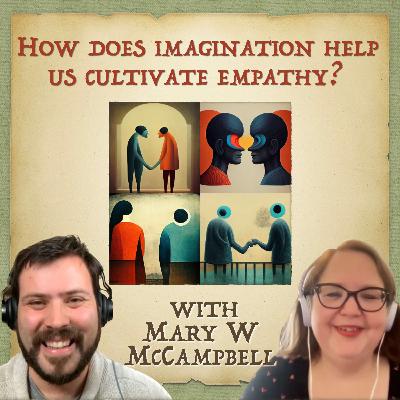
Mary McCampbell, author of Imagining Our Neighbours as Ourselves: How Art Shapes Empathy, discusses the place of imagination in shaping our attitudes and actions to those around us.How does empathy echo the incarnation? Is there a ‘sin of empathy’ where we take compassion too far so that other people’s agendas control us? How we can empathise while disagreeing well with or challenging other people?Dr. Mary McCampbell is an associate professor of humanities at Lee University where she regularly teaches courses on contemporary fiction, film, popular culture, and modernism.Find out more about Mary at her website marywmccampbell.com, and sign up for her Substack, The Empathetic Imagination.Timings00:00 Intro00:32 Welcome00:55 Introducing Mary and her book04:35 Why is empathy important to discipleship?10:00 How do you define 'empathy'?12:24 Imagination and the imago dei16:55 How can we choose stories to engage with that most cultive empathy?22:10 Why have some Christians get talked about the 'sin of empathy'?30:27 How do you have empathy for someone who shows no empathy?34:07 L'Abri, community and empathy38:41 Further recommendationsLinks* Get Mary’s book Imagining Our Neighbours as Ourselves - Fortress Press, Amazon.co.uk, Scribd* Watch Imagining Our Neighbours As Ourselves Fieldmoot Keynote Lecture, by Mary McCampbell* Choose Your Own Enchantment - How should Christians decide what media to consume? by Caleb Woodbridge, Equip.org including listening to our neighbour’s stories as a way of loving them* An example of the evangelical suspicion of empathy that we critiqued in the podcast: The Enticing Sin of Empathy - Joe Rigney, Desiring GodTranscriptThis is an auto-generated transcript that has been lightly corrected and edited. Please excuse any remaining errors and infelicities!Caleb Woodbridge: Welcome to Imaginative Discipleship. I'm Caleb Woodbridge, and I'm really pleased to have with me this week Mary McCampbell. Welcome Mary!Mary McCampbell: Thank you. I'm so excited to be here. Thank you very much.Introducing Mary and her bookCaleb: The topic we've got is one that you've written on. We're going to be exploring the connection between imagination and empathy and the Christian life. What's your background? How did you come to write about this?Mary: Just to say a little bit about me, I'm a professor at Lee University in Tennessee, and my area is literature, particularly contemporary literature and popular culture and how that relates with theology. I [00:01:00] think what really led me to writing about this book is basically my teaching and seeing what happens in the classroom. I think I've long been aware of how reading and watching movies and listening to music and looking at visual art helped me to see from somebody else's perspective, but the significance of it didn't really register on a deeper level until I saw what was happening with my students. And how you could, I could see transformations happening. And in particular, I have an article I wrote not too long ago, in particular about teaching Othello, Shakespeare's Othello, in a regular class I teach every year. Also teaching the autobiography of Frederick Douglass. And I teach in the deep south United States and certainly there's still so much racial tension, and there will also be students, [00:02:00] white students that might have come from communities where they really didn't interact with people of color very much.So reading both of those books, because Othello deals so much with racial profiling, and then also reading of course Douglas's Narrative. I've had so many students that really had never thought, in particular white students, who had never thought about the experience of a person with darker skin being judged and having these kind of microaggressions leveled at you and overt aggressions, in the case of both of those books. They just had never thought about it and it really struck something in them.And it also, of course, with these cases I would see with black students, it was empowering for them to be able to speak openly about these things if they wanted, you know, so anyway, I see it with all kinds of works of literature and film, but those two really stand [00:03:00] out to me.So, and I thought this is, this is about a kind of spiritual formation. I mean, every semester that I start with my general education classes, I talked for years, I've done this, I talk about the importance of empathy, and I give examples of how you must use your imagination in order to put yourself in the life experience, shoes of another, in order to love them more deeply. So [chuckles] that's just a little intro!Caleb: Yeah. Great. And your book is "Imagining Our Neighbors As Ourselves: How Art Shapes Empathy." So that's very much the overall theme and thesis of it. I think that's really interesting and vital. I wrote an article about how Christians should think about what they watch and engage with. And often, that question's approached from the question of, "Is it suitable? Is the content suitable?"Mary: Yeah.Caleb: And I was saying, well, actually, I [00:04:00] think there's an important sense in which it's a form of listening attentively to our neighbors. And yes, it's really helpful to have that perspective. On this podcast, I'm keen to be exploring that intersection of imagination and spiritual formation, the role it plays in our discipleship.Why is empathy important to discipleship?Caleb: So, why is cultivating empathy an important part of Christian discipleship? How does it fit within that frame and picture?Mary: Yeah, I mean, I'm gonna go to maybe the most extreme example, I mean, since I've been really reading and thinking a lot more about this, I've realized how much the idea of loving enemies is really at the heart of the gospel.Caleb: Mm-hmm.Mary: And it really is what sets Christianity apart. I mean, of course, there are many things that set Christianity apart, but even those who would say they're open-minded and liberal in their understanding of love one [00:05:00] another, there still tends to be a kind of tribalism.Caleb: Mm-hmm, yeah.Mary: Whereas Christianity is, we, in our rebellion, had made ourselves enemies to God, and the idea that Christ is the most... You can't get any deeper empathy than the incarnation, you know, and it's not possible for us to, of course, do what Christ did and really understand what it was like to live like us. But our imagination, in order to try to get over that hurdle and our natural inclination, which is to label others, dismiss others, gravitate towards people that we're initially comfortable with.But, it really does take intentional work of cultivating the imagination. And you use the word attentiveness. Attentiveness is really just to kind of [00:06:00] linger. I mean, that's an act of love to linger on someone's story, to spend more time, to slow down.Caleb: Mm-hmm.Mary: And I think that allows us to expand the imagination, to think how they are, what life is like for them. And I talk a lot about the Good Samaritan story, and there's a great MLK quote where he talks about the priest and Levite who didn't go over and help the man who had been beaten up.And he said that in their minds, it was, "What's gonna happen to me if I go over?" It's a fear-based, "What's gonna happen to me?" Whereas the Samaritan did what we should all be doing, "What's going to happen to him if I don't?"And so there's a sense of humility, but I think maybe we think less of ourselves if we allow space to hear the other story and then imagine life [00:07:00] that they're experiencing.Caleb: Yeah. I'm reminded of the line in the film Lady Bird where you have the exchange someone says to her, "Oh, you really seem to love the community she's in," and she says something like, "Oh, no, I just pay attention." And the person replies to her, "Don't you think attention and love are the same thing?" And I think that's a really interesting thing we. Would you go so far to say that in the act of imaginatively putting ourselves in other people's shoes, there is in that some kind of echo of the incarnation, how Christ as God became a human became one of us to sort of bridge that gap between us?Mary: Yeah, that's a really good question. I think it echoes Christ's most perfect and complete act of empathy. When we create, we're echoing the most perfect and whole act of creation. You know, when God began, started the world and created the world. I feel like we're called to love our enemies, and the only way we can really do that is through imagining what it's like to be them, rather than objectifying them. So, yes, that is echoing Christ. I mean, I'm just thinking about Christ on the cross when he says, "They know not what they do," and it's like he knows the whole story. He knows why they're doing this. He knows. There's a sense that he is... Yeah, I'm thinking about Christ with the woman at the well. He knows her story, and rather than dismissing her, banishing her, he loves her.How do you define ‘empathy’?Caleb: Just on that in terms of defining terms a bit. How would you define empathy then? What's the relationship between love and empathy, just to distinguish those?Mary: I think empathy, well, sympathy. Sympathy, and these terms have flipped in their meaning over the years. So it's interesting. But the way we think of it now generally is that sympathy is when you feel sad for someone, and it seems to still keep a power differential.Caleb: Mm-hmm.Mary: There could be a kind of condescension there, whereas empathy is allowing yourself to feel as the other person feels. So you're on the same plane?Caleb: Mm-hmm. Yeah.Mary: So, I'm thinking about an example. In the... I don't know if you've watched The Chosen?Caleb: No, I've been hearing good things about it. I've actually just downloaded the app onto my Apple TV so I can watch it on my TV at some point. But yeah, do you recommend it?Mary: Oh, I do. I really love it. But, well, you could look for this
In this episode, I grill Ted Turnau, author of Popologetics and the forthcoming duology of Oasis of Imagination and Imagination Manifesto (the latter of which is co-authored with Ruth Naomi Floyd, and both of which I’m editing for IVP!) What exactly is the imagination, and why is it important for Christians to understand and appreciate it?Ted Turnau teaches culture, media, and religious studies at Anglo-American University in Prague, Czech Republic. He’s lived there with his wife and family since 1999. He graduated from Westminster Theological Seminary with both an M.Div. and a Ph.D. in apologetics. His writing and research interests circle around the territory where faith, imagination, and culture (especially popular culture) intersect.Watch this episode on YouTube: https://youtu.be/6Okwb34BG30Ted’s books:* Popologetics: Popular Culture in Christian Perspective (P&R, 2012)* The Pop Culture Parent: Helping Kids Engage Their World for Christ (with E. Stephen Burnett and Jared Moore, New Growth Press, 2020)* Oasis of Imagination (forthcoming, summer 2023, IVP)* Imagination Manifesto (with Ruth Naomi Floyd, forthcoming, summer 2023, IVP)Books mentioned:* You Are What You Love - James K A Smith* Jim Davies - Imagination: The Science of Your Brain’s Greatest Power* Why Art Matters - Alastair GordonMovies discussed:A Love Song for Bobby Long (2004, dir Shainee Gabel)A Short Film About Love (1988, dir Krzysztof Kieslowski)Music discussed:* Pink Floyd* 21 Pilots* Andrew Peterson* The Gray Havens* Ruth Naomi Floyd This is a public episode. If you would like to discuss this with other subscribers or get access to bonus episodes, visit www.biggerinside.co.uk
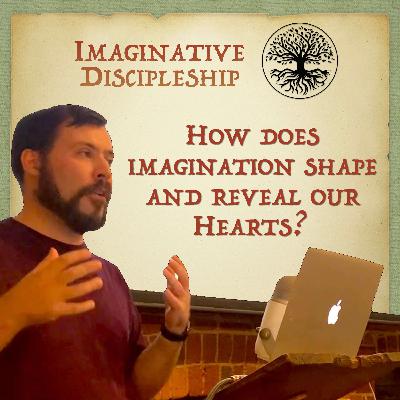
This week I’m pleased to share with you a talk that I gave on Imaginative Discipleship at L’Abri Fellowship, England on 30th September 2022. Thanks to L’Abri for letting me share the recording here on the podcast!** How imagination shapes and reveals our heartsHow does the renewal of our imaginations shape our Christian life and witness?How do we cultivate the renewal of our imaginations by the Spirit through the Word, for life in the world?I explore the nature of the imagination and how it connects to the biblical theme of the heart, the importance of imaginative renewal for our discipleship, and suggests some steps we can take to help participate in God's redemption of our imaginations. Download the lecture slides.** Fieldmoot and Zoom Q&AI’m also excited that this talk will be part of Fieldmoot, an online conference to celebrate and encourage Christians in the creative arts, 3rd to 6th November 2022.I’ll be releasing the video recording of the talk as part of Fieldmoot, and doing a live Q&A on Zoom to discuss it further on Friday 4th November.Sign up at Fieldmoot.com for the full programme and to join in!** What is L’Abri Fellowship?L’Abri is a community that’s been a very special place for me in my own journey of discipleship. It’s a place of shelter where students can go and join in the life of the community, and explore honest answers to life’s big questions.You can find out more, including subscribing to the L’Abri lecture podcast, at englishlabri.org. For more resources, visit the L'Abri Ideas Library at labriideaslibrary.org. The library contains over one thousand lectures and discussions that explore questions about the reality and relevance of Christianity. This is a public episode. If you would like to discuss this with other subscribers or get access to bonus episodes, visit www.biggerinside.co.uk

Welcome to the first full episode of the Imaginative Discipleship podcast! Typically I’ll be interviewing guests about their perspectives on and experiences with imagination and discipleship – but in this case I’ve asked my friend and experienced podcaster Rachel Redeemed to interview me about why I’m launching this show.What is imagination? What is discipleship? Why put the two together? What exactly prompted me to start this podcast now? What can listeners expect from upcoming episodes?Find out all this as we begin the adventure!Follow Imaginative Discipleship: Twitter - Instagram - Facebook - YouTubeFeaturing:* Caleb Woodbridge - Twitter @CalebWoodbridge, Instagram calebwoodbridge* Rachel Redeemed - Twitter @RachelRedeemed, Instagram rachredeemed YouTube channelInspiration from:Andrew Peterson - www.andrew-peterson.comThe Rabbit Room - www.rabbitroom.comA big hello to the UK Moot Community!Join on Facebook: https://www.facebook.com/groups/892284851682666Some places I’ve written for on story and faith:* My blog and newsletter - calebwoodbridge.com / biggerinside.co.uk* Threads UK - https://threadsuk.com/writtenby/caleb-woodbridge* Christian Research Journal - https://www.equip.org/christian-research-journal/Useful resources:* L’Abri Ideas Library - www.labriideaslibrary.org* Talks by Andrew Fellows:* The Two Streams: Integrating Reason and Imagination* Fantasy vs. ImaginationBooks:* Gentle and Lowly - Dane Ortlund - https://www.crossway.org/books/gentle-and-lowly-hcj/* Jesus Lover of my Soul - Julian Hardyman https://ivpbooks.com/jesus-lover-of-my-soulWatch the video of this episode on YouTube. This is a public episode. If you would like to discuss this with other subscribers or get access to bonus episodes, visit www.biggerinside.co.uk
Welcome to the Imaginative Discipleship podcast! Over the last year, I’ve been exploring the theme of discipleship and imagination on my email newsletter, Bigger on the Inside (www.biggerinside.co.uk). Join me as I explore all this and more on my new show, launching imminently!I’ll be hosting conversations about faith and imagination with a variety of guests. The first few guests include Rachel Redeemed, Ted Turnau, Mary McCampbell and Sophie Killingley with more to come. I've had a blast chatting to them and can't wait to share the conversations with you.I’d love to hear your thoughts and ideas: What topics would you like to hear tackled? Who would you like me to invite onto the show? And if you’d like to take part, I’d love to hear from you! Leave a comment, or drop me a line at caleb@biggerinside.co.uk.If you would like to support the show, please consider becoming a paid subscriber via www.imaginativediscipleship.com. This is a public episode. If you would like to discuss this with other subscribers or get access to bonus episodes, visit www.biggerinside.co.uk
Comments

Download from Google Play

Download from App Store
 United States