DiscoverImpact(ed)
Impact(ed)
Claim Ownership

Impact(ed)

Author: Impact(ed)

Subscribed: 0Played: 0
Share

Description

For its first two seasons, Impact(ed) carved out space for practitioners of color to speak candidly about their work. It showcased the importance of diverse, creative perspectives and a non-traditional, non-linear path into the world of investing. It grounded the conversation in lived experience and real decision-making, not just frameworks and conference talking points. And importantly, it gave a platform to perspectives and voices that are too often pushed to the side.

This season, Impact(ed) will take conversations even deeper. Because there are things we all know–but don’t say out loud: We know most LPs are still optimizing for risk-adjusted returns, not impact. We know investment committees rarely behave the way their mission statements suggest they do. We know entire strategies get framed as “market opportunity” when they’re really a function of where capital feels comfortable flowing. And we know that when markets tighten, a lot of the courageous rhetoric gets silenced quickly.

Where our first two seasons -- importantly -- shone on a light on practitioners of color in the middle of their careers reflecting on how they got there, and the many pieces of the impact investing puzzle (from ESG-screening at some of the largest pensions, to impact VC, and employee ownership as an alternative to traditional buyouts) this season will be a deeper dive into the structural levers that control how capital is allocated. We started with a mission of showing the whole chessboard and widening the tent to including more voices and perspectives in the conversation, and now we're eager to dive deeper into honest discussions about the more granular barriers and genuine opportunities for scale within impact investing. This season we'll be covering topics like:

  • Blackstone and Your Retirement
  • Impact Investing in the Built Environment
  • Are There Too Many VC's?
  • The Current State of Community Development
  • The Pro's and Con's of PE
  • The Business of Asset Management
  • How IC's Actually Work
  • What Went Wrong with Tricolor
  • Impact Investing & Public Policy
  • And a Retrospective Review of Past Episodes
23 Episodes
Reverse
Our second Impact(ed): Live! conversation explored what employers, funders and impact investors can do differently if they actually want to widen pathways into the field.
The Capital We Deserve

The Capital We Deserve

2026-09-2242:12

In 1984, community banks numbered 15,767 and held 39% of U.S. banking assets. By 2024, only 4,128 remained, holding 11%. The "big four" now control $9.5 trillion in assets but lend out only 41% of it, versus 70% for community banks. This episode asks what got lost — and what rebuilding it takes.PART ONE: THE CASE FOR LOCAL BANKINGJournalist Oscar Perry Abello unpacks his book The Banks We Deserve. His core argument: community development finance isn't a newer field bolted onto banking — it's what banking used to be, before consolidation moved lending decisions away from the neighborhoods they serve. Community banks hold $153 billion in construction loans versus $51 billion at the big four. Abello cites Adelphi Bank in Columbus, Ohio — chartered in 2023, the first new Black-designated minority depository institution (MDI) in 20 years — which turned $27 million in startup capital into $100 million in community investment within three years, and Redemption Bank in Utah, formerly Holladay Bank and Trust, now Black-owned after investors acquired and rebranded it. Of roughly 3,900 community banks left nationwide, only about 125 are MDIs."Getting things done at scale in this country has always taken community banks, local banks, local credit unions to actually do all this work."Abello explains how these institutions fund growth: equity (roughly $1 for every $10–11 in deposits), deposits, and wholesale borrowing through the Federal Home Loan Bank system, built in the 1930s for this purpose. His metaphor: an impact fund waters one tree in a burned forest; rebuilding banking policy seeds rain clouds that water the whole forest.PART TWO: COMMUNITY DEVELOPMENT ON THE GROUNDJacqueline Waggoner, newly installed president and CEO of Century Housing, a California CDFI that has deployed $3.5 billion to create or preserve 60,000+ homes, joins next. She previously led Enterprise Community Partners' Solutions Division, helping design the Local Rental Owners Collaborative (LROC) — a 2021 South LA program pairing small, often Black and Latino landlords owning 2–20 units with rent relief and property support, keeping affordable housing out of corporate hands.Century grew out of the Century Freeway (I-105), whose construction displaced 7,000 homes and 21,000 LA residents — a reminder that community development often means redressing harm from past infrastructure decisions. Her underwriting centers on relationship and character: decades of history with the same borrowers, and attention to "the souls behind the doors."The episode closes on policy: the proposed FY2027 federal budget would cut CDFI Fund awards by 63% (over $200 million), shrinking the fund from $324 million to about $119 million. Both guests frame CDFIs and community banks as core infrastructure, not niche impact vehicles.⸺GLOSSARY:CDFI (Community Development Financial Institution): Federally certified lender focused on underserved communities.MDI (Minority Depository Institution): A bank majority-owned by minority individuals, or with a majority-minority board and customers.Community Reinvestment Act (CRA), 1977: Requires regulators to ensure banks meet credit needs of low- and moderate-income neighborhoods.Equal Credit Opportunity Act (ECOA), 1974: Barred credit discrimination; before it, a woman generally needed a husband present to get a loan.Redlining: Denying loans to residents of specific neighborhoods, typically by race, via lending maps.Federal Home Loan Bank (FHLB) System: A 1930s wholesale lending network funding member banks beyond local deposits.Character-Based Lending: Underwriting that weighs a borrower's relationships and community standing, not just credit metrics.
The built environment accounts for ~37% of global CO₂ emissions, 41% of global energy use, and 42% of landfill waste. Over 22 million U.S. households spend more than 30% of their income on rent. This episode asks: why isn't more capital flowing here to make our housing affordable and sustainable?The Institutional Turn:Cole Cage (Jonathan Rose Companies) argues affordable housing has matured into a core institutional asset class. Government-backed Section 8 HAP contracts, a 7-million-unit housing shortage, and durable renter demand make it a stable, low-volatility investment — not a concessionary one."The best investments are ones where impact is inherent to the product itself."The Capital Gap:Ruby Schifrin (Joist / Turner Labs) identifies a structural trap: housing tech startups are too regulated for generalist venture, too early for real estate capital, and too complex for software investors. Joist — Turner Labs' new venture fund — targets this gap, backing modular construction, financing tools, and AI-powered permitting software. Meanwhile, philanthropic capital that should be taking early risk is crowding into the same proven plays as institutional investors."If you take a venture model to philanthropy, you should expect 90% of your businesses to fail. Yet in the impact space, people think any failure means they're doing something wrong."What Makes It Expensive — and the Call to Action:Well-intentioned regulations pile up into a crushing burden. Ruby proposes a "menu model" — let developers pick three public benefits from a defined list rather than mandating all of them. Cole flags Davis-Bacon prevailing wage rules as a separate 40% labor cost driver on federally funded projects. Jonathan Rose Companies' approach: listen to communities before proposing anything, then unlock government resources to fill the gaps. The closing ask — developers: try the deal you assumed wouldn't pencil. Investors: revisit affordable housing on a risk-adjusted basis. Individuals: go to a local community meeting. The roadmap exists — what's missing is more people deciding this is their problem.GLOSSARY:AMI: Area Median Income — HUD's benchmark for affordability. Housing is "affordable" when a household pays ≤30% of income on rent. Programs target different thresholds (30%, 60%, 80%, 100% AMI).Capital Stack: All financing layers in a deal (equity, debt, tax credits, grants) ordered by repayment priority. Affordable housing stacks typically involve 5–8 sources.Cost-Burdened: Spending >30% of gross income on housing costs. "Severely cost-burdened" = >50%.Davis-Bacon Act: Federal law (1931) requiring prevailing wages on federally funded construction — can add ~40% to labor costs in high-wage cities.HAP Contract: Housing Assistance Payment contract — HUD pays the gap between tenant income and market rent under Section 8, providing stable government-backed revenue.LIHTC: Low-Income Housing Tax Credit — the primary federal subsidy for affordable rental housing. Developers sell credits to investors to generate project equity; units must stay affordable for 30+ years.Workforce Housing: Housing for households earning 60–120% AMI — too much for deep-subsidy programs, too little for market-rate in high-cost cities. Often supported by tax relief rather than direct subsidy.
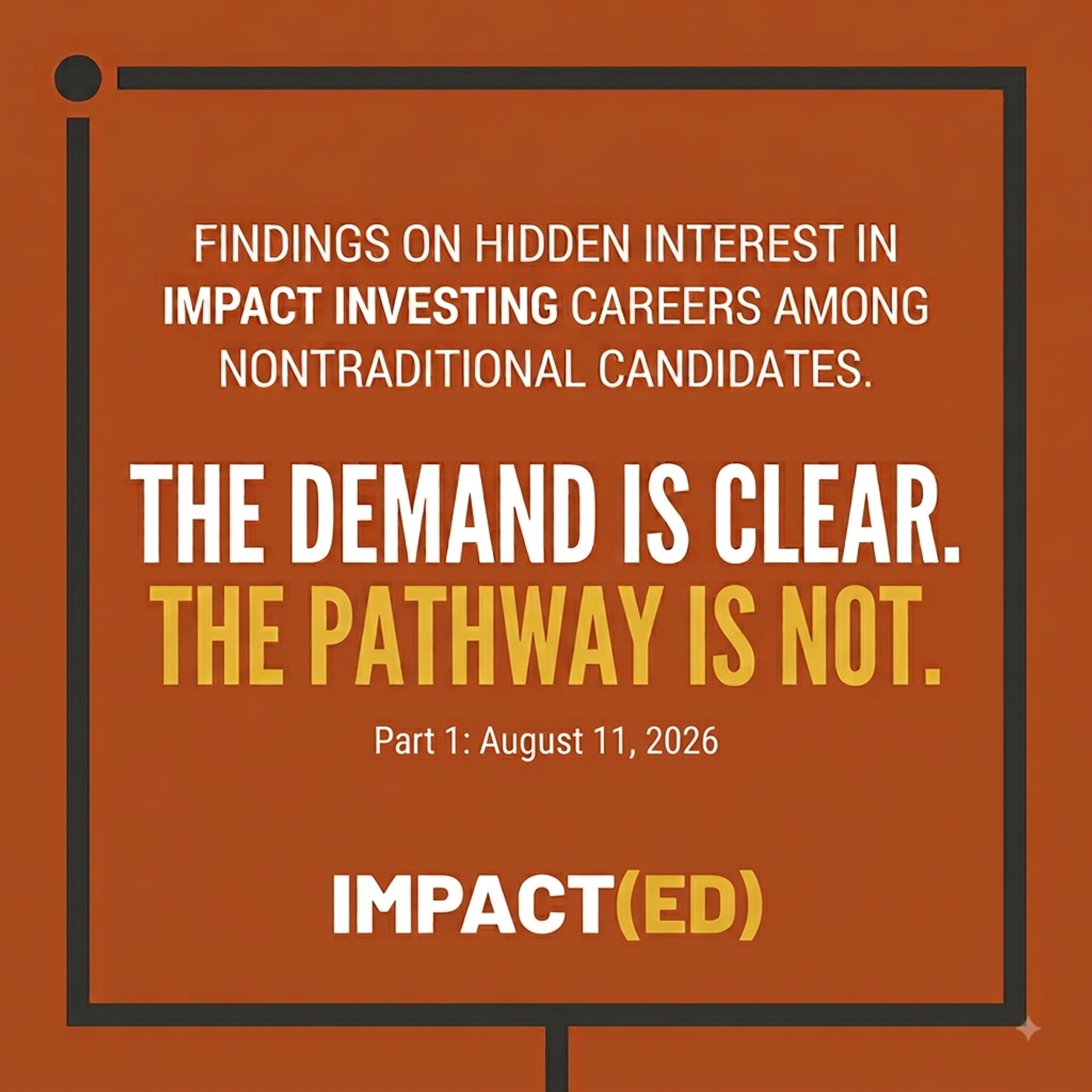
Impact(ed) co-host Lucas Turner-Owens sat down with Eric Horvath and Shuvam Rizal to unpack their first-of-its-kind research: analyzing broad-based demand for impact-first investing careers from candidates who do not come from MBA programs and traditional financial institutions. Eric and Shuvam shared findings and observations based on more than 250 respondents, including analysis and trends on who's interested in these jobs, how much experience they have, and what they feel are major blockers to employment. This was the first of two sessions exploring this topic. The second -- to be hosted in September -- will focus on ways employers and field-builders can think about expanding career pathways for this abundance of talent.Be sure to follow Impact(ed) on Substack for more.This exploration is supported by Tufts' Certificate in Impact and Sustainable Investing (CISI) and Untapped Capital Consulting.
Private equity can feel as though it has always existed—a permanent villain of the investment industry. But it hasn’t.The modern industry is only a few decades old, younger than some of the people now sitting on pension and endowment committees deciding how much of it to hold.PE grew around a specific thesis: that patient, controlling ownership could counter the short-termism of public markets and create genuine value, not merely generate financial returns. Today, that thesis is being tested from two directions at once. A multitrillion-dollar asset class must demonstrate that enough real opportunity remains to justify its enormous scale. At the same time, a higher-cost-of-capital environment is stripping away the cheap debt that helped make many of its past returns possible.So what happens when financial engineering is no longer enough? What does PE look like when returns must come from actually building better businesses? And as private ownership reaches further into the institutions that shape our daily lives, who gets to decide what those businesses are ultimately designed to produce—and for whom?Smitha Das is Senior Director of Investments at World Education Services (WES), where she leads the investment practice and is helping steer the organization’s full balance sheet toward mission alignment. She is an unusually credible voice on this topic because she has sat on nearly every side of the table. She began her career at an infrastructure PE fund, later worked as an intermediary, and now allocates capital as an asset owner.Rodney and Eric sat down with her for a conversation that resists the easy version of the PE debate and instead examines the mechanics through which value—or harm—is actually created.We talked about:Daycare centers, nursing homes, local newspapers, and youth sports leagues—the everyday institutions now owned by PE that many people assume are still locally controlled.The two versions of PE WES holds at once: a “current-state” portfolio, where the organization pushes incrementally for better incentives, governance, and structures within the existing playbook; and a “catalytic portfolio,” where it is testing entirely new models of ownership and governance.PE as a tool and a set of design choices, rather than an inherently good or bad asset class—and why incentives, governance, and investment structure are the three levers that most directly shape outcomes.GlossaryPrivate EquityDefinition: An investment model in which a firm raises capital from institutional investors to acquire controlling stakes in companies—usually private companies, though sometimes publicly traded companies that are taken private—with the intention of holding, improving, and eventually selling them for a return.Why it matters: Much of the public debate treats PE as either a monolithic villain or an unqualified engine of growth. But because the ownership model is so flexible, “Is private equity good or bad?” is the wrong question. The more useful question is: what are a particular firm’s incentives, governance, and investment structure designed to produce?Roll-Up / ConsolidationDefinition: A strategy in which a firm acquires multiple companies within the same industry or geographic region and combines them under shared ownership, often to gain scale, reduce costs, or control a larger share of a market.Why it matters: Roll-ups can be difficult to detect. A consolidated daycare chain may continue operating under its original, locally recognizable name even after ownership has changed. That opacity makes the resulting loss of competition—and the decisions that follow—harder for affected communities to trace back to the actual owner.
loading
Comments