


 Claim Ownership
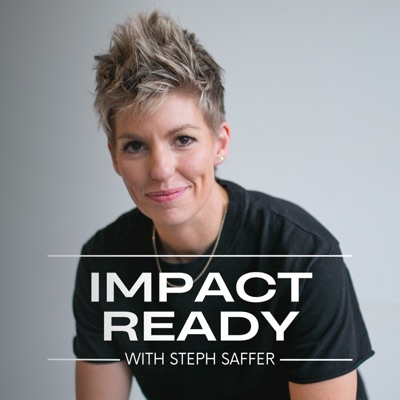
Impact Ready
Subscribed: 2Played: 13
Subscribe

© Steph Saffer
Description
Have you ever felt like you had great potential but couldn't get to your next level? Harness the power of your impact with “Impact Ready”. Hosted by Steph Saffer, mindset coach, speaker, entrepreneur, and acupuncturist, this podcast is your guide to elevating your impact and sparking meaningful change. Dive into insightful discussions on ownership and the power of your energy, and unlock actionable strategies to create a ripple effect of exponential results. Get ready to impact.
250 Episodes
Reverse

Even a healthy tree can fall, so how much of your energy is going into a risk assessment of things you can't control?Impact Ready celebrates its 250th episode, and Steph marks the milestone by reflecting on what building this podcast has taught her about embracing uncertainty. Drawing a parallel between a recent conversation and everyday life, she explores how to weigh risk with clear eyes and how hypervigilance drains the energy we need for personal growth. Steph shares practical life lessons on fear management, showing how to take calculated risks while releasing what sits outside our control. This episode is a reminder that resilience grows when we make peace with unpredictability and get on with living fully.In this episode you'll discover:Assessing risk is an important part of everyday life.Hypervigilance can lead to unnecessary stress and anxiety.We often worry about things beyond our control.Your takeaways:We are more resilient than we realize or give ourselves credit for.Fear is a natural part of life, but it shouldn't dictate our actions.Finding balance means accepting some level of risk.Chapters00:00 Celebrating Milestones and Taking Action04:11 Assessing Risk in Life10:51 Finding Balance and Embracing Uncertainty📊 Take the Impact Scorecard: impactreadyquiz.com📩 Join my newsletter: stephsaffer.com🤝 Work with me 1:1: stephsaffer.com/contact-me/
Every relationship hits rough patches, and the ones that last are built by people who know how to repair after conflict.Steph breaks down the art of repair, one of the most underrated skills in communication, leadership, and parenting. She walks through the five steps of an effective repair: returning to the conversation, owning your part, acknowledging the impact, getting curious about the other person's experience, and making a correction. Healthy relationships are rich in repair, and every sincere repair attempt strengthens trust and connection. Steph also shares why modeling repair for our kids is one of the most powerful emotional intelligence lessons we can give them.In this episode you'll discover:- Why what happens after a conflict shapes the relationship more than the conflict itself- The five steps to effective repair, from returning to the conversation to making a correction- How modeling repair builds trust with your team and teaches your kids conflict resolutionYour takeaways:- Repair is one of the most important and underrated skills in relationships and leadership.- Owning your part in a conflict is crucial for effective repair.- Modeling repair for others teaches valuable conflict resolution skills.Chapters00:00 The Importance of Repair in Relationships18:04 Steps to Effective Repair18:47 Conclusion and Call to Action---📊 Take the Impact Scorecard: impactreadyquiz.com📩 Join my newsletter: stephsaffer.com🤝 Work with me 1:1: stephsaffer.com/contact-me/
Holding tighter to the plans, people, and outcomes you care about could be the very thing feeding your stress, and letting go may be where your freedom begins.Steph explores non-attachment, a life philosophy rooted in Eastern traditions that invites you to release your grip on outcomes, relationships, and circumstances. Through personal stories, she clears up common misconceptions and shows how non-attachment lets you engage fully with life while holding it with an open hand. Steph unpacks the illusion of control, the reality that change is constant, and how clinging fuels suffering. With mindfulness and self-awareness as guides, this episode offers a practical path to stronger emotional well-being, more resilient relationships, and lasting personal growth.In this episode you'll discover:What non-attachment really means and where the practice comes fromHow non-attachment differs from detachment and indifferenceWhy control over external circumstances is an illusion, and how clinging creates sufferingYour takeaways:Non-attachment is about letting go of control.Asking 'What can I let go of?' can facilitate non-attachment.Embracing non-attachment can lead to greater joy and creativity.Chapters00:00 Introduction to Non-Attachment02:28 Defining Non-Attachment05:11 What Non-Attachment Is Not07:11 The Practice of Non-Attachment10:01 Understanding Control and Suffering12:07 Personal Experiences with Non-Attachment15:23 Practical Applications of Non-Attachment17:36 The Broader Impact of Non-Attachment📊 Take the Impact Scorecard: impactreadyquiz.com📩 Join my newsletter: stephsaffer.com🤝 Work with me 1:1: stephsaffer.com/contact-me/
We think that some people are born with courage and the ability to do hard things, but the reality is it is a skill we can practice and get better at, we just haven't been choosing to practice .Steph breaks down bold courage: the ability to take action even when fear is loud. She makes the case that courage is a learned skill you build over time, and she walks through real-life examples that show what bold courage looks like and where people get it wrong. You'll also learn the nine C's of courage, from coping to confidence to commitment, plus why community support matters so much when you're overcoming fear. This one is for anyone ready to make braver decisions and step into real personal growth.In this episode you'll discover:What bold courage is notHow to define bold courage through real-life examplesThe nine C's of courageYour takeaways:Bold courage is taking action in the face of fear.You can build the muscle of bold courage with practice.Discomfort is often a precursor to growth and confidence.Chapters00:00 Introduction to Bold Courage02:59 Understanding What Bold Courage Is Not04:58 Defining Bold Courage Through Real-Life Examples09:55 The Nine C's of Courage13:46 The Importance of Bold Courage in Life18:10 Conclusion and Call to Action📊 Take the Impact Scorecard: impactreadyquiz.com📩 Join my newsletter: stephsaffer.com🤝 Work with me 1:1: stephsaffer.com/contact-me/
Some of the heaviest things you carry are old stories, old grief, and old regret, and letting go is where emotional freedom begins.Steph explores what happens when we hold on to past pain, grief, and regret, and why that grip creates so much suffering. Drawing on Buddhist teachings, the natural rhythms of change, and a powerful client story about releasing grief, she shows how acceptance and mindfulness open the door to real transformation. We look at the stories that keep us stuck, how to feel emotions fully while allowing them to move through, and why "keep it moving" is a useful practice . Steph closes with practical steps to identify what you're ready to release so you can make room for more peace, resilience, and personal growth.In this episode you'll discover:The impermanence of life and the importance of accepting changeThe role of mindfulness and awareness in letting goThe ongoing practice of emotional release and freedomYour takeaways:Holding on to past pain causes suffering and prevents growthWe often carry stories and burdens that are no longer ours to holdReleasing emotions can lead to greater freedom and peaceChapters00:00 Introduction to the theme of change and holding on00:19 The stories we tell ourselves about the past02:21 The impact of holding on to pain and grief04:04 A client owner's story of releasing grief05:15 The phrase 'keep it moving' and embracing change07:11 Feeling emotions fully without clinging08:22 Nature's lesson on change and renewal09:33 Practical steps to identify what to let go📊 Take the Impact Scorecard: impactreadyquiz.com📩 Join my newsletter: stephsaffer.com🤝 Work with me 1:1: stephsaffer.com/contact-me/

Comments

Download from Google Play

Download from App Store
 United States