



 Claim Ownership
Increments
Subscribed: 35Played: 1,439
Subscribe

© 2026 Ben Chugg and Vaden Masrani
Description
Vaden Masrani, a senior research scientist in machine learning, and Ben Chugg, a PhD student in statistics, get into trouble arguing about everything except machine learning and statistics. Coherence is somewhere on the horizon. Bribes, suggestions, love-mail and hate-mail all welcome at [email protected].
110 Episodes
Reverse
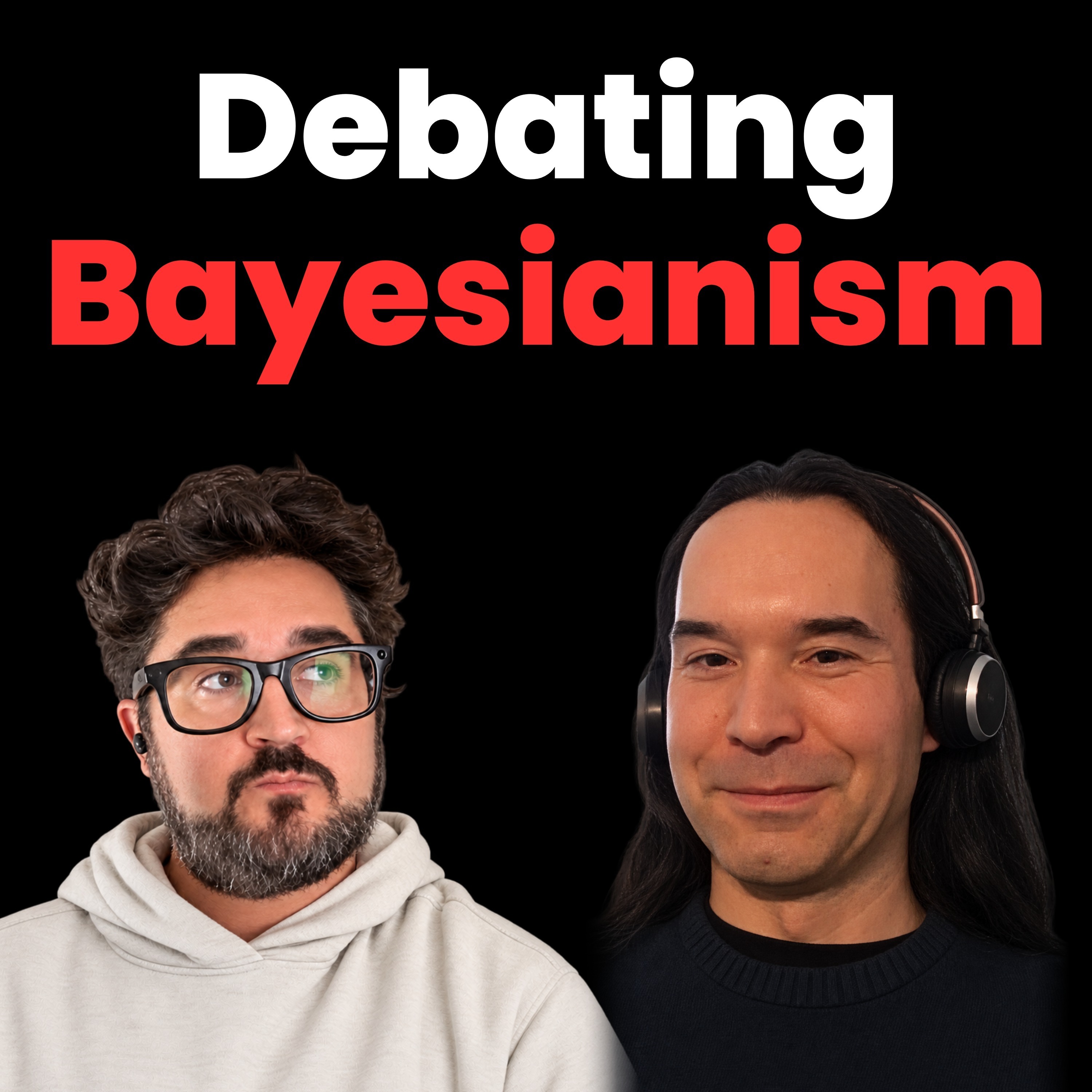
Vaden manages to penetrate deep into the rationalist stronghold in San Francisco, the Mecca of Yudkowsky himself, and - exactly as we'd all expect - gets into an epistemological standoff. Can he shake a Bayesian's credence in Bayesianism, or does he find in himself a Jaynesian acolyte, ready to make sure that no Dutchman is going to be able to mess with his books?
We discuss
Critical rationalism vs. Bayesianism
Toby Ord's doom estimates
Asteroids vs. AI risk
What probabilities measure
Comparing made-up numbers
Is probability a law?
Cox's theorem and Dutch books
COVID models and Monte Carlo
AI expert surveys
How we actually decide
Bentham's Bulldog and Pascal's mugging
Animal consciousness and vegetarianism
Strong longtermism
References
I Have Lost My Ability to be Charitable to Vaden (Eneasz Brodsky, Death Is Bad)
The Bayesian Conspiracy ep. 273, "Vaden Masrani on... Critical Rationalism?"
Death Is Bad, Eneasz's blog
The Bayesian Conspiracy podcast
Learning Bayesian Statistics ep. 160, "Bayesian Statistics vs Epistemology" (Alexandre Andorra with Vaden Masrani)
Is P(Doom) Meaningful? Epistemology Debate with Vaden Masrani and Ben Chugg (Doom Debates, Liron Shapira; also Increments bonus ep. 76)
Vaden's four-part longtermism series:
A Case Against Strong Longtermism: A response to Hilary Greaves and William MacAskill (EA Forum version)
Proving Too Much: A response to the EA forum
The Credence Assumption: The paradoxes and problems with Cox's Theorem
The Poverty of Longtermism: Why longtermism isn't an idea that could save one hundred billion trillion lives
Books and papers
The Precipice: Existential Risk and the Future of Humanity (Toby Ord)
The Case for Strong Longtermism (Hilary Greaves, William MacAskill) (GPI summary)
Global Catastrophes and Trends: The Next Fifty Years (Vaclav Smil, MIT Press, 2008)
Conjectures and Refutations (Karl Popper)
The Scout Mindset (Julia Galef)
What's your P(Vaden is Bad Faith)? Send your credence, and only your credence, over to [email protected]

Vaden has been annoyed about the Hugging Face incident for weeks, and the only known cure is yelling
about it on the podcast. Ben, who as usual is more even-headed and objective about the incident (incidentally, he also writes the episode descriptions) plays devil's advocate. Was there ever really a sandbox? Did the agents cheat, or did they just do what they were told? Is terrifying the public good for an IPO? Multiple analogies enter the fray, zero minds are changed, and Saturday Night Live gets the last word.
We discuss
What actually happened in the Hugging Face incident (and what is ExploitGym?)
What Project Glasswing and Mythos already told us about AI and cybersecurity
Is a sandbox with Artifactory access still a sandbox?
Did the agents cheat, or just follow their prompt?
Negligence, PR stunt, or both? Going through OpenAI's timeline
How independent is an "independent" investigation?
Does anthropomorphic language help you predict what AI will do?
Grenades, knives, and yogurt: parenting styles for package managers
References
The Hugging Face incident and the road ahead (OpenAI blog post):
https://openai.com/index/hugging-face-incident-and-the-road-ahead/
OpenAI's technical report on the incident (PDF): https://cdn.openai.com/pdf/67869394-cb91-4c12-888c-5cbd85c7814c/OpenAI-Hugging-Face%20Incident-Technical-Report.pdf
Making Sense #494, "A Coin Toss for the Future" (Sam Harris with Ryan Greenblatt):
https://www.samharris.org/podcasts/making-sense-episodes/494-a-coin-toss-for-the-future
Redwood Research on the incident:
https://blog.redwoodresearch.org/p/the-openaihuggingface-incident-redwood
Dwarkesh Podcast with Ajeya Cotra, "Inside the OpenAI agent swarm that hacked Hugging Face": https://www.youtube.com/watch?v=X50zezLFWWI&pp=ygUVZHdhcmtlc2ggaHVnZ2luZyBmYWNl
Melanie Mitchell, "Misleading Metaphors and Real Risks":
https://aiguide.substack.com/p/misleading-metaphors-and-real-risks
Anthropic's Project Glasswing: https://www.anthropic.com/glasswing
JFrog Artifactory: https://jfrog.com/artifactory/
Our episode with Melanie Mitchell: https://www.incrementspodcast.com/45
Socials
Follow us on Twitter at @IncrementsPod, @BennyChugg, @VadenMasrani
Come join our discord server! DM us on twitter or send us an email to get a supersecret link
Become a patreon subscriber here. Or give us one-time cash
donations to help cover our lack of cash donations here.
Click dem like buttons on youtube
We urge you to urge us to stop. Send your urges over to [email protected]

At 3am, tossing and turning in your bed, have you ever wondered why this generation is full of a bunch of fragile sissies? Journalist Abigail Shrier has, and her answer is: Therapy. Too much God d*** therapy. Is she right? Ben and Vaden read her 2024 book on the subject, Bad Therapy, and discuss it, including the good, the bad, and the preposterous footnotes.
Buy the book here https://www.amazon.com/dp/0593542924 and check out the rest of Shrier's work here https://www.abigailshrier.com/.
We discuss
Iatrogenesis and whether there are negative side effects of therapy
Why overly focusing on your feelings can lead to unhappiness
Should kids be asked about suicidal ideation?
Some problems with Shrier's analysis
For God's sale, are kids fragile, or are they not?
References
Bad Therapy: https://www.amazon.com/dp/0593542924
Irreversible Damage: https://en.wikipedia.org/wiki/Irreversible_Damage
Dr. K's youtube channel: https://www.youtube.com/c/HealthyGamerGG
Part 1 of Decoding the Gurus series on Dr K: https://decoding-the-gurus.captivate.fm/episode/dr-k-part-1-oped-ayurvedic-medicine-vs-nerfed-western-allopathy
Let Grow: https://letgrow.org/
Socials
Follow us on Twitter at @IncrementsPod, @BennyChugg, @VadenMasrani
Come join our discord server! DM us on twitter or send us an email to get a supersecret link
Become a patreon subscriber here. Or give us one-time cash donations to help cover our lack of cash donations here.
Click dem like buttons on youtube
Would you rather go to therapy or fight in WWII? Tell us at [email protected]
After Jason Arday, the second biggest topic of conversation has of course been the rise of the neuro-grifting guru. And for good reason! Neuroscience has been causing confusion lately. What is the hippocampus up to in there? Is your pre-post-medial-cerebrum-corta-bellum even working properly? What does neuroscience say about whether you should start each day with a slap in the face?
Being incapable of answering these questions ourselves, we're bringing on bonafide neuroscientist and substacker Tommy Blanchard to help us navigate this terrain. Check out Tommy's website and substack, Cognitive Wonderland.
We discuss
Models of decision-making in neuroscience
The common currency model
What do we actually know about the brain?
What constitutes an explanation in neuroscience?
What neuroscience is put on a pedestal
Neuro-grifting Gurus, aka Huberman et al.
References
Tommy's post about his research appearing in the NY Times: https://cognitivewonderland.substack.com/p/scientists-hope-gambling-monkeys
Socials
Follow us on Twitter at @IncrementsPod, @BennyChugg, @VadenMasrani
Come join our discord server! DM us on twitter or send us an email to get a supersecret link
Become a patreon subscriber here. Or give us one-time cash donations to help cover our lack of cash donations here.
Click dem like buttons on youtube
Which area of your brain lights up when you consider sending an email to [email protected]?Special Guest: Tommy Blanchard.

We've spent a long time bashing Bayesian epistemology on the podcast. Unfortunately, this is sometimes taken to mean that we bash all things Bayesian. But our God-fearing listeners will be pleased to learn that we do not bash all things that the Reverend Thomas Bayes stood for. Bayesian statistics, when appropriately separated from epistemology, has many things to teach us. And instead of taking our word for it, we're bringing on an expert in this field: Alex Andorra, a research scientist at Meta and host of the Learning Bayesian Statistics podcast. The Gods Smile.
Check out Alex's website and the Learning Bayesian statistics podcast.
We discuss
538 and election forecasting
Sports analytics and why Messi is objectively the best
What is Bayesian statistics?
What is the difference between Bayesian and frequentist statistics?
What is the allure of Bayesian statistics?
Are priors best thought of as beliefs?
How do critical rationalists make decisions?
References
Learning Bayesian Statistics: https://learnbayesstats.com/
Silver Bulletin: https://www.natesilver.net/
Vaden's blog post on decision making: https://vmasrani.github.io/blog/2020/vaden_second_response/#what-other-options-to-decision-theory-are-there
# Socials
Follow us on Twitter at @alex_andorra, @IncrementsPod, @BennyChugg, @VadenMasrani
Come join our discord server! DM us on twitter or send us an email to get a supersecret link
Become a patreon subscriber here. Or give us one-time cash donations to help cover our lack of cash donations here.
Click dem like buttons on youtube
Send us an email because you have - no, because you want to - over at [email protected] Guest: Alex Andorra.

Comments

Download from Google Play

Download from App Store
 United States