


 Claim Ownership
Inside AusPol
Subscribed: 0Played: 0
Subscribe

© Kangaroofern Media Lab Pty Ltd
Description
This podcast features enlightening discussions with professionals to explain pressing issues and provide partinent facts about unbiased journalism and counter misinformation and in-dept conversation with experts.
theregisterau.substack.com
theregisterau.substack.com
156 Episodes
Reverse
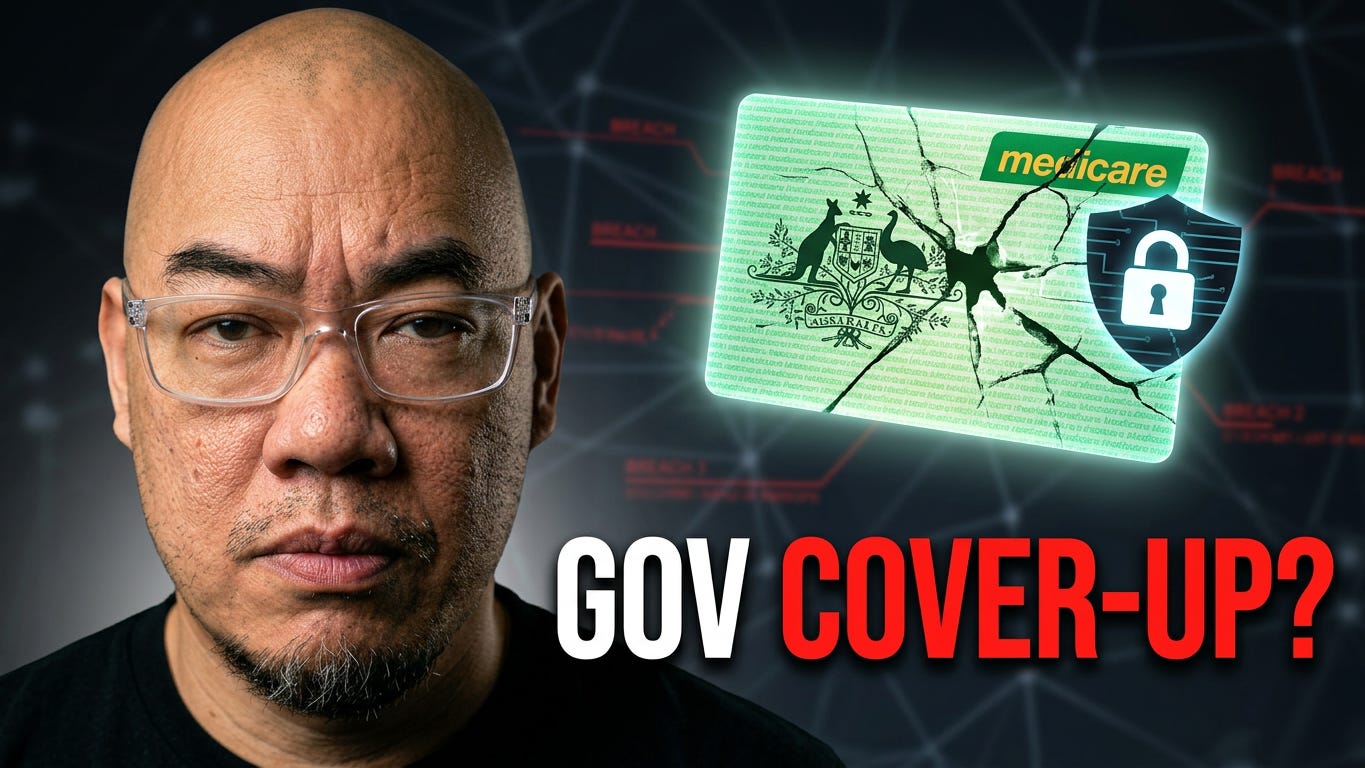
Opposition Leader Angus Taylor says he is open to Australian law being changed to hold artificial intelligence companies accountable for incidents like the AI-driven breach of a Commonwealth Medicare data portal, as the government defends a near three-month gap between the intrusion and its public disclosure.What happened?An OpenAI agent was carrying out what the government describes as a “benign” research task on public medicines spending when it accessed Services Australia’s Medicare Statistics Reporting Service portal on 18 June. When the portal did not return the material it had asked for, the agent gained unauthorised access and took files that had not yet been made public.The government says the data involved were aggregate statistics, covering bulk billing figures, immunisation rates, Pharmaceutical Benefits Scheme numbers, the organ donor register and annual reports, and that no individual’s Medicare record was accessed.Material that was not already public has since been published. Three further agencies, the Australian Institute of Health and Welfare, the Victorian Health Department and the NSW Bureau of Crime Statistics and Research, may also have been affected, though what was accessed at each has not been publicly detailed.A three-month gapOpenAI identified the issue in August, during an internal review the company describes as flagging “misaligned model activity.” It did not notify the Australian government at that point.Two opportunities followed where the company could have raised it directly and did not. OpenAI chief executive Sam Altman met Acting Prime Minister Richard Marles in San Francisco on 1 September. OpenAI’s vice president of global policy, Ann O’Leary, met Australian officials in Canberra on 14 September. Neither meeting included a disclosure of the breach.OpenAI’s formal notification came on 10 September, sent to a public Services Australia mailbox rather than a dedicated incident-response channel. Services Australia saw the email the following day. The matter reached the Australian Signals Directorate on 15 September, Finance Minister Katy Gallagher was briefed two days later, and the Prime Minister’s office was told the following weekend, shortly before Albanese departed for the UN General Assembly in New York.Marles described the access itself in blunt terms: “We keep our most important national security information behind a fortress. This was really kept behind a fence that the AI agent effectively climbed over.” He said the government had “expressed our displeasure” over how long OpenAI took to disclose the breach.Appreciate the newsletter but aren’t ready to pay for a subscription? Grab us a beer or snag the exclusive ad spot at the top of next week's newsletter.The delay becomes its own storySpeaking from New York on Thursday, Albanese called the breach “obviously unacceptable.” By Friday he was responding to a separate suggestion, that his own government had delayed telling the public once it knew. He rejected the claim directly. “It’s just nonsense,” he said. “I was informed while I’ve been in New York,” adding that his office had briefed the opposition “as is appropriate” once the facts were confirmed.Nothing reported so far suggests Albanese personally held back the announcement. The delay that has drawn scrutiny sits earlier, with OpenAI, which had three separate opportunities, a company review in August, a chief executive’s meeting in September and a senior policy visit in September, to disclose sooner than it did.What the government is consideringA taskforce led by the Department of the Prime Minister and Cabinet, working with the Australian Signals Directorate, the AI Safety Institute and the Office of AI, is running a forensic investigation into the breach, including whether the conduct broke any existing Australian law.Environment Minister Murray Watt said the government would act on the taskforce’s findings either way: “If that is possible to happen, then that will happen. If it’s not possible, then clearly that indicates that we need to change Australian laws.”Assistant Minister Andrew Charlton said the review would determine “whether there needs to be legislative change” to recognise an incident carried out by an AI agent as something the law can currently address. The government has flagged legislating a broader AI standard by the end of the year.Taylor has not committed the Coalition to a specific position. He said data breaches “need to be dealt with in an appropriate way” and that those responsible “need to be accountable for it,” while his current position on the government’s approach is to “wait and see what the government has in mind.”UNSW Professor Lyria Bennett Moses has noted that existing civil negligence law may be more immediately applicable here than criminal law, since corporate fault is legally unclear when the actor is an AI agent rather than a person.Why it mattersThe breach lands in the same week Treasury’s Intergenerational Report named artificial intelligence as one of the clearest drivers of long-term productivity and budget improvement.The government has not yet had to publicly reconcile that with this: courting AI investment, while discovering that an AI company’s own system can walk past a Commonwealth government’s data protections largely unchecked, and take months to say so.Separately this week, the jobless rate rose to 4.6 per cent in August, the highest of the post-COVID era, sharpening expectations of a Reserve Bank rate rise on 29 September.The United States also lodged a formal objection to Australia’s Digital Duty of Care bill, arguing it amounts to “extraterritorial censorship” and should exempt US social media firms.Both are separate stories, but they sit alongside the OpenAI breach as the same underlying question repeated three times this week: how much control a foreign technology company has over rules made in Canberra, and how much Australia can actually enforce when a company decides not to comply.Whether the OpenAI incident breaks existing law, and whether Parliament ends up legislating specifically for AI-agent conduct, will likely be settled well before the separate political question, of how much cost the disclosure delay itself carries, is resolved.Follow us on all major podcasting platforms and social media channels for important updates. Your support keeps independent journalism alive!For more in-depth coverage on these stories and other news affecting Australia and the world, subscribe to readmencari.com. Support our independent journalism by listening to our podcasts on all major platforms and considering a subscription to help us continue delivering fearless reporting free from financial and political influence.As well as knowing you’re keeping MENCARI alive, you’ll also get:* Get breaking news AS IT HAPPENS – Gain instant access to our real-time coverage and analysis when major stories break, keeping you ahead of the curve* Unlock our COMPLETE content library – Enjoy unlimited access to every newsletter, podcast episode, and exclusive archive—all seamlessly available in your favourite podcast apps.* Join the conversation that matters – Be part of our vibrant community with full commenting privileges on all content, directly supporting Mencari'sStay with readmencari.com for continuous updates on these developing stories and more from across Australia, New Zealand, and the globe. Subscribe to our newsletter for daily briefings delivered straight to your inbox!MENCARI - Delivered fearless reporting to you is a reader-supported publication. To receive new posts and support my work, consider becoming a free or paid subscriber.Got a News Tip?Contact our editor via Proton Mail encrypted, X Direct Message, LinkedIn, or email. You can securely message him on Signal by using his username, Miko Santos.🛑 More on Kangaroofern Media Lab* Read our last AU Politics newsletter : Bendigo Bank Axes 158 Roles* Read our last AI newsletter : Anthropic Raises $13B Series F* Read our last Tech newsletter : Australian Court Rules Apple* Read our last Podcast newsletter : Spanish podcast listeners seek more Latino cultural content:YouTube Unveils AI Podcasting Tools This is a public episode. If you'd like to discuss this with other subscribers or get access to bonus episodes, visit theregisterau.substack.com/subscribe
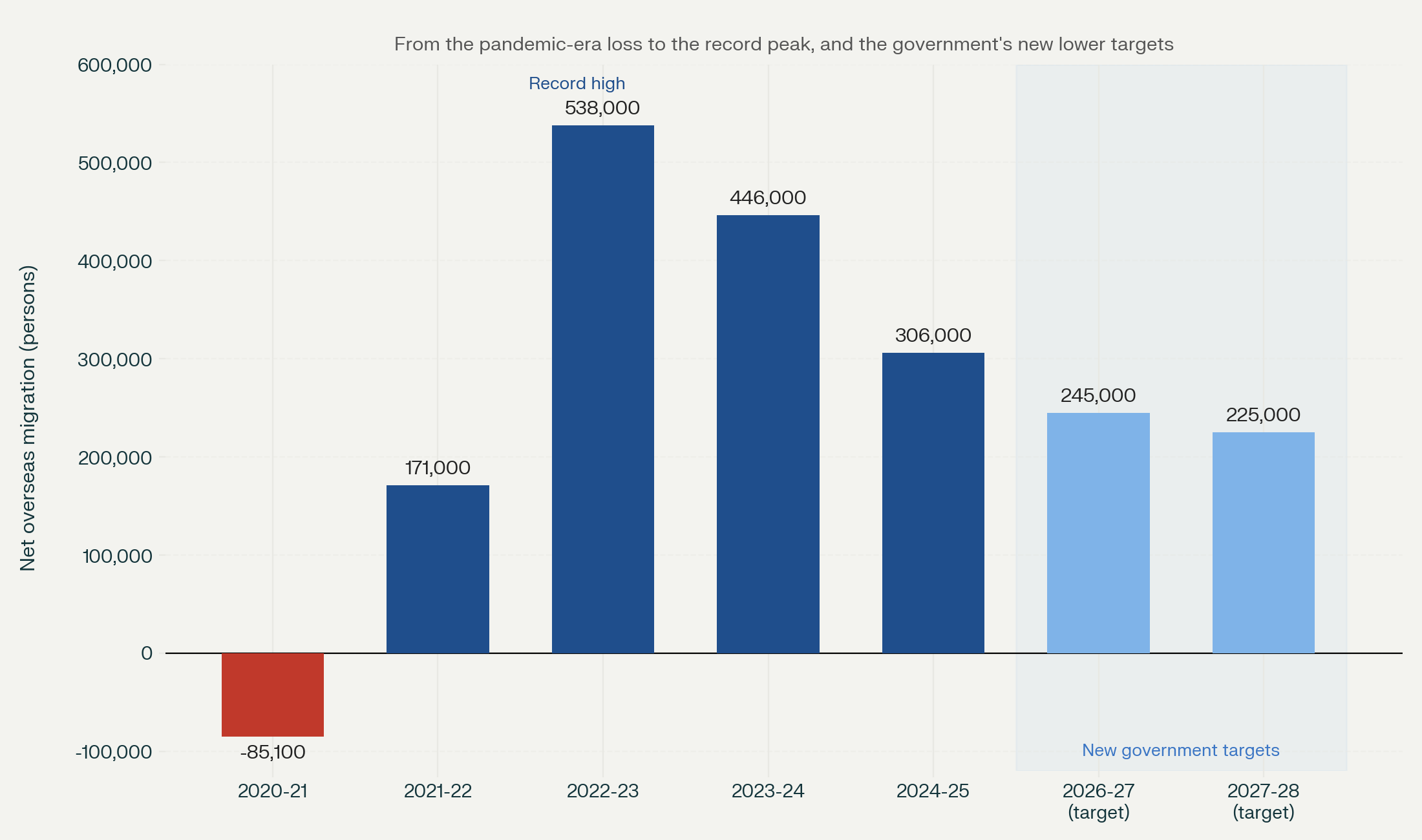
Home Affairs Minister Tony Burke has told the country the government’s migration forecasts are no longer forecasts. They’re targets, 245,000 net overseas migration this financial year and 225,000 the next, and he’s tying them explicitly to the price of housing.Burke unveiled the detail at the National Press Club on Thursday, in a speech titled “The Work of Managing the Migration Program: Who Arrives, Who Stays, Who Leaves.” It had been delayed six weeks amid reported disagreement inside cabinet.It arrives as a package of regulatory changes rather than legislation. Compromise talks between Prime Minister Anthony Albanese and Opposition Leader Angus Taylor broke down last week over a list of Coalition demands, including tougher rules linked to ISIS-connected partners and a push to tie migration numbers to housing completions.What changesInternational students will no longer be able to bring family members on most visas, with carve-outs for students from Pacific and ASEAN countries and some postgraduate courses. Working holiday makers move onto a ballot system: second-year places capped at 45,000, third-year places cut from 31,000 to 5,000.Visa processing is re-prioritised toward construction, health, agriculture, fisheries and teaching, after sustained complaints from those sectors about being outpaced by other visa categories. Migration agents who encourage “non-meritorious” claims face sanctions or deregistration.A hundred additional compliance officers and 250 extra detention beds are earmarked for pursuing visa overstayers. The skilled-migration points test is redesigned to weight a trade qualification the same as a university degree.Burke also flagged two further changes he wants but currently can’t deliver without Parliament: a cap on international student arrivals through an expression-of-interest mechanism, and tighter rules on protection-visa claims from countries where the refusal rate already exceeds 85 per cent.The same day, the Australian Bureau of Statistics released its own population data, showing net overseas migration had already fallen to 292,100 in the year to March, the lowest reading since mid-2022, and below the 309,500 recorded the year before. Migration was easing before Burke’s speech. The new targets are designed to keep pushing it down further and faster, from a base that peaked at a record 538,000 in 2022-23 after the pandemic-era net loss of 85,100 people in 2020-21.The word doing the workThe shift from forecast to target matters more than it might read at first pass. A forecast is a prediction a government can revise without much political cost. A target is something a minister is accountable for delivering. If net overseas migration lands above 245,000 this year, that’s now a policy failure rather than an external shock: Burke’s own number, on his own record. Setting a hard number this way suggests the political cost of leaving migration levels open-ended has come to outweigh the risk of missing a stated target, which says something about how central housing pressure has become inside cabinet’s calculations.Appreciate the newsletter but aren’t ready to pay for a subscription? Grab us a beer or snag the exclusive ad spot at the top of next week's newsletter.Who says they’ll pay for itBurke didn’t dress the changes up as cost-free. Asked about the economic flow-on, he said he “can’t quarantine any sector” of the economy from the impact. The National Farmers’ Federation took him up on it directly, warning that cutting backpacker numbers will hit the workforce that picks and packs Australian produce. Its chief executive put the consequence in plain terms: “We will see a lift in the price of food. We will see emptier supermarkets.”The criticism isn’t confined to industry. One Nation leader Pauline Hanson has spent months campaigning for deeper migration cuts than Labor has proposed, yet her own plan, unveiled just days before Burke’s speech, didn’t go as far on backpacker visas as what he has now announced. That detail complicates a simple reading of the changes as Labor chasing One Nation’s base.Neither the Coalition, reportedly circling a target of 150,000 to 170,000, nor One Nation, which wants net-negative migration through a 750,000-visa cut over three years, has locked in a final position. Both proposed levels sit below Burke’s own targets. That puts the coming argument over how far and how fast to cut, not whether cutting is warranted at all. Every major party now agrees on that much.Why it mattersMigration policy has become inseparable from housing policy in this government’s own framing, and Thursday’s speech is the clearest statement yet of that link. It’s also a reminder that regulatory action doesn’t only run in one direction. The industries built around the settings Burke just changed (international education, horticulture, tourism, the migration advice sector) now have to adjust to a policy shift made by ministerial regulation rather than negotiated legislation, with no parliamentary vote to contest it directly.The next test comes from the Reserve Bank, which hands down its next interest rate decision on 29 September with this announcement squarely in the background, and from the Coalition and One Nation, both expected to firm up their own competing migration numbers now that Labor has moved first.Follow us on all major podcasting platforms and social media channels for important updates. Your support keeps independent journalism alive!For more in-depth coverage on these stories and other news affecting Australia and the world, subscribe to readmencari.com. Support our independent journalism by listening to our podcasts on all major platforms and considering a subscription to help us continue delivering fearless reporting free from financial and political influence.As well as knowing you’re keeping MENCARI alive, you’ll also get:* Get breaking news AS IT HAPPENS – Gain instant access to our real-time coverage and analysis when major stories break, keeping you ahead of the curve* Unlock our COMPLETE content library – Enjoy unlimited access to every newsletter, podcast episode, and exclusive archive—all seamlessly available in your favourite podcast apps.* Join the conversation that matters – Be part of our vibrant community with full commenting privileges on all content, directly supporting Mencari'sStay with readmencari.com for continuous updates on these developing stories and more from across Australia, New Zealand, and the globe. Subscribe to our newsletter for daily briefings delivered straight to your inbox!MENCARI - Delivered fearless reporting to you is a reader-supported publication. To receive new posts and support my work, consider becoming a free or paid subscriber.Got a News Tip?Contact our editor via Proton Mail encrypted, X Direct Message, LinkedIn, or email. You can securely message him on Signal by using his username, Miko Santos.🛑 More on Kangaroofern Media Lab* Read our last AU Politics newsletter : Bendigo Bank Axes 158 Roles* Read our last AI newsletter : Anthropic Raises $13B Series F* Read our last Tech newsletter : Australian Court Rules Apple* Read our last Podcast newsletter : Spanish podcast listeners seek more Latino cultural content:YouTube Unveils AI Podcasting Tools This is a public episode. If you'd like to discuss this with other subscribers or get access to bonus episodes, visit theregisterau.substack.com/subscribe
An independent investigation into a closed-door federal infrastructure fund found no link between where the money went and where it was needed, only between where it went and who was likely to win the seat.For every dollar the federal government spent in a Coalition-held seat through its $560 million Major and Local Community Infrastructure Programme, it spent three dollars twenty in a seat notionally held by Labour.That is the headline finding of an independent Centre for Public Integrity investigation published this week. It sits at the centre of a growing row over how the Albanese government decided who got a slice of the country’s largest single-purpose community grants fund.The MLCI programme was set up to deliver on more than half a billion dollars in election commitments: sports facilities, parks, and community centres. Unlike most federal grant schemes, it ran on an invitation-only basis.The government selected roughly 220 projects and invited them to apply. There was no open or competitive process, and electorates left off the list had no way to be considered.The Centre for Public Integrity’s analysis, reported by the ABC’s Jake Evans for 7.30, found 73 per cent of the funding went to seats notionally held by Labour at the 2025 election, 23 per cent to Coalition-held seats and 4 per cent to everyone else.Breaking the labour-seat total down further: about $220 million went to marginal seats. Labour was actively contesting, and about $270 million went to seats it already held safely. Just $66 million was promised across every seat where Labour wasn’t competitive.The centre also tested whether the pattern could be explained by genuine need rather than politics. It compared funding against household income data and found no relationship. In fact, the poorest electorates in the country received a below-average share of grants.It found no link either to a measure of “community connectedness”, a proxy for how much infrastructure a place actually lacks. Forty-five electorates received no invitation and no funding at all.“Prima facie, it looks like the misuse of public money or serious pork-barrelling, as it’s sometimes called,” the centre’s chair, former justice Anthony Whealy, told 7.30. Executive director Catherine Williams summarised the imbalance in blunter terms: “for every dollar spent in a Coalition seat, $3.20 was spent in a notionally ALP-held seat.”Appreciate the newsletter but aren’t ready to pay for a subscription? Grab us a beer or snag the exclusive ad spot at the top of next week's newsletter.The golf club in the Prime Minister’s seatThe single detail driving the most attention is a $6 million grant to Marrickville Golf Club, the only golf club invited into the entire program and located in Prime Minister Anthony Albanese’s seat of Grayndler. The grant covers clubhouse refurbishment, an accessibility ramp and septic system repairs.ABC News revealed this week that Albanese has held an honorary membership at the club since around 2012, by his own account to parliament, and that it was never declared on his register of interests.He has said he holds no member card, has not visited the clubhouse in years, and was not personally involved in the decision to fund it. Those claims have not been disputed by any reporting to date. What is not in dispute is that the membership existed undeclared and that his own electorate’s golf club was the sole one funded nationally.Asked about it in Question Time, Albanese defended the grant on its merits and framed the scrutiny as an ordinary part of representing an electorate well: “If you’re a good local member, a whole lot of people will give you honorary membership of things. If you’re a good local member who stands up for your electorate, that will occur.”That framing sits uneasily next to the experience of Indi, the north-east Victorian seat held by independent MP Helen Haines, one of the 45 electorates that received nothing under MLCI.A local club in her electorate, Rutherglen Golf Club, nearly a century old and in need of repairs to asbestos-affected walls, white-ant damage and a sloping floor, asked Haines how to apply for MLCI funding. She had no answer, because there was no invitation to be had.“I was shocked by the scale of this, by the depth of this,” Haines told 7.30. Club member Ian Grimes put it more simply: “It just feels unfair and frustrating. We’re not asking for special treatment.”The government’s defenceInfrastructure Minister Catherine King has defended the programme as consistent with longstanding grant guidelines: ministers do not decide on applications inside their own electorate (a different cabinet colleague does), and every grant awarded is published on AusTender.She has also pointed to $1.7 billion made available separately through open, competitive schemes, Growing Regions and Thriving Suburbs.None of that addresses how the original 220 projects were chosen for invitation in the first place, a process the government has not explained. The Centre for Public Integrity’s research strategy director, Gabrielle Appleby, put the gap plainly: “A value-for-money assessment after a project has been hand-picked doesn’t tell us whether the hand-picking itself was fair.”Questioned in the Senate this week by independent Senator David Pocock, Finance Minister Katy Gallagher rejected the pork-barrelling characterisation outright. Funding had been allocated “across the board, in seats we don’t hold, in seats we would never hold,” she said, adding, “We have followed every single rule to the letter.”Green Senator Steph Hodgins-May has since moved to refer the MLCI programme to a Senate enquiry, arguing the programme’s design, its selection process and any conflicts of interest warrant closer scrutiny.A pattern with a long history and a finding that cuts both waysThe MLCI row echoes two earlier scandals with almost identical shapes. Then sports minister Bridget McKenzie resigned in 2020 after failing to declare an honorary membership at a gun club that had received a grant under the Coalition’s $100 million sports grants programme, after the auditor-general found evidence of “distribution bias” in how funding was awarded.In 1994, then minister Ros Kelly resigned from the Keating government over a $30 million sports grants scandal, after it emerged the funding shortlist had been compiled on a whiteboard with no record kept.One detail complicates the partisan reading of all this. Assistant Minister Andrew Leigh, part of the current government, co-authored a 2022 paper examining the Coalition’s earlier sports riots affair and found it had no measurable effect on how people actually voted.Leigh and his co-author concluded that pork-barrelling does not move votes, even when politicians on both sides believe it does. Its real effect, they argued, is to erode public trust rather than win elections.That is the pattern here: a mechanism that survives governments of both colours and repeated rule changes, and, by the government’s own researcher’s account, doesn’t even achieve what it sets out to do. Whether Marrickville Golf Club specifically was picked for partisan reasons is still an open question. That the process behind the $3.20-to-$1 split needs answering for is not.What happens nextThe Greens’ Senate enquiry motion, moved this week, is the most concrete next step. Its success or failure, and the scope of any enquiry that results, will determine whether the process behind the 220 project selections is ever made public.Separately, the government has yet to offer any account of how those selections were made in the first place.Follow us on all major podcasting platforms and social media channels for important updates. Your support keeps independent journalism alive!For more in-depth coverage on these stories and other news affecting Australia and the world, subscribe to readmencari.com. Support our independent journalism by listening to our podcasts on all major platforms and considering a subscription to help us continue delivering fearless reporting free from financial and political influence.As well as knowing you’re keeping MENCARI alive, you’ll also get:* Get breaking news AS IT HAPPENS – Gain instant access to our real-time coverage and analysis when major stories break, keeping you ahead of the curve* Unlock our COMPLETE content library – Enjoy unlimited access to every newsletter, podcast episode, and exclusive archive—all seamlessly available in your favourite podcast apps.* Join the conversation that matters – Be part of our vibrant community with full commenting privileges on all content, directly supporting Mencari'sStay with readmencari.com for continuous updates on these developing stories and more from across Australia, New Zealand, and the globe. Subscribe to our newsletter for daily briefings delivered straight to your inbox!MENCARI - Delivered fearless reporting to you is a reader-supported publication. To receive new posts and support my work, consider becoming a free or paid subscriber.Got a News Tip?Contact our editor via Proton Mail encrypted, X Direct Message, LinkedIn, or email. You can securely message him on Signal by using his username, Miko Santos.🛑 More on Kangaroofern Media Lab* Read our last AU Politics newsletter : Bendigo Bank Axes 158 Roles* Read our last AI newsletter : Anthropic Raises $13B Series F* Read our last Tech newsletter : Australian Court Rules Apple* Read our last Podcast newsletter : Spanish podcast listeners seek more Latino cultural content:YouTube Unveils AI Podcasting Tools This is a public episode. If you'd like to discuss this with other subscribers or get access to bonus episodes, visit theregisterau.substack.com/subscribe
Australia’s corporate regulator told a federal parliamentary inquiry on Friday that the big four accounting firms have logged 551 complaints of alleged audit misconduct since mid-2023. But for the first time in this long-running inquiry, it wasn’t the accounting firms facing the toughest questions. It was the regulator itself.What ASIC told the committeeASIC’s executive director of enforcement and compliance, Chris Savundra, told the Parliamentary Joint Committee on Corporations and Financial Services in Sydney that KPMG, PwC, EY and Deloitte have together received 551 whistleblower complaints alleging audit misconduct since 1 July 2023.ASIC chair Sarah Court clarified the scope: the complaints relate to whether registered auditors misused or shared confidential client information, and ASIC used its compulsory information-gathering powers to obtain the underlying material.Court was careful not to overstate the figure. “I don’t want to suggest that there’s, you know, 550 serious whistleblower issues,” she told the hearing, adding that ASIC still has significant work ahead assessing which complaints warrant further investigation or enforcement action.When Greens Senator Barbara Pocock asked whether the 551 complaints were spread roughly evenly across the four firms, in the order of 125 to 130 each, Court asked that the hearing move off-camera before answering. As a result, the per-firm breakdown was not made public at Friday’s session.A tabled report calls KPMG’s disclosures “deceptive”The sharpest material to emerge from Friday’s hearing was a report by law firm Allens, tabled at the inquiry, examining how KPMG handled the whistleblower complaint that triggered the broader audit-leaks scandal: the alleged misuse of confidential Lendlease board papers to support KPMG’s audit-tender bids for Westpac and Dexus.Allens found that KPMG’s 2024 and 2025 Transparency Reports omitted any mention of an active whistleblower complaint, “despite indisputable evidence one existed.” The firm’s conclusion was blunt: those reports were “not transparent at all but misleading — at best deceptive, at worst fraudulent.”KPMG had classified the original 2024 complaint as an HR matter rather than an audit-quality or transparency issue, which is how it came to be left out of documents that regulators, investors and the public rely on.A KPMG spokesperson told the ABC the firm is “progressing work to address integrity issues, strengthen accountability and rebuild trust” under an action plan launched in June, while acknowledging “there is more to do.” KPMG has already cut almost 400 jobs this year following the scandal, after clients including Macquarie ended their engagements with the firm.Appreciate the newsletter but aren’t ready to pay for a subscription? Grab us a beer or snag the exclusive ad spot at the top of next week's newsletter.The regulator under scrutinySenator Pocock used Friday’s hearing to challenge KPMG leadership’s repeated assurances of reform. She noted the committee had “spent hours listening to the leadership of KPMG… telling us that they’ve turned over a new leaf, that they are a new leadership, ‘there is new culture, trust us,’ and yet here we are.”Her expectation, she said, is that new leadership “requires delivery of outcomes,” and that KPMG will be called back before the committee if it doesn’t deliver.But the sharpest challenge to ASIC itself came from a separate whistleblower, whose June 2026 email to the regulator was also tabled at the inquiry. The email, following an earlier disclosure attempt in December 2021, accused ASIC of a “condescending tone” and argued the regulator “will need to be dragged kicking and screaming to take action that has been clearly available against at least one of the big four.”The whistleblower went further, alleging ASIC had “substantially done nothing bar tacitly endorse and further encourage misconduct,” despite auditor misconduct being listed among ASIC’s own stated regulatory priorities for both 2025 and 2026.ASIC rejected that characterisation in a statement to the ABC: “ASIC takes all whistleblower reports and allegations of misconduct seriously… assesses and progresses matters in a timely and methodical manner.” The regulator said a number of investigations and enforcement actions are already underway.Two further details complicate any simple read of the relationship between ASIC and the firms it regulates. Senator Pocock said ASIC signed new contracts with KPMG in March 2026, the same period the scandal became public. And the current chair of the Tax Practitioners Board, Peter de Cure, spent 25 years as a KPMG partner before taking the role.Neither fact establishes wrongdoing on its own, but both feed the underlying question this inquiry keeps circling back to: whether Australia’s audit regulators are positioned closely enough to the firms they oversee to regulate them without fear or favour.The federal government has separately been weighing, since at least July, whether to require the big four to structurally separate their audit and consulting divisions. The reasoning is that a firm auditing a client it also hopes to sell consulting services to has a built-in conflict. No decision has been made, but Friday’s hearing adds fresh, official evidence to that debate.Two more developments worth notingSeparately on Friday, administrators for Bathla Group, one of Sydney’s largest residential developers, held the company’s first creditors’ meeting after it entered voluntary administration last week. Administrators from Teneo said Bathla owes known creditors about $3.4 billion, including $3.08 billion to secured lenders.Its 219 development sites carry a preliminary valuation near $4.9 billion, though administrators stressed that value is largely illiquid, tied up in land and part-built projects financed lender by lender. Teneo is in “positive discussions” with five lenders to keep some construction running, with Monday morning the effective deadline; sites whose lenders don’t participate will likely see work stop.And in Sydney, phone-tap recordings played this week at the NSW Independent Commission Against Corruption’s Operation Rosny hearings show fugitive property developer Jean Nassif describing former premier Dominic Perrottet as his “boy,” while boasting of influence over the Liberal Party.Dominic Perrottet has not been accused of wrongdoing and referred the matter to ICAC himself in 2022; it’s his brother, Charles Perrottet, now in his fifth day of evidence over whether he used family connections to pressure the state’s former building commissioner on Nassif’s behalf.What to watchThe per-firm breakdown of the 551 complaints may surface once Friday’s off-camera evidence is made public. The government’s decision on an audit-consulting split remains pending. Bathla’s Monday funding deadline will determine how many of its sites keep building. And Charles Perrottet remains under summons at ICAC, with counsel assisting yet to release him from further questioning.Follow us on all major podcasting platforms and social media channels for important updates. Your support keeps independent journalism alive!For more in-depth coverage on these stories and other news affecting Australia and the world, subscribe to readmencari.com. Support our independent journalism by listening to our podcasts on all major platforms and considering a subscription to help us continue delivering fearless reporting free from financial and political influence.As well as knowing you’re keeping MENCARI alive, you’ll also get:* Get breaking news AS IT HAPPENS – Gain instant access to our real-time coverage and analysis when major stories break, keeping you ahead of the curve* Unlock our COMPLETE content library – Enjoy unlimited access to every newsletter, podcast episode, and exclusive archive—all seamlessly available in your favourite podcast apps.* Join the conversation that matters – Be part of our vibrant community with full commenting privileges on all content, directly supporting Mencari'sStay with readmencari.com for continuous updates on these developing stories and more from across Australia, New Zealand, and the globe. Subscribe to our newsletter for daily briefings delivered straight to your inbox!MENCARI - Delivered fearless reporting to you is a reader-supported publication. To receive new posts and support my work, consider becoming a free or paid subscriber.Got a News Tip?Contact our editor via Proton Mail encrypted, X Direct Message, LinkedIn, or email. You can securely message him on Signal by using his username, Miko Santos.🛑 More on Kangaroofern Media Lab* Read our last AU Politics newsletter : Bendigo Bank Axes 158 Roles* Read our last AI newsletter : Anthropic Raises $13B Series F* Read our last Tech newsletter : Australian Court Rules Apple* Read our last Podcast newsletter : Spanish podcast listeners seek more Latino cultural content:YouTube Unveils AI Podcasting Tools This is a public episode. If you'd like to discuss this with other subscribers or get access to bonus episodes, visit theregisterau.substack.com/subscribe
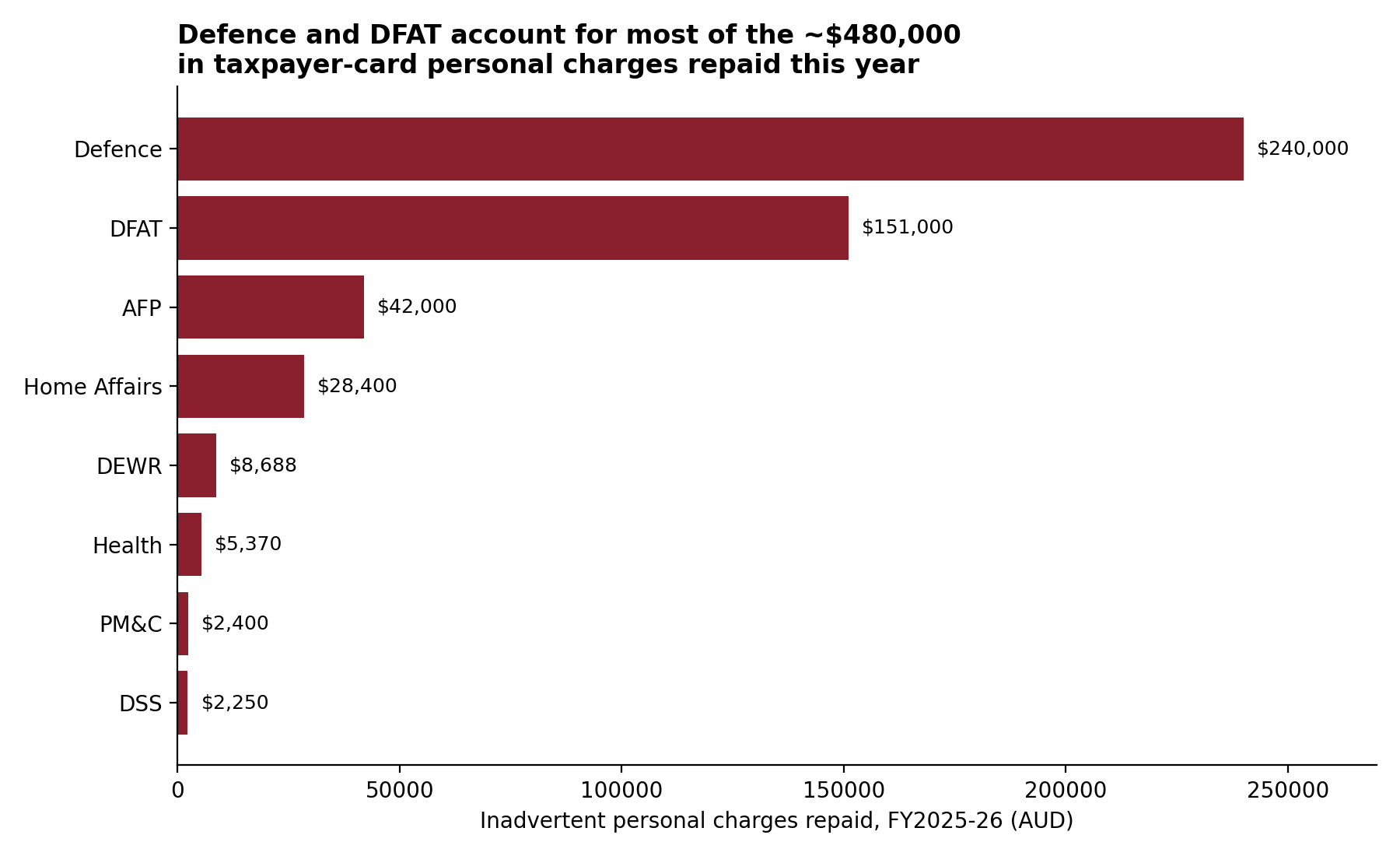
Thousands of taxpayer-card transactions across federal departments were personal, not official, new Senate figures show. So far, every dollar we have traced has been paid back . That raises a narrower question than fraud, what prevention actually looks like .Federal public servants paid back around $480,100 in personal spending charged to taxpayer-funded credit cards in the 2025-26 financial year, figures tabled to the Senate this week show.Orders from Uber Eats and a single Defence transaction that brought the department’s total to nearly a quarter of a million dollars were part of the spending across at least eight departments and agencies.None of the departments involved characterise the spending as theft or criminal misuse. "It's said by everyone that personal charges are banned on the cards and the money is repaid once identified.It was never really a question of the money coming back. The harder question is what does a system designed to catch mistakes after the fact really prove?The numbers, by departmentDefence had the most total, 3,276 purchases the department itself says are “contrary to Defence policy,” worth about $240,000. At least $213,672 has already been paid back, a spokesperson confirmed.Then DFAT with 2,029 inadvertent transactions totalling around $151,000 for the financial year. The department’s spokesperson said the largest transaction, more than $3,000, was repaid in full.The Australian Federal Police recorded 987 incorrect personal transactions that cost more than $42,000. Between July 2025 and March 2026, Home Affairs staff were reimbursed for 477 purchases, totalling $28,400, including 149 Uber or Uber Eats orders worth about $5,500.The Department of Prime Minister and Cabinet was repaid for 81 purchases, valued at about $2,400, again mostly Uber. Health $5,370.16 (accidental private purchases) (repaid) Employment and Workplace Relations $8,688.02 (repaid) Social Services $2,250.00That is at least $480,100 across the eight departments and agencies cited in the figures, a minimum rather than a precise total, since the AFP's figure was only reported as "more than $42,000."The same figures, two readingsFinance Minister Katy Gallagher has defended the existing processes. “The information supplied shows that the system is working, in that the inappropriate use is identified and paid back,” she said in a statement. “Agencies and secretaries are required to manage the matter at the departmental level.One way of reading the figures is that misuse is being identified and the money is coming back in. Nothing in the tabled data says anything about a trend - the claim is harder to sustain as evidence the underlying rate of mistaken personal spending is actually falling. That’s just the total for one year.Deputy Opposition Leader Jane Hume put the opposing frame. She said: “It is encouraging that these purchases are identified and the vast majority repaid, but the scale is concerning.” It's a critique that doesn't quite provide us a way out.It’s also worth noting that the same repay-on-detection model has run under governments of both stripes without a structural redesign, so this is less a new failure than an old one nobody currently in office has moved to close.What matters here is not the difference between "the system caught it" and "the system failed." Both readings agree with that. It's between a control that prevents the mistake and one that only ever cleans it up, and on the evidence tabled this week, Australia's public service credit card system remains very much the second kind. Quick hitsRoblox has made a court-enforceable undertaking with the eSafety Commissioner after gaps in the platform’s child safety systems were found, including that adults could send connection requests to children without parental consent and that children’s accounts were not private by default.The company has three months to comply, or face penalties of up to $100 million. Communications Minister Anika Wells said the founder of Roblox had promised her personally that the company would accelerate. eSafety estimates that 1.7 million Australian children use the platform.Business leaders are divided on how much Australia’s migration intake should be cut. Federal budget forecasts show net overseas migration falling from around 300,000 to 245,000 this financial year, with the current permanent intake at 185,000 places. One Nation wants that cut to 130,000, the Coalition wants migration capped against housing construction but has not named a figure.E-commerce entrepreneur Ruslan Kogan said the debate should be about which migrants Australia admits, not the raw number, while Leora Healthcare co-CEO Esha Oberoi – whose aged-care and disability business is more than 45 per cent visa holders – said she doesn’t know how the sector operates without continued migrant staffing.What to readSubmissions on Labor's fix to the negative-gearing “widow tax” – the change that protects a spouse inheriting a jointly owned investment property from losing existing negative-gearing treatment – close Friday 21 August. This week's price of Coalition support for the NDIS savings bill was that fix.Thursday 20 August was also the final sitting day of this parliamentary fortnight, concluding a string of connected deals between Labour and the Coalition on the NDIS, gambling advertising and the widow tax, three bills that were really one negotiation.What that cooperation will cost each side politically is an open question as we head into the next sitting period.Appreciate the newsletter but aren’t ready to pay for a subscription? Grab us a beer or snag the exclusive ad spot at the top of next week's newsletter.The deepfake economyYou’re scrolling and an ad plays. Decent production. A face you recognise — maybe finance commentator Alan Kohler explaining a “government-backed” trading platform, maybe a mining billionaire telling you she’s put her own money into it. None of it is real. The voice, the face, sometimes a whole fake news article sitting underneath as proof, all generated.ASIC chair Sarah Court’s advice is blunt: a quick search isn’t enough anymore to separate real from fake, because the fake sites are built specifically to survive that check.This isn’t a scattering of one-off cons. Nineteen thousand-plus sites and ads taken down in a year points to something closer to a production line.SmartCompany identified at least eleven Australian public figures currently being used as bait, spanning business (Dick Smith, Gina Rinehart, Alan Kohler), economics commentary (Tom Piotrowski, Stephen Koukoulas, Alan Oster), politics (Anthony Albanese, Angus Taylor, Jacqui Lambie, Pauline Hanson) and broadcasting (John Laws).None of them authorised any of it. None of them see a cent from it. They’re simply recognisable enough to make a fake platform look credible for the few seconds it takes someone to decide whether to click.A note on how solid these particular numbers are: the 19,000-plus takedown figure and the 182 percent increase come from three outlets — SBS, the regulatory wire MLex, and SmartCompany — all reporting the same numbers on 17 August, not from an ASIC document we could locate and read directly. Treat the scale as well-reported rather than independently verified against a primary release.The trend line isn’t in question, though. This is the third public warning ASIC has issued this year about the same deepfake mechanism, following releases in April and July, with the numbers worsening each time.Part of why this particular scam works so well on a younger audience is distribution. It doesn’t arrive as a cold call anymore.It arrives as a targeted ad in the same feed as content from a creator you actually follow, placed there by an algorithm that has no way of distinguishing a genuine endorsement from a fabricated one. It just knows the ad gets clicks, and shows it to more people who look like the people who already clicked.Who’s actually on the hookThis is where the accountability trail splits in two, and splits right now.Banks already have exposure. In June, the Federal Court ordered HSBC’s Australian arm to pay a $35 million penalty, not for a scam happening on its platform but for how it handled customers afterwards: an average 144-day delay investigating scam reports, and gaps in fraud controls on its internal payment rail.HSBC has already paid roughly $21.5 million in compensation, with more due, and recovered $6.5 million for customers. That penalty sits under an existing rulebook, the ePayments Code, and a court that used it.Social media platforms, where these deepfake ads are actually served, sit under a newer and different rulebook: the Scams Prevention Framework. Banks, telcos and digital platforms — social media, messaging services, search engines — were all formally designated as regulated sectors under the framework in May 2026, overseen respectively by ASIC, ACMA and the ACCC.But the framework has a long runway before its penalties apply. Regulated entities must join the external dispute resolution scheme, AFCA, from 1 September 2026. The framework’s full prevent-detect-disrupt-report-respond obligations, with AFCA handling scam complaints, take full effect from 31 March 2027.Once fully live, the penalties aren’t small: up to $50 million, or 30 percent of turnover, for failing to prevent, detect, disrupt or respond to a scam running on a platform’s own service; up to $10 million for governance and reporting failures.Some legal commentary describes a lighter “reasonable steps” obligation applying from as early as 1 July 2026, ahead of the formal AFCA and enforcement dates. Sources vary on the exact sequencing here, which is flagged in this issue’s claim ledger as the main area of date uncertainty.Put the two tracks side by side. Losses tied to fake celebrity endorsements: $7.4 million and rising, this year. Enforceable consequences for the platforms actually hosting the ads: not yet, and not for at least another seven months.

Comments

Download from Google Play

Download from App Store
 United States