


 Claim Ownership
Iron Direct Primary Care Podcast
Subscribed: 2Played: 8
Subscribe

© Stefan Hartmann
Description
Learn Functional Medicine with Iron DPC and more.
For providers and patients alike.
For patients: register on ironDPC.com
For providers wanting to learning how to start a functional medicine DPC check out our course https://stefan-hartmann.mykajabi.com/pl/2148697525
For providers and patients alike.
For patients: register on ironDPC.com
For providers wanting to learning how to start a functional medicine DPC check out our course https://stefan-hartmann.mykajabi.com/pl/2148697525
39 Episodes
Reverse

What happens when addiction medicine, primary care, and national drug policy collide? On this episode of the Iron Direct Primary Care Podcast, Stefan Hartmann, PA-C sits down with Dr. Andrea Barthwell, one of the most experienced voices in American addiction medicine.Dr. Barthwell is a past president of the American Society of Addiction Medicine (ASAM) and served in the George W. Bush White House as Deputy Director for Demand Reduction at the Office of National Drug Control Policy (ONDCP). She is the founder of Encounter Medical Group and Two Dreams and was the founding chair of the $100 million Foundation for Opioid Response Efforts (FORE).This wasn't a conventional addiction-medicine interview.We discuss how American drug policy has changed—from the Bush-era War on Drugs and demand-reduction strategy to modern approaches emphasizing legalization, decriminalization, and harm reduction—and what decades of experience can teach us about the consequences of those choices.A major part of the conversation focuses on marijuana and the increasing tendency to treat cannabis as medicine or routine self-care. Dr. Barthwell explains her concerns about the medicalization of marijuana, particularly when patients assume that legalization or a medical-marijuana designation automatically means strong evidence of therapeutic benefit or long-term safety.We also go deep into something primary-care clinicians deal with every day:Sleep.Patients frequently arrive already using or requestingmedications such as:Eszopiclone (Lunesta) Trazodone GabapentinHydroxyzine Diphenhydramine (Benadryl) Atypical antipsychoticsWe discuss the tradeoffs of using psychoactive medications simply to make someone sleep, how dependence and substance-use history should change prescribing decisions, and why insomnia deserves more thoughtful evaluation than simply adding another sedating drug.We also discuss the role of primary care in identifying addiction early. Substance-use disorders do not always walk into the office announcing themselves. Alcohol, cannabis, prescription medications, stimulants, and opioids can become part of a patient's routine long before anyone formally identifies a disorder.Finally, Dr. Barthwell explains why she remains strongly supportive of evidence-based medications for opioid use disorder, including methadone and buprenorphine, and why these therapies should be viewed as medical treatment rather than simply substituting one drug for another.If you would like to learn anti aging medicine for primary care check out HRTPCP.COM to take our HRT courseConnect with Dr. Barthwell at https://www.linkedin.com/in/drandreabarthwell/andtwodreams.com

To download and read the full paper check out https://www.irondpc.com/blogTo learn HRT go to HRTPCP.com AbstractBackgroundInsulin resistance and elevated apolipoprotein B (ApoB) frequently coexist in adverse cardiometabolic phenotypes. However, biologic association does not establish that fasting insulin and ApoB provide interchangeable clinical information. Whether individuals with low fasting insulin reliably demonstrate low ApoB in routine primary care remains uncertain.ObjectiveTo characterize the relationship and discordance between fasting insulin and ApoB among adults undergoing same-day testing in a real-world primary care population, with secondary analyses incorporating hemoglobin A1c and exploratory analyses of female age, LC-MS estradiol, and ApoB.MethodsWe conducted a retrospective observational analysis of routinely collected laboratory data from a community-based primary care practice. The primary cohort included adults aged 18 years or older with numeric ApoB and explicitly fasting insulin measurements obtained on the exact same collection date. Each patient contributed the first chronologically qualifying paired measurement to the primary analysis. The primary outcome was the Spearman correlation between fasting insulin and ApoB. Secondary analyses assessed ApoB prevalence across fasting-insulin quartiles and multivariable associations adjusted for age and sex. Hemoglobin A1c was incorporated as an additional glycemic covariate in participants with same-day measurements. An exploratory female analysis evaluated exact same-day LC-MS estradiol and ApoB measurements.ResultsThe primary cohort included 365 adults (62.7% male; mean age 48.0 plus or minus 13.0 years). Mean ApoB was 100.9 plus or minus 28.6 mg/dL, and median fasting insulin was 7.7 (IQR 5.1 to 12.6). Fasting insulin and ApoB were positively but weakly correlated (Spearman rho = 0.156; p = 0.0029). After adjustment for age and sex, each doubling of fasting insulin was associated with 4.19 mg/dL higher ApoB (95% CI 1.46 to 6.93; p = 0.0028).Despite this association, substantial discordance was observed. Among participants in the lowest fasting-insulin quartile, 59.8% had ApoB of 90 mg/dL or higher and 44.6% had ApoB of 100 mg/dL or higher.Hemoglobin A1c was available on the same date in 347 participants (95.1%). After additional adjustment for A1c, each doubling of fasting insulin remained associated with 3.47 mg/dL higher ApoB (95% CI 0.66 to 6.28; p = 0.015). Among 79 adults with both A1c less than 5.7% and fasting insulin in the lowest quartile, 60.8% had ApoB of 90 mg/dL or higher and 46.8% had ApoB of 100 mg/dL or higher.In an exploratory analysis of 133 adult women with exact same-day ApoB and LC-MS estradiol measurements, estradiol was modestly inversely associated with ApoB in unadjusted analysis (Spearman rho = -0.182; p = 0.036), but this association was attenuated after adjustment for age.ConclusionsFasting insulin was positively but weakly associated with ApoB in this real-world primary care population. Elevated ApoB remained common among patients with low fasting insulin, including patients who simultaneously had A1c less than 5.7%. These findings suggest that fasting insulin, chronic glycemia, and ApoB provide overlapping but substantially nonredundant information. Exploratory female analyses demonstrated opposing age-related trajectories of estradiol and ApoB, although a single contemporaneous estradiol measurement did not independently explain ApoB after adjustment for age.Keywords: apolipoprotein B; ApoB; fasting insulin; hemoglobin A1c; insulin resistance; estradiol; cardiometabolic risk; primary care; discordance

Prevalence of Silent Atherosclerosis across Adult Life. NEJM, August 2026. REACT imaged 16,808 apparently ASCVD-free adults aged 18–70 with carotid/femoral 3D ultrasound and coronary CTA. Silent atherosclerosis was already present in 57.1% overall and was detectable even at age 18–29. Plaque burden then rose dramatically with age.
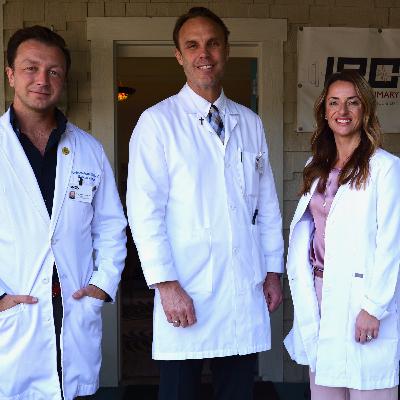
What does primary care look like when you combine traditional medicine, functional medicine, hormone optimization, cardiovascular prevention, and longevity medicine under one roof?In this conversation, I sit down with Dr. Manuel Salvadori, Biologo Nutrizionista, for a fascinating Italian-American discussion about what we do at Iron Direct Primary Care in Melbourne, Florida—and why our model looks so different from conventional healthcare in both the United States and Italy.We start with the basics: What is a Physician Associate (PA-C)? What is Direct Primary Care? And how can a primary care practice spend 60–90 minutes with a new patient instead of trying to solve complex problems in a seven-minute visit?From there, the conversation goes much deeper.We discuss:• How Iron DPC combines primary care + functional medicine + anti-aging/longevity medicine• Why prevention should be built into primary care rather than treated as a separate specialty• Hormone replacement therapy and the differences between replacement, optimization, and abuse• Estradiol, progesterone, testosterone, menopause, muscle loss and healthy aging• Why simple interventions—diet, exercise, sleep, appropriate medications and hormone management—often matter more than exotic biohacks• My evolving view of biohacking and why constant optimization can become counterproductive• Peptides, NAD, mitochondrial medicine and when we actually use them• Cold plunge, sauna, red-light therapy, exercise and recovery at Iron DPC• Why I increasingly favor a little “Euromaxxing”: coffee, conversation, slower living and enjoying life• The economics of Direct Primary Care and why patients pay a predictable monthly membership rather than paying us every time they need care• Major differences between the American and Italian healthcare systems• And our somewhat ambitious proposal: could Italy eventually develop its own version of the Physician Associate model with Functional Medicine combined?One of the central ideas behind Iron Direct Primary Care is simple:Primary care should not just manage disease after it appears. It should actively work to preserve health, function, muscle, metabolic health and cardiovascular health for decades.That means treating the knee injury that walks in today—but also thinking about the patient's cholesterol, hormones, exercise, sleep, nutrition and long-term risk.Medicine does not have to exist in silos. This was one of my favorite international conversations because Manuel approaches these subjects from an Italian nutrition and functional-medicine perspective, while I approach them from everyday clinical practice in the United States.🇺🇸 Conversation recorded in Italian🇮🇹 with English subtitles availableLearn more about Iron Direct Primary Care on Instagram and YouTube or at ironDPC.com For healthcare professionals interested in my complete course on hormone and anti-aging medicine: HRTPCP.comStefan Hartmann, PA-CCEO, Iron Direct Primary Care Melbourne, FloridaThis discussion is for educational purposes only and is not individualized medical advice.#DirectPrimaryCare #FunctionalMedicine #LongevityMedicine #HormoneReplacementTherapy #HRT #PrimaryCare #AntiAgingMedicine #MensHealth #WomensHealth #Biohacking #Peptides #PreventiveMedicine #IronDirectPrimaryCare

Gillian Godon Perue MD on Acute Ischemic Stroke Guidelines at the FAPA conference in Daytona Beach June 26, 2026.As always, if interested in our HRT course please pre register via the linkhttps://docs.google.com/forms/d/1GoX_B7V9PxZGAPch8_MeRED5WLIVKghqSMwFhqNJo1E/edit

Comments

Download from Google Play

Download from App Store
 United States