


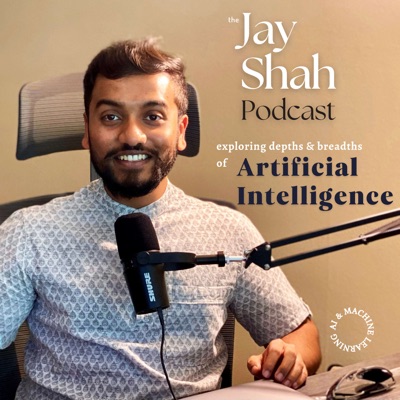
Jay Shah Podcast
Subscribed: 21Played: 131
Subscribe

© Jay Shah
Description
Interviews with scientists and engineers working in Machine Learning and AI, about their journey, insights, and discussion on latest research topics.
99 Episodes
Reverse

Subham Sahoo is a Research Scientist and Team Lead at the Institute of Foundation Models at MBZUAI, where he leads the Diffusion LLM team. His research focuses on discrete diffusion language models and the question of whether diffusion can offer a fundamentally different, and potentially more efficient way of generating language compared with traditional autoregressive models.Prior to that, Subham completed his Ph.D. at Cornell Tech. And his recent work includes studies of how diffusion models could be scaled and evaluated against autoregressive models. His work has helped push diffusion LMs from an interesting alternative toward a much more serious research direction for language generation.00:00:00 Highlight & Introduction00:02:10 Journey into AI & First Interest in Diffusion Models00:11:37 Learning the Mathematics Behind Diffusion Models00:16:58 Research, Publishing Pressure & Finding the Right Validation00:20:31 How to Filter Noise from AI Research00:23:32 Academia vs. Industry After a PhD00:26:32 Diffusion Models vs. Autoregressive LLMs00:29:01 How Blockwise Diffusion Solves the Latency Problem00:30:57 Why Autoregressive LLMs Still Have Room for Improvement00:38:00 How Hybrid Diffusion + Autoregressive Models Work00:41:50 Can Blockwise Prediction Preserve Model Quality?00:44:03 Will Diffusion Replace Autoregressive LLMs?00:47:52 Does Diffusion Training Make LLMs Learn Gibberish?00:50:45 Comparing Training Costs & Scaling00:55:00 How Hybrid Models Scale with More Data00:59:02 Lossy vs. Lossless Speedups01:02:09 Are Hybrid Diffusion Models Production Ready?01:04:54 How to Choose a Good AI Research Direction01:08:06 Advice for Early-Career AI Researchers01:11:39 Closing ThoughtsAbout the Host:Jay is a Machine Learning Engineer III at PathAI working on improving AI for medical diagnosis and prognosis. Linkedin: https://www.linkedin.com/in/shahjay22/Twitter: https://twitter.com/jaygshah22Homepage: https://jaygshah.github.io/ for any queries.Stay tuned for upcoming webinars!***Disclaimer: The information in this video represents the views and opinions of the speaker and does not necessarily represent the views or opinions of any institution. It does not constitute an endorsement by any Institution or its affiliates of such video content.***
Simran Khanuja is a Ph.D. candidate at Carnegie Mellon University. Her research focuses on making AI systems more useful for people across different languages and cultures, with an emphasis on multilingual and multimodal foundation models.Prior to CMU, Simran spent over two years as a Pre-Doctoral Researcher at Google Research, contributing to multilingual language technologies and also did some interesting research at Microsoft Research India. Her recent work includes the Pangea multilingual multimodal foundation model, image transcreation for cultural localization, and new approaches to evaluating culturally relevant AI systems.00:00:00 Highlight & Introduction00:01:20 Journey into AI00:06:27 Industry Experience before Ph.D.00:12:38 Why Pursue a Ph.D. in AI?00:17:54 From Multilingual to Multicultural AI00:24:11 Are Foundation Models really general purpose?00:29:51 Should every Culture have tts own AI model?00:32:38 The biggest bottleneck in cultural alignment00:38:49 Can Prompting solve cultural alignment?00:44:41 Why Images need Translation too00:51:14 Beyond Text: Translating culture across modalities00:55:01 How do you evaluate Image Transcreation?01:00:48 Preventing catastrophic forgetting in Multilingual LLMs01:04:50 Can LLMs learn undocumented cultures?01:11:05 Are LLMs reliable as AI Judges?01:19:32 Can creativity ever be benchmarked?01:28:20 How AI Has changed research workflows01:41:12 Choosing an AI research topic in 202601:52:12 The most overlooked problem in AI today02:01:28 Closing thoughtsMore about Simran's ongoing research: https://simran-khanuja.github.io/About the Host:Jay is a Machine Learning Engineer III at PathAI working on improving AI for medical diagnosis and prognosis. Linkedin: https://www.linkedin.com/in/shahjay22/Twitter: https://twitter.com/jaygshah22Homepage: https://jaygshah.github.io/ for any queries.Stay tuned for upcoming webinars!***Disclaimer: The information in this video represents the views and opinions of the speaker and does not necessarily represent the views or opinions of any institution. It does not constitute an endorsement by any Institution or its affiliates of such video content.***
Dr. Jackie Cheung is an Associate Professor at McGill University where he co-directs the Reasoning and Learning Lab. He is also an Associate Scientific Director at Mila-Quebec Artificial Intelligence Institute. He and his team are developing computational models to improve the reliability, pragmatics, and evaluation of large language models to ensure they are contextually appropriate and factually grounded.Jackie was worked as a consultant researcher with Microsoft Research and before his current appointments, he earned his PhD and MSc in Computer Science from the University of Toronto, focusing on computational linguistics, and his BSc from the University of British Columbia.00:00:00 Highlight & Introduction00:02:04 Entrypoint in AI & NLP00:04:47 Academia vs. Industry: Career choices00:09:48 Language Revitalization using AI00:12:24 Addressing Biases & Data sovereignty in language revitalization 00:15:49 Evaluating LLMs as Judges00:17:14 Validity and reliability in LLM evaluation 00:25:11 Evidence-centered benchmark design (ECBD) framework00:30:38 Gaps in LLM benchmarks and meaning of "general purpose" AI00:35:24 General purpose intelligence vs reasoning00:40:16 Safety as an undefined bundle in LLMs00:51:45 Stochastic chameleons: how LLMs generalize and hallucinate 01:03:02 Potential & Biases of agentic frameworks for research01:05:52 Evaluating LLMs for summarization01:11:43 Scaling large language models01:16:33 Advice to beginners entering AI in 202601:20:33 Pitfalls to avoid in AI research & development More about Jackie & his research: https://www.cs.mcgill.ca/~jcheung/About the Host:Jay is a Machine Learning Engineer III at PathAI working on improving AI for medical diagnosis and prognosis. Linkedin: https://www.linkedin.com/in/shahjay22/Twitter: https://twitter.com/jaygshah22Homepage: https://jaygshah.github.io/ for any queries.Stay tuned for upcoming webinars!***Disclaimer: The information in this video represents the views and opinions of the speaker and does not necessarily represent the views or opinions of any institution. It does not constitute an endorsement by any Institution or its affiliates of such video content.***
Andrew Beck, MD, PhD is the Co-founder and CEO of PathAI, where he and his team are developing AI tools to improve the precision of pathology and the efficacy of drug development for diagnosis of cancer and also many other complex diseases.Before founding PathAI, Andrew was an Associate Professor at Harvard Medical School, where his research focused on the application of machine learning to cancer pathology. He earned his MD from Brown University and his PhD in Biomedical Informatics from Stanford University, where he pioneered some of the first computational models used to predict patient outcomes in oncology.Time stamps of the conversation:00:00:00 Highlights00:01:28 Introduction00:02:18 Entrypoint in AI00:07:02 Background in Medicine and Bioinformatics 00:10:00 Leap from academia to entrepreneurship00:16:20 Translating AI developments to Pathology00:21:15 Specialist vs Generalist AI models in medicine00:24:15 What sets PathAI apart?00:26:32 AI adoption medicine00:34:25 Usage of AI tools in clinical workflows, example MASH00:40:10 AI in Dermatopathology00:42:15 AI for biomarker discovery00:47:05 Will AI models replace pathologists?00:52:28 Avoiding over-reliance on AI00:57:40 Is AI living unto the hype?01:01:00 Challenges in clinical trials 01:05:12 AI reaching patients directly01:09:50 Working at intersection of AI & Healthcare01:15:30 Pitfalls to learn fromMore about PathAI: https://www.pathai.com/and Andy: https://www.pathai.com/about-us/andy-beckAbout the Host:Jay is a Machine Learning Engineer III at PathAI working on improving AI for medical diagnosis and prognosis. Linkedin: https://www.linkedin.com/in/shahjay22/Twitter: https://twitter.com/jaygshah22Homepage: https://jaygshah.github.io/ for any queries.Stay tuned for upcoming webinars!***Disclaimer: The information in this video represents the views and opinions of the speaker and does not necessarily represent the views or opinions of any institution. It does not constitute an endorsement by any Institution or its affiliates of such video content.***
Dr. Aida Nematzadeh is a Senior Staff Research Scientist at Google DeepMind where her research focused on multimodal AI models. She works on developing evaluation methods and analyze model’s learning abilities to detect failure modes and guide improvements. Before joining DeepMind, she was a postdoctoral researcher at UC Berkeley and completed her PhD and Masters in Computer Science from the University of Toronto. During her graduate studies she studied how children learn semantic information through computational (cognitive) modeling. Time stamps of the conversation00:00 Highlights01:20 Introduction02:08 Entry point in AI03:04 Background in Cognitive Science & Computer Science 04:55 Research at Google DeepMind05:47 Importance of language-vision in AI10:36 Impact of architecture vs. data on performance 13:06 Transformer architecture 14:30 Evaluating AI models19:02 Can LLMs understand numerical concepts 24:40 Theory-of-mind in AI27:58 Do LLMs learn theory of mind?29:25 LLMs as judge35:56 Publish vs. perish culture in AI research40:00 Working at Google DeepMind42:50 Doing a Ph.D. vs not in AI (at least in 2025)48:20 Looking back on research careerMore about Aida: http://www.aidanematzadeh.me/About the Host:Jay is a Machine Learning Engineer at PathAI working on improving AI for medical diagnosis and prognosis. Linkedin: shahjay22 Twitter: jaygshah22 Homepage: https://jaygshah.github.io/ for any queries.Stay tuned for upcoming webinars!**Disclaimer: The information in this video represents the views and opinions of the speaker and does not necessarily represent the views or opinions of any institution. It does not constitute an endorsement by any Institution or its affiliates of such video content.**

Comments

Download from Google Play

Download from App Store
 United States