


Kessler Foundation Podcasts
Subscribed: 62Played: 803
Subscribe


© All rights reserved
Description
Kessler Foundation - Changing the lives of people with disabilities through research in stroke, brain injury, multiple sclerosis, spinal cord injury and by funding innovative programs that promote employment for people with disabilities. Podcasts are from various consumer and professional lectures presented by our researchers and guest lecturers.
359 Episodes
Reverse
A proven cognitive training program is being adapted and tested in new ways at Kessler Foundation. Led by Dr. Nancy Chiaravalloti, the study explores the Kessler Foundation modified Story Memory Technique (KF-mSMT®️), which helps adults aged 60 and older improve memory and daily functioning. Over ten bi-weekly sessions, participants learn to use visualization and contextual cues to strengthen recall—methods previously shown to benefit people with multiple sclerosis and traumatic brain injury. This five-year study examines both short- and long-term effects on thinking skills and quality of life, offering a promising path for supporting healthy cognitive aging.
=====================================================================================
Kessler Foundation Investigators:
Lead: Nancy D. Chiaravalloti, PhD, https://kesslerfoundation.org/aboutus/Nancy%20Chiaravalloti
=====================================================================================
EXPLORE our research
Neuropsychology and Neuroscience: https://kesslerfoundation.org/center-neuropsychology-and-neuroscience-research
Traumatic Brain Injury: https://kesslerfoundation.org/research/tim-and-caroline-reynolds-center-spinal-stimulation
PARTICIPATE:
Interested in participating in our research remotely or in-person? Go to https://kesslerfoundation.org/join
=====================================================================================
LOOKING FOR MORE PODCASTS?
Join our listeners in 90 countries who enjoy learning about the work of Kessler Foundation. Subscribe to our SoundCloud channel, “KesslerFoundation,” for more research updates.
This podcast was recorded, produced, and edited by Joan Banks-Smith, Creative Producer at Kessler Foundation in October 2025.
=====================================================================================
Kessler Foundation uses AI voices and narrators to make our media more accessible. These tools help ensure people with visual or cognitive impairments can access our materials. Automated voices may not always capture intonation or pronunciation as clearly as the accompanying text. If you experience issues with our AI narrators, please contact us at communications@kesslerfoundation.org.

Are you ready to be part of something bigger? Join a research study TODAY and help transform lives.
At Kessler Foundation, our award-winning scientists are developing and testing breakthrough interventions to improve mobility, cognition, and quality of life for people with neurological and developmental disabilities.
More than 10,000 volunteers have already joined us - And over half have come back to participate in more than one study!
Since 2020, we've completed over 7,000 research sessions - Thanks to participants who showed up, stayed committed, and helped drive real progress.
Here are 3 reasons to join a research study:
#1 - You Can Help Drive Discovery
Support the development of rehabilitation strategies
Provide valuable data that improves care and independence
Test new therapies and help scientists better understand medical conditions
#2 - Flexible Options for Taking Part
Join us in person at our research centers in East Hanover and West Orange, NJ
Or participate from home - some studies require no in-person visits
Time commitments vary, and we'll make sure you know what to expect
We make participation easy - and even enjoyable!
#3 - Experience Hands-On Research
Depending on the study, you might:
Engage in exercise-based programs or imaging studies using MRI
Complete questionnaires or cognitive tests that feel like fun brain games
Try cutting-edge tech like robotic exoskeletons or virtual reality equipment
Ready to make an impact?
Contact Jackie Leddy at 973.323.3686
Email us at researchstudies@kesslerfoundation.org
Or visit kesslerfoundation.org/join
Be part of the discovery. Join a research study today.
Anthony H. Lequerica, PhD brings deep expertise and heart to his work at Kessler Foundation’s Center for Traumatic Brain Injury Research. As a Senior Research Scientist and staff neuropsychologist at Kessler Institute for Rehabilitation, he’s on the front lines of advancing care for individuals recovering from brain injury.
His research dives into critical areas like sleep and wake disorders following brain injury, and how cultural diversity shapes rehabilitation outcomes. Passionate about equity, Dr. Lequerica is dedicated to improving neuropsychological testing and cognitive rehabilitation for Spanish-speaking and underserved communities.
A respected voice in the field, he’s an active member of the American Psychological Association and the Hispanic Neuropsychological Society. He also co-chairs the Inclusion, Diversity, Equity, and Accessibility Special Interest Group within the Traumatic Brain Injury Model System—championing inclusive practices in research and care.
Missed our past events? View them to https://www.youtube.com/playlist?list=PL21CEB6CAC402EA50
Want to Get Involved?
Whether you're interested in participating in our research remotely or in person, we’d love to hear from you! Go to https://KesslerFoundation.org/join to learn how you can contribute to advancing brain injury research.
Read the transcript, https://kesslerfoundation.org/sites/default/files/2025-10/Focusing%20on%20Strengths%2C%20Not%20Deficits%20in%20Neurodiversity%20-TRANSCRIPT.pdf
At Kessler Foundation’s Center for Autism Research, scientists are redefining how they support neurodiverse individuals—especially those on the autism spectrum—by focusing on strengths rather than deficits. Led by Helen Genova, PhD, associate director of the Center, the team developed KF-STRIDE, a specialized program that uses positive psychology to help adolescents and young adults identify their strengths and prepare for the workforce. Early results show increased confidence, self-awareness, and improved interview skills. Through strategic partnerships, this research is expanding to include individuals with ADHD and dyslexia, paving the way for a more inclusive and equitable future.
=====================================================================================
Kessler Foundation Investigators:
Lead: Helen M. Genova, PhD, https://kesslerfoundation.org/aboutus/Helen-Genova
=====================================================================================
EXPLORE our autism research:
https://kesslerfoundation.org/autism-research
LEARN more about KF-STRIDE
https://kfstride.org
PARTICIPATE:
Interested in participating in our research remotely or in-person? Go to https://kesslerfoundation.org/join
READ our 2024 Impact Report:
https://kesslerfoundation.org/2024-impact-report
LISTEN to all our 2024 Impact Report stories:
https://soundcloud.com/kesslerfoundation/sets/kessler-foundation-impact-reports
=====================================================================================
LOOKING FOR MORE PODCASTS?
Join our listeners in 90 countries who enjoy learning about the work of Kessler Foundation. Subscribe to our SoundCloud channel, “KesslerFoundation,” for more research updates.
This podcast was recorded, produced, and edited by Joan Banks-Smith, Creative Producer at Kessler Foundation in September 2025.
=====================================================================================
Kessler Foundation uses AI voices and narrators to make our media more accessible. These tools help ensure people with visual or cognitive impairments can access our materials. Automated voices may not always capture intonation or pronunciation as clearly as the accompanying text. If you experience issues with our AI narrators, please contact us at communications@kesslerfoundation.org.
Read the transcript, https://kesslerfoundation.org/sites/default/files/2025-10/From%20Stroke%20to%20Strength_How%20Robotics%20Are%20Transforming%20Rehab-TRANSCRIPT.pdf
Research scientists at Kessler Foundation are pioneering a new frontier in neurorehabilitation through groundbreaking studies in robotic exoskeletons. This research helps individuals recovering from stroke and brain injury walk again. It also explores how intensive robotic therapy can drive lasting brain changes, potentially redefining recovery protocols for millions. Led by Karen J. Nolan, PhD, associate director in the Center for Mobility and Rehabilitation Engineering Research, our scientists are investigating how wearable robotics can restore mobility and independence. With support from Liz Lowenstein and the Reitman Foundation, the Foundation’s work has led to FDA-clearance for multiple devices and a federally funded clinical trial—the first of its kind for adults with acute stroke.
=====================================================================================
Kessler Foundation Investigator:
Lead: Karen J. Nolan, PhD, https://kesslerfoundation.org/aboutus/Karen-Nolan
=====================================================================================
EXPLORE our mobility research:
https://kesslerfoundation.org/research/center-mobility-and-rehabilitation-engineering
PARTICIPATE:
Interested in participating in our research remotely or in-person? Go to https://kesslerfoundation.org/join
READ our 2024 Impact Report:
https://kesslerfoundation.org/2024-impact-report
LISTEN to all our 2024 Impact Report stories:
https://soundcloud.com/kesslerfoundation/sets/kessler-foundation-impact-reports
=====================================================================================
LOOKING FOR MORE PODCASTS?
Join our listeners in 90 countries who enjoy learning about the work of Kessler Foundation. Subscribe to our SoundCloud channel, “KesslerFoundation,” for more research updates.
This podcast was recorded, produced, and edited by Joan Banks-Smith, Creative Producer at Kessler Foundation in October 2025.
=====================================================================================
Kessler Foundation uses AI voices and narrators to make our media more accessible. These tools help ensure people with visual or cognitive impairments can access our materials. Automated voices may not always capture intonation or pronunciation as clearly as the accompanying text. If you experience issues with our AI narrators, please contact us at communications@kesslerfoundation.org.
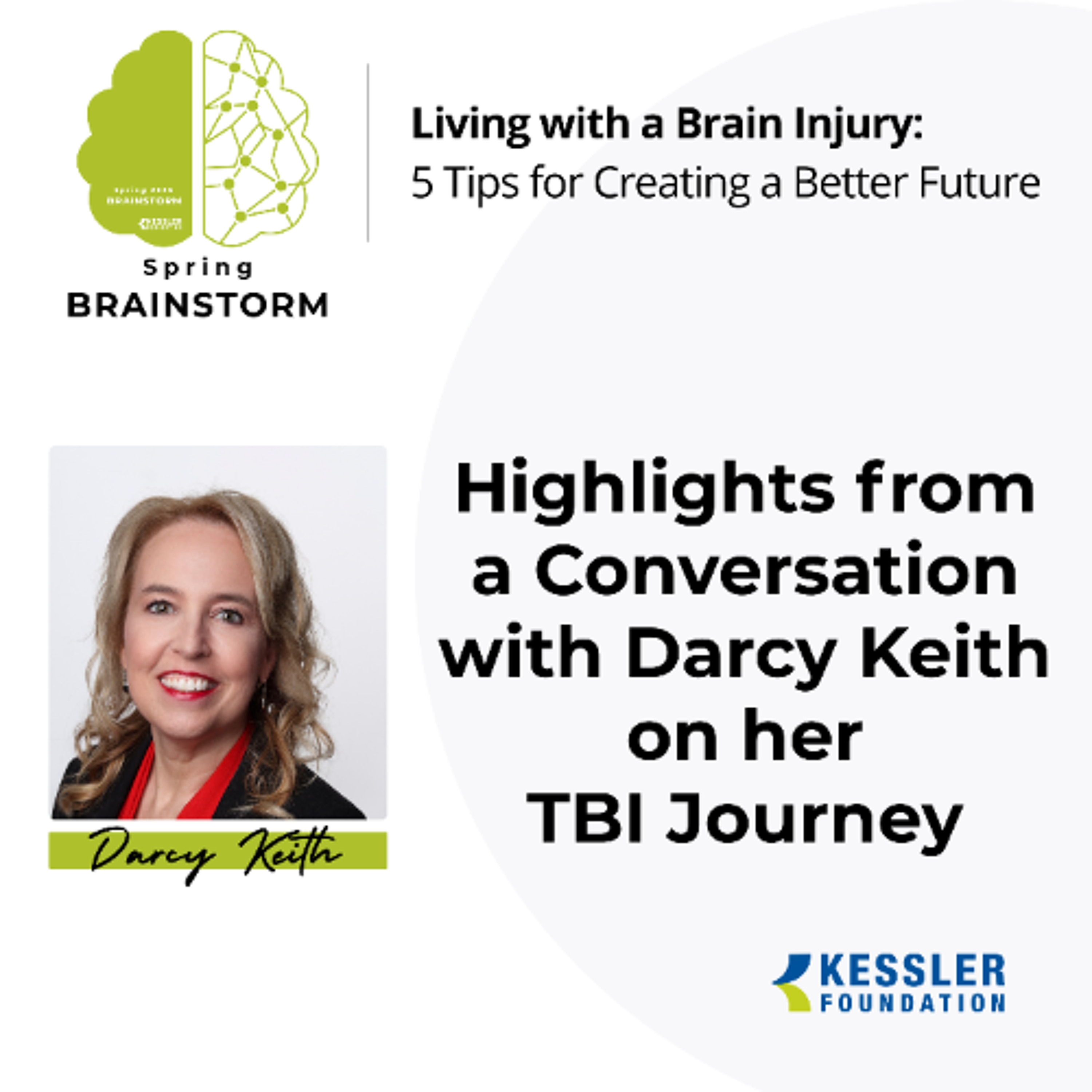
In this episode, Darcy Keith shares candid insights from her TBI journey and offers practical tips to manage memory and daily life challenges. Topics include:
Using repetition, verbal, and visual cues to improve memory
The importance of regular routines and structure to avoid overwhelm
Embracing new interests when physical abilities change
Utilizing devices and notes for organization
Prioritizing rest and self-care.
Darcy also reflects on her career achievements post-TBI, including earning three professional insurance designations and working as a business analyst for Liberty Mutual Insurance Company. Her story is one of determination, gratitude, and living life to the fullest despite adversity.
Catch Up Anytime!
Missed one of our past BrainStorm events? No worries — you can watch all previous presentations on our YouTube channel, https://www.youtube.com/playlist?list=PL21CEB6CAC402EA50. Dive into inspiring stories, expert insights, and practical tips at your convenience.
Want to Get Involved?
Whether you're interested in participating in our research remotely or in person, we’d love to hear from you! go to https://kesslerfoundation.org/join to learn how you can contribute to advancing brain injury research.
- Learn more about Darcy at www.DarcyKeith.com
In this episode of the Estabrook Distinguished Research Scientist Lectureship series, Dr. Karen Minassian from the Medical University of Vienna shares groundbreaking research on transcutaneous spinal cord stimulation (tSCS). This non-invasive method uses surface electrodes to activate spinal circuits and induce coordinated leg movements in chronic spinal injury patients. Stemming from accidental observations during epidural studies, his work combines computational modeling and clinical research to show how spinal anatomy and pulse duration affect tSCS effectiveness. Now FDA-approved, this approach offers new hope for neurorehabilitation by enhancing spinal function without surgery. Tune in to discover how these findings are advancing spinal cord injury treatment.
Intro & Welcome: 00:04
Lecture: 01:06
Q&A: 55:01
Closing remarks: 1:20:37
=====================================================================================
Learn more about:
Karen Minassian, PhD, https://www.meduniwien.ac.at/web/forschung/researcher-profiles/researcher-profiles/detail/?res=karen_minassian&cHash=e1a4705d6c154272ca49e231996ec501
Associate Professor
Medical University of Vienna, Austria
Center for Medical Physics and Biomedical Engineering
=====================================================================================
VIEW Dr. Karen Minassian's presentation:
https://kesslerfoundation.org/sites/default/files/2025-10/Karen%20Minassian-Presentation%20tSCS-OCT25.pdf
EXPLORE our spinal stimulation research:
https://kesslerfoundation.org/research/tim-and-caroline-reynolds-center-spinal-stimulation
PARTICIPATE:
Interested in participating in our research remotely or in-person? Go to https://kesslerfoundation.org/join
=====================================================================================
LOOKING FOR MORE PODCASTS?
Join our listeners in 90 countries who enjoy learning about the work of Kessler Foundation. Subscribe to our SoundCloud channel, “KesslerFoundation,” for more research updates.
=====================================================================================
Kessler Foundation uses AI voices and narrators to make our media more accessible. These tools help ensure people with visual or cognitive impairments can access our materials. Automated voices may not always capture intonation or pronunciation as clearly as the accompanying text. If you experience issues with our AI narrators, please contact us at communications@kesslerfoundation.org.
Read the transcript, https://KesslerFoundation.org/sites/default/files/2025-07/Stroke-RLS%20-%20Shifting%20Perspectives-%20Prism%20Adaptation%20and%20Stroke%20Recovery%20%E2%80%93%20Peii-CHen.pdf
Spatial neglect is a common but often overlooked condition following stroke or brain injury, where individuals struggle to notice one side of their environment—making everyday tasks like eating, dressing, or walking more difficult. In this episode, we explore Kessler Foundation Prism Adaptation Treatment (KF-PAT®), a promising, low-cost therapy that uses special goggles to shift the visual field and retrain the brain through simple pointing exercises. This innovative approach helps stimulate spatial awareness and reduce neglect symptoms.
We dive into a major review led by Kessler Foundation researchers, analyzing over two decades of PAT data from more than 4,000 stroke patients across 16 U.S. rehabilitation hospitals. While real-world clinical use shows strong benefits, formal trials have produced mixed results due to variations in treatment protocols. Learn how key factors—like prism strength, session frequency, and measurable after-effects—are shaping the future of stroke rehabilitation and helping integrate PAT into more recovery programs worldwide.
=========================================================
Podcast Links:
Read the full study, doi.org/10.3389/fresc.2025.1539887
Visit our website to learn more about clinical tools that support spatial neglect recovery developed by Foundation scientists, featuring Kessler Foundation Neglect Assessment Process (KF-NAP®) and Kessler Foundation Prism Adaptation Treatment (KF-PAT®) - https://KesslerFoundation.org/research/stroke/rehabilitation
Read this summary at https://KesslerFoundation.org/xxxxxxxx
Missed a summary, check out our Real-Life Science archives, https://KesslerFoundation.org/publication-archives#block-consumer-friendly-tbi-study-summaries
Interested in participating in our research remotely or in-person? Go to KesslerFoundation.org/join
=========================================================
Kessler Foundation uses AI voices and narrators to make our media as accessible as possible. These tools help us ensure that individuals with visual or cognitive impairments are not prevented from accessing the materials that Kessler Foundation uses to change the lives of people with disabilities.
These automated voices may not correctly capture intonation or pronunciation that may be clearer in the accompanying text. If you encounter any issues related to Kessler Foundation's use of AI narrators in our multimedia content, please reach out to Communications@KesslerFoundation.org
=========================================================
Tuned in to our podcast series lately? Join our listeners in 90 countries who enjoy learning about the work of Kessler Foundation. Be sure and subscribe to our SoundCloud channel “KesslerFoundation” for more research updates.
Follow us on Facebook, Twitter, and Instagram. Listen to us on Apple Podcasts, Spotify, SoundCloud, or wherever you get your podcasts.
This podcast was recorded in July 2025 and was edited and produced by Joan Banks-Smith, Creative Producer for Kessler Foundation.
Welcome to this special podcast series for people living with paralysis due to spinal cord injury, multiple sclerosis, or related conditions and their families. We know that finding a new path forward can be challenging, but through expert talks and peer discussions, we’re here to help you set meaningful goals and take actions to experience a fulfilling life—whether in health, recreation, family, work, or community.
Our first event, "Creating a New Vision for Life with Spinal Cord Injury," features Reveca Torres, founder of BACKBONES, who shares insights on identity and goal setting. You’ll also hear from inspiring BACKBONES Leaders who offer real-life stories and practical tips for navigating your journey and achieving your goals.
Join us to explore resources, strategies, and research opportunities that empower you and your loved ones to create positive change—both personally and in your community. Together, we’ll build new paths forward with hope and determination.
===========================================
Podcast Timestamps:
00:04 – Welcome by Jeanne Zanca, MPT, PhD, https://kesslerfoundation.org/aboutus/Jeanne-Zanca
01:19 – Reveca Torres
04:54 – Panel Discussion with Shante Nelson, Andrew Lewis, Michael Maruzzi
1:00:21 - Episode Wrap-Up with Jeanne Zanca, MPT, PhD and Announcer
===========================================
Guest speaker:
Reveca Torres, founder of BACKBONES, https://www.linkedin.com/in/reveca-torres-539b816/
Panel:
BACKBONES Leaders Program members, https://www.backbonesonline.org
LEARN more about this event series:
https://kesslerfoundation.org/2025-spinal-cord-injury-community-event-series
===========================================
TO LEARN MORE ABOUT OUR SCI RESEARCH:
LISTEN to more podcasts:
https://soundcloud.com/kesslerfoundation/sets/spinal-cord-injury-research
EXPLORE our website:
https://kesslerfoundation.org/research/center-spinal-cord-injury-research
PARTICIPATE:
Interested in participating in our research remotely or in-person? Go to https://kesslerfoundation.org/join
===========================================
LOOKING FOR MORE PODCASTS?
Join our listeners in 90 countries who enjoy learning about the work of Kessler Foundation. Subscribe to our SoundCloud channel, “KesslerFoundation,” for more research updates.
This podcast was recorded, produced, and edited by Joan Banks-Smith, Creative Producer at Kessler Foundation in July 2025.
===========================================
Kessler Foundation uses AI voices and narrators to make our media more accessible. These tools help ensure people with visual or cognitive impairments can access our materials. Automated voices may not always capture intonation or pronunciation as clearly as the accompanying text. If you experience issues with our AI narrators, please contact us at communications@kesslerfoundation.org.

Read the transcript, https://kesslerfoundation.org/sites/default/files/2025-10/Hearst%20Fellows%20Shaping%20the%20Future%20of%20Cognitive%20Rehabilitation%20Research-TRANSCRIPT.pdf
In this episode, we spotlight emerging leaders in cognitive rehabilitation research at Kessler Foundation—Dr. Aubree Alexander, Dr. Silvana Lopes Costa, and their mentor, Dr. Nancy Chiaravalloti. Together, they’re advancing innovative approaches to aging and neurorehabilitation, from home-based cognitive training to eye-tracking technologies that enhance independence. Supported by prestigious Hearst Fellowships, their work exemplifies how mentorship and discovery fuel the future of rehabilitation science.
===========================================
Article Timestamps:
00:00 - Welcome
04:42 - KF-PUPIL (Kessler Foundation-Play, Understand, Partner, Interact, and Learn)
04:54 - Gateway to learning
06:46 - A journey to discover
09:52 - Episode Wrap-Up
===========================================
Kessler Foundation Investigators:
Aubree Alexander, PhD, https://kesslerfoundation.org/about-us/foundation-staff/aubree-alexander-phd
Nancy Chiaravalloti, PhD, https://kesslerfoundation.org/aboutus/Nancy%20Chiaravalloti
Silvana Lopes Costa, PhD, https://kesslerfoundation.org/aboutus/Silvana%20Costa
===========================================
READ our 2025 Fall Your Impact Newsletter:
https://kesslerfoundation.org/Newsletter-issuu/2025-fall-your-impact-newsletter
LISTEN to all our 2025 Your Impact Report stories:
https://soundcloud.com/kesslerfoundation/sets/your-impact-audio-newsletter
EXPLORE our research:
Neuropsychology and neuroscience, https://kesslerfoundation.org/center-neuropsychology-and-neuroscience-research
PARTICIPATE:
Interested in participating in our research remotely or in-person? Go to https://kesslerfoundation.org/join
===========================================
LOOKING FOR MORE PODCASTS?
Join our listeners in 90 countries who enjoy learning about the work of Kessler Foundation. Subscribe to our SoundCloud channel, “KesslerFoundation,” for more research updates.
This podcast was recorded, produced, and edited by Joan Banks-Smith, Creative Producer at Kessler Foundation in October 2025.
===========================================
Kessler Foundation uses AI voices and narrators to make our media more accessible. These tools help ensure people with visual or cognitive impairments can access our materials. Automated voices may not always capture intonation or pronunciation as clearly as the accompanying text. If you experience issues with our AI narrators, please contact us at communications@kesslerfoundation.org.
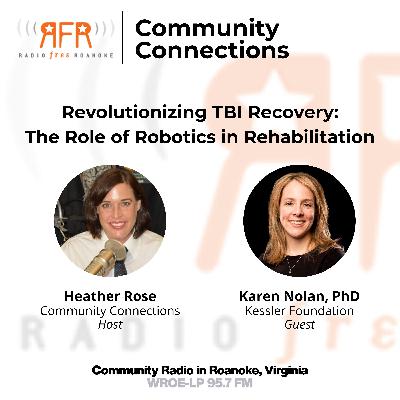
Karen J. Nolan, PhD, associate director in the Center for Mobility and Rehabilitation Engineering at Kessler Foundation, sat down with Heather Rose, host of Community Connections at Radio Free Roanoke, to discuss leads on groundbreaking research in traumatic brain injury rehabilitation. Dr. Nolan's work focuses on developing innovative robotic interventions to improve mobility and walking function for people with neurological conditions. These smart robotic systems, unlike traditional assistive devices, aim to help people regain natural movement patterns and participate more fully in community activities.
Dr. Nolan's research also explores biomechanics and the use of sophisticated technology to create individualized treatment strategies. Her efforts have helped multiple devices gain FDA clearance, transitioning from research-only tools to clinically available equipment for both hospital and home use.
Used by permission: Community Connects, https://radiofreeroanoke.org/show/civic-connections-2/
=====================================================================================
Kessler Foundation Investigators:
Lead: Karen Nolan, PhD, https://kesslerfoundation.org/aboutus/Karen-Nolan
=====================================================================================
EXPLORE our mobility research:
https://kesslerfoundation.org/research/center-mobility-and-rehabilitation-engineering
PARTICIPATE:
Interested in participating in our research remotely or in-person? Go to https://kesslerfoundation.org/join
=====================================================================================
LOOKING FOR MORE PODCASTS?
Join our listeners in 90 countries who enjoy learning about the work of Kessler Foundation. Subscribe to our SoundCloud channel, “KesslerFoundation,” for more research updates.
=====================================================================================
Kessler Foundation uses AI voices and narrators to make our media more accessible. These tools help ensure people with visual or cognitive impairments can access our materials. Automated voices may not always capture intonation or pronunciation as clearly as the accompanying text. If you experience issues with our AI narrators, please contact us at communications@kesslerfoundation.org.
Read the transcript, https://kesslerfoundation.org/sites/default/files/2025-10/Thinking%20Through%20MS-How%20Cognition%20Shapes%20Daily%20Life-TRANSCRIPT.pdf
In this episode, we explore groundbreaking research from Kessler Foundation that reveals how subtle cognitive changes in people with multiple sclerosis can have a profound impact on daily life. Dr. Yael Goverover, a visiting scientist and professor of occupational therapy at NYU, shares insights from her studies linking executive function, memory, and attention to everyday tasks like managing finances, taking medications, and navigating online platforms. Her work is helping to develop innovative tools and strategies that empower individuals with MS to maintain independence and improve quality of life—by making cognition not just measurable, but truly understood.
=====================================================================================
Kessler Foundation Investigators:
Lead: Yael Goverover, PhD, OTR/L, https://kesslerfoundation.org/about-us/foundation-staff/Yael%20Goverover
=====================================================================================
TO LEARN MORE ABOUT OUR RESEARCH:
Read the full study, doi.org/10.1186/s12984-025-01636-6
Read this newsletter at https://kesslerfoundation.org/2025-fall-ms-newsletter
READ all our Milestone newsletters:
https://kesslerfoundation.org/publication-archives#block-kessler-views-block-multiple-sclerosis-newsletter-block-1-2
LISTEN to all our Milestone newsletter podcasts:
https://soundcloud.com/kesslerfoundation/sets/milestones-multiple-sclerosis
EXPLORE our multiple sclerosis research:
https://kesslerfoundation.org/researchcenter-neuropsychology-and-neuroscience-research/ms/multiple-sclerosis
PARTICIPATE:
Interested in participating in our research remotely or in-person? Go to https://kesslerfoundation.org/MSresearchstudies
=====================================================================================
LOOKING FOR MORE PODCASTS?
Join our listeners in 90 countries who enjoy learning about the work of Kessler Foundation. Subscribe to our SoundCloud channel, “KesslerFoundation,” for more research updates.
This podcast was recorded, produced, and edited by Joan Banks-Smith, Creative Producer at Kessler Foundation in July 2025.
=====================================================================================
Kessler Foundation uses AI voices and narrators to make our media more accessible. These tools help ensure people with visual or cognitive impairments can access our materials. Automated voices may not always capture intonation or pronunciation as clearly as the accompanying text. If you experience issues with our AI narrators, please contact us at communications@kesslerfoundation.org.
Read the transcript, https://kesslerfoundation.org/sites/default/files/2025-10/Employment%20and%20Disability_A%20New%20Path%20to%20Independence-TRANSCRIPT.pdf
Over 14 million Americans with disabilities rely on Social Security Disability Income (SSDI) or Supplemental Security Income (SSI) to survive. Yet, the very system designed to support them often creates barriers to financial independence. Complex rules around employment and earnings can discourage individuals from entering the workforce, trapping them in cycles of poverty. HireAbility Vermont, a program within the state’s Division of Vocational Rehabilitation, is working to change that narrative. With funding from Kessler Foundation, the program combines work incentive counseling and career planning to help individuals understand their earning potential, navigate benefit rules, and pursue meaningful employment. This episode explores how strategic support and innovative funding are transforming lives and reshaping the future of disability employment.
=====================================================================================
EXPLORE our disability employment research:
https://kesslerfoundation.org/research/center-employment-and-disability-research
PARTICIPATE:
Interested in participating in our research remotely or in-person? Go to https://kesslerfoundation.org/join
READ our 2024 Impact Report:
https://kesslerfoundation.org/2024-impact-report
LISTEN to all our 2024 Impact Report stories:
https://soundcloud.com/kesslerfoundation/sets/kessler-foundation-impact-reports
=====================================================================================
LOOKING FOR MORE PODCASTS?
Join our listeners in 90 countries who enjoy learning about the work of Kessler Foundation. Subscribe to our SoundCloud channel, “KesslerFoundation,” for more research updates.
This podcast was recorded, produced, and edited by Joan Banks-Smith, Creative Producer at Kessler Foundation in October 2025.
=====================================================================================
Kessler Foundation uses AI voices and narrators to make our media more accessible. These tools help ensure people with visual or cognitive impairments can access our materials. Automated voices may not always capture intonation or pronunciation as clearly as the accompanying text. If you experience issues with our AI narrators, please contact us at communications@kesslerfoundation.org.
En este episodio de Ciencias de la Vida Real, exploramos un estudio convincente de la Fundación Kessler y sus socios del Sistema Modelo de Lesiones Cerebrales Traumáticas (LCT). La investigación analiza cómo el lugar de nacimiento (si una persona hispana con LCT nació en EE. UU. o en el extranjero) afecta su capacidad para trabajar, estudiar o realizar actividades de voluntariado. Con 706 participantes de diversos orígenes, el estudio revela que la productividad después de una LCT no solo depende del lugar de nacimiento, sino también del lugar de residencia y del idioma que se habla en su comunidad.
Los hallazgos muestran que los latinos nacidos en el extranjero con LCT tienen casi tres veces más probabilidades de ser productivos en zonas con mayor número de hablantes de idiomas extranjeros, mientras que los hispanos nacidos en EE. UU. prosperan en comunidades con menos. Estos hallazgos resaltan la importancia de los programas de rehabilitación vocacional adaptados cultural y lingüísticamente. Este episodio ofrece valiosas conclusiones para cuidadores, profesionales clínicos y cualquier persona afectada por una LCT, enfatizando el papel de la comunidad, el idioma y el apoyo en la recuperación.
==============================================
Investigadores de la Fundación Kessler:
Anthony H. Lequerica, PhD, https://kesslerfoundation.org/aboutus/Anthony%20Lequerica
Amanda Botticello, PhD, https://kesslerfoundation.org/about-us/foundation-staff/amanda-botticello-phd-mph
John O’Neill, PhD, https://kesslerfoundation.org/aboutus/John-ONeill
Jean Lengenfelder, PhD, https://kesslerfoundation.org/aboutus/Jean%20Lengenfelder
Denise Krch, PhD, https://kesslerfoundation.org/aboutus/Denise%20Krch
Nancy D. Chiaravalloti, PhD, https://kesslerfoundation.org/aboutus/Nancy%20Chiaravalloti
Publicado en The Journal of Head Trauma Rehabilitation 2019
===============================================
Enlaces del podcast:
Lea el estudio completo: https://pubmed.ncbi.nlm.nih.gov/29863616
Visite nuestro sitio web para obtener más información sobre la investigación sobre lesiones cerebrales traumáticas: https://kesslerfoundation.org/research/center-traumatic-brain-injury
Lea este resumen: https://kesslerfoundation.org/sites/default/files/2024-04/KesslerFoundation-Real-Life%20Science-Spring%202024.pdf
¿Se perdió el resumen? Consulta nuestro archivo de Ciencias de la Vida Real: https://kesslerfoundation.org/publication-archives#block-real-life-science-consumer-friendly-study-summaries
Escucha todos nuestros resúmenes: https://soundcloud.com/kesslerfoundation/sets/real-life-science
¿Te interesa participar en nuestra investigación de forma remota o presencial? Visita kesslerfoundation.org/join
==========================================================
La Fundación Kessler utiliza voces de IA para mejorar la accesibilidad en nuestros medios. Sin embargo, estos narradores automatizados pueden no siempre captar la entonación o la pronunciación con precisión. Si tienes algún problema, contáctanos en communications@kesslerfoundation.org
===============================================================
¿Has escuchado nuestra serie de podcasts últimamente? Únete a nuestros oyentes en 90 países que disfrutan aprendiendo sobre el trabajo de la Fundación Kessler. Suscríbete a nuestro canal de SoundCloud "KesslerFoundation" para obtener más actualizaciones sobre las investigaciones.
Síguenos en Facebook, Twitter e Instagram. Escúchanos en Apple Podcasts, Spotify, SoundCloud o donde escuches tus podcasts.
Este podcast se grabó en septiembre de 2025 y fue editado y producido por Joan Banks-Smith, productora creativa de la Fundación Kessler.
Read the transcript, https://kesslerfoundation.org/sites/default/files/2025-09/RLS-ANGELI_Spinal%20Stim_New%20Insights%20to%20Restore%20Function%20After%20Spinal%20Cord%20Paralysis-TRANSCRIPT.pdf
In our latest episode of Real-Life Science, we delve into our groundbreaking research that is transforming the lives of people with spinal cord injury. Once considered impossible, independent standing is now a reality for some, thanks to targeted spinal cord epidural stimulation combined with focused rehabilitative training.
Lead author Claudia Angeli, PhD, assistant director of the Tim and Caroline Reynolds Center for Spinal Stimulation, shares insights into how this innovative approach is helping participants regain the ability to stand with little or no manual support.
=====================================================================================
Kessler Foundation Investigators:
Lead: Claudia Angeli, PhD, https://kesslerfoundation.org/about-us/foundation-staff/claudia-angeli-phd
=====================================================================================
TO LEARN MORE ABOUT OUR RESEARCH:
Read the full study, doi.org/10.1186/s12984-025-01636-6
Read this summary at https://kesslerfoundation.org/new-insights-restore-function-after-spinal-cord-paralysis
READ all our Real-Life Science summaries:
https://kesslerfoundation.org/publication-archives#block-real-life-science-consumer-friendly-study-summaries
LISTEN to all our Real-Life Science summaries:
https://soundcloud.com/kesslerfoundation/sets/real-life-science
EXPLORE our spinal stimulation research:
https://kesslerfoundation.org/research/tim-and-caroline-reynolds-center-spinal-stimulation
PARTICIPATE:
Interested in participating in our research remotely or in-person? Go to https://kesslerfoundation.org/join
=====================================================================================
LOOKING FOR MORE PODCASTS?
Join our listeners in 90 countries who enjoy learning about the work of Kessler Foundation. Subscribe to our SoundCloud channel, “KesslerFoundation,” for more research updates.
This podcast was recorded, produced, and edited by Joan Banks-Smith, Creative Producer at Kessler Foundation in July 2025.
=====================================================================================
Kessler Foundation uses AI voices and narrators to make our media more accessible. These tools help ensure people with visual or cognitive impairments can access our materials. Automated voices may not always capture intonation or pronunciation as clearly as the accompanying text. If you experience issues with our AI narrators, please contact us at communications@kesslerfoundation.org.
Read the transcript,https://kesslerfoundation.org/sites/default/files/2025-09/RLS-Language%2C%20Location%20%26%20Life%20After%20Brain%20Injury%20in%20Hispanic%20Communities-TRANSCRIPT.pdf
A compelling study from Kessler Foundation and its partners in the Northern New Jersey Traumatic Brain Injury Model System investigates how nativity—whether a Hispanic individual with TBI was born in the U.S. or abroad—affects their ability to engage in work, education, or volunteer activities. With 706 participants from diverse backgrounds, the research reveals that productivity after TBI is not just about where someone was born, but also about where they live and the language spoken in their community.
In this episode of Real-Life Science, we explore these findings and their valuable takeaways for caregivers, clinicians, and anyone impacted by TBI, emphasizing the role of community, language, and support in recovery.
=====================================================================================
Kessler Foundation Investigators:
Lead: Anthony H. Lequerica, PhD, kesslerfoundation.org/aboutus/Anthony%20Lequerica
Amanda Botticello, PhD, kesslerfoundation.org/about-us/found…icello-phd-mph
John O’Neill, PhD, kesslerfoundation.org/aboutus/John-ONeill
Jean Lengenfelder, PhD, kesslerfoundation.org/aboutus/Jean%20Lengenfelder
Denise Krch, PhD, kesslerfoundation.org/aboutus/Denise%20Krch
Nancy D. Chiaravalloti, PhD, kesslerfoundation.org/aboutus/Nancy%…0Chiaravalloti
Read this Real-Life Science summary at kesslerfoundation.org/sites/default/…ing%202024.pdf
Read the complete scientific article: Relationship Between Hispanic Nativity, Residential Environment, and Productive Activity Among Individuals with Traumatic Brain Injury: A TBI Model Systems Study. https://pubmed.ncbi.nlm.nih.gov/29863616
=====================================================================================
TO LEARN MORE ABOUT OUR RESEARCH:
Read this summary at https://kesslerfoundation.org/sites/default/files/2024-04/KesslerFoundation-Real-Life%20Science-Spring%202024.pdf
READ all our Real-Life Science summaries:
https://kesslerfoundation.org/publication-archives#block-real-life-science-consumer-friendly-study-summaries
LISTEN to all our Real-Life Science summaries:
https://soundcloud.com/kesslerfoundation/sets/real-life-science
EXPLORE our traumatic brain injury research:
https://kesslerfoundation.org/research/center-traumatic-brain-injury
PARTICIPATE:
Interested in participating in our research remotely or in-person? Go to https://kesslerfoundation.org/join
=====================================================================================
LOOKING FOR MORE PODCASTS?
Join our listeners in 90 countries who enjoy learning about the work of Kessler Foundation. Subscribe to our SoundCloud channel, “KesslerFoundation,” for more research updates.
This podcast was recorded, produced, and edited by Joan Banks-Smith, Creative Producer at Kessler Foundation in July 2025.
=====================================================================================
Kessler Foundation uses AI voices and narrators to make our media more accessible. These tools help ensure people with visual or cognitive impairments can access our materials. Automated voices may not always capture intonation or pronunciation as clearly as the accompanying text. If you experience issues with our AI narrators, please contact us at communications@kesslerfoundation.org.
Read the transcript, https://kesslerfoundation.org/sites/default/files/2025-08/Supporting%20SCI%20Recovery%20at%20Every%20Stage%20-%20TRANSCRIPT.pdf
In this "Rebuilding Lives Through Research" episode of Supporting SCI Recovery at Every Stage, we explore how two groundbreaking programs from the Center for Spinal Cord Injury Research at Kessler Foundation are transforming the lives of individuals with spinal cord injuries (SCI). From the moment of injury through the transition home, these initiatives provide a comprehensive roadmap for recovery. The SCI Rehabilitation Transition Program ensures that patients and their families receive critical support from hospital to home, while the Caregiving Skills and Support Program equips caregivers with the tools and confidence they need to provide effective, compassionate care.
We also hear from John McAleavey, a 32-year SCI survivor, podcaster, and peer counselor, who shares his personal journey and how his lived experience is shaping these programs. As a steering committee member, John offers invaluable insights into the real-world challenges of SCI recovery. Thanks to generous donor support, these programs are not only easing the burden of injury but also empowering individuals and families to thrive in their new realities.
=========================================================
Links:
Read the full article, https://KesslerFoundation.org/2024-impact-report
Listen to the full report, https://soundcloud.com/kesslerfoundation/sets/kessler-foundation-impact-reports
Denise Fyffe, PhD, https://KesslerFoundation.org/aboutus/Denise%20Fyffe
Jeanne Zanca, PhD, https://KesslerFoundation.org/aboutus/Jeanne-Zanca
Visit our website to learn more about the Center for Spinal Cord Injury, https://KesslerFoundation.org/research/center-spinal-cord-injury-research
Interested in participating in our research remotely or in-person? Go to KesslerFoundation.org/join
=========================================================
Kessler Foundation uses AI voices and narrators to make our media as accessible as possible. These tools help us ensure that individuals with visual or cognitive impairments are not prevented from accessing the materials that Kessler Foundation uses to change the lives of people with disabilities.
These automated voices may not correctly capture intonation or pronunciation that may be clearer in the accompanying text. If you encounter any issues related to Kessler Foundation's use of AI narrators in our multimedia content, please reach out to Communications@KesslerFoundation.org
=========================================================
Tuned in to our podcast series lately? Join our listeners in 90 countries who enjoy learning about the work of Kessler Foundation. Be sure and subscribe to our SoundCloud channel “KesslerFoundation” for more research updates.
Follow us on Facebook, Twitter, and Instagram. Listen to us on Apple Podcasts, Spotify, SoundCloud, or wherever you get your podcasts.
This podcast was recorded in July 2025 and was edited and produced by Joan Banks-Smith, Creative Producer for Kessler Foundation.
Read the transcript, https://KesslerFoundation.org/sites/default/files/2025-07/Brainwaves%20SUMMER%202025%20Audio%20Newsletter%20TRANSCRIPT.pdf
After a life-altering car accident left Luke Bonenberger with a traumatic brain injury, his world was consumed by rage, confusion, and a loss of identity. But what began as a devastating setback became the spark for a remarkable transformation. In this episode, Luke opens up about his journey to becoming a motivational speaker and author. With the help of community support and mental wellness strategies, he found a new path—one rooted in healing, acceptance, and the power of storytelling.
Listeners will also meet Bill, a fellow TBI survivor whose involvement in the Inspire Arts program showcases the healing potential of creative expression. Together, their stories illuminate the vital roles of occupational therapy, family support, and community reintegration in recovery.
=========================================================
Chapters
00:00:00 - Welcome and Introduction
00:00:46 - In Pain, He Found Purpose
00:03:26 - Listen and Learn
00:04:07 - Lessons Learned
00:04:56 - Back in Action
00:06:53 - Talking about TBI
00:07:33 - The Art of Healing
00:08:49 - Episode Wrap Up
=========================================================
For more information:
Watch the video or listen to the podcast—Recycling Pain: Pain to Purpose with Luke Bohnenberger:
video - https://www.youtube.com/watch?v=WHRk3RHHTZk
podcast - https://soundcloud.com/kesslerfoundation/recycling-pain-pain-to-purpose-with-luke-bohnenberger
Read our TBI Brainwaves newsletter (link TBD)
Listen to past Brainwaves audio newsletters: https://kesslerfoundation.org/publication-archives#block-traumatic-brain-injury-research-newsletter
Learn more—TBI Facts Sheets from the Model Systems Knowledge Translation Center msktc.org/tbi/factsheets
Interested in participating in our research remotely or in-person? Go to KesslerFoundation.org/join
=========================================================
Kessler Foundation uses AI voices and narrators to make our media as accessible as possible. These tools help ensure that individuals with visual or cognitive impairments are not prevented from accessing the materials we provide to help change the lives of people with disabilities.
These automated voices may not correctly capture intonation or pronunciation that may be clearer in the accompanying text. If you encounter any issues related to Kessler Foundation's use of AI narrators in our multimedia content, please reach out to Communications@KesslerFoundation.org
=======================================================
Tuned in to our podcast series lately? Join our listeners in 90 countries who enjoy learning about the work of Kessler Foundation. Be sure and subscribe to our SoundCloud channel “KesslerFoundation” for more research updates.
Follow us on Facebook, Twitter, and Instagram. Listen to us on Apple Podcasts, Spotify, SoundCloud, or wherever you get your podcasts.
This podcast was recorded in July 2025 and was edited and produced by Joan Banks-Smith, Creative Producer for Kessler Foundation.
Read the transcript https://kesslerfoundation.org/sites/default/files/2025-07/Gaming%20for%20Good%20-%20How%20Virtual%20Therapy%20is%20Changing%20Stroke%20Recovery%20Forever-TRANSCRIPT.pdf
This "Rebuilding Lives Through Research" series episode, "Gaming for Good: How, showcases the life-changing innovations made possible by donor support. We explore how virtual reality is reshaping stroke rehabilitation—bringing immersive, game-based therapy into the homes of people with stroke and helping them regain independence.
Peii Chen, PhD, senior research scientist at the Center for Stroke Rehabilitation Research, shares how her team is using VR to treat spatial neglect, a common but often overlooked condition after stroke. You’ll also hear the inspiring story of Maria Martin, a stroke survivor who’s making real progress through virtual therapy.
=========================================================
Links:
Read the full article, https://KesslerFoundation.org/2024-impact-report
Listen to the full report, https://soundcloud.com/kesslerfoundation/sets/kessler-foundation-impact-reports
Peii Chen, PhD bio, https://KesslerFoundation.org/aboutus/Peii%20Chen
Visit our website to learn more about the Center for Stroke Rehabilitation Research, https://KesslerFoundation.org/research/stroke/rehabilitation
Interested in participating in our research remotely or in-person? Go to KesslerFoundation.org/join
=========================================================
Kessler Foundation uses AI voices and narrators to make our media as accessible as possible. These tools help us ensure that individuals with visual or cognitive impairments are not prevented from accessing the materials that Kessler Foundation uses to change the lives of people with disabilities.
These automated voices may not correctly capture intonation or pronunciation that may be clearer in the accompanying text. If you encounter any issues related to Kessler Foundation's use of AI narrators in our multimedia content, please reach out to Communications@KesslerFoundation.org
=========================================================
Tuned in to our podcast series lately? Join our listeners in 90 countries who enjoy learning about the work of Kessler Foundation. Be sure and subscribe to our SoundCloud channel “KesslerFoundation” for more research updates.
Follow us on Facebook, Twitter, and Instagram. Listen to us on Apple Podcasts, Spotify, SoundCloud, or wherever you get your podcasts.
This podcast was recorded in July 2025 and was edited and produced by Joan Banks-Smith, Creative Producer for Kessler Foundation.
Read the transcript https://kesslerfoundation.org/sites/default/files/2025-07/Rewiring%20Hope_Epidural%20Stimulation%20for%20Spinal%20Cord%20Injury%20Recovery-Transcript.pdf
In this episode, we spotlight groundbreaking research in epidural spinal stimulation at Kessler Foundation’s Tim and Caroline Reynolds Center for Spinal Stimulation. This transformative therapy uses electrical impulses to help restore movement and autonomic functions—such as bladder control, blood pressure, and breathing—in people with paralysis. More than 70 individuals have contributed to this research, including Alexa Alvarez, who shared her journey after being diagnosed with acute transverse myelitis at age 21.
The Foundation’s work—developed in collaboration with the University of Louisville, Johns Hopkins Applied Physics Lab, and Medtronic—has led to FDA-approved technologies that are already changing lives. The episode also features the StimXS controller, a tablet-based device in development that offers users greater control over critical body functions.
=========================================================
Links:
Read the full article, https://kesslerfoundation.org/2024-impact-report
Listen to the full report, https://soundcloud.com/kesslerfoundation/sets/kessler-foundation-impact-reports
Visit our website to learn more about the Tim and Caroline Reynolds Center for Spinal Stimulation, https://kesslerfoundation.org/research/tim-and-caroline-reynolds-center-spinal-stimulation
Gail Forrest, PhD, https://KesslerFoundation.org/aboutus/Gail%20Forrest
Claudia Angeli, PhD, https://KesslerFoundation.org/about-us/foundation-staff/claudia-angeli-phd
Enrico Rejc, PhD, https://KesslerFoundation.org/about-us/foundation-staff/enrico-rejc-phd
Steven Kirshblum, MD, https://KesslerFoundation.org/about-us/foundation-staff/steven-kirshblum-md
Interested in participating in our research remotely or in-person? Go to KesslerFoundation.org/join
=========================================================
Kessler Foundation uses AI voices and narrators to make our media as accessible as possible. These tools help us ensure that individuals with visual or cognitive impairments are not prevented from accessing the materials that Kessler Foundation uses to change the lives of people with disabilities.
These automated voices may not correctly capture intonation or pronunciation that may be clearer in the accompanying text. If you encounter any issues related to Kessler Foundation's use of AI narrators in our multimedia content, please reach out to Communications@KesslerFoundation.org
=========================================================
Tuned in to our podcast series lately? Join our listeners in 90 countries who enjoy learning about the work of Kessler Foundation. Be sure and subscribe to our SoundCloud channel “KesslerFoundation” for more research updates.
Follow us on Facebook, Twitter, and Instagram. Listen to us on Apple Podcasts, Spotify, SoundCloud, or wherever you get your podcasts.
This podcast was recorded in July 2025 and was edited and produced by Joan Banks-Smith, Creative Producer for Kessler Foundation.

Comments

Download from Google Play

Download from App Store
 United States