


 Claim Ownership
Let's Have A Chat!
Subscribed: 6Played: 167
Subscribe

©2021 Nicole Birkholzer - Mindful Connections®
Description
Your dog has separation anxiety. Whines, and cries every time you pick up your keys.
Your new cat is fighting with your older cat, and one of them is not using the litter box.
Your horse is shying at the mounting block when she used to stand like a statue.
Living with animals enriches our lives in so many ways, yet when they are confused or unwell, their behaviors become our concern.
The truth is, in order to make themselves known, our animals express themselves through quirky, and sometimes undesired behaviors. When their communications fail to reach us they have to resort to demonstrative behaviors.
When our animals "speak" to us we are given a choice: we can dismiss them as silly and goofy or we can choose to stop… and listen.
By knowing how to listen to your pet, you will solve problems and be shown a world that is nothing short of miraculous.
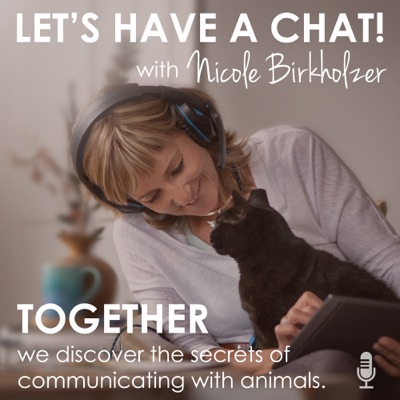
In this podcast, "Let's have a Chat," you will discover the secret to communicating with animals successfully.
If your animal is your soul-mate, then listen in as Nicole Birkholzer, animal communication expert, author, and storyteller provides you with ideas to have a mindful and meaningful chat with your own animal to resolve quirky and undesired behaviors.
Connect with Nicole at mindful-connections.com
Your new cat is fighting with your older cat, and one of them is not using the litter box.
Your horse is shying at the mounting block when she used to stand like a statue.
Living with animals enriches our lives in so many ways, yet when they are confused or unwell, their behaviors become our concern.
The truth is, in order to make themselves known, our animals express themselves through quirky, and sometimes undesired behaviors. When their communications fail to reach us they have to resort to demonstrative behaviors.
When our animals "speak" to us we are given a choice: we can dismiss them as silly and goofy or we can choose to stop… and listen.
By knowing how to listen to your pet, you will solve problems and be shown a world that is nothing short of miraculous.
In this podcast, "Let's have a Chat," you will discover the secret to communicating with animals successfully.
If your animal is your soul-mate, then listen in as Nicole Birkholzer, animal communication expert, author, and storyteller provides you with ideas to have a mindful and meaningful chat with your own animal to resolve quirky and undesired behaviors.
Connect with Nicole at mindful-connections.com
103 Episodes
Reverse

"There's only one thing we're still dealing with," Remmy's owner mentioned. "He paws terribly when standing in cross-ties." Immediately, I had a vision of Remmy in the barn aisle, held by cross ties – two ropes attached to the walls, clipped to his halter. I responded, "No wonder he's upset when stuck in cross-ties for two hours." At the same time, Remmy's owner added, "I knew he had been left in cross-ties for hours with the last trainer." We shared a moment of realization and concern. I spoke, "This horse was made to stand in cross-ties for two hours…" "Yes, after his rides," she confirmed. I could feel Remmy's experience in my own body. "Imagine being ridden hard, then stuck in cross-ties while the sweat dries, leaving you itchy and unable to move or reach for water after an intense workout. It's no surprise he's distressed." Show notes available here:https://www.mindful-connections.com/post/101-left-hanging-out-to-dry

I was doing something mundane, like the dishes, when I felt a proverbial tap on my left shoulder. With it, a horse I knew, Topaz, came into my mind. "What about the rib?" he asked me. Topaz and his person had been on the phone with me a week prior. Topaz was worried about going into the wash stall. When I tuned in to him, he told me, "Slippery, slippery!" Due to an old injury, he was concerned about slipping. During that call, Topaz also pointed out that a rib on his left side was out of alignment. His person, a veterinarian and chiropractor, said she would check and fix it. So, I was surprised to hear from Topaz asking about his rib while I was doing the dishes a week later. I knew his person would have checked it right away, but Topaz insisted, "What about the rib?" So I texted his person: Topaz is nudging me. I wonder if you checked out his left rib cage and if you noticed anything. She answered: Yes, I did and it was ok. I can check him again tomorrow. I answered: He keeps pointing to his left side, and I wonder if anything is stuck there. Just keep an eye on it. The next day, I received a text. Guess who had a rib out, left-hand side #cantmakethishsitup Being genuinely heard means that the one listening is mindful of receiving it. My animal clients don't just reach out to me like that. I have good boundaries around that. I am present with the animal during our phone session. After that, I am present with something or someone else. I am not an open channel. Can you imagine? I would lose my mind if I heard animals coming in left and right. Animals wouldn't do that out of respect. But Topaz knew his person could help, so he was persistent. In that case, I will listen—closely—because listening builds trust. Show notes available here:https://www.mindful-connections.com/post/100-the-art-of-listening

The dog wanted to show me his favorite place: I saw a lake, nature, and pine trees. The dog expressed how much he loved the scent of pine needles. The dog's person was not impressed. He said, "I don't know what the dog was talking about." Next, the man asked me what his dog's favorite spot in the house was. I saw the dog in the bedroom, covered by something that made the space dark and cozy. Maybe he likes to be under the bed, I wondered. The human said, "Nope." It turned out the dog was happiest under a blanket on the bed. That was close enough for me. But, more importantly, why did the guy ask? He knew the answer. "What is my dog's favorite treat?" he asked next. "It's small and dark brown," I answered, "I'd say it looks like a liver treat?" "No," the guy said, "it's a duck treat. Considering the variety of dog treats available, from cream-colored milk bones to green teeth-cleaning treats, cubes of cheese, and hide-free chew sticks, my description of a small brown treat was spot on. Does the dog know the difference between liver and duck? Was it maybe duck liver? Who the heck cares? And more so, why are we talking about things the man already knew? This was the first time I offered my money-back guarantee. The guy declined. There is more ... time to tune in! Show notes available here:https://www.mindful-connections.com/post/99-it-ain-t-a-parlor-game

Are you breathing with our therapy horses? Breathing? You might think right now. We don't have time for that. The parents will complain if the student is not on horseback within the first five minutes. I get it. Twenty-five years ago, I ran a traditional program: We quickly got the rider on the horse to maximize the time on horseback. I changed the program when I realized that horses were often little more than vehicles for getting the job done. We integrated more bonding time and more opportunities for the riders to get to know the horse by seeing the world through the horse's eyes. They transformed as we added more mindful interactions to our students' lessons. They became not just more compassionate and understanding but advocates for the horses. And our horses? They were not just happier; they were thriving. Their well-being became a testament to the effectiveness of our approach. And our board of directors? They were not just pleased; they were impressed. The vet bills went down, and our safety records soared. Join me to explore the world through your therapy horse's eyes. Show notes available here:https://www.mindful-connections.com/post/98-through-the-eyes-of-a-therapy-horse

It's important to understand that animals, just like humans, may not necessarily like each other. We don't always get along with every person we meet, even if we share the same workplace, school, or family. This is also true for horses, who are often brought together in small spaces without much choice. Each horse has its own history, experiences, and needs that must be met in a domestic setting. Sometimes, these needs are complex and cannot be easily met. The same can be said for our pets. In this episode, we will explore how to ensure everyone gets along. Show notes available here: https://www.mindful-connections.com/post/97-let-s-all-get-along

Comments

Download from Google Play

Download from App Store
 United States