


Make Change Happen
Subscribed: 54Played: 515
Subscribe


© All rights reserved
Description
IIED's mission is to build a fairer, more sustainable world, using evidence, action and influence in partnership with others. We link local priorities to global challenges, and our 2019-2024 strategy details how we will Make Change Happen
35 Episodes
Reverse
The focus is on food systems. The world is missing targets for addressing hunger and malnutrition while food systems contribute to nature loss and climate change. So how can sustainable food systems tackle those issues and also provide jobs, support economies and reduce poverty?
In this episode, IIED executive director Tom Mitchell discusses revitalising a commitment to international development and in the process, getting money to where it is needed most and can be used to best effect – to the local level.
In this episode, principal researcher Ebony Holland talks to Simon Cullen about the importance of nature finance and the need for changes in practice to make sure money for nature resilience gets to Indigenous Peoples and local communities.
In this episode, IIED researcher Francesca Booker and Ritchel Cahilig from the Haribon Foundation talk about the critical role local leadership plays not only in restoring nature itself but also in conserving local culture, identity and communities too.
In this episode, IIED’s senior researcher Karen Wong-Pérez talks to IIED’s senior press and PR manager, Simon Cullen, about global progress towards gender justice and why the journey towards gender-just environmental action isn’t moving quickly enough.
In this episode, IIED’s climate diplomacy researcher Camilla More and senior climate finance researcher Sejal Patel discuss why so many countries missed the recent deadline for submitting their 2035 climate targets – and the implications for global climate action.

Our latest episode revisits the key themes covered on Make Change Happen during 2025, including critical minerals, climate action and reform of the international financial architecture.
As well as reflecting on the progress made, our hosts – IIED’s Simon Cullen and Lindlyn Moma – highlight the big opportunities for global action in 2025, discussing what it will take to see change in the nature, climate and inequality crises.
There is a critical need to reform the international financial architecture (IFA) – the framework of institutions, policies, rules and practices that govern the global financial system.
In the episode, IIED’s Laura Kelly and Mohsen Gul set the scene by explaining why the IFA needs to be fit for purpose and work for everyone, including the least developed countries (LDCs), and why discussions around IFA reforms must include the voices of lower-income countries, LDCs and Small Island Developing States (SIDS).
IIED’s chief economist Paul Steele then outlines three priorities for reform of the IFA. We also hear from IIED’s Ritu Bharadwaj who discusses the Global SIDS Debt Sustainability Support Service, co-designed by IIED to alleviate crippling levels of debt and build economic resilience, and IIED partner Isatou Camara, who calls for faster and more accessible funding to reach the most vulnerable countries.

IIED has launched a 'Manifesto for a thriving world’ and the need for new responses to a range of compounding crises, greater uncertainty and growing injustice.
In this episode, the chair of IIED's board of trustees Tara Shine and trustee John Taylor discuss the intitute's plans for the future and changing ways of working.
Tom Mitchell, IIED's executive director, stresses the importance of IIED being outward looking and being grounded in evidence and including the knowledge and voices of Indigenous Peoples and local communities.
And Crissy Guerrero of the Non-Timber Forest Products Exchange Programme in Asia gives a practical example, outlining a certification scheme designed by forest producers to replace a system created by external parties for designating what can be labelled as organic.
Critical minerals – such as cobalt, lithium and copper – are in the headlines, attracting global attention for their potential in supporting the green energy pathway and accelerating the shift away from fossil fuels.
They make green technologies including electric vehicles, solar panels and wind turbines possible. The opportunities are huge and demand is booming.
But this doesn't come without issues. If not managed well, extraction can have negative impacts on communities, ecosystems and local economies.
This episode is a conversation between IIED senior researcher Eric Bisil and executive director of Africa Resources Watch (Afrewatch) Emmanuel Umpula. They discuss the potential of critical minerals in speeding up the fossil fuel phase-out, and how they can support the productivity and economic growth of countries that are rich in these minerals.
Other contributors include Ketakandriana Rafitoson, executive director of Publish What You Pay, IIED senior researcher Rose Mosi and IIED’s head of energy Ben Garside.
Despite global efforts to tackle the impacts of climate change, we are failing to achieve critical climate objectives. IIED’s Hidden Handbrake campaign aims to reveal and explain the bureaucratic, political, legal and practical barriers to countries taking effective action in response to climate change.
Progress on mitigation and adaptation measures and anticipatory actions to reduce the potential of loss and damage is drastically slowed where these barriers exist. They must be brought out into the open, challenged and removed.
This episode is a conversation between Tom Mitchell, executive director of IIED, and Sejal Patel, a senior researcher in IIED focusing on climate finance and climate-resilient development. The episode also has vital contributions from three climate and environment specialists: Megan Rowling and David Shukman, both highly regarded journalists, and Achala Abeysinghe, regional director and head of programmes at the Global Green Growth Institute.
Read more: https://www.iied.org/hidden-handbrakes-whats-holding-back-climate-action
This special guest episode, produced by the Indian Institute for Human Settlements (IIHS) looks at the work of a social network in Delhi that delivered food relief during the COVID-19 pandemic. The Delhi Coordinated Relief Network succeeded in reaching some of the most vulnerable neighbourhoods in the city during an unprecedented crisis.
This episode of Make Change Happen is hosted by Rashee Mehra of the Indian Institute for Human Settlements, with guests Juhi Jain, deputy director of the Centre for Advocacy and Research and Dr Gautam Bhan, the associate dean of the School of Human Development at IIHS.
According to UNHCR, the global number of people forcibly displaced by conflict, violence, human rights abuses, and other forms of persecution has reached 110 million. When asked to imagine the living conditions of refugees and internally displaced people (IDPs), rows of white tents or temporary structures often come to mind. In fact, around 60% of refugees and IDPs live in towns and cities.
This episode of Make Change Happen is hosted by Lucy Earle, director of IIED's Human Settlements research group, and features Nassim Majidi, co-founder and executive director of Samuel Hall; Jack Makau, associate director of Slum Dwellers International in Kenya; and Samer Saliba, director of city practice at the Mayors Migration Council.
The podcast discusses challenges and lessons from ‘participatory forums’ – part of a 3.5-year research project – that bring together different stakeholders and refugee representatives together.
Read more: https://www.iied.org/help-cities-help-people-bringing-everyone-together-refugee-response-make-change-happen-podcast
As a listener of IIED's Make Change Happen podcast, we value your opinion and are keen to understand your preferences and gather valuable feedback to enhance our podcast. Please, take this survey to help us create content that resonates with you: https://www.surveymonkey.co.uk/r/IIEDpodcastsurvey
Your responses will play a crucial role in shaping the future of the Make Change Happen podcast, making it an even more informative experience for all.
In this episode of Make Change Happen, marking LGBTQI+ Pride month, we want to spark conversations about how urban development and climate action can be truly inclusive of queer communities. What can we learn from queer thinking and practice? How can we challenge LGBTQI+ erasure in decision making to deliver stronger and more equitable change?
Hosted by Tucker Landesman, senior researcher in IIED’s Human Settlements research group, this podcast features lawyer and urban planner Rodrigo Faria G. Iacovini, working with the Instituto Pólis in Sao Paul, Brazil and queer activist Sarah Louis Montgomery, project coordinator at the global network GenderCC-Women for Climate Justice in Berlin, Germany.
Both guests share their experience working with queer communities and activists to bridge gaps between LGBTQI+ civil society and urban development and climate action, respectively, to achieve a just result.
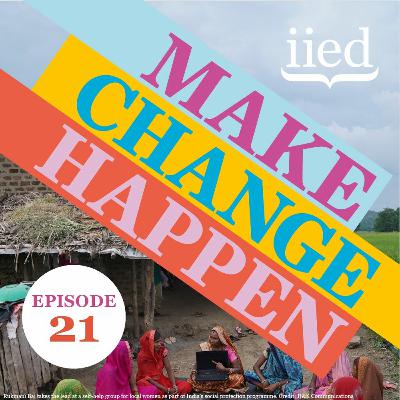
In this episode, launched to coincide with International Women’s Day, an all-women panel share the transformative change driven by women as they take on leadership roles at every level – from remote rural villages to international conventions.
Hosted by James Persad, director of IIED’s Communications group, this podcast features Ritu Bharadwaj, principal researcher in IIED’s Climate Change research group; Omaira Bolaños, director of the Latin America and Gender Justice programmes at Rights and Resources Initiative; and Ivonne Higuero, secretary-general of CITES.
Participants discuss what women leadership looks like, why spaces must be created for women leaders in climate and biodiversity, and practical measures to make this happen.
Read more: https://www.iied.org/ripple-effects-revolutions-women-leaders-climate-biodiversity
IIED’s ‘Make Change Happen’ podcast provides an opportunity to hear our researchers and guests discuss key global development challenges and explain what we are doing to support positive change.
Our last episode of 2022 brings together experts from across the world to explore how far climate mitigation action can respond to pervasive urban poverty in the global South – seen in a lack of housing and basic services such as water, sanitation and energy – and contribute to more just and equitable cities.
This special episode is hosted by Anna Walnycki, principal researcher in IIED’s Human Settlements research group. Alongside two IIED colleagues, principal researcher Aditya Bahadur and researcher Tucker Landesman, she is joined by two experts working on urban mitigation projects. Bijal Brahmbhatt is executive director of the Mahila Housing Trust in Gujarat, India; Daniel Kozak is senior researcher at the National Scientific and Technical Research Council of Argentina and director of the Research Center Habitat and Energy.
At COP26, political leaders called for more action to address biodiversity loss and climate change together. In this episode of Make Change Happen, we discuss how this must be financed and the possible mechanisms for spurring actions on the ground.
Hosted for the first time by James Persad, IIED’s new director of communications, this episode features Mandy Barnett from the South African National Biodiversity Institute (SANBI), Moses Egaru of the International Union for Conservation of Nature (IUCN), Yiching Song from the Farmers’ Seed Network China and Xiaoting Hou Jones, senior researcher at IIED's Natural Resources research group.

In this episode of Make Change Happen, we discuss racism and decolonisation in the development sector.
Hosted by Liz Carlile, IIED’s outgoing director of communications, this episode features Natalie Lartey, IIED’s advocacy and engagement manager; Maryam Mohsin, head of media and communications at Bond; and Mpho Tapela, executive director of Youth Unlimited Network in Botswana.
We explore how development organisations have responded to the Black Lives Matter movement, with a particular focus on language and narratives.
As IIED celebrates its 50th birthday, this episode of Make Change Happen brings together four established members of the IIED family to reflect on key movements in the journey towards sustainable development.
Host Liz Carlile, IIED's director of communications, is joined by ex-colleagues Steve Bass, now a consultant in sustainable development; Saleemul Huq, director of the International Centre for Climate Change and Development (ICCCAD); and former IIED director Camilla Toulmin, who is now a professor at the University of Lancaster’s Environment Centre and an associate at the Institute for New Economic Thinking. All three are also senior associates working with IIED.
They discuss some of the key movements that have pushed sustainable development forward in recent decades, how the landscape has changed, and what might come next.
To reflect on International Women’s Day, and the 2022 theme ‘Gender equality today for a sustainable tomorrow’, this episode of Make Change Happen discusses how gender equity and intersectionality approaches are central to climate justice, and that means putting people’s rights, lived experiences and priorities at the centre of every response.
Heather McGray, director of the Climate Justice Resilience Fund, Vitumbiko Chinoko, project manager at the Open Forum on Agriculture and Technology in Nairobi, and IIED’s Tracy Kajumba join host Liz Carlile.
We explore what is meant by the term ‘climate justice’, and unpack how through shifting the dynamics of oppression, and taking an intersectional approach to climate responses, the burdens of climate change are more likely to be shared fairly and equitably.

Comments

Download from Google Play

Download from App Store
 United States