


 Claim Ownership
Misguided: The Podcast
Subscribed: 16Played: 132
Subscribe

© Matthew Facciani
Description
Misguided: The Podcast explores how social and psychological forces shape our understanding of the world. Hosted by social scientist Matthew Facciani, the show delves into the latest insights from sociology, psychology, and information science. Matthew shares his own research and engages in thought-provoking conversations with guests from diverse backgrounds.
matthewfacciani.substack.com
matthewfacciani.substack.com
23 Episodes
Reverse
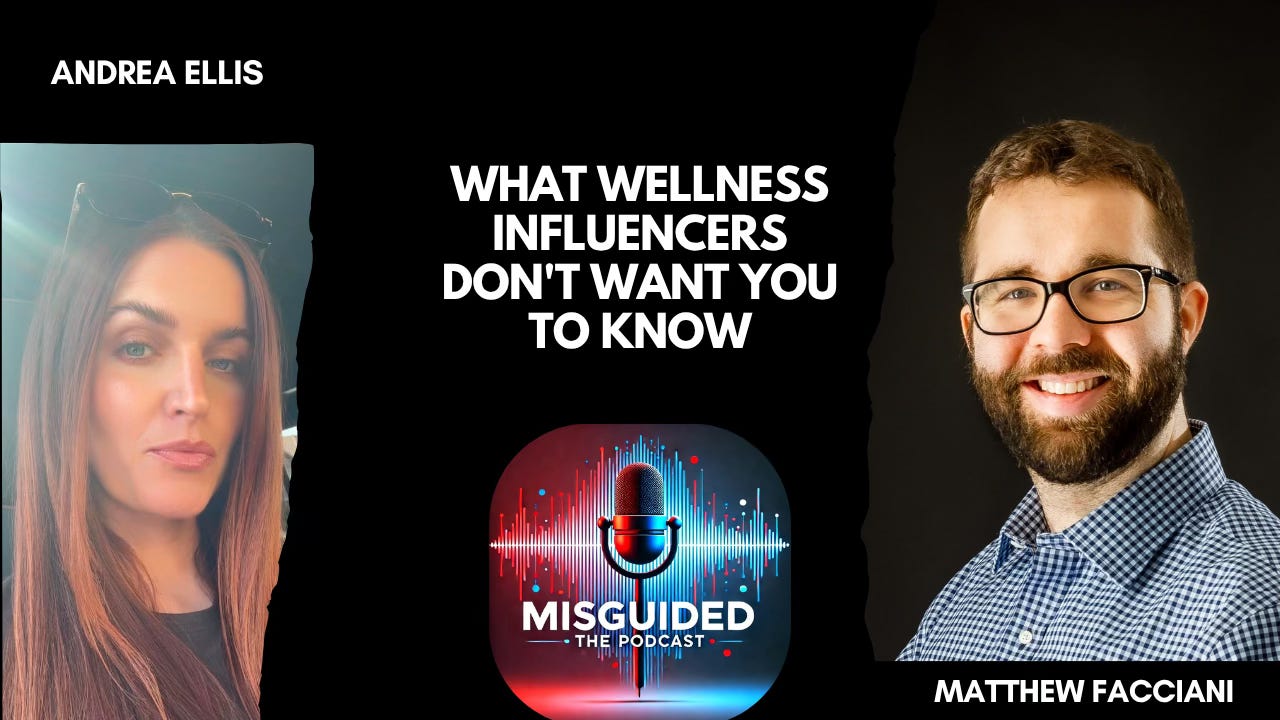
A few years ago, Andrea Ellis was a rising wellness influencer. She was a certified integrative health practitioner, made six figures a year from Instagram alone, and had built a community of followers who trusted her the way you’d trust a close friend. Today, she’s one of the most thoughtful critics of the industry.I sat down with Andrea for the latest episode of Misguided: The Podcast, and we dive into not just why people fall for wellness misinformation, but the actual business mechanics behind it, and how closely those mechanics mirror the “Big Pharma” boogeyman the wellness world defines itself against.The wellness influencer economyPeople in medical freedom and wellness spaces often portray pharmaceutical companies as a shadowy cabal, accusing them of paying doctors under the table to push medications, hiding side effects, and profiting off sickness.But as Andrea explained, the wellness influencer economy can involve direct commissions for supplement sales, kickbacks for every lab test ordered, payments for name-dropping a product in a ten-second Instagram story, and very little oversight. Supplement companies still email her offers today, years after she stepped away from the industry. The dollar amounts she described, including thousands of dollars for steering clients toward a certification program and hundreds for a few seconds of screen time, make the “shill” accusation cut both ways.Faith, identity, and the pipelineAndrea and I also discussed how the wellness worldview maps onto certain Christian narrative frameworks: a fallen world, forces working against your health and wellbeing, the need to discern truth from deception, and the expectation that living rightly will draw persecution.Andrea described a pipeline she saw play out in real time during COVID: faith → conservative politics → conspiratorial thinking → wellness, with each reinforcing the others until it became difficult to tell where one identity ended and the next began.This is something I think about constantly in my own research: the more group memberships and identities someone shares with a source, the more credible that source can feel, regardless of whether the information holds up. When someone’s wellness influencer is also their fellow believer, fellow parent, fellow political ally, and fellow “truth-seeker,” that person’s claims may not get evaluated primarily on the evidence. They get evaluated through trust that was built somewhere else entirely.What could bring people backAndrea has watched people find their way out of these belief systems, but never because of one perfect debate or viral debunking. It’s slower than that: a stray thought that doesn’t sit right, a small inconsistency someone can’t shake, or a person outside the echo chamber they still trust enough to hear out.She called it being a “pebble in someone’s shoe.” Not an immediate conversion moment, just enough friction that, months or years later, it adds up or makes someone more open to listening to new perspectives.That’s a harder story to tell than the one the wellness world tells. Conspiracy narratives are simple, emotionally satisfying, and built for social media. “Eat well, move your body, sleep enough, and be patient” is true, but it doesn’t sell nearly as well.I really enjoyed this episode, and I think it provides a great overview of the wellness world while also showing how our identities and belief systems influence what we trust.You can listen to the full episode here or via the links below. As always, if you find my podcast useful or interesting, feel free to share it with someone who might also enjoy it.Follow Andrea on InstagramKeywords: Andrea Ellis, influencers, wellness, religion, social media, media literacy, science communication, health communicationMisguided: The Podcast - Apple PodcastsMisguided: The Podcast | Podcast on SpotifyMisguided - YouTube This is a public episode. If you'd like to discuss this with other subscribers or get access to bonus episodes, visit matthewfacciani.substack.com/subscribe
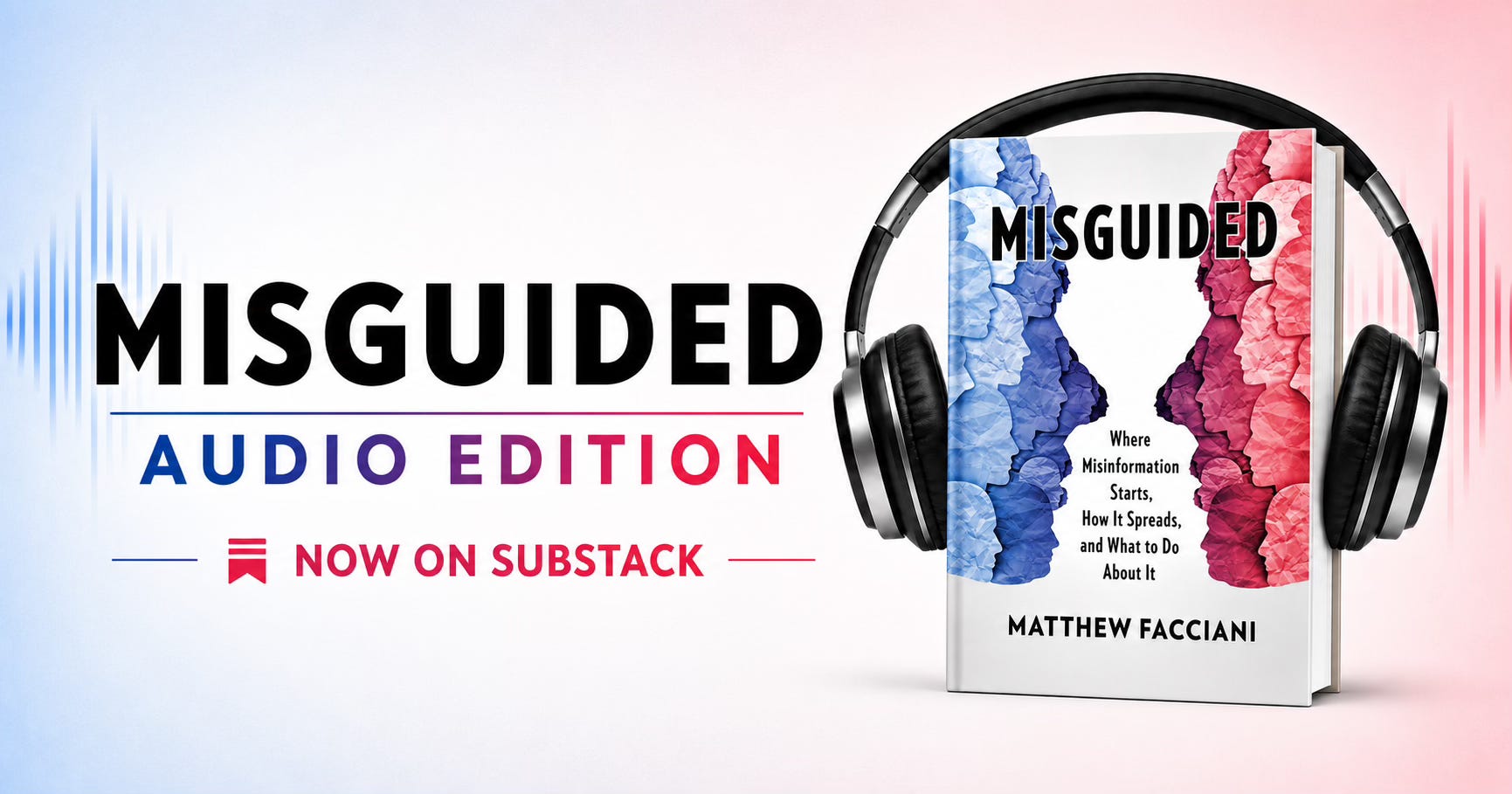
I’m launching Misguided: The Audio Edition right here on the newsletter. It’s a chapter-by-chapter audio companion to the book, with updated commentary on everything that’s happened since it went to press. Today, that series begins, and this first episode is free for everyone.Before you hit play, let me tell you a little more about what this project actually is and why it exists.Why this seriesWhen my book Misguided came out in early 2025, one of the most common things people told me was that they wished there was an audio version. So did I. My publisher explored it but ultimately couldn’t make it work, so I decided to make it myself. And the more I worked on it, the more I realized this format has real advantages over a straight recording of the book.Misguided can be dense in parts as I pack in a lot of social science research. That was intentional as I wanted every major claim backed by evidence, and I didn’t want to oversimplify. But that also means it can be a lot to absorb all of those scientific studies. This audio series gives you the core insights from each chapter in a focused, listenable form, without all the footnotes and detailed study breakdowns slowing things down. The nuances from the evidence-based insights are all still there, in the print and digital editions, if you want to go deeper. Think of this as the essential version, the ideas you should walk away with, presented as directly as I can manage.And then there’s what I’m calling the author’s update.Each episode has two parts. A summary of the chapter’s core research and arguments. And then my own unscripted commentary, where I go from “author presenting the book” to “author reflecting a year later.” This covers what I’d add now, what’s happened in the world since the book went to press, and how the science connects to the moment we’re actually living in.That last part is where things get interesting, because the world has moved significantly in the year since I finalized the manuscript. The chapter on rebuilding trust in public health institutions reads very differently in 2026. So does the chapter on the future of AI and misinformation. And the chapter on how political identity shapes what we believe, well, the evidence keeps piling up.The book came out about a year ago. I think it’s more relevant now than when I wrote it.What’s coming in the seriesHere’s the full lineup. Each episode covers one chapter, with a summary of the key research and my updated commentary.This first episode is free for everyone. Episodes 2–8 are for paid subscribers only. If you’ve been thinking about upgrading, this is a good moment to try the format before you decide.This episode is also available on the Misguided podcast, so if you’re a longtime podcast listener, you’ll find it there automatically. Future episodes in the series will be for paid Substack subscribers only and won’t appear in the public podcast feed.Episode 1 — Introduction (free)What is the scope of this book, and why did a sociologist who started in neuroscience end up studying misinformation?Episode 2 — The Scope and Consequences of MisinformationHow widespread is it, how can we measure it, and what does it actually cost us?Episode 3 — How Our Identities Make Us VulnerableWhat is the psychology behind why we reject facts, and what can actually help?Episode 4 — COVID, Politics, and Talking Across the DivideHow did a virus become partisan, and what does the evidence say about having difficult conversations across that divide?Episode 5 — How Social Networks Spread MisinformationWho we know shapes what we believe, but how exactly, and what can help?Episode 6 — Vaccine Misinformation and Rebuilding TrustHow does the anti-vaccine movement work, and can institutions earn trust back?Episode 7 — Media Literacy, Critical Ignoring, and PrebunkingWhat education actually works, and what’s just wishful thinking?Episode 8 — The Future of Misinformation, RevisitedI wrote this chapter during the AI explosion. One year in: what did I get right, what did I miss, and where is this all heading now?Episodes will drop roughly weekly.A personal note before you listenI submitted the last major revisions of Misguided on January 15th, 2025. About a week later, I received an email telling me my position at Notre Dame had been eliminated. The grant funding it had been cut for not aligning with the new administration’s priorities. The goal of that grant was simply to advance media literacy in the US, and in Southeast Asia, which is under-researched in this space. I was working on tools to help people recognize AI-generated video and understand why they trust information from chatbots. Nothing partisan. None of it mattered.It was a difficult period. Science and health funding was being cut broadly, misinformation research specifically was under attack, and finding a new position in that environment was genuinely hard. I cobbled things together: adjuncting, consulting, growing this newsletter and podcast, searching for funding for the science communication nonprofit I work with, The Evidence Collective. I also landed a research contract with Georgetown, as part of the Lancet Commission on health, faith, and trust, which I’ll talk more about when we get to the chapters on vaccines and institutional trust.Eventually, I found a wonderful new job at the Yale School of Public Health, where I study how and why people trust health information, and help run science communication training on campus. It’s a great fit and opportunity.I share all of this because it’s part of the story of why this series exists, and because it connects directly to what the book is about: the structural forces that shape what we know and what we’re allowed to say. The same year my book about misinformation went to press, misinformation research in the United States was severely defunded. While my book focuses on the social psychology of why we believe falsehoods, I also cover some structural issues, and the updated commentary of each chapter allows me to spend a little more time on that level as well. This is a public episode. If you'd like to discuss this with other subscribers or get access to bonus episodes, visit matthewfacciani.substack.com/subscribe
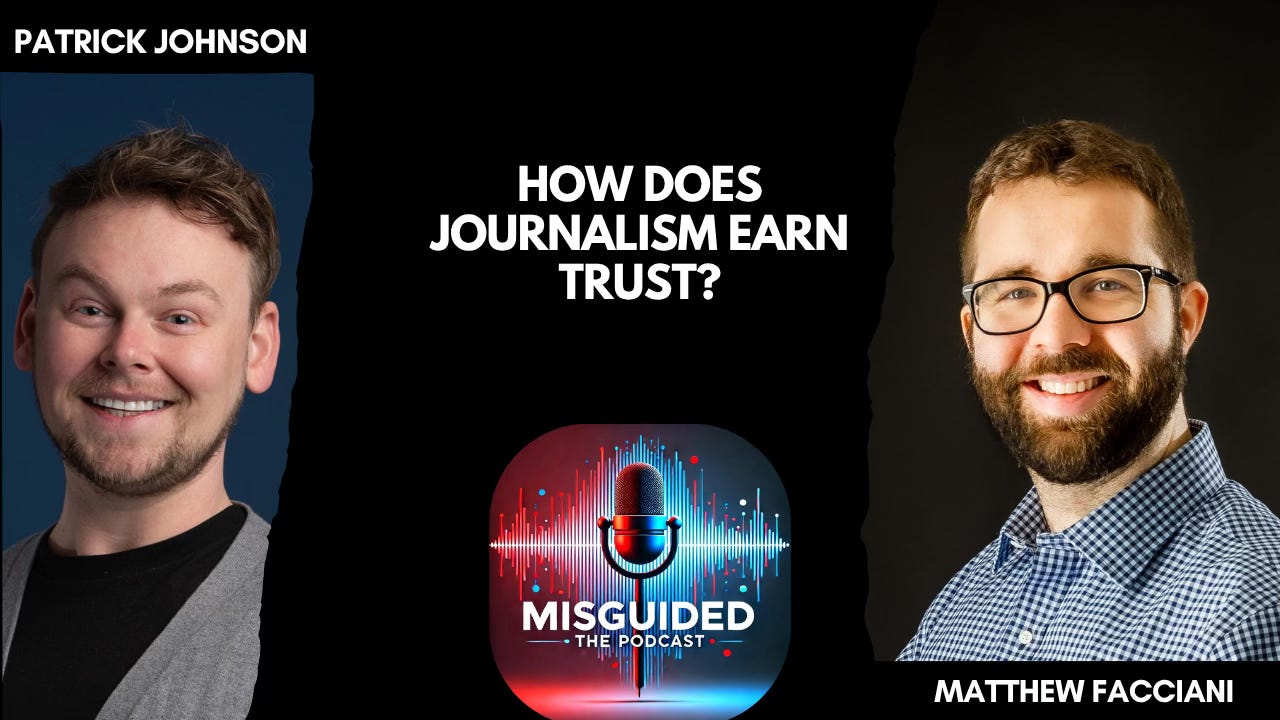
In this episode of Misguided: The Podcast, I’m joined by Dr. Patrick Johnson, a journalism scholar at Marquette University whose work focuses on news literacy, trust in journalism, and the relationship between media institutions and the communities they serve. Before entering academia, Patrick spent years teaching high school journalism, an experience that continues to shape how he thinks about journalism not simply as information delivery, but as a form of public education.We begin by discussing why trust in journalism has become so fractured, and why treating distrust as a single problem misses the bigger picture. Patrick explains how different communities experience journalism differently, from conservatives who feel misrepresented to marginalized groups whose distrust is rooted in histories of exclusion or harm. Rather than reducing trust to a survey metric, he argues that rebuilding it requires deeper engagement with communities and a rethinking of journalism’s role in public life.From there, we dig into Patrick’s research on what he calls metacognitive news literacy: the idea that journalists themselves must model transparency, reflection, and critical thinking if they want audiences to better understand how news is produced and evaluated. We also discuss the parallels between journalism and public health, why local news ecosystems matter so much, and how stronger relationships between institutions and communities can help rebuild trust.We close on a more hopeful note, discussing why Patrick remains optimistic about the future of journalism despite the challenges it faces. His answer ultimately comes back to people, the journalists trying to improve their craft, the students shaping the future, and the possibility that institutions can still grow into something better.You can listen to the full episode here or via the links below. As always, if you find my podcast useful or interesting, feel free to share it with someone who might also enjoy it.Patrick’s websiteTrustingNews.orgNews Avoidance and LGBTQ+ CoverageFollow Patrick on LinkedInKeywords: Patrick Johnson, media literacy, news literacy, journalism, science communication, health communicationMisguided: The Podcast - Apple PodcastsMisguided: The Podcast | Podcast on SpotifyMisguided - YouTube This is a public episode. If you'd like to discuss this with other subscribers or get access to bonus episodes, visit matthewfacciani.substack.com/subscribe
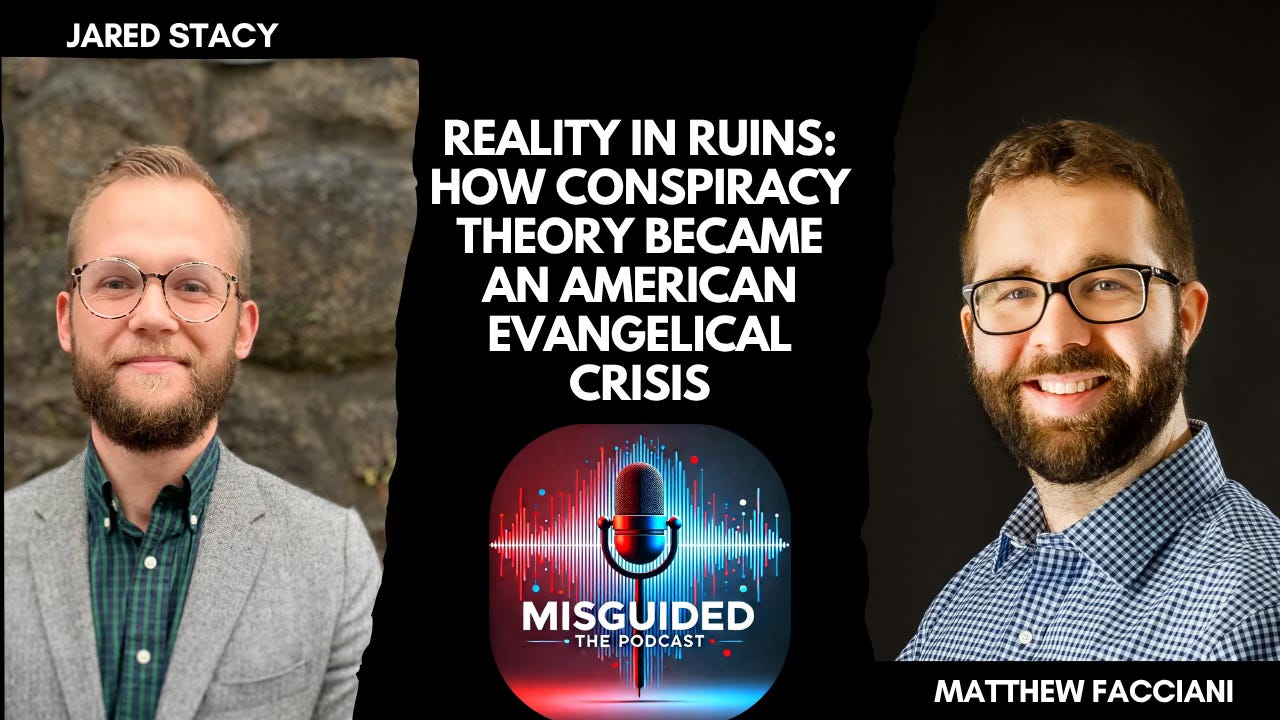
In this episode of Misguided: The Podcast, I’m joined by Dr. Jared Stacy, a theologian and former pastor who studies how conspiracy theories take root within evangelical communities. Jared completed his PhD in ethics at the University of Aberdeen and is the author of the new book Reality in Ruins, which examines how disinformation becomes uniquely resistant to correction when it gets woven into religious belief.We start by talking about Jared’s concept of holy paranoia: the idea that conspiracy theory isn’t a bug in American evangelicalism but a feature. The core argument is that once conspiratorial thinking gets absorbed into a religious story, fact-checking alone can’t dislodge it. It’s not that people lack access to good information; it’s that the conspiracy has already been integrated into something that feels coherent, total, and true.From there, we dig into the media ecosystems that make this possible — the radio networks, podcasts, and influencers that create a seamlessly reinforcing reality for many evangelical Christians, one where conservative political content and worship music flow together without friction or distinction.We close by discussing what science communicators and public health professionals get wrong when trying to reach faith communities, and why Jared believes the most effective interventions will require theologians and scientists working together rather than talking past each other.You can listen to the full episode here or via the links below. As always, if you find my podcast useful or interesting, feel free to share it with someone who might also enjoy it. Buy Jared’s book: Reality In RuinsJared’s websiteFollow Jared on Threads and InstagramKeywords: Jared Stacy, disinformation, conspiracy theories, religion, Evangelicalism, media, science communicationMisguided: The Podcast - Apple PodcastsMisguided: The Podcast | Podcast on SpotifyMisguided - YouTube This is a public episode. If you'd like to discuss this with other subscribers or get access to bonus episodes, visit matthewfacciani.substack.com/subscribe
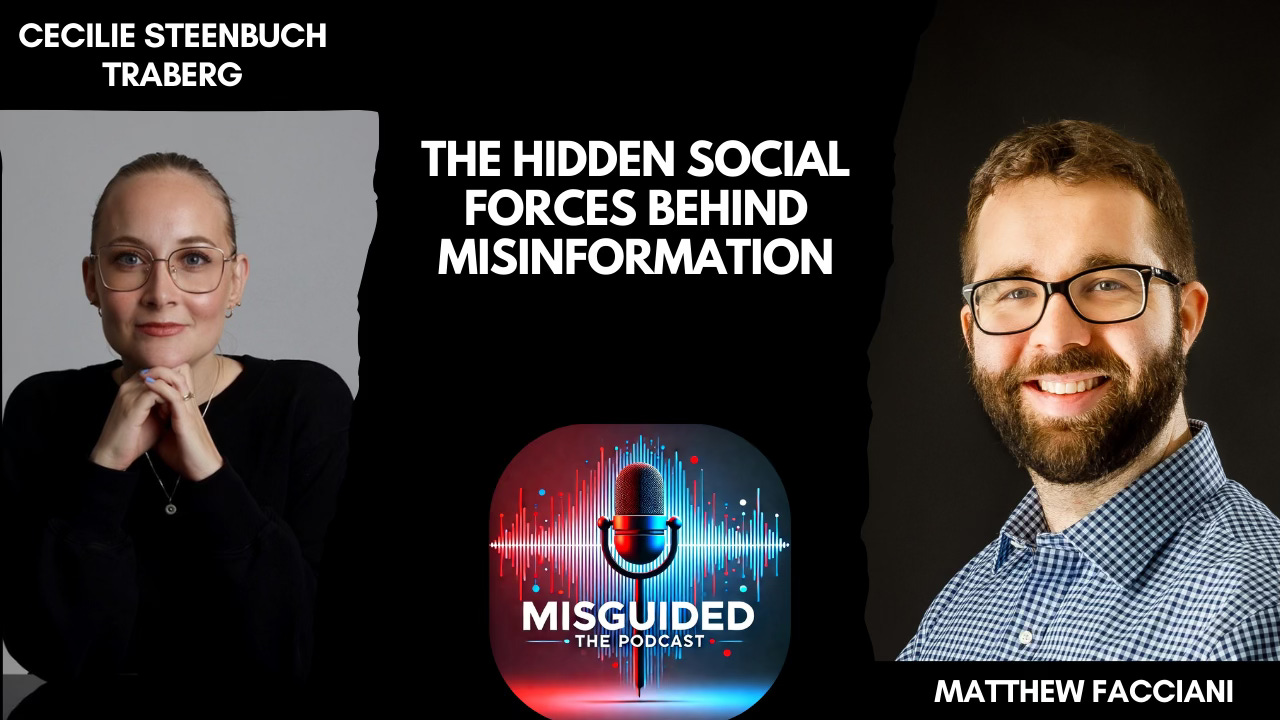
In this episode of Misguided: The Podcast, I’m joined by Dr. Cecilie Steenbuch-Traberg, a professor at the Copenhagen Business School who studies how social context shapes our susceptibility to misinformation, and what interventions actually work to counter it. Cecilie’s path into the field took a detour through marketing before she found her true passion: not trying to persuade people, but protecting them from being persuaded.We start by talking about how the classic pre-bunking games (like Bad News and Harmony Square) hold up when you test them in more realistic social conditions. The short answer is that they mostly work, but people are still vulnerable to the surrounding social cues: who’s sharing something, how many likes it has, whether the source feels politically similar to you. Even a handful of comments can make a fringe belief feel like consensus. That gap between individual-level learning and real-world social context is where Cecilie sees the biggest unmet need.From there, we dig into her new project, Solomon’s Secret: a murder mystery game designed to teach social influence literacy without ever announcing that it’s a misinformation game. The goal is to reach people who would never seek out a media literacy tool, by making the learning feel incidental to the fun. We also connect this to some of my own research comparing pre-bunking games across cultural contexts.We close by discussing how AI is reshaping both the threat and the opportunity. AI can certainly be used as a tool for scaling manipulation, but it can also help personalize interventions in ways that weren’t previously possible.You can listen to the full episode here or via the links below. As always, if you find it useful, feel free to share it with someone who might benefit from the conversation.Follow Cecilie on LinkedInCecilie’s websiteCecilie’s Google ScholarSolomon’s SecretKeywords: Cecilie Steenbuch Traberg, prebunking, media literacy, AI, social influence, psychological inoculation, social media, psychologyMisguided: The Podcast - Apple PodcastsMisguided: The Podcast | Podcast on SpotifyMisguided - YouTube This is a public episode. If you'd like to discuss this with other subscribers or get access to bonus episodes, visit matthewfacciani.substack.com/subscribe

Comments

Download from Google Play

Download from App Store
 United States