


Modern Law Library
Subscribed: 261Played: 4,565
Subscribe

Description
Discover books and stories that explore the law in new and surprising ways through eye-opening conversations with their authors. Whether it’s fiction or non-fiction that you seek, Modern Law Library features today’s top legal authors and delves into legal theories, historical events, true crime, and law-inspired storytelling. Join Lee Rawles twice a month as she opens up a new legal publication on Modern Law Library, a Lisagor Award-winning podcast.
271 Episodes
Reverse

On March 8, 1950, Senator Joseph McCarthy stood before a Senate subcommittee and named his first alleged communist: New York lawyer Dorothy Kenyon.
Kenyon didn’t back down. “Who in the heck is Joseph McCarthy?” she asked the reporter who broke the news, before calling the junior senator “an unmitigated liar.” She also called him a coward and, as author Jennifer Brinkley puts it, a low-down worm. Then Kenyon went to Washington and took his charges apart. The subcommittee found no evidence against her, but as she later put it, the truth never catches up with the lie. She never received another public appointment.
In Justice Was Her Calling: The Fierce and Fascinating Life of Dorothy Kenyon, Brinkley traces the career McCarthy derailed: a municipal court judgeship under Mayor Fiorello La Guardia, the first equal pay resolution at the UN Commission on the Status of Women, and decades of pushing the ACLU to take sex discrimination seriously. Brinkley joins host Lee Rawles to discuss Kenyon’s free-love summers at Barn House on Martha’s Vineyard, her partnership with Pauli Murray on White v. Crook, and why her name appeared on Ruth Bader Ginsburg’s brief in Reed v. Reed.

When Tracy Thomas first joined the faculty of the University of Akron School of Law, the dean assumed she must know all about their local heroine, Judge Florence Allen.
"She was literally staring at me from my classroom," says Thomas. "There was a picture of Florence Allen on one of our old concrete wall classrooms."
Born in 1884, Florence Allen would chalk up many firsts. In 1918, she became the first female prosecutor in Ohio. In 1920, she became the first female judge in Ohio when she won election to the Cuyahoga County Common Police Court in Cleveland. In 1922, she was elected to become the nation's first woman to serve on a state supreme court. And in 1934, she was appointed by President Franklin Delano Roosevelt to sit on the U.S. Court of Appeals for the 6th Circuit, the first woman to be a federal appellate judge. She even came within a hair's breadth of being nominated to the U.S. Supreme Court, by two different presidents.
But who was Florence Allen, and why did it take so long for her successors to make it to the bench? After her retirement in 1959, the next woman to be appointed to the 6th Circuit was in 1979. Although she joined the Ohio Supreme Court in 1922, another woman wouldn't serve on that court until the 1980s.
In her new book, The First Woman Judge: The Life and Legacy of Florence Allen, Thomas delves into Allen's suffragette connections, her political ambitions, and the two women who would be her life partners. She shares how Thomas navigated in a world of men, and built a base of support from women of both political parties.
In this episode of the Modern Law Library, Thomas and host Lee Rawles talk about the responses of Allen's judicial colleagues to her ascending the bench (one took to his bed for two days); her defense of another female judge during the Lavender Scare; and why she ended up having to hear so many tax and patent cases.

Julie Suk is worried about American democracy.
"Over time, the control of our constitutional future has really been in the domain of the judiciary and the executive branch, with the judiciary increasingly green-lighting actions by the executive branch," Suk tells host Lee Rawles. "And at the same time, our institutions, our lawmaking institutions that are supposed to represent the people have become less and less representative because of gerrymandering, and also less and less capable of making laws that push back against judicial and executive power."
In her new book, The Shadow Court: Rescuing Democracy from the Supreme Court, Suk proposes one potential tool to fight back.
The "shadow docket" may be a familiar term to people who have been paying attention to growing controversies over the U.S. Supreme Court's emergency decisions. But a shadow court is a different–and older–concept, Suk says. Just as a shadow parliament is intended to be a check on the power of a parliament, a shadow court could issue legal opinions independent of h a supreme court's actions. Many other countries have constitutional courts in addition to courts of litigation, that issue advisory opinions on constitutional issues.
Suk proposes that Congress could create "a watchdog institution that provided an alternative jurisprudence or an alternative set of rulings so that the people could know what would we have in America if we actually had institutions that were designed better for the purposes of constitutional lawmaking and constitutional change."
One benefit of an Article I shadow court would be the ability for its judges to weigh in on constitutional questions without the necessity of a plaintiff with standing bringing a case through the entire Article III court system to reach the U.S. Supreme Court, Suk says. They could evaluate pending legislation or executive actions with much greater speed.
"And that opinion is advisory," says Suk. "It's not binding on Congress. It doesn't invalidate the state statute. It doesn't suspend the operation of the executive order in the same way that a court can issue a preliminary or permanent injunction. The shadow court's opinion being advisory, I would say could still, if it's designed properly, could still have a tremendous effect on our politics and also on our law."
In this episode, Suk and Rawles discuss how other countries have used shadow parliaments and constitutional courts to safeguard democracy. They also discuss ways to make a shadow court more reflective of changing public attitudes, and Suk's Lego-piece theory for improving the United States government.

"In most other countries, there are laws, criminal laws that prohibit the expression of racial hatred or incitement to racial hatred," says Samantha Barbas, author of Hate Speech: The Legal and Cultural History of an American Dilemma, in this episode of the Modern Law Library. "There are no hate speech laws in the United States, and that makes the U.S. a true exception, a true outlier in the world. And so my book was trying to get to the question, why did the U.S. take this unique path? How do we explain that historically? Where and when and why did we diverge from the path that was taken by most other countries?"
World War II prompted a barrage of hate speech legislation after it ended, but not in the United States, Barbas tells host Lee Rawles.
"We had just seen how totalitarian governments establish themselves through censorship," Barbas says. "There are two really important ideals that seem to be clashing in the post-war era. Many hate speech laws are proposed, but they are rejected or struck down on free speech grounds. So at this moment when Europe is adopting hate speech laws, America is going the other way: Proposing them, but then rejecting them, and that consensus in favor of freedom of speech is going to hold for several decades."
In this episode of the Modern Law Library, Barbas and Rawles discuss how American courts and society have dealt with hate speech issues in the past, and how the growing awareness of psychological harm has impacted public attitudes about hate speech. They also explore Henry Ford and the Dearborn Independent, D. W. Griffith and Birth of a Nation, the Streisand Effect, and a series of cases about Illinois Nazis.
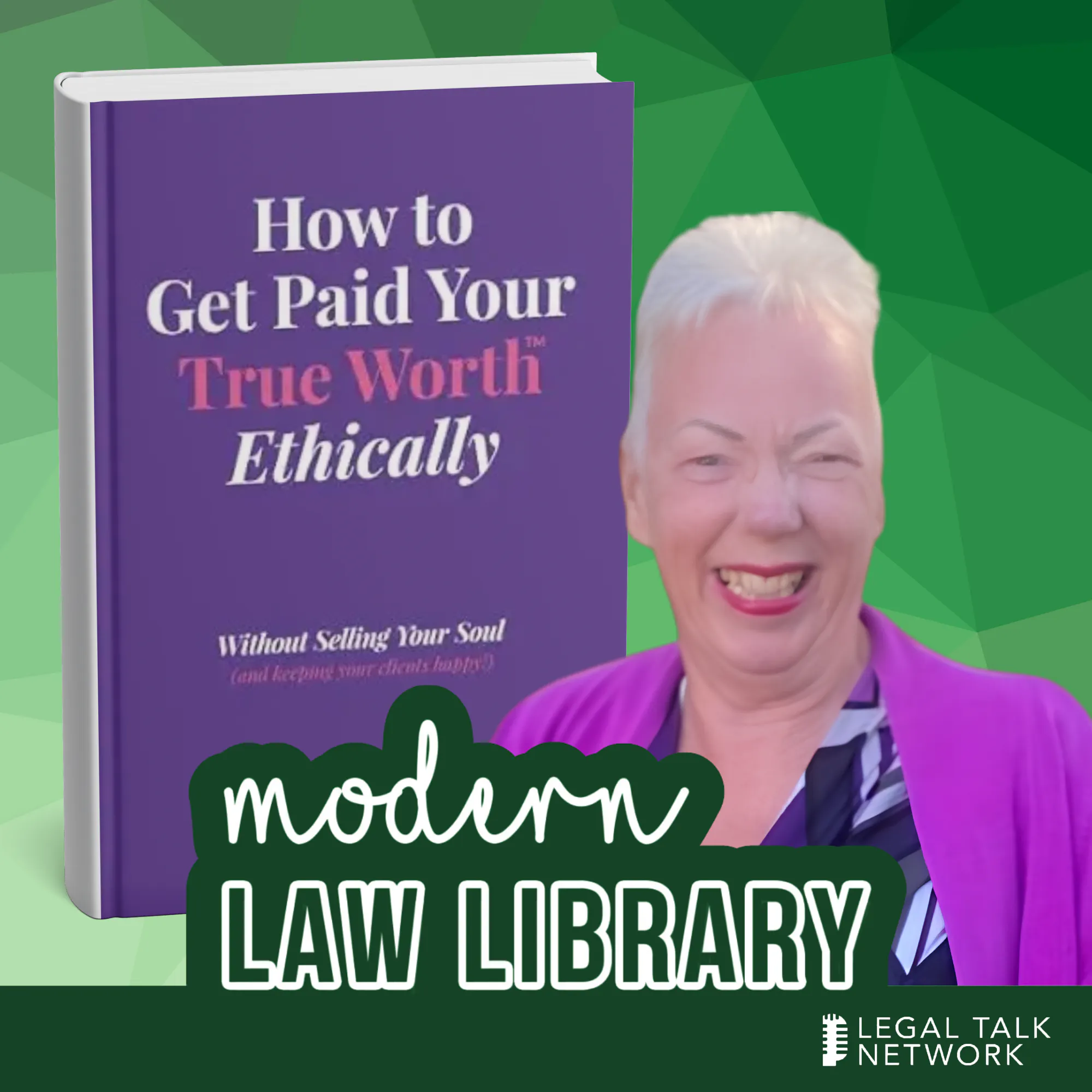
Vanessa Ugatti is the True Worth Expert, a UK-based international keynote speaker, transformational trainer and coach, and author of How to Get Paid Your True Worth Ethically, Without Selling Your Soul.
Through her unique True Worth™ Methodology, Vanessa helps forward-thinking law firms and sole practitioners get paid their true worth ethically, without over-servicing, discounting or losing clients.
“Lawyers are quite fearful people, certainly in the UK, and I’m imagining it’s probably not that much different in the States,” Ugatti tells Modern Law Library host Lee Rawles. "They're driven by fear. Fear of losing the client, fear of getting in trouble with their board. Just fear. And so they'll tend to focus on doing the legal work at the expense of the business–that comes second–and the expense of themselves."
In her new book, How to Get Paid Your True Worth Ethically: Without Selling Your Soul (and Keeping Your Clients Happy!), Ugatti shares her methodology, based on the acronym TRUE WORTH.
"Getting paid your true worth is not just about making enough revenue to have a sustainable life and business," says Ugatti. "It's also to make sure that you are well, you can supply the right work to your clients, and you can give them the level of service that they need."
In this episode of the Modern Law Library, Ugatti outlines what each letter of TRUE WORTH stands for, and discusses her own journey towards having the confidence to value herself properly.

Comments

Download from Google Play

Download from App Store
 United States