


 Claim Ownership
Nature Sounds
Subscribed: 902Played: 8,898
Subscribe

© Copyright 2026, Australian Broadcasting Corporation. All right reserved.
Description
Listen to the soothing sounds of nature directly from the microphones of Dr Ann Jones. 'That bird lady from the ABC' captures wildlife and wilderness in all its glory — bringing you soundscapes of the ocean, forests, rain and storms across Australia. If you need a podcast for white noise, meditation, or to finally get some sleep, this is just what the doctor ordered.
22 Episodes
Reverse
No music, no voices, just the sound of a gentle stream and frogs calling on a still, cool night in regional Victoria.Moonlight floods the landscape of Wadawurrung country. Big, old candlebarks stand still and silent and a creek flows through a shallow valley. Grasses grow up to the waist, except where kangaroos have been nibbling them! And within the sedges by the creek lurk frogs who revel in the still night, the cold air and the perfect opportunity to sing for a mate.It's hard to hear many of the other sounds above the water flowing and the frogs, but there are actually many creatures in this recording if you've got very good ears and time to listen hard.Listening notes from Ann Jones:01:50 Common eastern froglet with a "creaky-creaky-creaky" call. Don't let the name fool you — these are tiny frogs, with a maximum size of 3cm. The best way to see them is to wait until night and use a torch to try and see tiny little eyes on the edge of the water. They will appear in almost any habitat really, they're not too picky and will probably breed at any time of year also.24:00 The brown tree frogs are calling. These are medium frogs – that means they'll only get up to about 4.5cm. It's a pretty common little frog throughout the south-eastern part of the mainland – and will be heard in natural areas, farms and even in town! They'll call at basically any time of year.25:42 A female powerful owl is calling in the distance. This is Australia's largest owl, and the female's call is ringing out across her territory.38:48 A female fox is calling in a characteristic scream/cough, though it's very faint with all the rowdy frogs. She's advertising her presence to other foxes, and who knows if she got a response. She did set distant dogs off barking though! These dogs bark on and off throughout this whole recording. Their voices really carry – I think they were well over a kilometre away. You can just hear their lower tones floating underneath the close water and frog sound.44:27 A possum in a tree being rowdy as it cullumps through the branches.51:20 Sugar gliders are nearby, chirping out their little barks. And also…. if you listen closely, you can hear a launch, silence while she glides, and a landing. To be fair though, this could be a ringtail in the tree, as shortly after the noises, a ringtail starts calling. Possibly more likely to be a ringtail, they're more clumsy.52:05 The ringtail sounds like an extremely high-frequency horse's whinny. They almost sound like insects. They have a prehensile tail, meaning they use it to grip branches, or to carry things, like bunches of leaves back to their hollows. The ringtails in Victoria are, I think, much cuter than the ringtails further north. Gauntlet thrown.1:34:45 I think this sharp, strong insect sound is possibly a katydid.2:12:40 You can hear the scolding, throat-clearing calls of the brush-tailed possums. There are several through this recording and they also move through trees, in a very characteristically noisy way throughout the soundscape. If you hear rustling, it's likely a possum looting a tree.2:38:10 This is one of those breaks, where all the frogs just decide, through some cue, to stop calling all at once in an area. Then, one will start up — and it all kicks off again.

No music, no voices, just the sound of a valley halfway up a Tasmanian mountain. This soundscape is full of birds and breeze echoing backwards and forwards across a reservoir. Kunyani is swirled with mist and the city of Hobart spreads below, in miniature, on a still, early morning. We’re halfway up the mountain, at the Hobart Waterworks Reserve where two huge reservoirs store water for use by the populace below. The deep valley where the reservoirs are situated means there is an echoey, dream-like quality to all the sound. You can hear a unique mix of forest and water birds at this place every single morning. There were tawny frogmouths coming as I trudged up the hill, and as I was sitting listening to the day unfold a scarlet robin danced on the edge of the bush — feeding, patrolling and, just maybe, calling for the microphone. Listening notes from Ann Jones: 06:06 A fan-tailed cuckoo calls, making a trilling, descending whistle, quavering slightly as it goes. This cuckoo is a parasitic breeder, sneakily laying its eggs into another bird's nest. The fan-tailed cuckoo in particular targets tiny birds, like scrubwrens, to bring up its offspring. 07:10 Kookaburras are not native to Tasmania, but were introduced in the early 20th century and are established. 12:51 The ploinking call is probably part of the call repertoire of the grey shrikethrush. 13:38 A single call of a green rosella. This bird is only found in Tasmania and is Australia’s largest rosella. 14:10 The repetitive notes of the striated pardalote, calling in almost perfectly timed beats. 19:52 The deep oooom of a bronzewing pigeon calling from the bushland. Often heard, rarely seen! 23:15 The kelp gulls, normally associated with the seaside, love to visit the reservoir. You can hear their calls echoing over the water and around the hills. They look like a big, beefy seagull with a black cape on, a bright yellow beak with a spot of red lipstick. 25:10 The footsteps of a jogger running past the microphone. 37:14 European blackbirds are singing throughout much of this recording. Released into Australia and well established in the colder areas, these songsters fill the air with a distinctive song. Think the beginning of Blackbird by The Beatles — it is, literally, a blackbird recording. Here they’re interspersed with native Australian birds, but it’s the one that sounds like an old man whistling an unknown tune. 38:20 Listen for the flight calls of the green rosellas. 40:10 Behind the grey shrikethrush and the blackbird, there are tiny chirps and a sequence of extremely high-pitched twitters, like a sea shanty sung in super-fast motion. This is the grey fantail, who will be flitting and flying through the dappled sunlight catching insects on the wing. 41:07 This slightly grumpy sounding quack is probably a pacific black duck. 49:32 The grey shrikethrush sings with clarity and force, and all across Australia its call varies slightly. 55:30 The kookaburras are still solidifying the boundaries of their territories and their relationships by singing choruses across the other side of the reservoir. 56:36 A coot doing its harmonic squawk. 1:15:34 The alarm call of the blackbird, who has momentarily stopped singing to warn of danger. 1:24:18 You can hear a masked lapwing become upset and take off, calling and swirling in the air. 1:28:34 A short interlude from distant ravens. These are forest ravens, the only sort that can be found in Tasmania. 1:29:15 A duck is chattering away in the background. I think it’s a wood duck! Quack!
 1
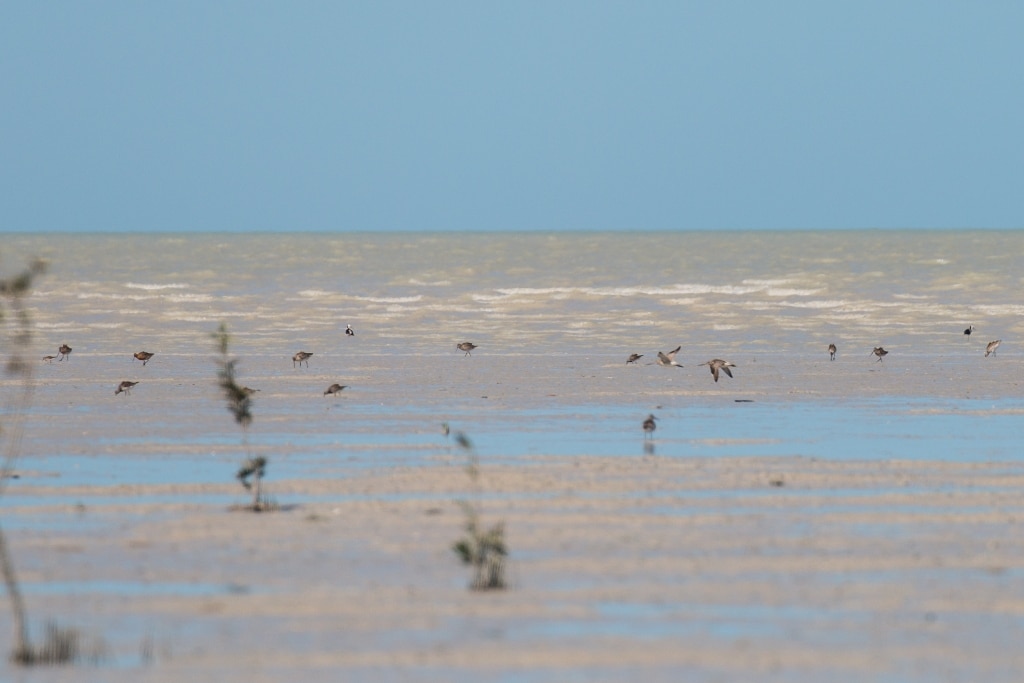
1No music, no voices, just the sound of the Roebuck Bay mudflats near Broome, WA. Hear the breeze across the water, crabs and mudskippers flipping and flopping, and a tide that slowly comes in. Roebuck Bay is on the traditional lands of the Yawuru people is one of the most magical places in Australia. It is a 34,119-hectare mudflat, washed every day by a tide that reaches kilometres from the shoreline. In the sapphire waters there are all sorts of sea turtles, saw fish and dugongs, and the red sands roll down to meet the water in a way that is absolutely unique to this area. It is a wetland of international significance, used every year by at least 300,000 shorebirds as a launching pad for their migration to the Northern Hemisphere.This recording is on the edge of the clicks and snips of tiny mudskippers as they move around the mudflats at low tides is the constant white noise of nature. On the edge of the mudflats of Broome you hear a mix of shorebirds and passerines as well as the cicadas which buzz in waves as the wet builds up.

No music, no voices, just the sound of the forest coming to life early one morning near Canberra -- where the gum trees grow small and with twisting white trunks. In the twilight of the morning I creep out from under the covers to set up the microphones right next to a dam.We are on the land of the Ngunnawal and Ngambri people, and not far away there are paddocks, livestock, a road and a farmhouse. But right here all there is, is nature waking up for the day.Listen for the drops of dew falling from the gumtrees and onto the leaf-litter below.Listening notes from Ann Jones:02:34, 04:50 and all through the recording, you can hear rosellas softly chattering to each other, their wing beats as they fly between trees, and the tiny clicks of them cracking open gumnuts to eat the softer seeds inside. They are probably crimson rosellas.06:17 Australian magpies are the only birds in the world that carol like this.08:15 Hear those wing beats? It's literally the sound of the air flowing over the feathers of bird wings. There are also black cockies calling in the distance just after this bird flies past.15:26 This is the wing beat of a tiny bird, such as a thornbill or spinebill. It sounds like fluttering — "pfffffrt pfffffrt" — because they flap so fast each wing beat blurs into one shaky sound.17:12 A wood duck calls from the dam, and sounds pretty happy with itself really (they always do). You can hear the duck's wings and also its feet on the water.23:32 The rosellas continue their morning feast, and this is a particularly satisfying gumnut crack.25:34 This is a rosella's flight call – a "sqwauk" that is often heard receding into the bush. Just ten seconds later, you hear the sweetest sound in the Australian bush – the piping, bell-like tings of the rosella's chiming call.37:50 The "shhhhhhh" is the sound of a water-skiing wood duck.40:49 Some small croaks from Crinia signifera – common eastern froglets. These are tiny little things, never getting bigger than 3cm, but their voice is mighty and carries a long way.42:50 There is a bird having a bath on the edge of the dam.47:00 The magpies really get going here and they are even joined by a kookaburra!48:50 A sulphur-crested cockatoo does a flyby.52:50 There are yellow-tailed black cockies in the distance as the magpies are singing their morning tunes.1:01:15 A tiny bell-like repeating call of the eastern spinebill, a fetching tiny little bird with a long downward-curved bill for sipping nectar from flowers. Its call is one note, repeated and often getting faster as it goes. It's followed by magpie warbles and rosella chimes — then, a gust of wind pushes through the trees.1:12:05 This is a white-throated tree creeper calling. It has special feet which enable it to grip onto a vertical surface, and it spends most of its time bouncing in an upwards direction around tree trunks looking for insects to eat.1:15:40 You can hear a tiny bird, such as a scrubwren bouncing, alighting, flying and hunting in this section.1:16:35 In the background there is the squeaky-toy beg of a juvenile sulphur-crested cockie, who manages to annoy its parents on both the exhale and inhale.1:25:00 In this sequence, you can hear multiple magpies and how they sing together, because one is perched away from the microphones, and the other sounds like it's right on top of the microphone. The song is always started by the distant magpie, with the closer magpie joining in to finish the chorus.1:31:54 The call of the yellow-faced honeyeater, which repeats throughout this whole recording.1:32:24 The dew drops off the leaves fall onto the ground, and in this case, seem to occasionally hit something metallic!1:32:40 A willy wagtail scolds in the background, as parrots nip open seeds and the magpie family goes through its repertoire of harmonica impressions.1:36:38 The day is warming up, and the drips are dripping faster!1:39:20 These very high pitched "ziiiits" are probably from thornbills, or … some other LBJ (Little Brown Job – birding-slang for a small brown species that is hard to identify).1:40:50 There goes a wood duck!1:42:10 The "chuck-chuck-chuck-chuck" call of a red wattlebird.1:44:12 The little chatterbox call of the Australasian grebe, a tiny waterbird that loves dams like this, where there are areas of tall reeds with open water next door – the best of both worlds!1:48:06 A rosella is chomping seeds and calling very close to the microphone here. You can hear the multi-tonal qualities of its voice.1:51:57 Underneath a raucous sulphur-crested cockatoo call there is a sweet descending whistle of a white-throated gerygone (pronounced jeh-RIH-go-knee).1:52:35 After the raucous cockies, this sounds like corellas chattering. They are both big white parrots, but the corellas do not have a crest, are smaller and have coloured skin around their eyes.1:57:04 A black-faced cuckoo-shrike calls to its mate. This is a splendid little grey bird with a black mask, which is actually relatively common across all of Australia, though few people could recognise it. It's probably here in this patch of bushland because it borders farmland – they seem to like that semi-open sort of place to live.1:59:00 The gerygone continues to call, along with a scolding willie wagtail and in the far distance, currawongs ring in the morning.

No music, no voices, just the sound of a spring shower hitting a corrugated iron roof. This recording was made on Wadawurrung Country, in west Victoria, Australia.Listening notes from Ann Jones:00:02:00 Wind in the trees, and grey currawongs calling to each other in chiming duets.00:06:00 Galahs fly past, their nesting hollow is close by.00:07:41 I think this could be brown thornbills, tiny little birds. But would you believe, they’re actually sort of chunky for thornbills, at about seven grams. Thornbills are super tricky to identify because they’re all tiny and brown. And on top of that, sometimes they like to hang out altogether in a big mixed flock feeding.00:18:40 As a rain shower ends the birds still come out singing.00:27:00 An eastern common froglet calling at the dam in the distance.01:04:24 A superb fairy-wren comes and goes calling all the while.

Comments

Download from Google Play

Download from App Store
 United States