<p>In this Season 14 review (Part 3) Andrea revisits key insights from Dr. Shane Creado on the critical link between sleep, concussions and performance. The episode explains how even mild or repeated head impacts and sleep deprivation damage the same brain regions that support learning, memory, decision-making and emotional regulation, and how one all‑nighter can reduce hippocampal learning capacity by around 40%.</p>
<p>Practical takeaways include treating sleep as neurological recovery (7–9 hours), protecting the brain after head jolts, avoiding late alcohol and screens, and prioritizing consistent sleep routines to restore learning, resilience and long‑term brain health for athletes, students and professionals.</p>
<p>Welcome back to SEASON 14 of <em>The Neuroscience Meets Social and Emotional Learning Podcast</em>, where we connect the science-based evidence behind social and emotional learning and emotional intelligence training for improved well-being, achievement, productivity and results—using what I saw as the missing link (since we weren’t taught this when we were growing up in school), the application of practical neuroscience.</p>
<p>I’m Andrea Samadi, and seven years ago, launched this podcast with a question I had never truly asked myself before: (and that is) If productivity and results matter to us—and they do now more than ever—how exactly are we using our brain to make them happen?</p>
<p>Most of us were never taught how to apply neuroscience to improve productivity, results, or well-being. About a decade ago, I became fascinated by the mind-brain-results connection—and how science can be applied to our everyday lives.</p>
<p>That’s why I’ve made it my mission to bring you the world’s top experts—so together, we can explore the intersection of science and social-emotional learning. We’ll break down complex ideas and turn them into practical strategies we can use every day for predictable, science-backed results.</p>
<p>As we are nearing the end of Season 14 here, it has been about reflection as we have looked back and reviewed past interviews. Our goal has not been about nostalgia, or remembering these interviews, the goal has been about integrating what we have learned.</p>
<p></p>
<p>Taking what we <em>know</em>, aligning it with how the brain actually functions, and applying it consistently enough to change outcomes.</p>
<p>And if there’s one thing this season has reinforced, it’s this:</p>
<p>Sustainable success isn’t built on intensity or focus alone—it’s built on alignment.</p>
<p>As we move into what’s next, (Season 15) the focus shifts from understanding this alignment to bringing this alignment into a tangible, physical form, or embodiment.</p>
<p>Not more information—but better execution.</p>
<p>After hundreds of conversations with neuroscientists, educators, peak performers, and thought leaders, one truth keeps resurfacing—</p>
<p>lasting success is never about doing more.</p>
<p>It’s about alignment.</p>
<p>Alignment between how the brain actually works, how emotions drive behavior, and how daily habits compound over time.</p>
<p>Season 14 has been about stepping back—not to reminisce, but to integrate what we have learned into our current life.</p>
<p>I knew the minute that I was sent a couple of video clips from our past episodes, that I had forgotten about, that while I thought I had implemented the ideas from our past guests, I had some work to go myself.</p>
<p>For this reason, we spent Season 14 and will resume with Season 15 next January, reviewing past episodes, with the goal of noticing what we have now aligned, that’s bringing us results in our daily life.</p>
<p>Core Reflection</p>
<p>When we started this podcast 7 years ago, the goal was simple:</p>
<p>bridge neuroscience research with practical strategies people could actually use.</p>
<p>What I didn’t fully appreciate then—what only became clear through repetition, reflection, and real-life application—is that information alone doesn’t create change.</p>
<p>Understanding the brain doesn’t matter if we ignore what to do with the information we release each week:</p>
<ul>
improving our sleep
reducing our stress
practicing emotional regulation
with consistency
that actually changes who we are at the core: our identity
</ul>
<p>Season 14 has been about connecting those dots.</p>
<p>Listening again to conversations with voices like Dr. John Medina, Dawson Church, Bob Proctor, Dr. John Ratey, Friederike Fabritius, and so many others, one pattern became impossible to ignore:</p>
<p>The brain thrives on simplicity, repetition, and finding emotional safety to implement these concepts—not intensity or a quick fix.</p>
<p>We will take the time with each interview review to offer ways for all of us to implement the lessons learned, so that when we finish 2026, we will be able to look back, and see where our changes all began.</p>
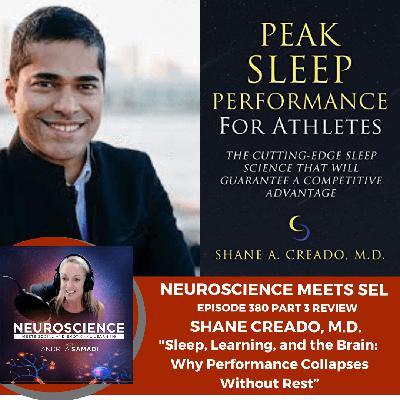
<p>This week, we move onto PART 3 of our review of EP 72<a href='#_edn1'>[i]</a> with Shane Creado, MD and his book <em>Peak Sleep Performance for Athletes recorded back in July of 2020. </em></p>
<p>✔ In PART 1<a href='#_edn2'>[ii]</a><em>, we covered:</em></p>
<p>How strategic napping, morning brain habits, and even the Silva Method all work together to reset your brain, boost performance, and transform your health from the inside out.</p>
<p>✔ In PART 2<a href='#_edn3'>[iii]</a> we continued with our review, diving a bit deeper into sleep deprivation and its impact of performance (whether you are an athlete, or just someone looking to improve productivity).</p>
<p>✔ PART 3, we will go a bit deeper into the impacts of concussions and brain injuries on our sleep and performance.</p>
<p>Let’s go back to 2020 and revisit what Dr. Creado had to say about sleep in this last episode of this season.</p>
<p> </p>
<p><a href='https://www.youtube.com/shorts/PN9zq64EMfs'>VIDEO 1 – Click Here to Watch</a></p>
<p> </p>
<p>In the first clip of this episode, with Dr. Creado, he dives into the connection with concussions and sleep. He says,</p>
<p>“Most people who have had a concussion end up with sleep problems. It makes a lot of sense when you think about the brain and how it regulates sleep and wakeful cycles and then it gets jarred. But what people don’t realize is that even a mild head injury can really damage your brain. Even if you’re not officially diagnosed with a concussion, you don’t have to lose consciousness to have a concussion. You don’t even need to have any symptoms to have your brain injured in some way. And then the little injuries along the way add up over time. So the brain is as soft as butter and in a hard, bony skull. Anything that jars it, even whiplash can cause your brain to be injured. And it accumulates over time. What’s interesting is that the same regions of the brain that are most damaged in head injuries are also damaged in sleep deprivation and also alcohol use. The frontal lobes, the temporal lobes and the parietal lobes at the top of the brain.”</p>
🧠 5 KEY TAKEAWAYS FROM DR. CREADO’S CLIP
<ol>
Concussions and sleep problems are tightly linked
Sleep disturbances are one of the <em>most common</em> long-term consequences of concussion—because the brain directly regulates sleep-wake cycles. My daughter had a concussion through her sports a few years ago, and I did ask her if she felt like the concussion affected her sleep afterwards, and her response was reassuring. While it did impact her sleep at the time, once her brain had healed, she went back to sleep as usual, showing that our brain can be injured, and heal, which shows its true resiliency.
You don’t need to lose consciousness to injure your brain
Mild head injuries, whiplash, or repeated small impacts can injure the brain—even without a formal concussion diagnosis or obvious symptoms. You do have to think back to any time where you think you had an incident where you brain was jarred, keeping in mind, that the consistency of our brain is like butter, in a hard skull, so any sort of jarring will likely have an impact.
Brain injuries are cumulative
Small, repeated “micro-injuries” add up over time, quietly impairing cognitive performance, emotional regulation, and recovery. You will know this once you have had one concussion, because doctors will always ask you “Is this your first concussion?” for this reason.
The brain is physically vulnerable
The brain’s soft tissue sits inside a rigid skull—any jarring motion can cause damage, even outside of contact sports. The first person I learned about Traumatic Brain Injuries (TBIs) was from Dr. Daniel Amen, who specializes in transforming mental and physical health with his work at Amen Clinics. His website is full of tips for brain health, including his Concussion Rescue Program<a href='#_edn4'>[iv]</a> that has helped NFL Players, Championship Boxers, and Thousands of Every Day People. His treatment is centered around his clinics that are in various locations in the USA, (Chicago, Dallas Fort Worth, Los Angeles Metro Area, Miami/Ft. Lauderdale, New York Metro Area, Orange County, a NEW clinic now in Phoenix/Scottsdale Metro, and San Francisco Bay Area. The treatment plans are targeted for each person’s situation, and include Hyberbaric Oxygen Therapy (HBOT), Neurofeedback, Hormone Evaluation and Replacement and Targeted Neutroceuticals.
Sleep deprivation damages the same brain regions as head injury
The frontal, temporal, and parietal lobes—critical for:
<ul>
Decision-making
Emotional regulation
Memory
Focus and awareness
</ul>
</ol>
<p>—are impaired by head injury, poor sleep, <em>and</em> alcohol use.</p>
<p></p>
<ol start="6">
Sleep is not passive—it’s protective and reparative
Quality sleep is one of the <em>primary tools</em> the brain uses to heal, detoxify, and restore neural function.
</ol>
<p>🔑 WHY THIS MATTERS (BEYOND ATHLETES)</p>
<p>Dr. Creado’s insight applies to:</p>
<ul>
Students with repeated minor head injuries impacting sleep loss
Educators & leaders under c


 Claim Ownership


 1
1




 United States
you are awesome 🥰🥰🥰
hello. thank you for this episode, but don't you think the "imagine and achieve" process is not one of the neuroscience related topics?