


 Claim Ownership
Next Steps Show
Subscribed: 4Played: 13
Subscribe

© Copyright 2022 The Next Steps Radio POSCAST Network. All rights reserved.
Description
This is a gathering forged to awaken conviction and stir resolve, where Faith, Politics, and Entrepreneurship converge as pillars shaping the destiny of We the People. We educate with purpose, challenge with clarity, and equip individuals to reclaim stewardship over their lives and communities. Through fearless truth and real solutions, we restore balance in belief, governance, and enterprise. This is more than conversation. It is a summons. Juntos, podemos restaurar el equilibrio y trazar el camino hacia un futuro próspero.
398 Episodes
Reverse
Monroe County GOP leadership: A movement does not survive on memory alone. It survives when truth returns, when leaders stop hiding behind titles, and when the people demand more than slogans. That is the burden hanging over Monroe County Republicans now. Not theory. Not nostalgia. Not talking-point theater. A real burden, made heavier by losses, distrust, and a public increasingly tired of political packaging sold as principle.
In this episode of The Next Step Show, Peter Vazquez takes listeners into the hard reality facing Monroe County Republicans after painful defeats, public frustration, and a crisis of trust that no amount of polished messaging can cover. The atmosphere is not triumphant. It is sober.
There is no illusion that a few better press releases or a handful of safe appearances will fix what has been broken. The conversation begins where honest rebuilding always begins: not with chest-thumping, but with exposure. Not with spin, but with reckoning.
That matters because parties often fail in a predictable way. They begin to confuse inherited language with living conviction. They repeat words like “values,” “service,” “community,” and “leadership,” but the words become ceremonial, hollowed out by habit. They are spoken often and proven rarely.
And when that happens, the people notice. They may not always articulate it in elegant terms, but they can smell the difference between conviction and choreography. The body politic is not always scholarly, but it is rarely blind. It knows when it is being managed instead of led.
This is why the discussion is not merely about campaign mechanics. It is about leadership under pressure. Not the cheap variety built on applause lines, donor smiles, and party titles, but the kind tested by scrutiny, accountability, and the willingness to answer hard questions in public.
Real leadership is not revealed when the room is friendly. It is revealed when the room is skeptical. It is revealed when the base is restless, when critics are circling, when past failures are still visible, and when every sentence spoken carries the weight of a wounded institution trying to prove it still deserves to exist.
Chairman Peter Elder steps into that fire, and that matters. It matters not because stepping into the arena makes a man automatically right, but because it shows a willingness to be measured.
In an era when many institutions prefer insulation to accountability, there is something valuable about being willing to stand before the public and be challenged. That is where the conversation becomes more than local politics. It becomes a test of whether leadership still understands what it owes the people.
And what does it owe them? Not perfection. Not mythology. Not invulnerability. It owes them honesty, steadiness, and labor. It owes them the discipline to admit what is broken and the courage to repair it without pretending the cracks are cosmetic.
A party does not rebuild by acting offended that people have questions. It does not rebuild by demanding loyalty on credit. It does not rebuild by insisting that the brand itself should be enough. It rebuilds when conviction becomes action, when truth outranks comfort, and when leaders earn trust instead of assuming they are entitled to it.
That distinction is the beating heart of the episode. Peter Vazquez does not approach the conversation as a ceremonial host offering flattery and warm towels. He presses on trust, on structure, on outreach, on turnout, on the disconnect between stated values and practical outcomes.
He raises the harder question that lurks behind every local political setback: what good is a platform if the public no longer believes the people carrying it have the discipline, coherence, or moral courage to embody it? That is the kind of question weaker men resent. Stronger men answer.
What emerges is bigger than one county or one election. It is a warning about the Vanbōōlzalness Crisis, that deeper civic rot that sets in when institutions ask for loyalty without honesty, when politics becomes performance, and when self-government is reduced to branding exercises for factions that have forgotten the purpose of power.
The crisis is not simply that people disagree. Disagreement is normal. In a free republic, disagreement is part of the machinery. The crisis begins when truth is treated like a nuisance, when accountability is treated like betrayal, and when leaders become more concerned with preserving the appearance of strength than with doing the difficult work that actual strength requires.
That is how decline hides in plain sight. It does not always come in the form of a dramatic collapse. Often it arrives dressed as maintenance. It looks like people going through motions, committees repeating rituals, slogans surviving after the substance has leaked out, and organizations asking to be trusted because of what they once were instead of what they are now. It is political dry rot. The paint still shines, but the beams are soft.
Monroe County GOP leadership sits right in that tension. On one side is the temptation of cosmetic repair: better optics, safer language, friendlier framing, and the old hope that memory alone will carry the movement another season.
On the other side is the harder road: tell the truth, acknowledge the damage, widen the reach, strengthen the structure, and engage communities and voters who have either drifted away or never believed they were invited in the first place. That second road is not glamorous. It is slow. It is bruising. It requires humility. It requires listening without surrendering principle. It requires leaders secure enough to welcome scrutiny and disciplined enough not to confuse criticism with sabotage.
This is where the idea of leadership becomes moral rather than merely operational. Leadership is not a brand. It is endurance. It is discipline. It is the moral obligation to stand firm when the ground is shifting. It is the refusal to let panic become policy or vanity become direction.
It is the capacity to absorb pressure without becoming dishonest. It is the strength to say, “Yes, we have failed in places. Yes, trust is thin. Yes, rebuilding will cost something. And yes, we are still responsible for doing it anyway.”
There is also a lesson here for the public, and it is not a comfortable one. Citizens often want renewal without participation. They want integrity without involvement. They want better leadership while remaining spectators to the decline around them. But self-government has never worked that way. A people cannot neglect the local machinery of civic life and then act surprised when institutions become brittle, distant, or captured by smaller and more organized factions. Nature hates a vacuum, and politics is no different. If good people withdraw, disciplined opportunists do not. They move in, rearrange the furniture, and then pretend the house always belonged to them.
So this episode becomes a challenge not only to party leadership, but to listeners themselves. Do not retreat into cynicism. Cynicism is often just disappointed pride wearing reading glasses. It sounds intelligent, but it builds nothing. And do not surrender to drift. Drift is how communities wake up one day to discover that the habits, structures, and standards that once sustained them have been replaced by improvisation and grievance. Rebuilding begins with truth, grows through trust, and survives only when leaders and citizens alike are willing to do the hard work.
That hard work is rarely cinematic. It looks like answering uncomfortable questions. It looks like strengthening weak structures. It looks like showing up where you have not shown up before. It looks like turning values into systems, systems into persuasion, and persuasion into votes, credibility, and durable community presence. It looks like refusing the lazy choice between purity without victory and victory without principle. It looks, frankly, like grown-up politics in a culture that often rewards theatrical adolescence.
And that may be the deepest current running through this discussion. A healthy political movement is not sustained by anger alone, even when anger is justified. It is sustained by ordered courage. By character. By a willingness to be accountable to truth before demanding allegiance from others. That is the antidote to the Vanbōōlzalness Crisis. Not noise. Not vanity. Not factional pageantry. Truth. Structure. Endurance. Leadership with spine.
That is why this episode matters. It is not simply about Monroe County Republicans trying to recover from a difficult season. It is about whether a movement can remember that leadership is not theater and politics is not just a contest of impressions. It is about whether honesty can still interrupt decline before decline becomes identity. It is about whether a broken map can still become a path forward.
Because in the end, memory is not enough. Heritage is not enough. Branding is not enough. What matters is whether leaders will stand in the light long enough to be measured, whether the people will demand substance over slogans, and whether both will accept the old and unfashionable truth that freedom requires character. That is the road back. Narrow, difficult, unglamorous, and absolutely necessary.
There is a moment before the microphone goes live when the room is quiet enough to hear your own thoughts.
You sit down. You glance at the monitor. Another stolen car. Teenagers in custody. The cycle repeats. Arrest. Release. Repeat. And then the bill arrives. Not just the one for groceries. Not just the mortgage. The insurance renewal. The premium that climbed again. Four thousand dollars a year. In some parts of New York, seven thousand. Nearly twice the national average.
When a system rewards exploitation, the honest are forced to finance the lie through their premiums, their taxes, their time, and eventually their trust. This conversation centers on a quiet crisis squeezing working families across New York: the soaring cost of auto insurance.
James Freedland, Spokesperson for Citizens for Affordable Rates, joins the discussion to unpack the structural breakdown behind the numbers. New York drivers face some of the highest premiums in the nation. Not because they drive worse. Not because they crash more. But because fraud, litigation abuse, and regulatory distortions have warped the system.
Staged crashes. “Crash for cash” schemes. Inflated medical claims. Orchestrated collisions where brakes are slammed intentionally in front of trucks. Shady clinics. Coordinated lawsuits. Massive payouts. And someone has to pay for that machinery. That someone is you.
Fraud is not abstract. It is baked into your monthly statement.
Governor Hochul has proposed reforms: stronger anti-fraud enforcement, clearer serious-injury thresholds, extended investigation windows, and limits on payouts for law-breaking drivers. Supporters argue it is a long-overdue effort to restore accountability. Critics question what is buried in the budget language.
Listeners call in with hard-earned realism. Financial literacy matters. Bundling policies can reduce costs. But why must citizens become full-time strategists just to afford legally required coverage? Why is basic mobility turning into a luxury tax on responsibility? And the questions deepen.
If fraud drives up premiums for millions, why has enforcement lagged? How much of your premium dollar goes toward honest risk coverage versus subsidizing exploitation? At what point does the cost of driving define economic mobility itself? This is not just about insurance. It is about accountability.
The discussion broadens into what we describe as the Vanbōōlzalness Crisis. A moment where metrics replace meaning, where leadership celebrates optics while middle-class resilience erodes.
Childcare costs averaging thirteen thousand dollars per year. Two point seven million public school students in New York now receiving free breakfast and lunch. Infrastructure funding flowing into local communities with promises of renewal. Electric school buses mandated by 2035. Voting laws contested. Trust strained.
From prison guard lawsuits to medical aid in dying legislation, from federal infrastructure windfalls to the electrification of school buses, the throughline remains the same: do institutions protect the people, or protect themselves?
Seventy percent of Americans believe the federal government is not fully transparent. Two-thirds believe the government is hiding information about UFOs. Trust in media is near historic lows. Skepticism has become default. Manipulation thrives when people stop paying attention. Freedom requires participation. Truth requires friction.
Historic leadership milestones are acknowledged — Governor Kathy Hochul as New York’s first woman governor, Adrienne Adams as New York City’s first Black Speaker — but representation alone does not guarantee results. Voters judge by outcomes, not headlines. The midterm elections revealed something important: when given direct say, citizens often chart a more moderate path than party leadership. Abortion rights protected even in conservative states. Voting access expanded. Slavery-era constitutional language removed. Minimum wages raised. Medicaid expanded.
Citizens are not asleep. But fatigue is real. Callers ask why they should continue to vote if promises dissolve. The answer offered is not naïve optimism. It is stubborn responsibility. Institutions are made of people. Systems change when friction is applied consistently.
Local sponsors remind listeners that reform is not abstract. Open Door Mission restores hope and changes lives. Cayuga Housing Council guides families toward stability. Youth for Christ provides sanctuary for teenagers navigating a culture that often shrugs at consequence.
Ninety percent of youth offenders are not hardened criminals. They are kids seeking structure. That matters. Auto insurance premiums are not just numbers. They are reflections of a moral architecture. When laws reward exploitation over responsibility, costs migrate to the honest. When accountability returns, dignity follows.
The microphone clicks off. But the questions linger. In a world that changes daily, what will you do next? Will you disengage, or apply friction? Will you finance the lie with silence, or demand reform grounded in truth? The cost of fraud is measurable.
The price of silence is generational.
Be a voice for liberty.
Be a steward of accountability.
Do not surrender participation to fatigue.
Because the system only corrects when the people refuse to look away.
Peter Vazquez walks the line between headline and heartbeat, tracing the Vanboolzalness Crisis where secrecy becomes policy and fear becomes currency. He begins in the sanctuary, where a Rhode Island report drags decades into the light and asks what happens when institutions protect the brand more than the soul. Lawrence Erickson, author of Vatican Coup, argues that abuse and cover-ups do more than shatter lives; they manufacture compromised leaders, the kind who can be pressured, coerced, and quietly redirected.
Then the lens swings to the street. From Chicago’s West Side, Honorable P. Rae Easley brings receipts and scars: blocks gutted after 2008, jobs shaved below full-time, a social-service economy that turns survival into obedience. She describes a machine that rewards silence, punishes dissent, and calls it “help,” until people forget what freedom feels like
Between church halls and city blocks, the pattern repeats: when truth is avoided, somebody else takes the wheel. The antidote is old-school and radical: confession, accountability, and courage that costs something.
A nation does not fall in a single crash. It erodes in silence. One edited headline at a time. One buried protest. One algorithmic nudge.
Truth is no longer merely debated. It is curated.
From the warning in Amos of a famine not of bread but of truth, to the modern reality of digital gatekeepers deciding what millions will see before they even take their first sip of coffee, the drift is undeniable.
Tom Olohan of MRC Free Speech America stepped into the fire and named it plainly. Apple News. Google News. MSN. Yahoo. Installed by default. Trusted by habit. Filtering by design.
Trust in media once stood at 76 percent. Today it sits at 28 percent. That is not a slump. That is a collapse of credibility.
Riots rebranded as peaceful. AI systems nudging voters while pretending neutrality. The March for Life, the largest human rights protest in the nation, disappearing from the feeds of the very citizens who carry the news in their pockets. This is not oversight. It is omission with consequences.
Section 230 shields power. Aggregators amplify narrative. Language reframes gun policy. Silence erases life issues. And the public is told this is objectivity.
Who defines truth now? The citizen. Or the code?
You can only be misled if you surrender discernment. Choose your media the way you choose your leaders. Carefully. Because when truth is filtered, liberty is rationed. And a rationed liberty is not liberty at all.
The conversation does not end here. It begins with vigilance.
Friday did not start with outrage. It started with Spanish, rock and roll, and the kind of laughter that reminds you America is still worth fighting for. Peter Vazquez opened the mic, Gary Stout joined the conversation, Bob Savage was at the table, and Bob D’Angelo held it all together in the control room, keeping the signal steady while the focus locked in: God, Country, Family is not a slogan. It is the order that keeps a free people from collapsing into managed chaos.
The discussion moved from “National Escape Day” and unrelenting stress to a culture that burns people out while calling it progress. Then came the harder truths: shutdown calls dressed up as solidarity, fear-driven compliance, and propaganda that turns small businesses into props. When people are pressured to perform instead of speak, truth becomes the first casualty.
From violent crime and family collapse to schools hijacked by so-called restorative excuses, the question stayed blunt: Who is school for, the disruptor or the kids who actually want to learn? No hedging. Structure matters. Discipline matters. Fathers matter.
The warning was unmistakable: faith diluted into a government-approved blend, borders treated like suggestions, and long-game influence operations betting that Americans stay distracted. With clarity and conviction, the line was drawn. A nation that forgets God, Country, Family will be sold a replacement story.
Take a breath. Then take a stand.
Albany is the perfect metaphor: polished power, dirty streets, and a political class that demands applause while families do the math in the dark. Peter Vazquez throws a hard rule on the table: “If you cannot explain what you believe without insulting people or hiding behind slogans, you do not understand it.” Then the show stops being theoretical.
Paul calls in at 72, living on Social Security, saying New York stripped Medicaid because he “makes too much.” No victim badge. Just grit: grow food, store food, hunt, fish, survive. That is not nostalgia. That is what people do when government “help” becomes a trapdoor.
Now put numbers to the ache. In 2022, 18.2% of adults reported recent anxiety symptoms and 21.4% reported recent depression symptoms. In 2023, 49,316 Americans died by suicide, including 27,300 firearm suicides. That is not a talking point. That is a body count.
So, when faith gets flattened into bumper-sticker unity, the hour refuses. Pastor Ken Todd draws the line between religion and relationship, adoption and servitude, and Septimus Scott steps in to argue for common ground without pretending truth has no edges. Romans 8:15 is the stake in the ground: family, not fear.
This is the Vanbōōlzalness Crisis: slogans as currency, nuance as a liability, and confusion sold as compassion. Listen sharp. Then speak up, because silence is how the rot wins.
Peter Vazquez got summoned to Albany, so the microphone passed to Dom Genova of the No Nonsense Roundtable, and the day turned into a reminder of what real community sounds like: imperfect, funny, human, and unexpectedly profound.
Dom does not “interview” people so much as sit with them, like two strangers at an airport bar, and ask the question that cracks open a life story: What did you want to be at ten years old? From Rochester broadcasters and music makers to the quiet builders of local culture, the thread is simple: everybody wants to be noticed, and the best leaders notice people on purpose.
A caller demanded commercial-free fairness, another spiraled into civil-war talk, and Dom answered with a hard truth about incentives and responsibility. Then the tone shifted when veteran Steve McAlpin called in, grateful for a platform that honored his service and helped push his long-delayed book toward the finish line. In between: Rochester music history, venues that still matter, and a sober nod to a world drowning in a 24/7 information flood.
Even the “car guy” wisdom landed like a civic lesson: know the Monroney label, watch for dealer gimmicks, and learn which problems are real and which are noise. Open Door Mission and Youth for Christ hover in the background as the quiet call to action: restore hope, invest locally, tell the stories that keep a city alive.
Snow fell hard in Rochester, the kind of cold that makes you respect gravity and good boots. With Peter Vazquez on assignment, Luis Martinez stepped into the studio and turned a January 27 broadcast into a warning bell, ringing in two languages and one clear message: the West is being tested, and truth is being rationed.
He dedicated the hour to Iranian American dissident Elica Le Bon, borrowing her framing of a “war on the West,” where legacy media does not merely miss stories, it curates reality. The target is not a party, but a civilization: reason over myth, the rule of law over rulers, individual dignity under God, and the free-market engine that built more prosperity than any planner ever did.
Luis traced the old fight from communist regimes to Islamist tyrannies, and then to the strange modern alliance of ideological extremes that thrive on grievance and confusion. He argued that propaganda works by inversion: the West is recast as the villain, and jihadists are polished into “oppressed freedom fighters,” while Iran’s brutality fades off the screen.
Then the phones lit up. A caller raised allegations about election integrity and machine vulnerabilities; Luis countered with on-the-ground concerns about New York’s registration safeguards, and the need for citizens to verify, document, and vote. Minneapolis surfaced as a symbol of institutional rot and online claims of deep corruption, alongside a reluctant truth: independent journalists now break what corporate media buries.
The station celebrated 150,000 podcast downloads. A reminder that people still want unfiltered reality. Offensive truth hurts. Comfortable lies rot. Choose wisely.
A city at a crossroads does not whisper. It argues. It grinds. It forces uncomfortable conversations at street level and kitchen tables alike.
This conversation crossed ideological lines without flinching. Peter Vazquez ‘sat across’ from Alex White, small business owner, Green Party activist, and former Rochester mayoral candidate, to do something rare in modern America: disagree honestly without dehumanizing.
Poverty, policing, housing, energy, transportation, public trust, Israel and Palestine, body cameras, minimum wage, cars versus communities, and the moral weight of policy decisions were all placed on the table, not as talking points, but as lived realities.
Listeners heard how decades of one-party control shaped Rochester’s outcomes, why good intentions still produce broken systems, and how ideology often collapses when confronted by math, incentives, and human nature.
From the cost of electricity to the limits of public housing, from crime driven by no consequences to compassion distorted into chaos, this was not a debate for applause lines. It was a test of whether adults can still talk.
Callers challenged assumptions. Scripture anchored values. Experience exposed gaps between theory and reality. No one walked away crowned a hero, but truth surfaced where slogans failed.
This episode is a reminder that a nation does not heal through silence or screaming, but through courageous dialogue grounded in accountability, humility, and a refusal to lie to ourselves.
If the country is going to find its footing again, these are the conversations that must happen.
In a city that keeps quoting Frederick Douglass while forgetting Frederick Douglass, Peter Vazquez turns up the truth and turns down the excuses. Lavelle Lewis, founder of the Black Republican Club of Rochester, walks in with receipts: the old black Republican tradition was not victimhood, it was ownership. Property. Family. Faith. Education as liberation. Self-government instead of supervised living.
They laugh, they spar, they name names, and then they land the punch: the modern machine runs on confusion. White progressive “leaders” write the diagnosis, black and brown bodies get used as the protest fuel, and the people who benefit most from division call it compassion. Meanwhile, the history that could free minds gets buried under slogans, statues, and selective memory.
Numbers do not lie, but they do expose. Poverty fell, family collapse rose. The culture says dependency is destiny, but the record says discipline built communities and faith anchored them. The question hanging in the studio is not partisan. It is personal: do you want to be managed, or do you want to be free?
Lavelle makes the invitation plain: join the work, learn the history, rebuild the foundation. Peter closes the way he always does, like a warning and a dare: be a leader, verify everything, and do not let your liberty become someone else’s talking point.
When a citizen asks, “Show me the books,” and the system answers with a smear, the republic is already sliding into a managed life. Peter Vazquez sits with Marly Hornik educator, strategist, and champion of individual liberty, and with Gary Stout in studio, to pull election reform out of slogans and into receipts: voter rolls, statutory compliance, chain of custody, and the black box that turns public trust into blind faith.
Marly, an inspiration to thousands of volunteers working to improve and reform our elections, lays out why accountability so often requires courts, why New York’s own records matter, and why transparency is treated as a threat. Then the stakes widen: a federal lawsuit challenging retaliation by state power, and the warning that elections do not need to be hacked to be controlled, they only need to become unauditable. Preserve the record, get punished. Demand oversight, get branded. This is the oldest American argument: do officials answer to the people, or do the people answer to the system.
A nation celebrates “choice” while the numbers climb, and the fight shifts from courtrooms to mailboxes. Peter Vazquez sits with Kelsey Pritchard, Communications Director for Susan B. Anthony Pro Life America, to trace the post Dobbs terrain: abortion drugs, telehealth shields, and a culture bold enough to call babies “excess births.”
Then a tremor hits the coalition, President Trump says Hyde needs “flexibility.” Hyde was the conscience line, the firewall that kept taxpayers from funding elective abortions. When leaders soften moral boundaries to cut deals, trust fractures, narratives rush in, and the Vanbōōlzalness Crisis grows teeth. Prayer, action, and support for women become the next steps.
Headlines scream war, but Pastor Mark Biltz (El Shaddai Ministries) walks the map beneath the noise: Israel at the center, Persia shaking, and church gatekeepers in Jerusalem trying to claim authority while condemning Christian Zionism.
Words like genocide and “moral urgency” are treated as loaded weapons when they outrun truth and accountability. Prophecy here is not panic, it is clarity: watchfulness means knowing God’s times and seasons, resisting sensationalism, and choosing astronomy about God over astrology about self.
The lens widens to cultural decay, collapsing literacy, Iran’s unrest and mosque closures, Greenland’s mineral chessboard and China’s reach, and UNRWA as “aid” without scrutiny. The charge is simple: watch with wisdom, not fear, and refuse the Vanbōōlzalness Crisis.
A hard reckoning echoes through this conversation on Dr. Martin Luther King Jr., culture, and consequence. Emery McClendon, Rev. David Lowery Jr., Michael Austin, and Bishop Garland R. Hunt confront how a moral movement became a political industry, how faith was traded for grievance, and how responsibility was replaced by dependency. This is not nostalgia. It is a warning, a call to rebuild family, character, and courage before the dream becomes only a slogan.
Religious Freedom is on the calendar, but the culture is clawing it back in real time. Peter Vazquez and Abe Hernandez trace two parallel journeys: a nation drifting as faith is pushed from schools and screens disciple children into numbness, and Abe’s own rise from 400 pounds to purpose. Faith on Film TV emerges as a counterstrike, reclaiming storytelling before algorithms finish what empty pews started.
Power no longer kicks down doors. It kneels in prayer, smiles with compassion, and asks you to surrender judgment for comfort. Peter Vazquez dissects New York’s State of the State, exposing how faith language, fear, and collectivism are fused to sell control, soften limits, and recast government as savior. When liberty is reframed as selfish and obedience as love, the cost is paid by families, faith, and freedom.
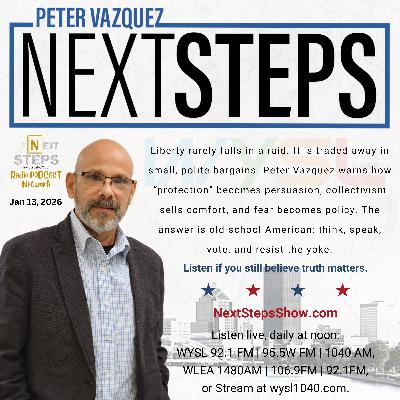
Liberty is not stolen in one raid, it is traded away in small, polite bargains. Peter Vazquez warns how “protection” becomes persuasion, how collectivism sells comfort and bills you later. Callers sharpen the fight: media, broken elections, and fear as policy. The cure is old-school American: think, speak, vote, and refuse the yoke.
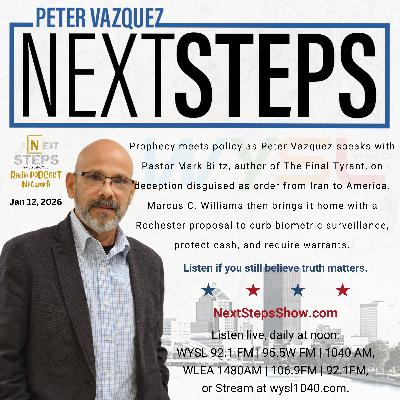
Prophecy meets policy as Peter Vazquez sits down with Pastor Mark Biltz, author of The Final Tyrant, tracing how deception wears the mask of order from Iran to America. Then Marcus C. Williams brings the fight home with a bold Rochester proposal to curb biometric surveillance, protect cash, and require warrants for data collection. Security without liberty is a velvet cage.
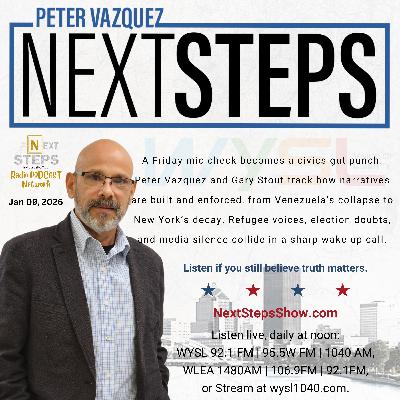
A Friday mic check turns into a civics gut punch. Peter Vazquez and Gary Stout trace how narratives are built, sold, and enforced, from Venezuela’s collapse to New York’s decay. Refugee voices cut through the comfortable lies, while talk turns to elections, media blackout, and the cost of leaderless politics. Not a rant, a wake up call with receipts.
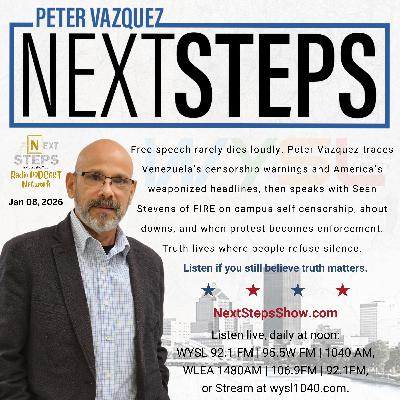
Free speech rarely dies with a bang. It gets managed, softened, and labeled “safety” until dissent becomes hazardous. Peter Vazquez presses the fault lines from Venezuela’s censored past to America’s weaponized headlines, then sits down with Sean Stevens of FIRE to map campus self censorship, shout downs, and the moment protest turns into enforcement. Truth survives only where people refuse to be trained silent.

Comments

Download from Google Play

Download from App Store
 United States