


OlympusTalks
Subscribed: 0Played: 4
Subscribe

© 2025
Description
Welcome to OlympusTalks, the podcast that brings you to the forefront of medical technologies as we explore advancements and innovations in gastrointestinal. This 8-episode series features talks with healthcare professionals, patients, and Olympus subject matter experts. Listen as they dive into various aspects of GI health focused on improving patient outcomes through best practices. Stay tuned for conversations designed to educate, inspire, and inform.
Thank you for listening to the OlympusTalks video podcast, powered by DeviceTalks.
To subscribe to this show on your favorite podcast player, please click: https://olympustalks.castos.com/subscribe
Thank you for listening to the OlympusTalks video podcast, powered by DeviceTalks.
To subscribe to this show on your favorite podcast player, please click: https://olympustalks.castos.com/subscribe
9 Episodes
Reverse

In this episode of OlympusTalks, host Tom Salemi is joined by Dr. Davinderbir Pannu, a gastroenterologist practicing at McLeod Health in South Carolina, and Amanda Call, Clinical Education Specialist at Olympus, for a conversation on how endoscopic imaging advancements support clinical decision-making during screening and therapeutic procedures. Together, they discuss real-world experiences using the EVIS X1™ endoscopy system and Extended Depth of Field (EDOF™) technology, with a focus on visualization, clinical efficiencies, and procedural confidence in both routine and advanced GI cases.
Chapter 1: Meet the Guests
Dr. Davinderbir Pannu discusses his career path into gastroenterology and advanced endoscopic procedures, including his current clinical practice.
Amanda Call shares her background as a registered nurse and her transition into clinical endoscopy support at Olympus.
Chapter 2: Clinical Challenges in GI Endoscopy
The importance of visualization in screening colonoscopy and advanced therapeutic procedures.
Common challenges related to movement, anatomy, and image clarity during endoscopic exams.
Chapter 3: Imaging Technologies in Practice
Overview of the EVIS X1™ endoscopy system, including TXI™ and RDI™ technologies.
How EDOF technology supports visualization during procedures.
Chapter 4: Supporting Screening and Therapeutic Procedures
Detecting flat and serrated polyps during screening exams.
Using imaging enhancements during procedures such as EMR, ESD, and third-space endoscopy.
Visualization considerations in inflammatory bowel disease and other GI conditions.
Chapter 5: Workflow, Ergonomics, and the Support Team
Ergonomic design considerations, including scope weight and button access.
Communicating scope and equipment needs across the endoscopy team to support efficient workflows.
For more episodes by OlympusTalks, please visit olympusamerica.com/podcasts. * This podcast has been paid for by Olympus Corporation of the Americas. The views and experiences shared are those of Dr. Davinderbir Pannu, a paid consultant of Olympus Corporation and its affiliates. Olympus makes no representations regarding the accuracy or applicability of the content and disclaims all liability arising from its use. Product performance may vary, and techniques, instruments, and clinical decisions are unique to each facility and practitioner. Always refer to the Instructions for Use (IFU) and applicable labeling for guidance, risks, and cautions.
ADDITIONAL RESOURCES: Bring more into focus. Discover EDOF technology and how it may support your clinical practice: https://info.olympusamericamarketing.com/edof-technology
Chapters
(00:00:00) - Meet the Guests(00:09:03) - Clinical Challenges in GI Endoscopy(00:16:04) - Imaging Technologies in Practice(00:20:05) - Supporting Screening and Therapeutic Procedures(00:21:11) - Workflow, Ergonomics, and the Support Team
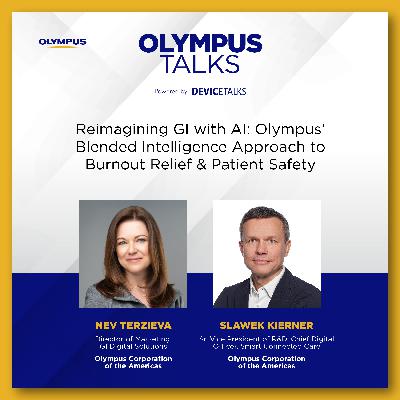
Artificial Intelligence is transforming healthcare—and Olympus is at the forefront. In this episode, Chief Digital Officer Slawek Kierner and Director of Marketing, GI Digital Solutions Neviana Terzieva share their journeys into medtech and discuss how Olympus is integrating AI into endoscopy, clinical decision-making, and workflow optimization.
Chapter 1: Meet the Guests
Slawek Kierner and Neviana Terzieva discuss their backgrounds in software, healthcare, and digital innovation, and what drew them to Olympus.
Chapter 2: Defining AI in MedTech
What does “AI” really mean for medical devices?
How AI supports the quintuple aim: better outcomes, lower costs, improved experiences, increased access, and reduced burnout.
Chapter 3: Blended Intelligence & Burnout
The concept of “blended intelligence”-- AI as a complement to human expertise.
Chapter 4: Olympus® Technologies in Action
Spotlight on EDOF™ scopes, CADDIE™ polyp detection software, and the OLYSENSE™ platform.
Real-world examples of AI enhancing clarity, precision, and detection rates in GI procedures.
Chapter 5: Clinical Impact & Physician Reception
How AI augments, not replaces, clinical decision-making.
Physician perspectives on adopting new technology and maintaining high standards of care.
Chapter 6: The Future of AI at Olympus
Vision for saving lives, supporting detection rates, and empowering healthcare teams.
For more episodes by OlympusTalks, please visit olympusamerica.com/podcasts.
This podcast has been paid for by Olympus Corporation of the Americas.
ADDITIONAL RESOURCES:
Meet OLYSENSE™ -- Olympus’ intelligent endoscopy platform powered by AI: https://medical.olympusamerica.com/olysense
See how ambulatory endoscopy centers (AECs) are reshaping GI care—combining independent physicians’ personal investment with “nimble” innovation and improved patient access.
In this episode, Olympus’ Director of Strategic Marketing for GI Diane Locher, joins Dr. Nalini Guda of GI Associates and Dr. Neil Parikh of CTGI & GI Alliance to discuss the unique challenges and opportunities of AECs. Learn how these centers streamline procedures, foster team-based care, and rapidly adopt new technologies, all while tackling access deserts and supporting physician well-being.
Chapter 1: Meet the Guests
Diane Locher shares her journey to Olympus and her focus on supporting AECs.
Dr. Nalini Guda and Dr. Neil Parikh introduce their backgrounds, independent practice models, and what drew them to GI.
Chapter 2: Defining AECs
What sets AECs apart from traditional ASCs and hospitals?
How “skin in the game” or independence drives efficiency, ownership, and patient-centered care.
The importance of nimbleness and adaptability in adopting new technologies.
Chapter 3: Access, Innovation, and Teamwork
Tackling “colonoscopy deserts” and improving patient access.
The team approach: physicians, nurses, anesthesiologists, and staff working toward a single goal.
How AECs serve as “innovation playgrounds” for piloting new GI technologies.
Chapter 4: Burnout, Well-being, and Technology
Physician burnout and how independent models help mitigate it.
The role of ambient listening and AI-powered documentation in streamlining workflow.
Training, onboarding, and staff support as critical components of AEC success.
Chapter 5: The Future of GI in AECs
Expanding the menu of procedures: from colorectal screening to endobariatrics and pancreaticobiliary care.
The evolving partnership between industry, physicians, and healthcare systems.
Advocacy and support to enable broader access.
For more episodes by OlympusTalks, please visit olympusamerica.com/podcasts. This podcast has been paid for by Olympus Corporation of the Americas. The views and experiences shared are those of Dr. Nalini Guda and Dr. Neil Parikh, paid consultants of Olympus Corporation and its affiliates. Olympus makes no representations regarding the accuracy or applicability of the content and disclaims all liability arising from its use. Product performance may vary, and techniques, instruments, and clinical decisions are unique to each facility and practitioner. Always refer to the Instructions for Use (IFU) and applicable labeling for guidance, risks, and cautions.
ADDITIONAL RESOURCES: Take your AEC to the next level—partner with Olympus. Visit our site for training, resources, and portfolio solutions tailored to your needs. Visit, Ambulatory Surg...
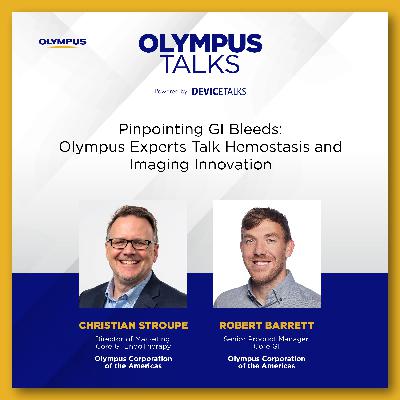
When a GI bleed strikes, the atmosphere in the procedure room changes instantly. In this episode of OlympusTalks, Olympus’ Christian Stroupe and Robert Barrett share how Olympus® technologies are designed to help physicians regain visibility and respond quickly to find the bleed and achieve hemostasis.
Chapter 1: Meet the Guests
Olympus’ Christian Stroupe and Robert Barrett explain their paths to medtech industry and their current roles in GI
Chapter 2: Why GI Bleeding Matters
The prevalence of GI bleeds and their impact on patient outcomes
Why it’s one of the top reasons for endoscopy
Chapter 3: The Moment Everything Changes
“You just see red everywhere” – how visibility is lost and urgency takes over
What it feels like when the room shifts from routine to critical
Chapter 4: Finding the Bleed
The challenge of pinpointing the source of the GI bleed
How advanced imaging helps physicians locate and assess the bleed
Chapter 5: Tools for Hemostasis
Overview of Olympus’ therapeutic options: clips, powders, and thermal forceps
Matching the right tool to the type of bleed
Chapter 6: Reducing Repeat Patient Visits
How effective hemostasis prevents rebleeds and follow-up procedures
Supporting physicians in getting it right the first time
Chapter 7: Hospital VS. ASC Settings
Difference in procedure complexity and patient profiles
Why even “routine” cases can present bleeding risks
For more episodes by OlympusTalks, please visit olympusamerica.com/podcasts.
This podcast has been paid for by Olympus Corporation of the Americas.
ADDITIONAL RESOURCES:
Discover how the EVIS X1™ Endoscopy System is elevating the standard of care and the role of RDI™ technology: https://medical.olympusamerica.com/technology/rdi
Learn how EndoClot™ PHS, an advanced powder hemostat, supports physicians achieve hemostasis: https://medical.olympusamerica.com/products/endoclotphs
Explore the Retentia™ HemoClip for reliable clipping and effective hemostasis during GI procedures: https://medical.olympusamerica.com/products/retentia-hemoclip
***
Enjoy this podcast? Follow OlympusTalks on all major podcast players: https://olympustalks.castos.com/subscribe + Follow us on Yo...
Chapters
(00:01:18) - Meet the Guests(00:07:27) - Why GI Bleeding Matters(00:10:28) - Finding the Bleed(00:14:27) - The Moment Everything Changes(00:20:17) - Tools for Hemostasis(00:21:22) - Reducing Repeat Patient Visits(00:24:03) - Hospital VS. ASC Settings

Infection preventionists are often the unsung heroes of patient safety—working behind the scenes to ensure that every procedure is as safe as possible. In this OlympusTalks episode, Jamie McGloin, Infection Prevention & Control Specialist at Olympus, and IPC consultant, Linda Dickey, bring their deep experience and unique perspectives to the forefront, offering a compelling look at the evolving role of IPs in GI endoscopy.
The episode explores practical aspects of medical device reprocessing, the importance of early collaboration between healthcare providers and manufacturers, and opportunities to improve consistency across the industry. From interpreting detailed IFUs to enhancing reprocessing workflows, Jamie and Linda highlight how infection preventionists are uniquely positioned to support safe and efficient patient care. Listen now to learn how infection prevention is not just a background process—but a frontline defense in modern healthcare.
For more episodes by OlympusTalks, please visit olympusamerica.com/podcasts.
* This podcast has been paid for by Olympus Corporation of the Americas. The views and experiences shared are those of Dr. Linda Dickey, a paid consultant of Olympus Corporation and its affiliates. Olympus makes no representations regarding the accuracy or applicability of the content and disclaims all liability arising from its use. Product performance may vary, and techniques, instruments, and clinical decisions are unique to each facility and practitioner. Always refer to the Instructions for Use and applicable labeling for guidance, risks, and cautions.
ADDITIONAL RESOURCES:
See how we can focus on infection prevention, together. Visit this page for additional resources, services, and tools to help support infection prevention at your facility: https://infectionprevention.olympus.com/en-us/
For infection preventionists looking to deepen their understanding of endoscope reprocessing, APIC’s resource offers evidence-based guidance and practical tools tailored to your role: https://apic.org/the-science-behind-endoscope-reprocessing/
***
Enjoy this podcast? Follow OlympusTalks on all major podcast players: https://olympustalks.castos.com/subscribe + Follow us on YouTube.com/@DeviceTalks to ensure you never miss an episode.
Want access to the complete DeviceTalks Podcast Network (DTPN)? Follow us today at https://devicetalks.castos.com/subscribe

Comments

Download from Google Play

Download from App Store
 United States