


 Claim Ownership
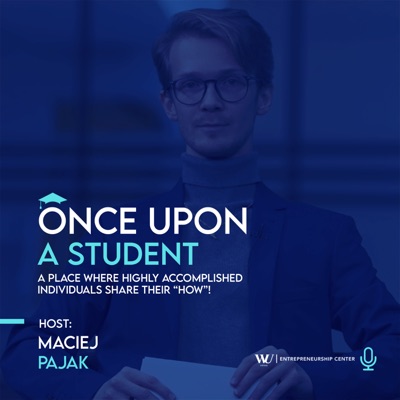
Once upon a Student
Subscribed: 0Played: 0
Subscribe

© Once upon a student
Description
This is a place where highly accomplished individuals show their "how". One aspect the guests have in common - their commitment to lifelong learning, extending well beyond their university years.
20 Episodes
Reverse

Finding an apartment should be simple. Yet for many people, it has become a frustrating process of endless searches, unanswered inquiries, and competition for the same few properties.But what if the problem isn't just the housing market itself, but the platforms we rely on to navigate it?Philipp Attensam co-founded Lystio to challenge how people search for homes. Since launching in March 2025, the company has grown to more than 90,000 property listings and over 1,600 real estate agents.Along the way, Philipp and his team discovered how established real estate platforms actually operate, why certain properties receive more visibility than others, and how difficult it can be to challenge an industry built around legacy business models.But the more interesting question may be whether better technology can actually make finding a home fairer, or whether it simply makes an already competitive market move faster.In this episode, we cover:• Why apartment hunting remains frustrating despite decades of technological progress• How real estate platform business models dictate which properties you see first• Why brokers pay for visibility and what that means for apartment seekers• How AI could move beyond traditional filters to understand what people actually want in a home• Whether algorithms can make housing searches fairer when hundreds compete for the same flat• What happened when Lystio challenged established competitors and faced legal threats• How Philipp built a platform with 90,000+ listings in just 18 months without coding skills• What building in a competitive industry teaches you about ambition, resilience, and personal sacrificeFrom the hidden economics of property rankings to the limits of technological innovation, this conversation explores who really shapes your apartment search—and whether the future of finding a home can genuinely be different.Follow & Connect:• Philipp Attensam: https://www.linkedin.com/in/philipp-attensam-ba1b342b6/• Lystio: https://lystio.at/• Once Upon a Student: https://www.instagram.com/once.uponastudent/• WU Gründungszentrum: https://www.instagram.com/wu_entrepreneurshipcenter/• Maciej Pajak (Host): https://www.instagram.com/paccmac/Chapters:(00:00) Intro(03:12) From zero to 90,000 property listings(05:15) Convincing a major broker before launching(08:02) The frustrating apartment search that started Lystio(11:45) Building a startup with friends(15:42) Why established platforms struggle to innovate(17:14) Can AI understand what we really want in a home?(19:41) The hidden economics of real estate platforms(23:28) Why finding an apartment has become a race(27:03) Can technology actually fix the housing market?(28:48) The challenges of building a two-sided marketplace(32:01) When established competitors threaten legal action(38:53) Fundraising, ambition, and European expansion(43:53) Building a company without planning an exit(44:41) The personal cost of entrepreneurship(49:27) Rapid fire – housing, co-founders & ambitionIf you enjoyed this episode, please leave us a rating and follow the show on Spotify so you never miss an interview!

What changes when you build a company for the second time?Karl Edlbauer started what would later become hokify while still studying at WU. Together with his co-founders, he tested the first ideas on campus, grew the company to almost 100 people and millions of job seekers, and eventually exited at a reported valuation of around €40 million. Then, the same three founders decided to start again.In this episode of Once Upon a Student, Karl reflects on what experience really changes — and what it doesn’t. We talk about why he would raise less money today, why they abandoned a product that was already generating revenue, why hokify was sold even though an exit had never been the original plan, and how three friends managed to remain a founding team through almost a decade of company building. Today, Karl is building ONE100, entering healthcare with more experience, a stronger network and a track record, but also with different responsibilities and a very different understanding of what it takes to build a company. The second time is different. But is it actually easier?

Before you raise money, you should understand what venture capital really means.In this special crossover episode of Once Upon a Student x Entrepreneurs Talk, we explore what every founder should know before entering the fundraising journey: when VC makes sense, when it might not be the right path, what investors actually look for, and how founders can navigate the emotional reality behind raising capital.Together with Magdalena Möslinger-Gehmayr from PUSH VC, Hannah Wundsam from AustrianStartups, and Michael Hofmannrichter, CEO & Co-Founder of silana, we discuss venture capital from three different angles: the investor perspective, the ecosystem perspective, and the founder perspective.We talk about:• Why venture capital is not the right path for every startup• What early-stage investors look for in founders• Why the founding team often matters more than the idea• How fundraising momentum can change everything• What students and first-time founders often misunderstand about raising money• Why execution, timing, and obsession matter more than having the “perfect” ideaThis episode is for students, aspiring entrepreneurs, and early-stage founders who want to better understand the reality behind venture capital before they start raising money.

Every student wants better grades. Almost none of them are taught how to actually get them.Lennard Klein went from struggling student to perfect GPA using a system built entirely on neuroscience and peer-reviewed research. Not motivation, not grinding, not luck. In this episode of Once Upon a Student, he shares the exact framework he now teaches to students across Europe through his company Brain Boost.What you'll learn in this episode:· How to study for exams without burning out· Why passive studying (re-reading, highlighting, summaries) has zero scientific backing· The ideal study session length for maximum concentration and retention· How to go from bad grades to top of your class· Lennard's student did it in one semester· The mindset shift that separates students who improve from those who stay stuckThis episode is for students who are tired of working hard with nothing to show for it, parents looking for proven learning strategies for their kids, and anyone who wants to understand how the brain actually processes and retains information.The science exists. It's been there for 200 years. Now you know where to find it.🎙️ Once Upon a Student | Guest: Lennard Klein, Founder of Brain Boost

In this episode of Once Upon a Student, we sit down with Rosa Bergmann — social entrepreneur, former teacher, founder of Hobby Lobby, Teach For Austria alumna, and nominee for Austrian of the Year.Rosa has seen inequality where most people stop looking. Not just inside classrooms, but long before and long after them. She argues that the biggest educational gaps are often inherited, shaped by family background, language, money, attention, environment, and everything that happens once the school bell rings.What started as frustration in a Viennese middle school turned into a mission. After meeting children who dreaded weekends and holidays because school was the only stable place in their lives, Rosa realized how much opportunity depends on what families can afford outside the classroom.That insight became the foundation for Hobby Lobby — an organization that now reaches thousands of children and gives them access to experiences, creativity, mentorship, and support they otherwise might never get.But this conversation also breaks another illusion: that NGOs are somehow less serious than “real businesses.” Rosa explains why social impact cannot be built on good intentions alone. If you want to change lives at scale, you need to build with the same discipline, structure, and professionalism as any high-performing company.Today, she leads a growing organization with a multi-million-euro budget, a large team, and a model designed for long-term impact.This conversation goes far beyond education policy. We talk about inherited inequality, the hidden power of after-school life, the impossible pressure placed on teachers, why schools still look like they belong in 1950, what it means to build a serious impact organization, and why the world’s biggest problems are too often treated like side projects.If you are a student, founder, future leader, or someone who wants to build something that truly matters, this episode will challenge the way you think about fairness, responsibility, and what real impact actually requires.Timestamps00:00 Preview01:52 Introduction02:26 Where inequality really begins05:17 Why school alone cannot fix it09:41 Privilege, family, and the hidden head start15:36 The moment that changed everything21:28 What inequality does to a child’s self-worth27:31 How Hobby Lobby was built35:53 From social project to scalable organization38:26 Pressure, therapy, and leadership42:11 Why NGOs should be treated like real companies45:53 What building this organization actually cost53:16 What society keeps getting wrong58:27 Rapid Fire59:36 Rosa turns the question around01:02:19 Closing

Comments

Download from Google Play

Download from App Store
 United States