


 Claim Ownership
Operate Podcast
Subscribed: 8Played: 96
Subscribe

© Copyright 2025 All rights reserved.
Description
A behind-the-scenes look at company building from the perspective of builders themselves - this is how we operate! With host Carey Ransom.
166 Episodes
Reverse
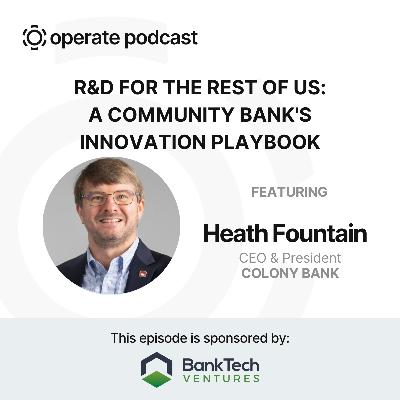
In this new format "brief" episode of the Operate Podcast, I caught up with Heath Fountain, CEO of Colony Bank, the largest community bank in Georgia with locations spanning Georgia, Alabama, and the Florida Panhandle. We explored how community banks can approach innovation strategically without overextending their resources. Heath shared the practical thinking behind his bank's decision to get involved in collaborative innovation efforts such at BankTech Ventures and how that choice has paid dividends in unexpected ways.
Our conversation centers on a fundamental challenge facing community banks today: the technology landscape is evolving rapidly, but most institutions lack the internal resources to evaluate every emerging solution on their own. Heath described how his team framed their innovation investment as research and development expense, a mental model that helped his board understand the value of staying connected to the broader fintech ecosystem. Rather than trying to be on the bleeding edge, Colony Bank has found success positioning themselves just behind the leading edge, keeping pace with change without taking on unnecessary risk.
Heath offered candid insights into the tangible outcomes of this approach, including how networking with other technology-forward bankers led to hiring their Chief Innovation Officer, someone they would have never encountered otherwise. We discussed how having access to vetted portfolio companies has streamlined vendor evaluation, helping the bank discover solutions they didn't even know they needed. The conversation also touched on Heath's advice for peers trying to make the case to their own boards, including the simple math of spreading investment over time and comparing it to the cost of consultants or dedicated hires.
Throughout our discussion, Heath emphasized that the goal isn't to chase every trend, but to have the knowledge and relationships in place to make informed decisions when opportunities arise.
LINKS
Colony Bank (https://www.colony.bank )
Heath Fountain on LinkedIn (https://www.linkedin.com/in/heathfountain/ )
Bank Tech Ventures (https://www.banktechventures.com/ )
Chapter Markers
00:00 Preview
00:29 Intro
00:45 Sponsor
01:19 Why Community Banks Need Outside Innovation Partners
02:53 Finding a Chief Innovation Officer Through Networking
03:20 Getting Practical Value from Portfolio Companies
04:16 Making the Case to Your Board
05:15 Thinking About It as R&D Expense
06:27 Staying Just Behind the Leading Edge
06:53 Outro
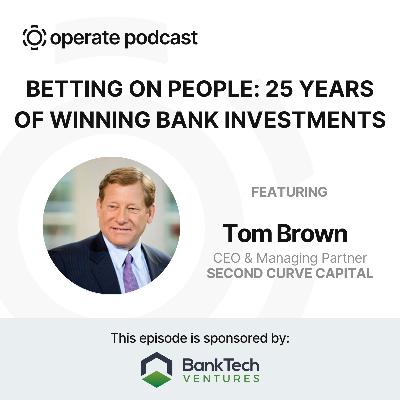
In this episode of the Operate Podcast, we dive deep into the world of banking investment strategy with Tom Brown, CEO and founder of Second Curve Capital. Tom brings an incredible 40-plus year perspective on the banking industry, starting as a top-rated Wall Street analyst before founding his equity investment firm exclusively focused on financial services about 25 years ago.
What makes Tom's approach truly unique is his commitment to understanding banks at the execution level, not just through financial statements and management presentations. We explore how early in his career he realized that bank executives often believed they were implementing cutting-edge strategies, but the reality on the front lines told a different story. This led him to develop his now-famous practice of visiting bank branches, applying for credit cards, and even showing up unannounced on a teller floor to test whether what management said matched what actually happened there.
Our conversation covers the evolving competitive landscape facing community and regional banks, particularly the threat from neobanks like Chime that are profitably serving market segments traditional banks have struggled with. Tom shares his perspective on why the relationship banking model still matters for banks under $10B in assets, but emphasizes that success requires increasingly sophisticated use of data, technology, and marketing. We discuss why many publicly-traded banks have become too risk-averse, how bringing executives from larger institutions to smaller banks can create tremendous value, and why JP Morgan Chase's Jamie Dimon religiously reads Tom's banking newsletter to understand what his bank cannot do.
Tom offers candid insights on where banks are over-investing and under-investing, from data lake projects that are becoming obsolete thanks to AI, to marketing budgets that remain stuck at 2% of expenses when they should be climbing higher. We explore the talent challenge facing community banks and how they can better attract digital-native young professionals by emphasizing the unique opportunity to work with diverse data and businesses. Throughout the conversation, Tom's philosophy remains clear: as an investor, he is ultimately making bets on people, and the ability to evaluate execution separates winning investments from losing ones.
Chapter Markers:
00:00 Preview
00:37 Intro
00:53 Sponsor
01:28 Tom Brown's Journey from Analyst to Fund Manager
06:19 The Turning Point: Going to the Branch Floor
07:43 The Customer Profitability Story
09:16 The Challenge of Executive Branch Visits
11:43 Investment Framework: Screening with Metrics, Deciding on People
13:14 The Power of Turnaround Executives
13:57 Bringing Big Bank Experience to Smaller Banks
16:45 50 Years of Change, Same Solutions
18:38 The Relationship Game and Geographic Focus
18:50 Jamie Dimon's Perspective on Community Banks
21:09 Finding Your Customer Segment Focus
22:37 The Line of Business vs. Relationship Approach
25:36 Technology Decision-Making Challenges
27:36 The Biggest Blind Spot: Risk Aversion
30:56 CEO as Chief Technology Officer
32:26 The Marketing Investment Gap
33:05 Capital One's Marketing Budget: 20%
36:27 Branch Strategy Done Right: Fifth Third's Approach
39:03 The Data Management Evolution
40:52 Attracting Digital Native Talent
44:52 The Death of New Bank Charters
46:09 The Neobank Threat: Chime as the Nucor of Banking
48:40 Outro
Resources:
Second Curve Capital (https://www.secondcurve.com)
Tom Brown's Banking Weekly Newsletter (https://www.secondcurve.com/Tom-Brown-Banking-Weekly)
Sponsor: Bank Tech Ventures (https://www.banktechventures.com/)
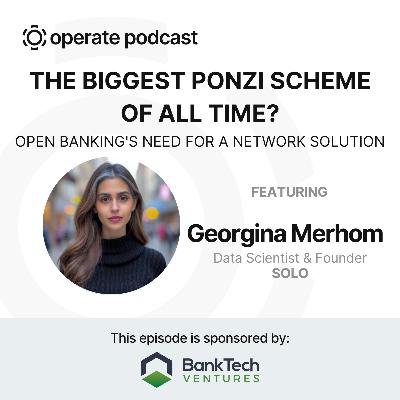
I'm so grateful that Georgina joined me for a conversation to explore the future of financial data infrastructure. As the founder and CEO of SOLO, she brings a unique outsider perspective to financial services, having started her career as a data scientist in cybersecurity before founding Egypt's first cross-border payments app, Ziv Me, which she later sold to the National Bank of Egypt.
We dove deep into the fundamental problems with today's financial data systems, where customers must constantly reintroduce themselves to every institution despite having established trust records elsewhere. Georgina explained how the current infrastructure was built to scale transactions rather than relationships, creating $30 billion in annual data collection costs for banks and frustrating reset experiences for consumers.
Georgina revealed the shocking reality behind credit bureaus, describing them as "the biggest Ponzi scheme of all time" where banks pay for data they already had and provided. She contrasted this with SOLO's vision of a customer data clearing house that would make trust portable across financial institutions while maintaining proper regulatory compliance as an FCRA-regulated entity.
We explored the concept of data as representing relationships rather than just transactions, and how SOLO's network model could transform the $50 billion annual spend on data collection and aggregation into a collaborative system where banks are incentivized to help customers rather than hoard their information. Georgina also shared candid insights about entrepreneurship, including the importance of founder-market fit and learning when to listen to "no" as market feedback rather than obstacle to overcome.
I hope this conversation offers a compelling vision for how financial services could work better for everyone - banks, fintechs, and consumers alike - through smarter data architecture and aligned incentives.
RESOURCES:
Learn more about Solo: https://solo.one
Connect with Georgina Merhom on LinkedIn: https://www.linkedin.com/in/georginamerhom
Thanks to show sponsor, BankTech Ventures: https://www.banktechventures.com
Chapter Markers
00:00 Preview
00:37 Intro
00:53 Sponsor
01:26 Introducing Georgina Merhom and SOLO
04:45 Challenges in Traditional Banking Data Systems
08:38 SOLO's Innovative Approach to Data Collection
09:49 Use Cases and Benefits of SOLO
13:45 Regulatory Challenges and Responsibilities
17:56 The Future of Open Banking and Data Sharing
26:45 The SOLO Network Model
35:57 Georgina's Entrepreneurial Journey
43:19 Advice for Aspiring Entrepreneurs
47:47 Final Thoughts
48:12 Outro

In this episode of the Operate Podcast, we took a deep dive into the world of community banking with John Maxfield, the mind behind Maxfield on Banks. We explored the critical role community banks play in local economies and the unique challenges and opportunities they face. John discussed his journey from studying various subjects like high-altitude mountaineering and maritime disasters to his in-depth 20-year exploration of the banking sector, driven by a long family history of community bank investments and the 2008 financial crisis. His investigative approach, including a recent cross-country road trip to visit banks, reveals the profound differences these institutions can make in their communities.
John also shared his insights on innovation within the banking industry, emphasizing the importance of steady, incremental improvements rather than disruptive, high-risk changes. He highlighted the need for banks to know their customers deeply, adapting to modern challenges like AI without losing the personal touch that defines community banking. We also discussed the characteristics of great bankers, focusing on their ability to make independent decisions, often shaped by overcoming personal hardships. John named Ross McKnight of InterBank as a prime example of such leadership.
We dug into the dynamics of bank leadership, the essential nature of understanding and serving one's community, and the importance of strong, independent boards. John provided a historical lens on banking cycles, emphasizing the necessity of maintaining discipline and avoiding dramatic changes during volatile times. This episode offered a rich perspective on how community banks can navigate current challenges and continue to serve their vital role in American society.
RESOURCES:
Subscribe to Maxfield on Banks: https://www.maxfieldonbanks.com
Connect with John J. Maxfield on LinkedIn: https://www.linkedin.com/in/johnmaxfield
Chapter Markers
00:00 Preview
00:14 Intro
00:30 Sponsor
02:38 John's Journey and Passion for Banking
04:09 The Road Trip and Insights on Community Banks
04:58 Deep Dive into Banking History and Theory
11:37 Challenges and Innovations in Banking
20:35 Spotlight on Ross McKnight: America's Best Banker
23:42 The Challenge of Standing Alone
23:59 Analyzing Top Bankers
24:33 Subjective Data and Personal Stories
25:27 The Impact of Hardship on Leadership
26:55 Leadership and Board Dynamics
27:53 Rallying Cry for Independence
29:48 The Role of Community Banks
34:28 Navigating Economic Challenges
40:25 The Value of Banking in Society
41:26 Conclusion and Call to Action
41:43 Outro

In this episode of the Operate Podcast, we explored leadership through volatility with Dan Holt, co-founder and CEO of BillGO. Rather than looking back at his entire career, we focused on the major transformation he's currently navigating both personally and professionally as his company pivots its business model.
Dan shared candidly about reducing his team from 340 to 150 employees while discovering that a somewhat neglected part of their business was actually growing and thriving with 90% profit margins. He discussed how his leadership approach had to evolve, realizing that the fighter mentality and feeling of invincibility that previously served him well had become limitations to where he needed to go.
Our conversation explored Dan's perspective that "the hardest battles aren't outside, they're inside," and his development of practices to maintain calm during crisis – including intentional morning routines, daily exercise, and slowing down to ask better questions. He emphasized how a leader's presence can either diminish or create space for trust and innovation.
We also discussed Dan's evolving view on "wartime" versus "peacetime" leadership, suggesting that effective leaders need both capacities simultaneously. Throughout the episode, Dan offered valuable insights on maintaining transparency during difficult transitions and how treating people with compassion through challenges builds lasting resilience and trust.
Thanks to show sponsor, BankTech Ventures.
Chapter Markers:
00:00 Preview
00:40 Intro
00:58 Sponsor
01:30 Introduction and Background
03:20 Current Leadership Transformation
06:45 Leading Through Volatility
13:32 Self-Leadership and Growth
17:14 Daily Practices for Leadership
19:52 Building Company Culture
24:10 Building Trust Through Change
28:50 The Pivot Decision
35:10 Wartime vs. Peacetime Leadership
42:59 Moving Forward: BillGO's Future
44:39 Outro

Comments

Download from Google Play

Download from App Store
 United States