


 Claim Ownership
Owl Posting
Subscribed: 8Played: 127
Subscribe

© Abhishaike
Description
a podcast about the intersection of biology and computation. all episodes on https://www.owlposting.com/s/podcast!
www.owlposting.com
www.owlposting.com
12 Episodes
Reverse
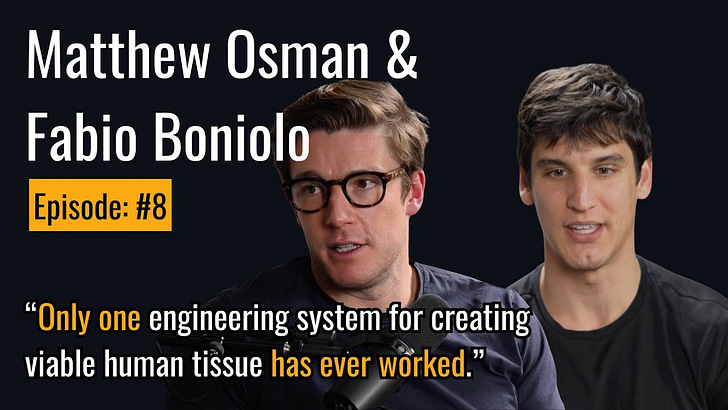
This is an interview with Matthew Osman and Fabio Boniolo, the co-founders of Polyphron.The thesis behind Polyphron is equal parts nauseating and exciting in how ambitious it is: growing ex-vivo tissue to use in organ repair.And, truthfully, it felt so ambitious as to not be possible at all. When I had my first (of several) pre-podcast chats with Matt and Fabio to understand what they were doing, I expressed every ounce of skepticism I had about how this couldn’t possibly be viable. Everybody knows that complex tissue engineering is something akin to how fusion is viewed in physics; theoretically possible, but practically intractable in the near-term. What we can reliably grow outside of a human body are simple structures—bones, skin, cartilage—but anything beyond that is surely decades away.But after the hours of conversation I’ve had with the team, I’ve began to rethink my position. As Eryney Marrogi lines out in his Core Memory article over Polyphron (https://www.corememory.com/p/exclusive-cracking-the-only-engineering), there is an engineering system that has reliably produced viable human tissue for eons: embryogenesis.What if you could recapitulate this process? What if you could naturally get cells to arrange themselves into higher-order structures, by following the exact chemical guidelines that are laid out during embryo development? And, most excitedly, what if you didn’t need to understand any of these overwhelmingly complex development rules, but could outsource it all to a machine-learning system that understood what set of chemical perturbations are necessary at which timepoints?This does not exist today, but Polyphron has given early proof points that is possible. In their most recent finding, which we talk about on the podcast, their models have discovered a distinct set of chemical perturbations that force developing neurons to arrange themselves with a specific polarity: just shy of 90°, arranged like columns. This is obviously still a simple structure—still a difficult one to create, given that even an expert could not arrive to that level of polarity—but it represents proof that you can use computational methods to discover the chemical instructions that guide tissue self-assembly.We discuss this recent polarity result, what the machine-learning problems at Polyphron looks like, and the genuinely insane economics of the whole endeavour. The last of which is especially exciting; it is rare you hear biotech founders talk about ‘expanding the Total Addressable Market’, and actually believe them. But here, it is a genuine possibility if the Polyphron approach ends up working.Enjoy!Youtube: https://youtu.be/3DWTF5mNcUUSpotify: https://open.spotify.com/episode/3aZr5yTgwB4QzUV5ADN0y9?si=9aTLjRZDRHuSBvmckenO1QApple Podcasts: https://podcasts.apple.com/us/podcast/what-if-we-could-grow-human-tissue-by-recapitulating/id1758545538?i=1000741694661Substack/Transcript: https://www.owlposting.com/p/what-if-we-could-grow-human-tissueTimestamps:(00:00:00) Clips and ad roll(00:02:16) Introduction(00:02:37) Why replace tissue rather than the whole organ?(00:10:34) Why not do simple stem/progenitor cell injections?(00:13:51) Can organs repair themselves naturally?(00:18:21) What does “structure” actually mean in tissue engineering?(00:21:04) Why are skin and bone the only FDA-approved tissues today?(00:23:45) What exactly are tissue scaffolds?(00:27:52) Why are organoids a “dead end” for this field?(00:35:08) The argument for recapitulating developmental biology(00:40:28) Walk us through the Polyphron experimental loop(00:47:56) Can you simulate morphogenesis with only small molecules?(00:49:49) How large is the set of possible tissue scaffolds?(00:52:32) How reliable are developmental atlases?(00:56:45) What is the machine learning model actually optimizing for?(01:04:04) Polyphron’s first big tissue engineering result: polarity(01:15:33) What comes after polarity?(01:17:09) Why is vascularization the hardest problem of tissue engineering?(01:20:33) Why can’t you just wash angiogenesis factors over the tissue?(01:22:25) How does the graft integrate with the host’s blood supply?(01:25:45) How do you validate tissue function before implantation?(01:29:01) How do you design a clinical trial for a biological pacemaker?(01:37:01) The argument for being a pan-tissue company(01:41:57) What are the biggest scientific and economic risks?(01:45:23) Who are Polyphron’s competitors?(01:47:07) Expanding the TAM beyond transplant lists(01:52:28) Autologous vs. Allogeneic approaches(01:55:07) Is a 3-year timeline to the clinic realistic?(01:56:28) Cross-species translation(01:58:05) What would you do with $100M equity free?*********Note: Thank you to latch.bio for sponsoring this episode!LatchBio is building agentic scientific tooling that can analyze a wide range of scientific data, with an early focus on spatial biology. Check out their agent at agent.bio! Clip on them in the episode.If you’re at all interested in sponsoring future episodes, reach out! Get full access to Owl Posting at www.owlposting.com/subscribe
Note: Thank you to rush.cloud and latch.bio for sponsoring this episode!Rush is augmenting drug discovery for all scientists with machine-driven superintelligence.LatchBio is building agentic scientific tooling that can analyze a wide range of scientific data, with an early focus on spatial biology. Clip on them in the episode.If you’re at all interested in sponsoring future episodes, reach out!***This is an interview with Yunha Hwang, an assistant professor at MIT (and co-founder of the non-profit Tatta Bio). She is working on building and applying genomic language models to help annotate the function of the (mostly unknown) universe of microbial genomes.There are two reasons you should watch this episode.One, Yunha is working on an absurdly difficult and interesting problem: microbial genome function annotation. Even for E. coli, one of the most studied organisms on Earth, we don’t know what half to two-thirds of its genes actually do. For a random microbe from soil, that number jumps to 80-90%. Her lab is one of the leading groups working to apply deep learning to solving the problem, and last year, released a paper that increasingly feels foundational within it (with prior Owl Posting podcast guest Sergey Ovchinnikov an author on it!). We talk about that paper, its implications, and where the future of machine learning in metagenomics may go.And two, I was especially excited to film this so I could help bring some light to a platform that she and her team at Tatta Bio has developed: SeqHub. There’s been a lot of discussion online about AI co-scientists in the biology space, but I have increasingly felt a vague suspicion that people are trying to be too broad with them. It feels like the value of these tools are not with general scientific reasoning, but rather from deep integration with how a specific domain of research engages with their open problems. SeqHub feels like one of the few systems that mirrors this viewpoint, and while it isn’t something I can personally use—since its use-case is primarily in annotating and sharing microbial genomes, neither of which I work on!—I would still love for it to succeed. If you’re in the metagenomics space, you should try it out!Youtube: https://youtu.be/w6L9-ySnxZI?si=7RBusTAyy0Ums6Oh Spotify: https://open.spotify.com/episode/2EgnV9Y1Mm9JV5m9KAY6yL?si=J5ZmF2i3TtuT10D40jjgawApple Podcast: https://apple.co/4pu4TRBTranscript: https://www.owlposting.com/p/we-dont-know-what-most-microbialTimestamps:00:02:07 – Introduction00:02:23 – Why do microbial genomes matter00:04:07 – Deep learning acceptance in metagenomics00:05:25 – The case for genomic “context” over sequence matching00:06:43 – OMG: the only ML-ready metagenomic dataset00:09:27 – gLM2: A multimodal genomic language model00:11:06 – What do you do with the output of genomic language models?00:17:41 – How will OMG evolve?00:20:26 – Why train on only microbial genomes, as opposed to all genomes?00:22:58 – Do we need more sequences or more annotations?00:23:54 – Is there a conserved microbial genome ‘language’?00:28:11 – What non-obvious things can this genomic language model tell you?00:33:08 – Semantic deduplication and evaluation00:37:33 – How does benchmarking work for these types of models?00:41:31 – Gaia: A genomic search engine00:44:18 – Even ‘well-studied’ genomes are mostly unannotated00:50:51 – Using agents on Gaia00:54:53 – Will genomic language models reshape the tree of life?00:59:18 – Current limitations of genomic language models01:08:54 – Directed evolution as training data01:12:35 – What is Tatta Bio?01:19:02 – Building Google for genomic sequences (SeqHub)01:25:46 – How to create communities around scientific OSS01:29:06 – What’s the purpose in the centralization of the software?01:35:37 – How will the way science is done change in 10 years? Get full access to Owl Posting at www.owlposting.com/subscribe

Sponsor note: the supporter of this video is rush.cloud. If you are at all involved with doing preclinical drug discovery and would benefit from computational tools, you should check out their platform + beautiful website here: rush.cloud.If you’re at all interested in working together for future episodes, reach out!This is an interview with Hunter Davis, the CSO and co-founder (alongside Laura Deming) of Until Labs, which you may also know by its prior name, Cradle. They are a biotech startup devoted to organ-scale cryopreservation. They raised a $58M Series A back in September 2025, and are backed by Founders Fund (especially interesting!), Lux Ventures, and others.In this interview, we mainly talk about the engineering and scientific difficulties in the cryopreservation field, including some background details on their September 2024 progress report on neural slice rewarming, how they characterize tissue damage in their attempts to do kidney cryopreservation, the potential economics of future cryopreservation protocols, and lots more.One of the most interesting conversations I’ve had in a long time. If any of this work seems interesting, Until Labs is actively and aggressively hiring!Enjoy!Substack + Transcript: https://www.owlposting.com/p/bringing-organ-scale-cryopreservationSpotify: https://open.spotify.com/episode/23g2lR7dWl8NXUn893KMgv?si=5628cd0e56184130Apple Podcasts: https://podcasts.apple.com/us/podcast/bringing-organ-scale-cryopreservation-into-existence/id1758545538?i=1000738128994Youtube: https://youtu.be/xaqwPd3ujHgTimestamps:[00:01:50] Introduction[00:05:00] Why don’t we have reversible cryopreservation today?[00:07:05] Why is freezing necessary at all for preservation?[00:08:23] Let’s discuss cryoprotectant agents[00:14:09] Until Lab’s 2024 progress report on neural tissue cryopreservation[00:20:28] How do you measure cryopreserved tissue damage?[00:22:34] Translation across species[00:26:04] Why was the cryopreservation storage time so short in the progress report?[00:30:47] Nuances of loading cryoprotectants into tissue[00:37:03] Let’s discuss rewarming[00:43:02] What scientific problems amongst vitrification and rewarming keep you up at night?[00:45:58] Why are there so few cryoprotectants?[00:48:11] How can you improve rewarming capabilities?[00:53:03] What are the experimental costs of running cryopreservation studies?[00:57:49] What happens to the cryoprotectants and iron oxide nanoparticles after the organ has been thawed?[01:01:34] Cryopreservation and immune response[01:03:25] How do you filter through the cryopreservation literature[01:05:54] How much is molecular simulation used at Until Labs?[01:10:04] What are the (expected) economics of Until Labs?[01:14:49] How much does cryopreservation practically solve the organ shortage problem?[01:17:04] Synergy between xenotransplantation and cryopreservation[01:21:12] How much will the final cryopreservation protocol likely cost?[01:21:58] Who ends up paying for this?[01:23:28] What was it like to raise a Series A on such an unorthodox thesis?[01:27:49] What are common misconceptions people have about cryopreservation?[01:29:58] The beginnings of Until Labs[01:34:07] What expertise is hardest to recruit for?[01:39:27] What personality type do you most value when hiring?[01:44:17] Why work in cryopreservation as opposed to anything else?[01:46:26] Until Lab’s competitors[01:49:30] What would an alternative universe version of Hunter worked on?[01:51:33] What would you do with $100M? Get full access to Owl Posting at www.owlposting.com/subscribe
Sponsor note: I am extremely happy to announce my first commercial, service-oriented sponsor: rush.cloud. I’ve been doing these podcasts entirely through very kind philanthropic graces, which is very nice, but I’d ideally like to be helping someone when they sponsor me. And now I have that! So, if you are at all involved doing preclinical drug discovery and would benefit from computational tools, you should check out their platform + beautiful website here: rush.cloud.******Youtube: https://www.youtube.com/watch?v=W0m3Ltz_YqUApple Podcasts: https://podcasts.apple.com/us/podcast/owl-posting/id1758545538?i=1000736122646Spotify: https://open.spotify.com/episode/5l9RMbMwdgOrrZ6uLS656R?si=938af7d2b79440a1Transcript: https://www.owlposting.com/p/can-machine-learning-enable-100-plex?open=false#%C2%A7transcript******Introduction:Ellen Zhong is perhaps one of the only people in the ML x bio field to have created an entirely new subfield of research during her PhD: the application of deep-learning to cryo-EM particle images.If you aren’t familiar with that field, I luckily have a 8,000~ word article covering it, which walks through a lot of Ellen’s papers. If you don’t have time to read something that grossly large, the general breakdown of the problem is as follows: cryo-EM can give you thousands of 2D views of a 3D protein from many different angles, from that data, can you discover what that 3D structure is? Ellen, who is a computer science professor at Princeton University, has spent her academic career investigating that question, and now has an entire lab at Princeton (E.Z. Lab) focused on that and related ones. Including, as the title mentions, the possibility of doing performing cryo-EM structure determination at ultra-high scales.In this podcast, we talk about her research, what she did during her recent sabbatical at Generate:Biomedicines, her recent interest in areas beyond cryo-EM (cryo-ET and NMR specifically), and more!Timestamps[00:00:00] Introduction[00:02:43] What does it mean to apply ML to cryo-EM?[00:04:28] Ab initio reconstruction and conformational heterogeneity[00:15:41] Can we do multiplex cryo-EM structure determination?[00:22:19] Datasets in cryo-EM[00:26:25] Why isn’t there a foundation model for cryo-EM particle analysis?[00:33:07] How much practical usage is there of these cryo-EM models amongst wet-lab cryo-EM researchers?[00:40:34] Where can things still improve?[00:46:57] Has deep learning done something in cryo-EM that was previously impossible?[00:48:22] Ellen’s experience in the cryo-EM field[00:53:40] Deep learning in cryo-EM outside of structure determination[00:57:32] 3D volume reconstruction versus residue assignment in cryo-EM[01:00:26] What did Ellen do during her sabbatical at Generate Biomedicines?[01:07:07] Ellen’s research in cryo-ET[01:13:54] Ellen’s research in NMR[01:21:05] How did Ellen get into the cryo-EM field?[01:26:57] Why did Ellen go back to graduate school?[01:32:17] What makes Ellen more confident about trusting an external cryo-EM paper? Get full access to Owl Posting at www.owlposting.com/subscribe
Note: Extremely grateful for Geltor (http://geltor.com/) for sponsoring this podcast, and for the founder of it (https://www.linkedin.com/in/alexanderlorestani) for reaching out to make to start with! Geltor produces designer proteins for beauty and wellness.The current in-vogue thing to do for most longevity companies is to go for cellular reprogramming. As in, fill a cell with the right transcription factors needed to reduce epigenetic noise, restore mitochondrial dysfunction, and so on. I’ve written about the promise there before, it’s definitely an exciting field.So, when I first met Alan— who told me that he was a longevity researcher — last October, I naively assumed he was also on the reprogramming train. But he told me that he was investigating something a bit different. His pitch was that, instead of reprogramming the cell to fix age-related damage, what if you just protected it from (genetic) insult first? It’s an obvious idea, but one that I’d never really deeply considered. He sold me on the concept, and I was very curious to hear what he’d do next to push it forwards.A few months after our chat, he spun up a company to pursue this line of thinking: Permanence Bio, which develops molecules that stabilize/protect the genome. They are just about eight months old, but there are already some exciting results coming out. I’m a sucker for people doing ‘contrarian research in consensus fields’, and I immediately knew I wanted to have Alan on the podcast. He graciously agreed and, during my trip to SF last month, we sat down and talked for a few hours.In this episode, we talk about why DNA protection is so important, what indications is it useful for, how to mentally conceptualize the idea of a molecule ‘stabilizing’ a genome, what it was like to raise money for a company pursuing such an out-of-distribution thesis, and lots more.Finally, Alan has a really great blog (something I mention in the video), and I wanted to attach a much longer article he’s written about the topic here.[00:00:00] Teaser clip[00:01:39] Introduction[00:07:32] What is Permanence working on?[00:11:48] What does DNA protection actually look like?[00:27:12] Why is DNA protection not focused on as much?[00:41:03] The utility of epigenetic clocks[00:46:47] Do you need multimechanism approaches for longevity?[00:51:58] Longevity outside of DNA protection[00:55:57] What's going on inside of Permanence?[01:05:54] How could Permanence fail?[01:09:03] How do you stay optimistic?[01:10:26] Why work on aging?[01:15:26] What are you bearish on?[01:19:12] Weirder types of aging beyond 110[01:21:37] How did you decide on DNA protection and what else would you have done?[01:25:27] What was it like raising money?[01:31:48] What do you think of past cancer prevention trials?[01:34:12] What does good wet-lab talent look like?[01:37:02] What does your information diet look like?[01:40:06] What's it like going from research to being a CEO?[01:42:20] What happens after cancer prevention for Permanence? Get full access to Owl Posting at www.owlposting.com/subscribe
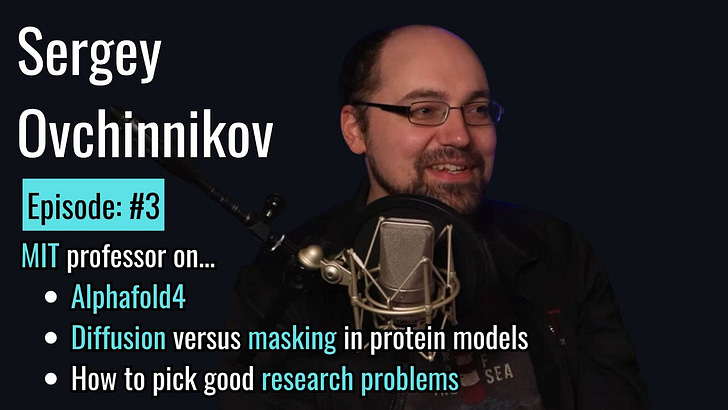
X: https://x.com/owl_postingSergey's X: https://x.com/sokryptonYoutube: https://youtu.be/6_RFXNxy62cSpotify: https://open.spotify.com/episode/0wPs3rmp0zrfauqToozrcv?si=DCtRf-xQTPiVYwslo-b2rQApple Podcasts: https://podcasts.apple.com/us/podcast/what-could-alphafold-4-look-like-sergey-ovchinnikov-3/id1758545538?i=1000704927828Transcript: https://www.owlposting.com/p/what-could-alphafold-4-look-like?open=false#%C2%A7transcriptTo those in the protein design space, Dr. Sergey Ovchinnikov is a very, very well-recognized name.A recent MIT professor (circa early 2024), he has played a part in a staggering number of recent innovations in the field: ColabFold, RFDiffusion, Bindcraft, automated design of soluble proxies of membrane proteins, elucidating what protein language models are learning, conformational sampling via Alphafold2, and many more. Of course, all these papers were group efforts, but Sergey's name comes up astonishingly frequently! And even beyond the research that have come from his lab in the last few years, the co-evolution work he did during his PhD/fellowship also laid some of the groundwork for the original Alphafold paper, being cited twice in it.As a result, Sergey’s work has gained a reputation for being something that is worth reading. But nobody has ever interviewed him before! Which was shocking for someone who was so pivotally important for the field.So, obviously, I wanted to be the first one to do it. After an initial call, I took a train down to Boston, booked a studio, and chatted with him for a few hours, asking every question I could think of. We talk about his own journey into biology research, some issues he has with Alphafold3, what Alphafold4-and-beyond models may look like, what research he’d want to spend a hundred million dollars on, and lots more. Take a look at the timestamps to get an overview!Final note: I’m extremely grateful to Asimov Press for helping fund the travel + studio time required for this episode! They are a non-profit publisher dedicated to thoughtful writing on biology and metascience, such as articles over synthetic blood and interviews with plant geneticists. I myself have published within them twice! I highly recommend checking out their essays at asimov.press, or reaching out to editors@asimov.com if you’re interested in contributing.Timestamps:[00:00:00] Highlight clips[00:01:10] Introduction + Sergey's background and how he got into the field[00:18:14] Is conservation all you need?[00:23:26] Ambiguous vs non-ambiguous regions in proteins[00:24:59] What will AlphaFold 4/5/6 look like?[00:36:19] Diffusion vs. inversion for protein design[00:44:52] A problem with Alphafold3[00:53:41] MSA vs. single sequence models[01:06:52] How Sergey picks research problems[01:21:06] What are DNA models like Evo learning?[01:29:11] The problem with train/test splits in biology[01:49:07] What Sergey would do with $100 million Get full access to Owl Posting at www.owlposting.com/subscribe
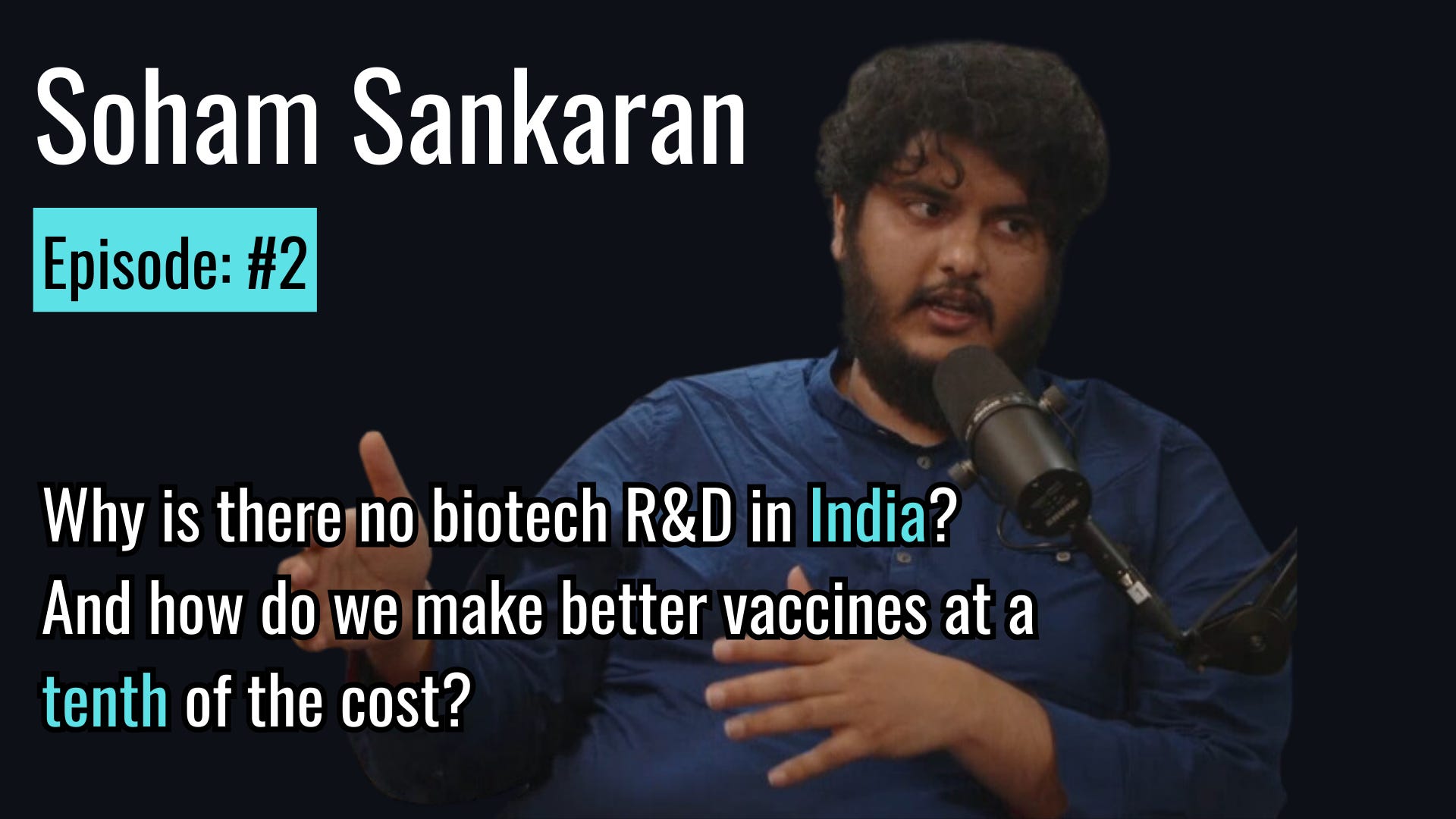
This is an interview with Soham Sankaran, the founder and CEO of PopVax, an mRNA vaccine development startup.Curiously, PopVax is based in India, specifically Hyderabad. This should be a surprise to most people in the field: we never really hear of interesting biotech research being done in a place that isn’t [US, Europe, East Asia].Yet, PopVax has been astonishingly successful, having a (in mouse) influenza vaccine that is 250x better than its competitors, multiple large research collaborations, and their first upcoming US based phase 1 clinical trial being fully sponsored and conducted by the NIH.It’s an extremely interesting success story from what feels like a very clear underdog. In this 2-hour podcast, we discuss everything from why so little biotech research gets done in India, a breakdown on what you care about in vaccine design (immunogens), how PopVax uses machine learning for precise immunogen design, how raising money for a vaccinology startup is going, and a lot more.Timestamps and transcripts are below. Just as in my last episode, I’ve included a ‘jargon explanation’ as a quick primer for some of the subjects discussed in the episode.Some final bits: the studio rental costs were kindly covered by Dylan Reid! Huge shout-out to him for making this episode possible. Also shout-out to Samarth Jajoo, Reha Mathur, and David Yang for some very helpful discussion about the Indian biotech scene. And, if you think PopVax is interesting, here is their Substack which has some articles on their results, their job section (they are actively hiring), and can be reached at contact@popvax.com.Timestamps01:31 Introduction02:38 Why is there such little biotech research in India?17:43 Advantages of building a company in India31:30 Policy prescriptions for India35:39 Questions on vaccine design50:55 What does PopVax do?01:01:58 The role of machine learning in vaccine design01:12:07 The (conservative) culture of vaccinology01:26:57 Hiring in India01:46:52 How fundraising for an Indian vaccine design startup is coming along01:57:36 How is PopVax so good at designing vaccines?02:02:07 Pet theories on immune mechanisms02:09:07 mRNA beyond infectious diseases02:12:38 What would you do with $100 million dollars? Get full access to Owl Posting at www.owlposting.com/subscribe

In my first (real) podcast episode, I talk with Corin and Ari Wagen, two brothers who I met through my writing. They are building something super cool: a molecular simulation company called Rowan (which recently got into the Nat Friedman AI grant program). We discuss neural network potentials (NNP’s), whether dynamics are useful at all, the role of computational chemistry in drug design, what the future of the field looks like for molecular simulation, and a lot more.If you work in molecular simulation, I recommend trying out their tool at rowansci.com. I’m not a chemist and cannot vouch for the tool personally, but I can vouch for how much I’d trust Corin and Ari to build something useful. Not a paid sponsorship, not anything I have an investment in, etc, etc, I just genuinely want their startup to succeed.If you're confused by this episode, check out the 'Jargon Explanation' on the Substack post: https://www.owlposting.com/i/152329408/jargon-explanationTranscript of this episode (contains links to all referenced organizations and papers)My TwitterMy Substack (you should subscribe!)Timestamps:00:00 Introduction01:19 Divide between classical and quantum simulation03:48 What are NNP's actually learning?06:02 What will NNP's fail on?08:08 Short range and long range interactions in NNP's10:23 Emergent behavior in NNP's16:58 Enhanced sampling18:16 Cultural distinctions in NNP's for life-sciences and material sciences21:13 Gap between simulation and real-life36:18 Benchmarking in NNP's41:49 Is molecular dynamics actually useful?53:14 Solvent effects55:17 Quantum effects in large biomolecules57:03 The legacy of DESRES and Anton01:02:27 Unique value add of simulation data01:06:34 NNP's in material science01:13:57 The road to building NNP's01:21:13 Building the SolidWorks of molecular simulation01:30:05 Simulation workflows01:41:06 The role of computational chemistry01:44:06 The future of NNP's01:51:23 Selling to scientists02:01:41 What would you spend 200 million on? Get full access to Owl Posting at www.owlposting.com/subscribe

I go through some questions I’ve had about longevity research, with plenty of background info, and give the answers I’ve found. Audio version of this essay: Get full access to Owl Posting at www.owlposting.com/subscribe

This is an audio version of a previously published post titled ‘Wet-lab innovations will lead the AI revolution in biology’. Get full access to Owl Posting at www.owlposting.com/subscribe

This is an audio version of a previously published post titled 'A primer on why microbiome research is hard'. Get full access to Owl Posting at www.owlposting.com/subscribe

Audio version of a published essay: Get full access to Owl Posting at www.owlposting.com/subscribe
Comments

Download from Google Play

Download from App Store
 United States