


 Claim Ownership
PT Pintcast - Physical Therapy
Subscribed: 4,758Played: 40,809
Subscribe

© PT Pintcast LLC
Description
PT Pintcast is a physical therapy podcast featuring conversations with physical therapists, clinic owners, educators, and leaders shaping the future of physical therapy.
Hosted by Jimmy McKay, PT, DPT, PT Pintcast blends real talk, big ideas, and practical insight on clinical care, business, culture, and where physical therapy is headed next. If a TED Talk and a radio show had a baby and raised it in a physical therapy clinic, this would be it.
Hosted by Jimmy McKay, PT, DPT, PT Pintcast blends real talk, big ideas, and practical insight on clinical care, business, culture, and where physical therapy is headed next. If a TED Talk and a radio show had a baby and raised it in a physical therapy clinic, this would be it.
993 Episodes
Reverse
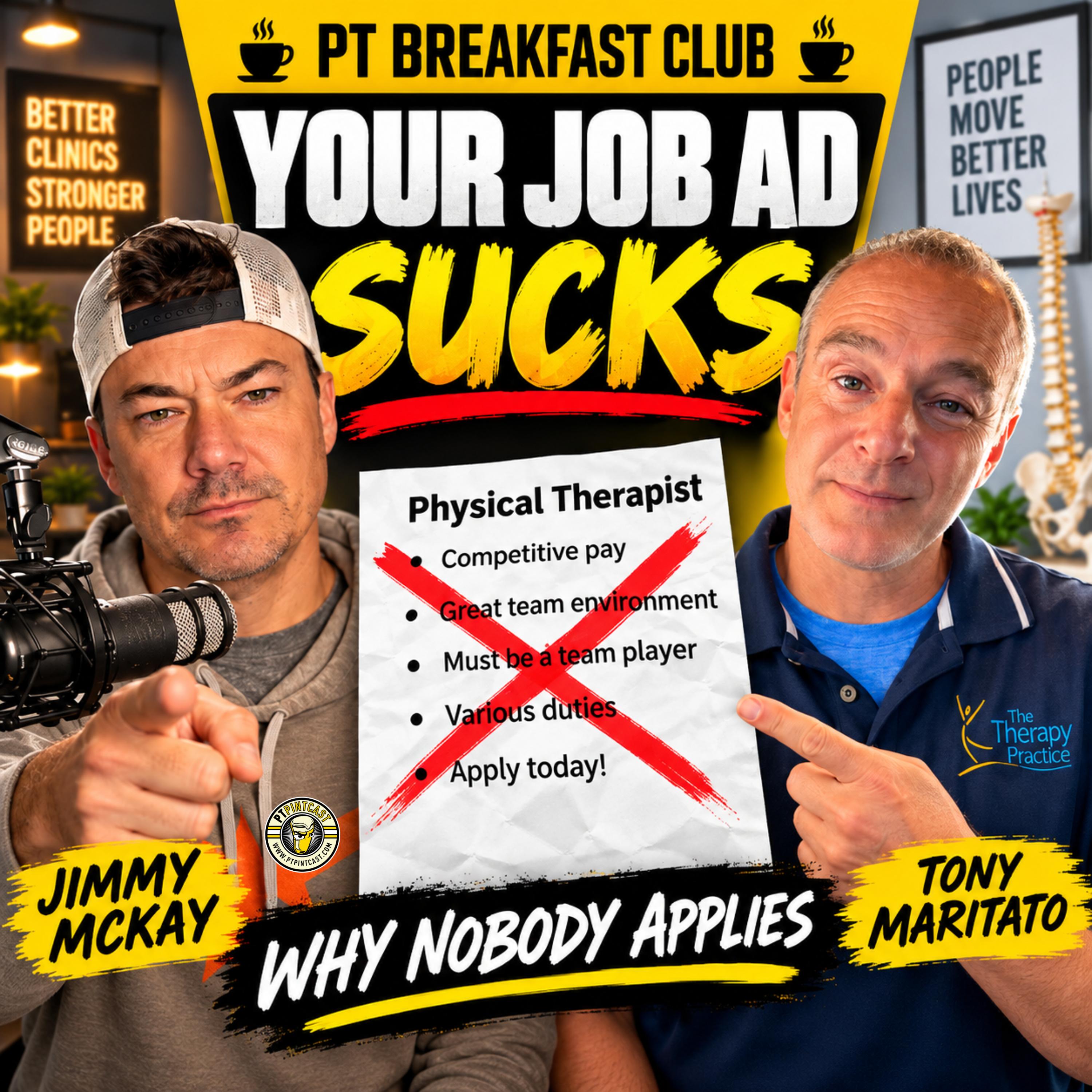
What if the goal of your next physical therapy job ad wasn’t to attract more people?What if it was to repel almost everyone except the few clinicians who would actually love working for you?Jimmy McKay and Tony Maritato dig into recruiting, advertising, AI and psychology after Tony asks a fascinating question:What would advertising legend David Ogilvy want to know before writing a job ad for a physical therapist?That question produces a 12-part framework clinic owners can use to evaluate their own recruiting.The conversation starts with the basics: Who exactly are you trying to hire? What does the employment model look like? How much control does the therapist have over their schedule? What does compensation actually look like?Then it gets more interesting.Jimmy and Tony argue that employers should explain not only what clinicians GET to do, but also what they DON'T have to do.Scheduling.Insurance verification.Marketing.Faxing plans of care.Administrative work.Whatever creates friction in that particular clinic.They also make the case for showing candidates the imperfect parts of the job instead of hiding them.The goal isn’t hundreds of applicants.The goal is a handful of people who understand the offer and think:“That sounds exactly like me.”The episode also explores how Josh Funk and Rehab 2 Perform use media as a recruiting tool, why simply spending more money on traditional job boards may not fix a hiring problem, and why short-form video could be an underused recruiting strategy in physical therapy.Later, the conversation expands into communication and content creation.How do you take one useful idea and package it as video, audio, images and text?Why do some pieces of content explode on one platform and disappear on another?And why do healthcare professionals spend years creating valuable information only to publish it as an unreadable screenshot?Finally, Jimmy and Tony tackle another uncomfortable idea: information has become incredibly cheap.People often aren’t paying coaches, consultants, courses or even clinicians purely for information.They may be paying for guidance, accountability, confidence and someone to help them take the next step.That leads to Jimmy’s warning about a $9,000 YouTube growth course and Tony’s story about spending roughly $33,000 on business education years ago.The episode closes with perhaps the simplest idea of the entire conversation:Before adding another form, another question, another feature or another step…Ask what you can remove.KEY TAKEAWAYS:• Recruit a specific person, not “everybody”• Transparency filters candidates instead of scaring them away• Explain the negatives before applicants discover them themselves• Sell what clinicians DON’T have to do• Make the next step conversational instead of bureaucratic• Great recruiting media can show what working somewhere feels like• One idea can become multiple kinds of media• Information and implementation are different products• Better experiences often come from subtractionFEATURED:Tony MaritatoTony on YouTube:https://www.youtube.com/c/MedicareBillingFOLLOW PT PINTCAST:Apple Podcasts:https://podcasts.apple.com/us/podcast/pt-pintcast-physical-therapy/id1000443325Spotify:https://open.spotify.com/show/3LmMUT64yrUc2iGo9EmafcYouTube:https://www.youtube.com/@PTPintcastLinkedIn:https://www.linkedin.com/in/jimmy-mckay-pt-dpt-a4207659/Instagram:https://www.instagram.com/ptpintcastWebsite:https://www.ptpintcast.com/Twitter/X:https://x.com/PTPintcast

Your Practice Sale Starts Years Before You SellMost physical therapy practice owners think about selling their business when they’re ready to sell.Paul Martin thinks that’s already too late.Paul is a physical therapist, founder of Martin Healthcare Advisors, and former clinic owner who helped grow a three-clinic operation into 21 locations.After decades working with PT practice owners, he says one mistake appears again and again:Owners treat selling their practice like an event.It isn’t.It’s a process.And according to Paul, the owners who begin preparing several years before a transaction have far more opportunities to improve the company, reduce risk and increase its potential value.Jimmy and Paul unpack what buyers actually look for when evaluating a PT business.In This EpisodeThey discuss:Why buyers care about cash flowWhat EBITDA means in a PT practiceWhy historical success alone doesn’t determine valueThe importance of demonstrating future growthHow financial preparation affects a transactionWhy leadership alignment mattersThe operational KPIs buyers examineCharge capture and proper codingProductivity versus complianceSchedule managementPT/PTA team modelsThe danger of a practice depending entirely on its ownerPaul’s “30-day test”Why larger practices often command higher multiplesHow Paul went from three clinics to 21Why systems and processes allow businesses to scaleThe difference between an owner’s perceived valuation and actual valuationWhy Paul believes PT continues to provide extraordinary healthcare valueOne Question Every Owner Should AskImagine telling your staff:“I’m leaving tomorrow. I’ll be gone for 30 days, and you cannot contact me.”What happens?If the clinic falls apart, Paul argues that you may not own a transferable business yet.You may own a job.Paul MartinFounder, Martin Healthcare AdvisorsWebsite: https://www.martinhealthcareadvisors.com/LinkedIn: https://www.linkedin.com/in/paulmartinsview/YouTube: https://www.youtube.com/@martinhealthcareadvisorsBook MentionedBuilt to SellJohn Warrillow

Are physical therapists spending too much time optimizing things that barely matter?Jimmy McKay and Tony Maritato start with the growing backlash against AI-generated content and quickly uncover a much bigger question: Are we arguing about the tool, the output, or just something we don't like?That same tendency shows up everywhere in physical therapy.We obsess over perfect exercise form.We debate tiny biomechanical details.We search for the perfect posting time.We chase follower counts.We optimize before we've done enough reps to have anything worth optimizing.Tony shares how his thinking around exercise prescription changed with experience, including why an imperfect row may still be an entirely useful row.Then the conversation takes a sharp turn into a fascinating idea for the PT workforce:Could physical therapists eventually negotiate something resembling NIL deals?Instead of compensation being limited to salary and clinical productivity, what happens when a clinician's audience, reputation, content, expertise and ability to attract attention create measurable value for an employer?Jimmy and Tony explore what that could mean for:• PT recruitment• clinician compensation• DPT and PTA programs• personal branding• recruiters acting more like talent agents• incentive-based compensation• employee-generated contentThey also break down an overlooked social media problem: more followers aren't automatically better.If the people following you don't care about what you actually create, a bigger audience can become a community of lukewarm people instead of the audience you actually need.Finally, Tony unveils a 28-day content challenge built around an aggressive idea: create at scale, build the system first and let repetition do the heavy lifting.Because eventually, the exciting part isn't the secret.The boring part is.Jimmy's closing thought:“The results that you're not getting are hiding in work that you're not doing.”PT Breakfast Club features conversations about physical therapy, private practice, careers, business, technology, marketing and the future of the profession.Follow:Tony Maritato — Total Therapy Solution on YouTubeDave Kittle — The Dave Kittle Show / conciergepainrelief.comJimmy McKay — PT Pintcast / PT Podcasts

AI has made experimentation cheap. So why are we still acting like every idea costs $5,000?On this episode of PT Breakfast Club, Jimmy McKay and Tony Maritato start with the debate over AI in education and end up somewhere much bigger: what happens to physical therapy when the cost of learning, creating, testing, building, and iterating drops dramatically?Tony walks through using AI to build a new website, generate social content, create viral knee-replacement imagery, analyze information, and explore business ideas that would have required significantly more time or money only a few years ago. Jimmy connects that to a familiar media principle:Attention → Trust → Action.The goal isn't simply to “make content.” It's to understand whose attention you're earning, why they should keep giving it to you, and what eventually happens because of that trust. The guys also dig into some surprisingly practical opportunities around PT.Key themesAI as a learning tool Instead of assuming AI eliminates thinking, what if educators taught students how to question outputs, find blind spots, compare perspectives, and apply information? The economics of experimentation If creating a website, image, script, campaign, or prototype costs a fraction of what it once did, the number of experiments businesses can run should increase dramatically. Identity beats generic content Tony explains why his knee-replacement tattoo images exploded online, while Jimmy breaks down how the same idea can translate into PT specialties, dogs, sneakers, ice cream, and other identity-driven concepts. Attention isn't the end goal Attention earns an opportunity to build trust. Trust eventually creates action, whether that means a patient choosing your clinic, someone listening to your podcast, buying something, or simply remembering you. Your customers are already giving you market research Google Reviews can reveal repeated language, beloved employees, missing services, hidden strengths, and opportunities that businesses may never mention in their own marketing. Does Facebook still work for PT clinics? Yes, if Facebook solves the problem you're actually trying to solve. The tool matters less than understanding the audience, objective, and platform. Three PT-adjacent business ideasTony also pitches several businesses hiding in plain sight:1. A transparent rehab reimbursement database Take publicly available hospital and insurance pricing information and make it understandable and usable for PT, OT, and SLP professionals.2. A physical therapy discount membership network A DentalPlans-style model where consumers pay for access to transparent discounted rates at participating clinics.3. A healthcare buyer's agent Think real estate buyer's agent, but for healthcare: someone helping patients understand pricing, benefits, providers, options, and complex healthcare decisions. The conversation closes with a deceptively simple question:When AI gives you access to expertise, comparison, analysis, and second opinions almost instantly, are you irresponsible for using it?Or are you irresponsible for refusing to learn how?

Why do physical therapy clinics feel broken even when everyone seems to be working harder?On this episode of PT Breakfast Club, Jimmy McKay, Tony Maritato, and Dave Kittle dig into physical therapist hiring, clinician recruitment, clinic marketing, reimbursement, RTM, AI-driven efficiency, and the economics of running a PT practice.The conversation starts with a simple hiring problem: most clinics are competing for the same physical therapists using the same job boards, the same bonuses, and the same messaging. If every clinic is fishing in the same pond, is doing more of the same actually a strategy?Then the conversation turns to marketing, attention, trust, and why a local pancake shop may understand brand building better than most healthcare organizations.Finally, the guys explore a bigger question for physical therapy: when technology makes care more efficient and less expensive to deliver, who actually captures that value? The clinician? The clinic? The patient? Or the payer?Topics include:• Physical therapist hiring and recruitment• PT clinic staffing challenges• Physical therapy job marketing• Clinician retention and hiring strategy• RTM and remote therapeutic monitoring• CMS and physical therapy reimbursement• AI and healthcare efficiency• Private practice physical therapy• PT clinic marketing• The economics of physical therapy practiceThe big takeaway: you may not need more applicants, more marketing, or more of the same strategy. You may need to play a different game.

Comments

Download from Google Play

Download from App Store
 United States