


 Claim Ownership
Patterson in Pursuit
Subscribed: 1,980Played: 23,620
Subscribe


© Steve Patterson
Description
Philosophy in the real world. Interviewing intellectuals across the globe. Grappling with the biggest ideas.
stevepatterson.substack.com
stevepatterson.substack.com
208 Episodes
Reverse

What an amazing few months it’s been for math. I just want to make a few predictions before the rest of the world figures this out. There were two problems with classical mathematics. The first was about infinity, which I’ve covered ad nauseam. The second is about information. Specifically, the discarding of relevant information from our mathematical constructions.Even more specifically, the treating of zero and non-zero as the same value. This happens absolutely everywhere in math and physics. It’s central to the theories underpinning classical mathematics. It’s foundational to calculus, limits, and the real number system. It’s a kind of theoretical glue holding modern mathematics together.And the reason for this concept is not because of the demands of truth or logic, but because of a preference for elegance, practicality, and simplicity. To make our math easier and prettier, we discard relevant information and then insist it doesn’t matter. Terms get really small and then erased—because it is indeed practical to treat really-really-really small as zero.It’s this discarded information which will end up being transformative to math, physics, and computer science.The Destruction of Beautiful High TheoriesOur entire modern view of the universe comes from our philosophy of mathematics, and our High Theories of math and physics are constructed around various symmetries. Without them, the math gets unwieldy and inelegant, or even impossible.The new math is going to be ugly (to the classical mind). There will be asymmetries everywhere. The puzzle pieces won’t fit just right. Nothing will be mathematically continuous. Or homogenous. Or isotropic. The old guard will insist the new math and physics can’t be right because it’s so ugly—or because it violates such-and-such theorem.The problem is, the smooth and beautiful world of classical mathematicians was created by smoothing over the world. By smudging it. By taking the crisp edges of reality and crossing one’s eyes until the edges blend together. Averaging it into a soup.That elegant fantasy world will be destroyed, and a new, sharp, precise reality will take its place. We will have access to precise mathematics again.We’re going to keep track of all the information and the asymmetries they produce, and it will probably turn out that these asymmetries are what makes the universe go.The frontiers of our technology will radically expand, letting us interact with the world at new levels of granularity.We’re going to learn the universe is not homogenous. Heat death is not our inevitable fate. And most importantly, circles do not and cannot exist :-)Mathematicians Behind the CurtainIn our world, what is considered “possible” or “impossible” largely depends upon what mathematicians and physicists claim is possible or impossible. There are theoretical guardrails keeping minds in order—e.g. the laws of thermodynamics are universal and absolute, right?—but it will turn out that those guardrails were mere conventions—enforced by social norms, not by nature.I expect all kinds of conjectures and theorems and laws to be invalidated in the next decade by the mathematical revolution. A few specificsComputers will have a different architecture. A bunch of design decisions were made over the past 70 years based on economic and engineering considerations that are no longer relevant. There will be multiple attempts to rebuild computers from scratch with new mathematics in mind. These new computers won’t use floating point numbers; approximation will not be fundamental. This will affect how AI is designed, with radical improvements in efficiency.Cellular automata are going to become way more popular, both in physics and biology (and Stephen Wolfram will come out looking very good).Basic things like motion and rotation are going to be seen as extremely complex and rich.And hopefully statistics will be understood as a tool for low-resolution, low-information environments, not as a fundamental piece of math or physics.There, a glimpse of the future before we enter it. The window is closing for humans to take credit for these kinds of predictions. I want to make sure a few things are added to the record before AI steals my thunder. Get full access to Steve Patterson's Substack at stevepatterson.substack.com/subscribe
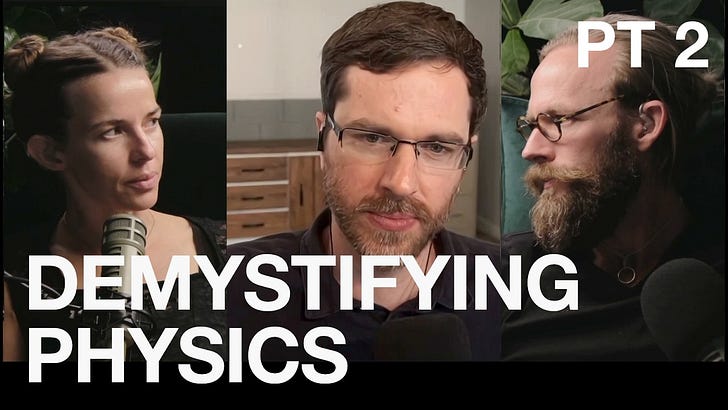
Part 2 of my conversation with Shilo and Anastasia of the excellentDemystifySci podcast: @DemystifySci_Podcast Watch Part 1 here: Buy the book: Paradox Lost: The Material Principles of Natural Philosophy:https://www.amazon.com/dp/B0H6TF366C Get full access to Steve Patterson's Substack at stevepatterson.substack.com/subscribe
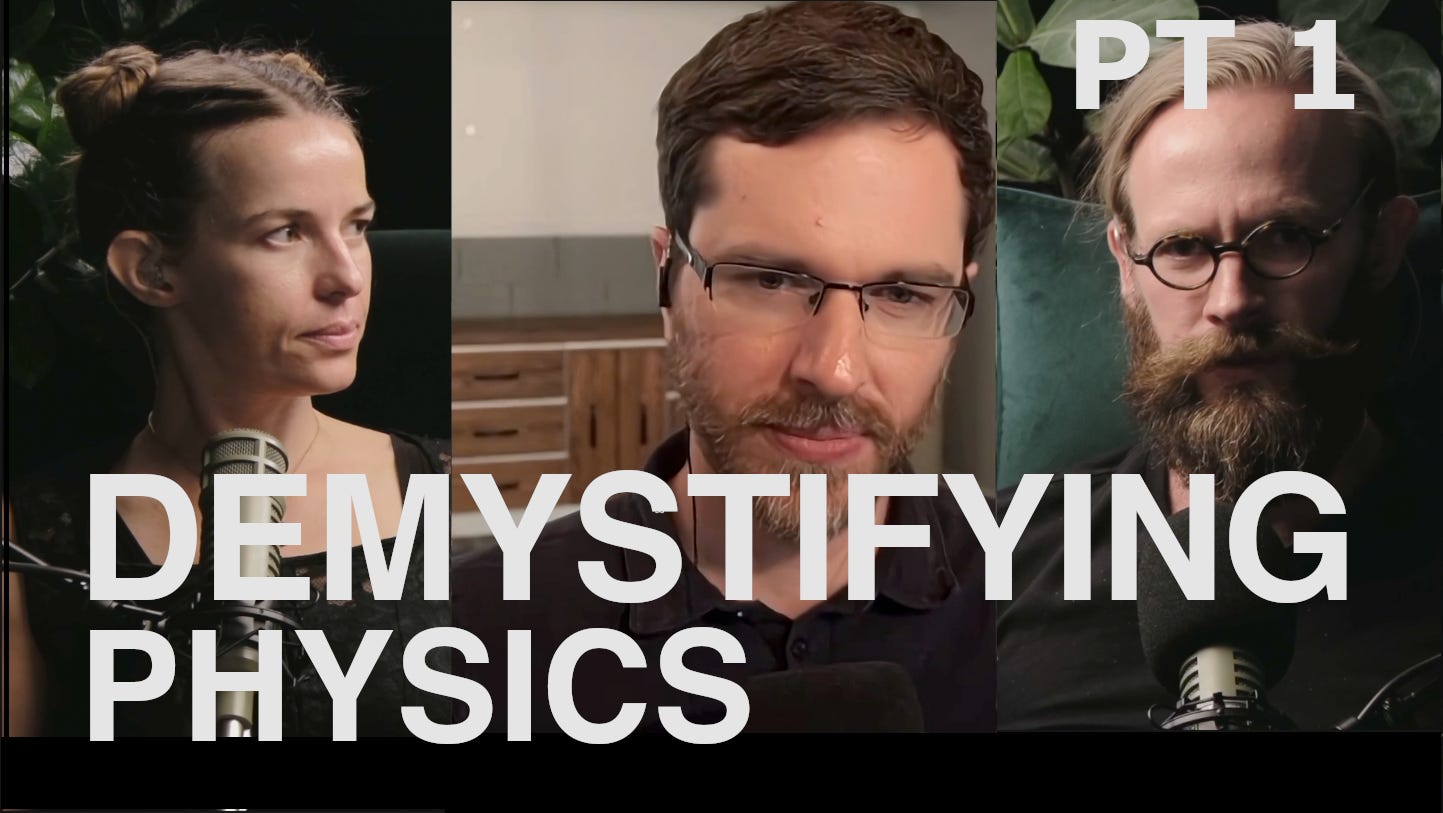
Part 1 of my conversation with Shilo and Anastasia of the excellentDemystifySci podcast: @DemystifySci_Podcast Buy the book: Paradox Lost: The Material Principles of Natural Philosophy:https://www.amazon.com/dp/B0H6TF366CPart 2 will be coming in a few days.(PS I found the brilliant and absurd puppet video we discuss in the beginning. Find me a more preposterous combination of high quality and low quality and I’ll give you $100) Get full access to Steve Patterson's Substack at stevepatterson.substack.com/subscribe

Simon Dixon and I talk about theories surrounding the hijacking of Bitcoin, the connection with Jeffrey Epstein, and some history about Bitcoin's funding and development.Simon's channel: @SimonDixon21 Get the Hijacking Bitcoin book: https://www.hijackingbitcoin.com/ Get full access to Steve Patterson's Substack at stevepatterson.substack.com/subscribe
There’s a purely rational argument for the divinity of love. The core Christian claims can be translated into straightforward analytical philosophy without appealing to mystery, faith, or superstition.I am not saying this argument is true, merely that it’s reasonable, coherent, and understandable in the context of standard philosophy.Here’s the argument:1) Patterns are real and mind-independent (we’ll call them “Forms”).2) There is a metaphysical hierarchy of Forms.3) At the top of the hierarchy is the Form of the Good.4) The highest form is Love.5) Therefore, Love is the Form of the Good.We can break this argument into two parts: Propositions 1-3, which can be understood as a simple Platonism (using the word “patterns” instead of the usual term “universals”); and Propositions 4-5 which can be understood as an empirical Christian claim which clarifies and updates the Platonic idea.What I mean by PlatonismBy “Platonism,” I do not mean a faithful reconstruction of Plato’s ideas—rather, a metaphysical framework which says that patterns, abstractions and relations are real features of existence, separate from our minds. There are cats, and there is Cat-ness, the pattern which all cats have in common, which sits outside the material world in an abstract domain.The point of this article is not to make an argument for this kind of Platonism (which I’ve done extensively elsewhere.) The point is to say that within this view, there is a hierarchy of Forms. As you go up the abstraction ladder, you reach higher and higher forms. Eventually you’ll find the Form of Justice Itself, which is an extremely high-level, high-dimensional pattern that every just action participates in.Impersonal Form of the GoodAt the top of this hierarchy, the Platonist wants to say, is the Form of the Good. This form is so absolute, so fundamental, that it’s the Form which grounds all of our ethical judgements. The form of the Good isn’t something which can be judged “good” or “bad”—it is Goodness itself, the Form-that-we-use to determine goodness.Functionally, this Form plays a similar role to God in theism. However, the classical Form of the Good is critically impersonal. If there is a Creator-God (or “demiurge” in the Platonic vocabulary), he sits underneath the Form of the Good, participating in it. The theistic God, by contrast, has nothing above him; he sits at the apex of the metaphysical hierarchy.That gives us the meaning of Propositions 1-3 of the original argument. Now the Christians come along.Empirical RevelationThe Christian wants to say: by the way, it turns out the Form of the Good is not a distant, impersonal abstraction.The Form of the Good turns out to be Love.In other words, Love is The Good. Love is Goodness itself—it’s the thing which we use to determine the goodness of everything else; it’s the Value underpinning all other values; it’s the objective meaning of life; it’s the first and final cause of everything.And Love is in the Form of a Person. Love is alive.This is not an aprioristically-true claim. It’s an empirical claim—that is how we can understand the meaning of “divine revelation”—God reveals his face, not through a purely logical argument, but through Incarnation.The Form of the Good “comes down from [Platonic] heaven” to live among us.Immediately, if such a thing happened—or if it plausibly happened—we would find ourselves grappling with the same philosophical questions as the early Christians. Divine Love is fully instantiated by Jesus Christ. So, what was Jesus’s exact relationship with God? Clearly he was a man, yet divine at the same time... and suddenly we’re back in the 4th century.So that’s the claim. If there is a hierarchy of Forms, then the Christians are saying Love is the highest Form and the essence of God.Note:If we want to replace the Platonic conception of the “Form of the Good” with the Neo-Platonic idea of “the One,” the Christian argument still holds.So we can swap out premise (3) for the claim “At the top of the hierarchy is The One,” which would change the conclusion to: (5) Therefore, Love is The One. Either formulation works. Get full access to Steve Patterson's Substack at stevepatterson.substack.com/subscribe

Comments

Download from Google Play

Download from App Store
 United States