


 Claim Ownership
People doing Physics
Subscribed: 33Played: 170
Subscribe

© Copyright 2026 Cavendish Laboratory
Description
As fascinating as physics can be, it can also seem very abstract, but behind each experiment and discovery stands a real person trying to understand the universe. Join us at the Cavendish Laboratory on the first Thursday of every month as we get up close and personal with the researchers, technicians, students, teachers, and people that are the beating heart of Cambridge University’s Physics department. If you want to know what goes on behind the doors of a Physics department, are curious to know how people get into physics, or simply wonder what physicists think and dream about, listen in!
Join us on Twitter @DeptofPhysics using the hashtag #PeopleDoingPhysics.
This podcast uses the following third-party services for analysis:
OP3 - https://op3.dev/privacy
Join us on Twitter @DeptofPhysics using the hashtag #PeopleDoingPhysics.
This podcast uses the following third-party services for analysis:
OP3 - https://op3.dev/privacy
46 Episodes
Reverse

Today, we have the privilege of being joined by one half of the team behind what is arguably one of humankinds’ epochal breakthroughs – the first observation of a planet outside our solar system. Both a professor at the University of Zurich and Jacksonian Professor of Natural Philosophy here at Cambridge, Didier Queloz began his research career by achieving the great aim of all PhD students; a publication in Nature. Since then, the techniques and instruments he pioneered have led to the identification of over 4,000 other exoplanets and revolutionised our understanding of planetary formation.His more recent work looks into the detection of earth-like planets, understanding their habitability, and the search for universal life more widely. He is now Director of the Leverhulme Centre for Life in the Universe here at Cambridge – an interdisciplinary hub looking at how life emerges, evolves, and persists in the cosmos.In the course of his career, he has published hundreds of papers and been recipient of numerous prestigious awards, including the unarguably most famous of all scientific awards – the Nobel Prize, which he shared with Michel Mayor and James Peebles in 2019 "for contributions to our understanding of the evolution of the universe and Earth’s place in the cosmos".Together we talk about Didier's route into physics, his work looking at one of the profound questions of whether humankind is alone in the universe, and whether he replaced the bike that made him miss the call from the Nobel Prize committee.Useful links:To learn more about Didier's current research, visit Home | Leverhulme Centre for Life in the UniverseWatch Didier's interviews for The Nobel Prize: Didier Queloz – Interview - NobelPrize.orgShare and join the conversationHelp us get better by taking our quick survey. Your feedback will help us understand how we can improve in the future. Thank you!If you like this episode don’t forget to rate it and leave a review on your favourite podcast app. It really helps others to find us.Any comment about the podcast or question you would like to ask our physicists, email us at [email protected] or join the conversation on Twitter using the hashtag #PeopleDoingPhysics.Episode creditsHost: Jacob ButlerRecording and editing: Chris BrockThis podcast uses the following third-party services for analysis: OP3 - https://op3.dev/privacy

Today we are delighted to be joined by Siddharth Shanker Saxena, known to friends and colleagues as Montu, a condensed-matter physicist at the Cavendish Laboratory and head of the Cambridge Central Asia Forum. By Montu’s own admission, he was never able to pick a side, and so has spent his whole life exploring the world of superconductivity, all the while advocating for international relations and anthropology.Together we talk about the moments that shape a scientific life: learning to believe you belong, the role of mentoring, and what “failure" can teach you. We also dig into the enduring puzzle of superconductivity: how to explain it simply, why it continues to captivate physicists, and how to stay comfortable saying “we don’t know.”Useful Links:Montu talked in depth about superconductivity in this podcast for Quanta Magazine: Will Better Superconductors Transform the World? | Quanta MagazineHe was also recently featured in this Varsity article: Meet the Cambridge physicist who advocates for the humanities | VarsityTo explore Montu's work : Siddharth Saxena | Jesus College in the University of CambridgeAnd finally, to learn more about the Cambridge Central Asia Forum, visit Cambridge Central Asia Forum |Share and join the conversationHelp us get better by taking our quick survey. Your feedback will help us understand how we can improve in the future. Thank you!If you like this episode don’t forget to rate it and leave a review on your favourite podcast app. It really helps others to find us.Any comment about the podcast or question you would like to ask our physicists, email us at [email protected] or join the conversation on Twitter using the hashtag #PeopleDoingPhysics.Episode creditsHosts: Charlotte Lane and Vanessa BismuthRecording and editing: Chris BrockThis podcast uses the following third-party services for analysis: OP3 - https://op3.dev/privacy
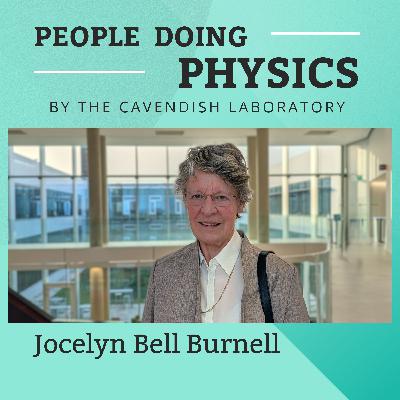
We are so happy to be joined by Professor Dame Jocelyn Bell Burnell, legendary astrophysicist who made the first observations of pulsars during her PhD at the Cavendish, and went on to become a fierce advocate of diversity in science. Dame Jocelyn is visiting Cambridge to give a special talk organised by the Cambridge University Women in Physics Society for International Women’s Day and we’re really excited to be able to spend time with her and ask her about her journey. --A brief note for our listeners: this episode includes personal reflections on life in academia and physics in past decades, and it may refer to attitudes, behaviours, and workplace cultures that many will find outdated, uncomfortable, or shocking. These accounts are shared to document lived experience and help us understand how the culture has changed; they do not represent current values and operations. Useful Links:Learn more about the Bell Burnell Graduate Scholarship Fund | Institute of PhysicsJourneys of discovery: Jocelyn Bell Burnell and pulsars - This article published on the University of Camrbidge website includes the photo of Jocelyn mentioned in our conversation.To explore Charlotte's student society's activities, visit Cambridge University Women in Physics Society | CUWPSShare and join the conversationHelp us get better by taking our quick survey. Your feedback will help us understand how we can improve in the future. Thank you!If you like this episode don’t forget to rate it and leave a review on your favourite podcast app. It really helps others to find us.Any comment about the podcast or question you would like to ask our physicists, email us at [email protected] or join the conversation on Twitter using the hashtag #PeopleDoingPhysics.Episode creditsHosts: Charlotte Lane and Vanessa BismuthRecording and editing: Chris BrockThis podcast uses the following third-party services for analysis: OP3 - https://op3.dev/privacy

Today we’re joined by Verity Allan, who works as a project manager, developer, and programmer of architecture and software for the Square Kilometre Array, which will be the world's largest radio telescope. A graduate of Cambridge, Oxford, and The Open University, Verity came to Cambridge from a town in the Midlands to study Anglo-Saxon, Norse and Celtic. How did she go from studying ancient languages, to coding, designing security for telescope software systems, and pursuing a PhD in high performance computing for astrophysics? These are just some of the twists and turns we hope to explore in our chat with Verity. Stay with us.Useful Links:Explore | SKAO - Learn more about the two largest telescope arrays in the worldRoss Anderson's book on Security Engineering, mentioned by Verity, is available at https://www.cl.cam.ac.uk/archive/rja14/book.html (all three editions plus some videos)Verity wrote two papers on the history of scientific computing: The Cavendish Computors: The women working in scientific computing for Radio Astronomy and Scientific Computing in the Cavendish Laboratory and the pioneering women ComputorsLearn more about Jodrell Bank Centre for Astrophysics - The University of Manchester and about our Astrophysics work in Cambridge.Share and join the conversationHelp us get better by taking our quick survey. Your feedback will help us understand how we can improve in the future. Thank you!If you like this episode don’t forget to rate it and leave a review on your favourite podcast app. It really helps others to find us.Any comment about the podcast or question you would like to ask our physicists, email us at [email protected] or join the conversation on Twitter using the hashtag #PeopleDoingPhysics.Episode creditsHosts: Vanessa Bismuth and Charlie WalkerRecording and editing: Chris BrockThis podcast uses the following third-party services for analysis: OP3 - https://op3.dev/privacy
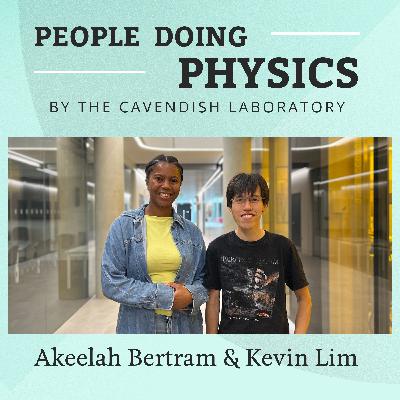
I’m delighted to welcome Akeelah Bertram and Kevin Lim to this episode of People Doing Physics.Akeelah, a British multi-disciplinary artist and the current Cavendish Arts Science Fellow, creates immersive installations that blend digital and interactive art, performance, creative technology, and sculpture—all with a focus on collective storytelling. Her work often experiments with new modes of communication, crafting experiences that connect people across different locations and contexts.Over the past year, Akeelah has been deeply engaged with scientists at the Cavendish Laboratory as part of her fellowship—a journey that led her to meet Kevin Lim.Kevin, a Postdoctoral Researcher in Physics at the Cavendish, describes himself as a curious creative in Cambridge: a singer-songwriter, storyteller, and scientist. By day, he investigates how water reacts to sound and light waves. After hours, he’s a musician and videographer, teaching guitar, releasing new music, and making short films.Naturally, their paths converged, sparking a vibrant exchange of ideas and perspectives. Out of this encounter emerged a rich and reflective conversation, weaving together the threads of physics, art, and culture through personal stories and philosophical exploration.Together we delve into the way scientific practice and artistic creativity intertwine, and consider how personal histories, institutional contexts, and different ways of knowing shape our pursuit of knowledge and creativity.Stay with us. Useful Links:LEAP Lab - Learn more about the LEAP Lab: Living Experiments in Arts-Science Practice to Re-imagine SustainabilityKevin's Youtube Channel - For more videos from Kevin, visit his YouTube channelKevin Lim - curious creative in Cambridge - Explore Kevin's artistic work on his website. Cavendish Arts Science - Learn more about the Cavendish Arts Science programme and fellowship.Akeelah Bertram websiteShare and join the conversationHelp us get better by taking our quick survey. Your feedback will help us understand how we can improve in the future. Thank you!If you like this episode don’t forget to rate it and leave a review on your favourite podcast app. It really helps others to find us.Any comment about the podcast or question you would like to ask our physicists, email us at [email protected] or join the conversation on Twitter using the hashtag #PeopleDoingPhysics.Episode creditsHosts: Vanessa BismuthRecording and editing: Chris BrockThis podcast uses the following third-party services for analysis: OP3 - https://op3.dev/privacy

Comments

Download from Google Play

Download from App Store
 United States