


 Claim Ownership
Personal Landscapes
Subscribed: 16Played: 690
Subscribe

© Ryan Murdock
Description
Ryan Murdock talks with the world’s most original writers, publishers and travelers to get the story behind great books about place.
www.personallandscapespodcast.com
www.personallandscapespodcast.com
80 Episodes
Reverse

Jan Morris seemed to live multiple lives.She was a soldier at the end of the Second World War, and a globetrotting journalist with a knack for turning up in the middle of what would become historic events.She was a man — James Morris — and then a woman, undergoing gender-reassignment surgery in Casablanca at the age of forty-six.She hated being called a travel writer but she wrote remarkable books about place, and was one of the finest descriptive writers of her time.She also wrote celebrated histories, including the Pax Brittanica Trilogy, an elegy to the British Empire that captured the period in a kaleidoscope of incidents and characters, steeped in melancholy and a sense of decline.The quality of her work is uneven. Money troubles led her to recycle newspaper articles into books that were often formulaic and disjointed. But the best of her work will stand among our greatest writing on place.The life behind that work was rife with contradictions. Morris preached the virtues of kindness, but according to her children she was a terrible parent, cold and cruel.Others have described her as a narcissist, a fabulist, and a class snob who told stories that inflated her family origins.Who better to uncover the complexities of this twentieth-century icon than a writer who excels at both biography and travel writing?Sara Wheeler is the author of Jan Morris: A Life.We spoke about Jan Morris’s iconic writing style, her late-life obsession with Welsh nationalism, and the unreconcilable sense of longing at the heart of her work.Personal Landscapes relies on the support of listeners like you to keep going. Please consider joining my Member's Club on Substack, where you'll find show notes for each episode, book reviews, reading-related videos, and more. You’ll be supporting an independent ad-free podcast that publishes carefully curated conversations like this one, backed by decades of reading. Go to https://www.personallandscapespodcast.com/p/start-hereFollow my travels — and buy my books — on https://ryanmurdock.com/You can listen to Personal Landscapes: Conversations on Books About Place on iTunes, Spotify, Stitcher, Podbean, Google Podcasts, Audible, PlayerFM, and TuneIn + Alexa.Please subscribe, and rate the podcast or leave a review.Your support is greatly appreciated. This is a public episode. If you'd like to discuss this with other subscribers or get access to bonus episodes, visit www.personallandscapespodcast.com/subscribe

George Forster is the most interesting 18th century explorer that I had never heard of.He traveled the South Pacific on Captain James Cook’s second voyage at age seventeen, sailing through icy waters tantalizingly close to undiscovered Antarctica.The common roots of those languages and cultures led him to develop a theory of Polynesian migration two centuries before it became the scientific consensus.The prevailing European notion at the time was also one of racial superiority, but Forster saw the peoples he met as equals and believed they had something of value to teach him.The book he wrote about the journey made him a coveted dinner guest all over Europe. He was friends with Goethe, Benjamin Franklin and Mary Wollstonecraft, and he became a mentor to Alexander von Humboldt.But Forster’s later life was not a happy one, and his work was largely forgotten until today’s guest rescued him from obscurity.Andrea Wulf is the author of The Traveller: The Revolutionary Life of George Forster.We spoke about Forster’s remarkable Pacific journey, why his ideas were so far ahead of their time, and his unfortunate end.Personal Landscapes relies on the support of listeners like you to keep going. Please consider joining my Member's Club on Substack, where you'll find show notes for each episode, book reviews, reading-related videos, and more. You’ll be supporting an independent ad-free podcast that publishes carefully curated conversations like this one, backed by decades of reading. Go to https://www.personallandscapespodcast.com/p/start-hereFollow my travels — and buy my books — on https://ryanmurdock.com/ This is a public episode. If you'd like to discuss this with other subscribers or get access to bonus episodes, visit www.personallandscapespodcast.com/subscribe

When Rory Maclean’s wife died of cancer at age 55, he set out on a series of journeys that changed his life.His newest book is an examination of grief, a celebration of love, and a cross-cultural exploration of the afterlife.He approached each religion like an an anthropologist, participating in the rituals of living traditions in the hope of reconnecting with the wife he had lost.From the heights of Bhutan to the plains of South Dakota, each journey and meeting opened the door to the next, as his path led him out of darkness and into a new understanding of the mystery that bookends our lives.Rory Maclean is the author of Geography of Heaven, Berlin: Portrait of a City, Pravda Ha Ha and other books. He’s a Fellow of the Royal Society of Literature, and the founder and curator of the annual Sherborne Travel Writing Festival.We spoke about the nature of grief, cross-cultural accounts of an afterlife, and what ancient rituals can teach us about modernity.Personal Landscapes relies on the support of listeners like you to keep going. Please consider joining my Member's Club on Substack, where you'll find show notes for each episode, book reviews, reading-related videos, and more. You’ll be supporting an independent ad-free podcast that publishes carefully curated conversations like this one, backed by decades of reading. Go to https://www.personallandscapespodcast.com/p/start-hereFollow my travels — and buy my books — on https://ryanmurdock.com/ This is a public episode. If you'd like to discuss this with other subscribers or get access to bonus episodes, visit www.personallandscapespodcast.com/subscribe
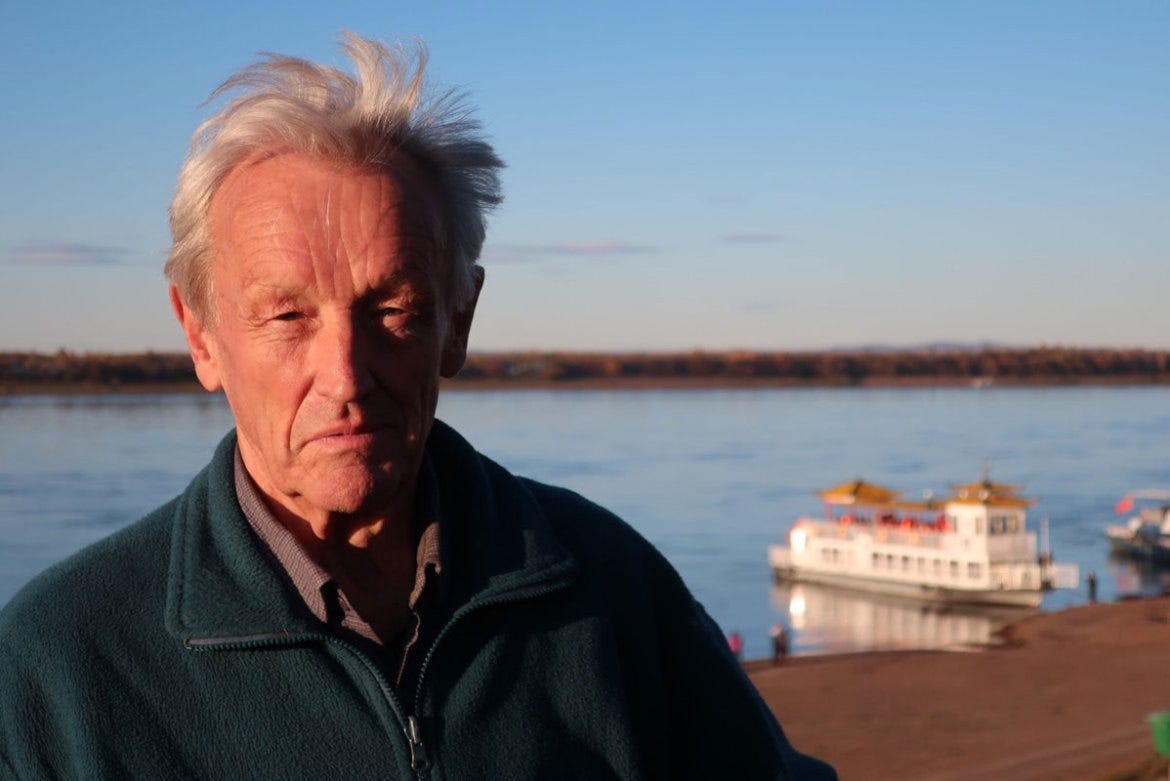
Colin Thubron’s keenly observed travel writing has made him one of our greatest writers on place.The scale of his journeys is immense, but his lyrical books focus on the small and immediate. He writes about ordinary people whose lives were shaped by forces beyond their control.He also shares stories of individuals on the fringes: radical Christian sects and animist shaman, Siberian poachers, gulag survivors, and cross-border traders.I have an abiding fascination with empty landscapes and cultural borders, and I’ve long wanted to talk to Colin about his remote Asian travels.We spoke about how Russia’s vast landscape shaped its psyche, Asia’s suspicious borderlands, and getting grilled by the KGB.You can listen on iTunes, Spotify, Stitcher, Podbean, Google Podcasts, Audible, PlayerFM, and TuneIn + Alexa. Please subscribe, and rate the podcast or leave a review.Personal Landscapes relies on the support of listeners like you to keep going. Please consider joining my Member's Club on Substack, where you'll find show notes for each episode, book reviews, reading-related videos, and more. You’ll be supporting an independent ad-free podcast that publishes carefully curated conversations like this one, backed by decades of reading. Go to https://www.personallandscapespodcast.com/p/start-hereFollow my travels — and buy my books — on https://ryanmurdock.com/ This is a public episode. If you'd like to discuss this with other subscribers or get access to bonus episodes, visit www.personallandscapespodcast.com/subscribe

When Tom Feiling lived in Tokyo in the early 1990s, Japan was a vision of the future. A place where science fiction existed next to centuries old Shinto shrines.He returned to the country nearly twenty-five years later to find some of the shine had worn off.Its population is aging and shrinking. Inflation is finally setting in after decades of economic stagnation. People are choosing solitude over companionship. And countryside villages are being abandoned as their last residents die off.Japan still looks like the future, but it is a troubling future, and a warning for us all.Tom is the author of Alone in Japan: A Journey to the Future.We spoke about Japan’s culture of overwork, extreme forms of solitude, sex doll showrooms, and attempts to save village life and big city prosperity.Personal Landscapes relies on the support of listeners like you to keep going. Please consider joining my Member's Club on Substack, where you'll find show notes for each episode, book reviews, reading-related videos, and more. You’ll be supporting an independent ad-free podcast that publishes carefully curated conversations like this one, backed by decades of reading. Go to https://www.personallandscapespodcast.com/p/start-hereFollow my travels — and buy my books — on https://ryanmurdock.com/ This is a public episode. If you'd like to discuss this with other subscribers or get access to bonus episodes, visit www.personallandscapespodcast.com/subscribe

Comments

Download from Google Play

Download from App Store
 United States