


 Claim Ownership
Photography Breakthrough System
Subscribed: 3Played: 6
Subscribe

Matthew Jordan Smith Copyright © 2025 All Right Reserved
Description
Welcome to the Photography Breakthrough Podcast, the place where burnt out
photographers come back to life. Where fear gets replaced with confidence and
where your gift finally starts working for you, not against you.
77 Episodes
Reverse
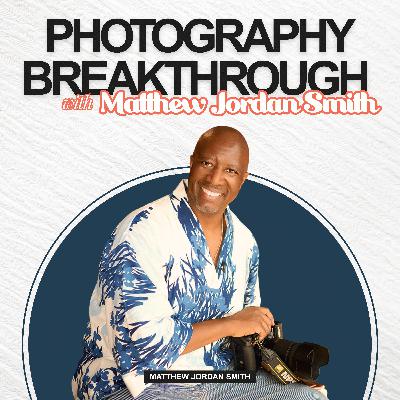
Is This the Best Portrait Lens Ever? Why I Love the Nikon 85mm f/1.2 SWhat if the secret to a beautiful portrait isn't making everything sharp?
After years of photographing some of the world's most recognizable faces, I've learned that technical perfection and beauty aren't always the same thing.
This week, I reached into my camera bag for the Nikon NIKKOR Z 85mm f/1.2 S, a lens that might just be the best portrait lens I've ever used.
Why? Because of the extraordinary way it combines tack-sharp eyes with beautifully soft, out-of-focus details. The results can look almost like paintings.
Today, many of the women I photograph are in their 40s, 50s, 60s, and beyond. My goal isn't to make them look younger. It's to capture the confidence, elegance, and beauty of who they are right now.
In this episode, I explain why the 85mm f/1.2 S has become such an important part of my portrait photography, how I use shallow depth of field to create that dreamy, painterly quality, and why I believe the most powerful photographs aren't necessarily the sharpest ones.
I also share why Nikon's eye-detection autofocus makes photographing at f/1.2 easier and how that freedom allows me to concentrate on connecting with my subjects.
In This Episode
Why I chose the Nikon 85mm f/1.2 S for my latest portrait shoot.
Sharpness versus beauty: Why showing every detail doesn't always create the strongest portrait.
The magic of f/1.2: Creating stunning transitions from sharply focused eyes to soft, dreamy facial details.
Photographing women beautifully at every age: Why my goal is to celebrate the person in front of my camera, not make her look younger.
Why 85mm is a classic portrait focal length: Flattering perspective, comfortable working distance, and better communication with your subject.
Nikon's eye-detection autofocus: How modern technology allows me to spend less time worrying about focus and more time capturing meaningful moments.
A creative challenge: An aperture exercise you can try with your own lens to discover what makes a portrait truly beautiful.
Try This Photography Challenge
On your next portrait shoot, photograph the same subject at four different apertures:
Your lens's widest aperture
f/2.8
f/4
f/5.6
Compare the photographs. Look at how the face, background, and overall feeling change.
Then ask yourself one question:
Which photograph makes me feel something?
Don't judge the photographs only as a photographer. Look at them as someone experiencing the portrait for the first time.
You might be surprised by what you discover.
Featured Gear: Nikon NIKKOR Z 85mm f/1.2 S
This is the lens I used for my latest portrait session, and it's one of my favorites for creating elegant, intimate, painterly portraits.
Explore the Nikon NIKKOR Z 85mm f/1.2 S here:
https://www.awin1.com/cread.php?awinmid=126679&awinaffid=3145815&clickref=Podcast&ued=https%3A%2F%2Fwww.nikonusa.com%2Fp%2Fnikkor-z-85mm-f12-s%2F20114
Affiliate disclosure: I'm a Nikon Ambassador, and this is my affiliate link. If you make a qualifying purchase through this link, I may earn a commission at no additional cost to you.
Let's Talk Photography
What's your favorite portrait lens, and why?
Is it an 85mm, a 105mm, a 135mm, or something completely different?
I'd love to hear what you're using and, more importantly, why you love it.
Thanks for listening to The Photography Breakthrough Podcast. Join me next week as we continue exploring "What's in My Camera Bag… and Why?"
Remember: Just because your camera can capture every detail doesn't mean every detail needs to be the center of attention.
— Matthew Jordan Smith
What's in My Camera Bag… and Why: Is the New Nikon 24–70mm f/2.8 S II Worth the Upgrade?
Photography Breakthrough Podcast | Episode 67 | November 9, 2026
What's in your camera bag and more importantly, WHY?
This week, I'm launching a new four-week series on the Photography Breakthrough Podcast, taking you inside my camera bag to explain the lenses I use, why I choose them, and how they help me create my photographs.
And we're starting with one of the most versatile lenses a photographer can own: the NIKKOR Z 24–70mm f/2.8 S II.
I've always loved prime lenses, but after using Nikon's new 24–70mm f/2.8 S II during a recent two-day portrait assignment in a beautiful traditional Japanese house, my perspective on zoom lenses has changed.
Over two days, I photographed seven clients wearing elaborate Japanese wedding kimonos, working through changing light, rain, sunshine, and long shooting days.
The new 24–70mm gave me the freedom to capture everything from intimate portraits to full-length images while maintaining the connection with my subjects.
And the autofocus? That's what really got my attention!
In this episode, I explain why the new version deserves serious consideration, especially if you already own the original.
In this episode, you'll discover:
Why the new 24–70mm f/2.8 S II has changed my approach to zoom lenses.
How the dramatically improved autofocus makes a difference when photographing people.
Why a lighter lens matters during a 12–14-hour shooting day.
The advantages of internal zooming for photography and video.
Why I love shooting wide open at f/2.8.
Whether upgrading from the original 24–70mm is worth the investment.
I also revisit my experience with the extraordinary NIKKOR Z 120–300mm f/2.8 TC VR S, including how I used it for portraits in a traditional Japanese house, not just sports photography.
Because choosing the right lens isn't about having the most equipment. It's about understanding how your equipment helps you create.
Explore the Nikon lenses featured in this episode
NIKKOR Z 24–70mm f/2.8 S II — Featured Lens
The second-generation 24–70mm is lighter, faster to focus, and features internal zooming and a redesigned optical system. After using it on my recent portrait assignment, I believe it's a serious upgrade worth considering.
Explore or purchase the NIKKOR Z 24–70mm f/2.8 S II:
https://www.awin1.com/cread.php?awinmid=126679&awinaffid=3145815&clickref=Podcast&ued=https%3A%2F%2Fwww.nikonusa.com%2Fp%2Fnikkor-z-24-70mm-f28-s-ii%2F20129
NIKKOR Z 120–300mm f/2.8 TC VR S
An extraordinary professional telephoto zoom with a constant f/2.8 aperture, built-in 1.4× teleconverter, and impressive autofocus performance.
I recently tested this lens at Tokyo's Komazawa Olympic Park and used it again during my portrait assignment in a traditional Japanese house. Its combination of reach, speed, and flexibility impressed me enormously.
Explore or order the NIKKOR Z 120–300mm f/2.8 TC VR S:
https://www.awin1.com/cread.php?awinmid=126679&awin affid=3145815&ued=https%3A%2F%2Fwww.nikonusa.com%2Fp%2Fnikkor-z-120-300mm-f28-tc-vr-s%2F20135
This Week's Photography Challenge
Take a look inside your camera bag.
What's the lens you reach for most often, and why?
This week, challenge yourself to use that lens differently. Change your perspective, experiment with focal lengths, and discover something new with equipment you already own.
Sometimes the breakthrough you're looking for doesn't come from buying another piece of equipment.
Sometimes it comes from seeing differently.
Join me next week as we continue exploring what's in my camera bag and why.
Matthew Jordan SmithPhotography Breakthrough Podcast
Affiliate Disclosure: I'm a Nikon Ambassador and Nikon affiliate. If you purchase through the links above, I may earn a commission at no additional cost to you.
A First Look at Nikon's New NIKKOR Z 120–300mm f/2.8Welcome back to the show. I'm your host, Matthew Jordan Smith, and today we're gonna change things up a little bit. It's Monday, November 2nd, 2026. And yes, I think this week, maybe more than ever, we need to focus just for a moment on something that's fun. It might be a heavy week, so let me distract you from everything you'll be hearing this week.
Every once in a while, a new piece of camera equipment comes along that makes you stop and say, "Wow!" Today was one of those days. I got my hands on an early edition of Nikon's brand-new Nikon Z 120 to 300 millimeter F2.8 TC VR S lens.
Now, this is one absolutely incredible lens. And I've got to tell you, I was absolutely blown away.
Now I've been shooting professionally for, for decades. I've worked with all kinds of cameras and all kinds of lenses. I've photographed many incredible people and found myself in situations where having the right equipment meant the difference between getting the photograph and missing the moment forever.
After just one day with this lens, I found myself thinking something I don't say very often, "I wish I'd had this lens five years ago when I was photographing the Tokyo Olympics."
Let me tell you why. First, let's talk about what makes this lens special.
You've got a beautiful 120 to 300 millimeter zoom with a constant 2.8 maximum aperture.
Now that's already incredibly useful when it comes to photographing sports, action, wildlife, and even certain types of landscapes. But here's where things get really interesting.
This Nikkor lens has a built-in 1.4 times teleconverter directly built into the lens. That's right. You can just flip a switch and change to the teleconverter. So simple, no stopping the action.
With the simple movement of a switch, you can instantly extend your reach all the way to 420 millimeters without removing the lens from your camera, without taking your eye away from the viewfinder.
With the teleconverter engaged, you're working at F4.
Now think about that for a second. You're photographing action quickly. Someone's running or jumping and you need to adjust your composition quickly. Maybe the action suddenly moves further away. You don't have time to switch cameras or lenses. You might not even have time to think. You just react. And that's exactly what this lens allows you to do in an instant.
For a professional telephoto zoom with this much reach, I found it surprisingly manageable to handhold. That's right, this baby is light.
And when you pair it with the Nikon Z 9, it becomes one incredible combination.
But specs are one thing. What I really wanted to know was how the lens would perform when something unexpected happened right in front of me. So today, I took it to a place here in Tokyo that holds a very special memory for me.
The Komazawa Olympic Park.
Now, if you've been to Japan, Tokyo, and been to this park, you know how amazing it is. Everywhere you look, people are moving, running, practicing basketball, training, jumping hurdles, preparing for the next competition.
It's a beautiful place to watch people push themselves physically. And for a photographer who loves capturing movement, it's a paradise.
I also have a personal connection to this place. Back in 2021, just before the Tokyo Olympic Games began, I came to this very same park to test a few long lenses before moving into the Tokyo Olympic Village for my assignment.
I was hired by the IOC back then as one of three photographers in history to ever work inside the Olympic Village. That's normally a no man's land. But in 2021, it was very different. It was the first time in history there was a worldwide pandemic, which meant once I entered into the village, for 30 days, I could not leave.
So I had to make sure I had all the gear I needed to handle anything that I might see while living in the village.
I went to this park to test everything out before moving in.
Back in 2021, the Tokyo Olympic Games were unlike any other. A global pandemic, testing every day, mask everywhere you went. The entire world felt different.
Coming back to Komazawa today brought back a flood of memories. Only this time, I had a lens that didn't exist back then. And I've gotta tell you, I couldn't wait to see what it could do.
At first, I started photographing the kinds of activities you expect. People running, playing basketball, athletes practicing relay, doing the hurdles. The new Nikkor lens was handling everything beautifully.
But then something caught my eye, something unexpected. Three kids were practicing an incredibly difficult acrobatic double Dutch routine.
Now, if you've ever watched double Dutch at a high level, you know how challenging it can be. Two ropes turning, precise timing, and everyone having to move in perfect coordination.
But these kids were taking things to another level. All three were trying to jump and spin together in a synchronized routine. It wasn't easy, and they kept missing it over and over and over again.
At one point, they put the ropes down and just practiced jumping and spinning. They'd start, build their rhythm, attempt the move, and always something would go wrong.
Then they try it again, and again.
I stood there watching, fascinated. Not just by the physical difficulty of what they were attempting to do, but by their determination to get it right.
As a photographer, that's the kind of moment I live for.
I could see what they were trying to accomplish. I could even imagine what that perfect instant might look like. But I had no idea when it would happen.
And that's the challenge of photographing action, my friends. You don't get to tell life when to give you the perfect photograph. You have to be ready when it happens.
So I kept my Nikon Z9 ready, following their movement through the new one twenty to three hundred millimeter lens.
And finally, after all those attempts, they nailed it, all three of them perfectly.
For one brief instant, everything came together. Their timing, their movement, their jump, their bodies in the air, the spin. It was incredible.
Did I get the shot? Absolutely. Every instant of the spin, of the jump. It was perfectly timed. That one moment made my entire day.
The amazing thing is they only got the entire routine once. That's it. Just one time.
And that's how life is. Very often you get one chance to get the shot. Life does not repeat itself.
Think about how easy it would have been to miss that photograph. A fraction of a second too early or too late, and that moment's gone forever. Or maybe your, your sharpness is off.
But with the Nikon Z 9 and this extraordinary new lens, focus is insane, and I was ready and I got the shot.
I've gotta tell you, standing there looking at what I captured, I couldn't stop thinking about 2021. I wish I'd had this lens back at the Tokyo Olympics. I didn't have the Z 9. I got my Z9 after the games.
Now, I'm not saying that the lenses I used back then weren't excellent. They were. But because this new 120-300 gives me something that's incredibly valuable when photographing action, lightweight freedom, the freedom to reframe instantly, the freedom to move from 300 to 420 without changing lenses, and the freedom to concentrate on what's happening in front of me instead of worrying about my equipment.
Maybe you've heard stories about how during the Olympics many photographers have to watch all their gear. Now, my situation was different. I was by myself in the Olympic Village with no other photographers around me. That was a special situation and one that will probably never happen again.
Well, hopefully we'll never have a global pandemic like that again.
But I digress. Being able to have one lens that gives you so much range is incredible. And here's the other unspoken thing, carrying that gear around all day long can get heavy, but having a lighter lens makes your life that much easier. For those who shoot all day long with heavy gear, you know what I'm talking about.
This takes a load off.
For me, that's what great camera equipment is supposed to do. It's supposed to get out of your way. It's supposed to allow you to see, to react, and to create.
I've always believed that the most important part of photography isn't the camera or the lenses. It's the photographer's ability to recognize a moment before it disappears. Photography is about the instant.
But when you combine that ability with equipment that responds as quickly as you do, something special happens. And today at Komazawa Kōen Olympic Park I felt that.
Now, I don't want to get too far ahead of myself. I've only had this lens for one day and tomorrow I've got a completely different kind of shoot planned, and I'm going to put it through another set of challenges.
But I can tell you this, after today's experience, the Nikkor Z 120-300 2.8 TC VR S may very well be the best telephoto zoom lens I've ever used. That's a big statement. And I don't make it lightly.
I am super excited to see what happens tomorrow. Because the more I use this lens, the more possibilities I see.
But here's what I want to leave you with today. Those three kids at the park today, they weren't thinking about cameras. They weren't performing for me. They were simply trying to accomplish something difficult. And after countless attempts, they finally succeeded.
Their perfect moment lasted only an instant. And now I have a photograph that will preserve that instant forever.
That's the magic of photography, capturing that special instant.
And that's why after all these years, I still get excited when I pick up a camera.
So to all my fellow photographers out there, here's my question for you. If you could have one lens that gave you the freedom to photograph almost any kind of action, what would it be? And more importantly, what would you want it to do?
Now, if you have that one photograph that you missed in your career that you wish you could go back and capture, I'd love to hear your stories. Leave me
You’re Doing Better Than You Think
I know it is hard to believe, but here we are.
October 26, 2026.
If you are listening to this podcast on the day it comes out, this is the last Monday of October.
The year has flown by.
And maybe you are beginning to look back at your year and wonder:
Why wasn’t it better?
Why didn’t I accomplish more?
Why am I not further along?
But here is the thing:
You are probably doing better than you think.
I know that may not be what your brain is telling you.
Your brain is probably keeping a very detailed list of everything you haven’t finished.
The project you haven’t started.
The email you haven’t sent.
The client you haven’t landed.
The money you haven’t made.
The thing you promised yourself back in January that you were finally going to do.
Our minds are very good at keeping track of what is missing.
They are not nearly as good at celebrating how far we have come.
So today, just for a moment, forget about everything you haven’t done.
Think about what you survived this year.
Think about what you learned.
Think about the days when you didn’t feel motivated, but you kept going anyway.
I have been there.
I have had those days too.
Think about the mistakes that taught you something.
Think about the people you met.
The things you created.
The chances you took.
And yes, even think about some of the things that didn’t work out.
Because sometimes the thing that didn’t work out was quietly pushing you toward something better.
Creative careers are funny that way.
We spend so much time waiting for the big breakthrough that we miss all the little breakthroughs happening around us.
A new idea.
A new connection.
A better question.
A little more courage.
A little less fear.
Sometimes progress does not look like fireworks.
Sometimes progress does not announce itself.
Sometimes it simply looks like getting out of bed and trying again.
And that counts.
So here is what I want you to do before October ends.
Take a moment and give yourself some credit.
Seriously.
You don’t need a trophy.
You don’t need applause.
You don’t even need anybody else to know.
Just stop for a moment and say:
You know what? I kept going.
And that is worth something.
And if October wasn’t your month, I have some good news.
November is coming.
And if November isn’t your month, December is right behind it.
Life keeps giving us another page.
So keep making things.
Keep laughing.
Keep experimenting.
Keep sending the email.
Keep taking the photograph.
Keep writing the song.
Keep painting.
Keep dancing.
Keep dreaming those ridiculous dreams.
And please, don’t wait until you feel completely ready.
Because nobody knows what they are doing all the time.
Some people are simply better at looking confident while they figure it out.
You do not have to have everything figured out to be headed in the right direction.
Let me say that again:
You do not have to have everything figured out to be headed in the right direction.
So before October ends, give yourself a little credit.
You are still here.
You are still creating.
You are still becoming.
And your story is not finished yet.
I’m Matthew Jordan Smith, and this is the Photography Breakthrough Podcast.
I’ll see you in November.
Until then, always dream big.
Bye for now.
Why Everyone Else’s Success Is Making You Question Your Own Creativity
Welcome back to the Photography Breakthrough Podcast.
Today, I want to talk to painters, photographers, writers, designers, filmmakers, musicians, actors, illustrators, and anyone who has ever tried to make something creative and put a piece of themselves into the world.
I want to begin with a simple question:
Have you ever opened Instagram feeling perfectly fine about your life and closed it feeling like you weren’t doing enough?
You see somebody announcing a new exhibition.
Someone else just landed a major campaign.
Another person has a new book.
Somebody else is traveling around the world doing something incredible in a breathtaking location.
Someone has a million followers.
Another artist seems to be having the career you thought you would have by now.
And suddenly, without even realizing it, you stop looking at their life and start judging yours.
Why isn’t this happening for me?
Am I behind?
Am I not good enough?
Did I miss my moment?
Should I be doing what they’re doing?
And maybe one of the most dangerous questions of all:
Maybe I’m just not as talented as I thought I was.
If you have ever felt that way, this episode is for you.
Because comparison may be one of the greatest threats to creativity today.
Not because seeing great work is bad.
Great work should inspire us.
The problem begins when inspiration turns into measurement.
When somebody else’s career becomes the ruler you use to measure your own.
That is a dangerous game.
Because you are comparing your entire life to a tiny piece of somebody else’s.
You are seeing the exhibition.
You are not seeing the years, maybe decades, when nobody cared.
You are seeing the awards.
You are not seeing the rejection letters.
You are seeing the finished painting.
You are not seeing the hundred failures that came before it.
You are seeing the photograph that went viral.
You are not seeing the thousands that didn’t.
Everyone sees the success.
Very few people see the cost.
And yet we take those tiny pieces of information and use them to make enormous conclusions about ourselves.
They’re winning.
I’m losing.
But listen to me carefully:
Somebody else’s success is not evidence of your failure.
Let me say that again.
Somebody else’s success is not evidence of your failure.
Their moment does not mean your moment isn’t coming.
Their opportunity does not mean there are fewer opportunities for you.
Their path does not determine the speed of yours.
But the problem with comparison goes even deeper.
Because eventually, comparison can start changing your work.
You see what gets attention, so you begin making more of that.
You see what gets likes, so you start creating something similar.
You notice which photographer gets hired, and slowly your photography begins to look like theirs.
You see what kind of paintings are selling.
What music is trending.
What videos are going viral.
What kind of work galleries seem to want.
And without realizing it, the question changes.
It goes from:
What do I want to create?
to:
What should I create so people will pay attention to me?
Those are two very different questions.
And over time, something extremely important begins to disappear.
You.
Your curiosity.
Your instincts.
Your strange ideas.
Your mistakes.
Your experiences.
The things that make absolutely no sense to anybody else but somehow make perfect sense to you.
Those are often the beginnings of your creative voice.
And today, more than ever, you need your own voice.
Creative voice is fragile in the beginning.
It needs experimentation.
It needs failure.
It needs privacy.
It needs periods when nobody understands what you’re doing.
Sometimes that is exactly when you are on the right path.
But today, we create in a world where everything feels like it needs to be shared immediately.
We make something.
We post it.
Then we wait.
Did people like it?
Did they comment?
Did it perform?
Did the algorithm like it?
And before we have even had time to decide what we think about our own work, we are asking the entire world what it thinks.
That is backwards.
As an artist, the first relationship you need to develop is with your own instincts.
Everybody is not going to understand what you are doing.
Especially in the beginning.
You need to know what moves you before you become obsessed with what moves everybody else.
There will always be trends.
There will always be somebody more popular.
Somebody younger.
Somebody with more followers.
Better connections.
Someone who seems to be moving faster than you.
You cannot build a creative life trying to outrun everybody.
You will exhaust yourself.
And even worse, you may reach the finish line and realize you were running somebody else’s race.
One of the great gifts of staying in a creative career for a long time is eventually understanding that there is no single timeline.
Some people explode onto the scene at 22.
Some create their most important work at 42.
Some at 62.
Some at 82.
Creativity does not have an expiration date.
Your path does not have to look like everybody else’s.
But you do have to protect it.
So I want to give you a challenge this week.
It is very simple.
Make something you have absolutely no intention of showing anyone.
That’s right.
Create something you plan to show to no one.
Don’t post it.
Don’t send it to a client.
Don’t put it on your website.
Don’t put it on social media.
Don’t ask your friends what they think.
Create something that has absolutely no purpose beyond the experience of creating.
And while you are doing it, ask yourself:
If nobody were ever going to see this, what would I make?
That is a powerful question for an artist.
Because suddenly there is no algorithm.
No audience.
No likes.
No competition.
There is simply you and the thing you want to create.
Maybe you are a photographer and you take your camera somewhere you have never photographed before.
Maybe you are a painter and you work with colors you have always been afraid to use.
Maybe you are a writer and you write something you would never publish.
Maybe you are a musician and you create a song that fits no genre.
Maybe you are a filmmaker and you shoot something simply because you love the light.
Maybe you are a designer and you make something completely impractical.
Whatever your medium is, give yourself permission to play again.
Remember play?
Before everything became content.
Before every creative decision became part of a business strategy.
Before you worried about whether something would perform.
Most of us started creating because something about it made us feel alive.
We weren’t thinking about followers.
We weren’t thinking about branding.
We weren’t thinking about algorithms.
We certainly weren’t thinking about optimizing anything.
We were fascinated.
Curious.
Excited.
We wanted to see what would happen.
I think every creative needs to return to that place occasionally.
Because that is often where breakthroughs begin.
Not when you are desperately trying to create the next successful thing.
But when you are curious enough to try something that might completely fail.
And here is something else I want you to remember:
The world does not need another version of the artist you are comparing yourself to.
We already have them.
What we don’t have is the version of you that hasn’t fully shown up yet.
The photographer you might become.
The painter.
The writer.
The designer.
The musician.
The filmmaker.
The artist you might become if you stop asking whether your work looks like somebody else’s and start asking whether it looks like you.
That is a harder path.
Imitation gives you a map.
Being yourself does not.
You have to discover your own path while you are walking it.
And sometimes that means being misunderstood.
Sometimes it means making work that gets very little attention.
Sometimes it means following an idea long before anybody else sees its value.
That does not mean you are lost.
It may mean you are finally going somewhere that is actually yours.
So this week, when you see somebody else’s success, celebrate it.
Let it remind you that possibilities exist.
But do not turn their success into evidence against yourself.
Their chapter is not your chapter.
Their timeline is not yours.
We all have our own story.
Our own path to take.
Close social media for a while if you need to.
Put down the phone.
Walk into your studio.
Your room.
Your creative space.
Pick up the brush.
The camera.
The notebook.
Sit at the piano.
Create something.
Not because somebody is waiting for it.
Not because it will generate likes.
Not because it will make money.
Not because it is what you are supposed to be doing.
Make something because you need to know what happens when you follow your own curiosity.
And then tomorrow, do it again.
Because your breakthrough may not come from watching what everybody else is doing.
It may come when you finally become quiet enough to hear what you want to do.
I am on the path just like you.
It is not always easy.
But stay on your path.
Stop comparing.
Start creating.
It is a great thing to be an artist.
It is not always easy, but some of your best work may come from the struggles you experience along the way.
So keep pushing.
Keep creating.
And stop comparing.
I’m Matthew Jordan Smith, and this is the Photography Breakthrough Podcast.
I look forward to seeing you right back here next week.
Until then, always dream big.
Bye for now.

Comments

Download from Google Play

Download from App Store
 United States