


 Claim Ownership
PostPhDirections
Subscribed: 13Played: 401
Subscribe

© Elena Hoffer
Description
The podcast features PhDs who’ve successfully transitioned into industry, along with deans of doctoral education, hiring managers, and recruiters. We explore how PhD holders can find fulfilling careers outside of academia and make the shift smoothly. Each episode dives into personal journeys, practical tips, and the resources available to support your transition, offering invaluable insights for anyone looking to take their skills beyond academic research and into the professional world.
Tune in and discover your next step!
Tune in and discover your next step!
36 Episodes
Reverse

Are you applying to junior roles because you think you need to prove yourself before you can aim higher?In this episode of PostPhDirections, I sit down with Crystal "CC" Kitanovski, a chemistry PhD who is now Principal Data Scientist at Shield Legal, where she leads data science and builds AI systems from the ground up. Her path was anything but linear, and it took 1,014 applications before it worked. Around application 250, she asked herself a very PhD question: if I spent five years becoming an expert in one thing, surely there are experts in job searching too. That question led her to Alma.me, where she became only the second person through our Job Accelerator Program.CC's story is a reminder that struggling with the transition isn't a sign you're unqualified. It's the normal experience almost nobody says out loud.We talk about:Why she applied to L1 and L2 roles as a PhD, and why hiring managers found that confusing rather than humbleHow calling herself a data scientist felt like lying, and what finally reframed it as accurateWhy she never talked herself out of imposter syndrome, and what actually shifted once she was doing the jobWhy "we don't speak corporate" is a language problem, not an intelligence problemThe most underrated PhD transferable skill, which has nothing to do with programming: total desensitization to failureIf the job search is wearing on you mentally, emotionally, and physically, this conversation will tell you the truth about how hard it is, and remind you there is light at the end of the tunnel and it is not a train.Connect with CC on LinkedIn: linkedin.com/in/crystalkitanovskiLearn more about Alma.me and our Job Accelerator Program: www.alma.meFollow Elena: LinkedIn (linkedin.com/in/elena-hoffer-/) | Instagram (@elenahoffer_phd) | TikTok (@eli_the_scientist)If you found this helpful, share it with a fellow researcher who's convinced the rejections mean something about them, and please leave us a review. 💙

Does your resume make your work sound smaller than it actually was?In this episode of PostPhDirections, I sit down with Angela Priest, co-founder and COO of Alma.me. Angela has spent 20+ years on the hiring side of industry, building high-performing teams and designing the hiring processes companies use to fill them, and she has helped dozens of PhDs get hired. She knows how these decisions actually get made and how your application is really read. We talk about something we see constantly in our Job Accelerator Program: PhDs sending us resumes with the most important skills missing. Not because they don't have them, but because those skills are buried inside protocols and approaches that feel too obvious to mention. Angela walks through the STAR method (Situation, Task, Action, Result) as a way to pull that detail back out, and explains why the people reading your resume will never connect the dots for you if you don't spell them out.The best part: you get a twofer. The same work that fixes your bullet points also prepares you for the interview.We talk about:Why recruiters don't infer your skills, and what that means for how you writeWhat Situation, Task, Action and Result actually look like for research workWhy your real skills are hidden in your methods and protocols, and how a thematic analysis of job descriptions helps you surface themThe mistake of treating the publication as your result, when the result is the finding inside the paperHow to build a bullet point that pairs a measurable (numerical or categorical) with a real impact, in about 192 charactersWhy PhDs who have raised millions in funding or reached millions of people leave those numbers off entirelyWhy colors, icons and graphics don't differentiate your resume, and what actually doesIf you have ever looked at your own resume and thought "this doesn't sound like the work I did," this conversation will show you how to fix that in an afternoon.Connect with Angela Priest on LinkedIn. Learn more about Alma.me and our Job Accelerator Program: www.alma.me If you want support making this transition, you can apply to work with us directly hereFollow Elena on LinkedIn, Instagram or TikTok @eli_the_scientist
✨ SPECIAL EDITION FROM THE ALMA.ME CAREERS WEEK 2026 ✨What does industry actually feel like once you get there? In this special panel episode recorded live at the Alma.Me Careers Week 2026, Angela Priest sits down with four Alma.me Job Accelerator Program alumni who recently made the leap from academia into industry. Together they get honest about the mindset shifts, the culture shocks, the unexpected challenges and what they wish they'd known before they started.The panel features Sophia Parks (PhD Toxicology → Project Manager in health tech), Michael Rempe (PhD Applied Mathematics → Senior Advanced Analytics Analyst at Grainger), Emory Richardson (Yale PhD → Data Scientist at PayPal) and Emily Richard (Lead Data Scientist at A-G Associates working with the Department of Veterans Affairs).This is one of the most candid conversations of the Careers Week. Because reading about the transition is one thing and hearing it from people who just lived it is something else entirely.Connect with Elena on LinkedIn and follow along on Instagram and TikTok. For hands-on support in your own transition, check out how Alma.Me can help at www.alma.me 💙

Are you applying to junior roles because you think you need to prove yourself before you can aim higher?In this episode of PostPhDirections, I sit down with Emily Richard, a cognitive neuroscience PhD who is now a Data Science Lead at AG Associates, working on veteran suicide prevention. When Emily started her industry job search, she did what so many PhDs do she aimed too low. She kept applying to entry-level roles, convinced she needed to earn her place first. What changed everything was realising that her PhD, her decade-plus of research experience, and her leadership background already qualified her for senior-level positions. Once she shifted her targets, everything clicked.Emily's story is a powerful reminder that choosing a job outside of academia doesn't mean giving up meaningful, mission-driven work and that your PhD already qualifies you for more than you think.We talk about:Why PhDs almost always underestimate the level they should be targetingHow one conversation with Angela completely reframed what Emily had to offerWhy your academic experience counts as real work experience — even when you don't believe it doesWhat skills Emily had been overlooking that actually qualified her for senior and leadership rolesHow she landed a role she genuinely loves — leading data science on veteran suicide preventionWhy aiming too low might actually be the reason you're not hearing backThe best job search advice you'll hear: treat every application and rejection like a data pointIf you're a PhD wondering what level to target or quietly convinced you need to start at the bottom then this conversation will change how you see yourself.Connect with Emily Richard on LinkedInLearn more about Alma.me and our Job Accelerator Program: www.alma.meFollow Elena on LinkedIn, Instagram and TikTokIf you found this helpful, share it with a fellow researcher who might be underselling themselves — and please leave us a review. It's the easiest way to help other PhDs find this podcast. 💙
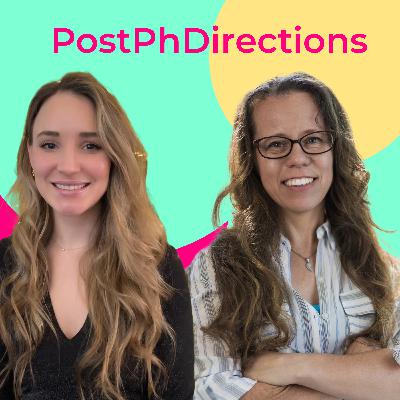
In this episode of PostPhDirections, I'm joined by my co-founder Angela Priest, who brings over 20 years of hiring experience across startups and big cooperates. We get into everything you need to know about the current job market — the honest, behind-the-scenes version.We cover:Why uncertainty has become the new normal for employers — and what that means for your job searchThe AI shift: what "AI native" means in job descriptions and why it matters for youWhy your data fluency is one of the most in-demand skills right now (and why most PhDs don't even realize they have it)The hottest roles for STEM PhDs in 2026: AI/ML, health tech, biotech & clinical researchThe #1 skill listed in 85% of job descriptions — and why PhDs often struggle with itHow to make interviewers actually want to hire you (the unspoken criteria nobody talks about)Why communication in industry means something completely different than it does in academiaIf you're a PhD or postdoc thinking about making the leap, this episode is full of raw, practical insight from someone who's spent decades in the hiring room.Connect with Angela Priest on LinkedInLearn more about Alma.me and our Job Accelerator Program: Follow Elena on LinkedIn, Instagram, TikTok and YouTube.If you found this helpful, share it with a fellow researcher — and please leave us a review. It's the easiest way to help other PhDs find this podcast. 💙

Comments

Download from Google Play

Download from App Store
 United States