


 Claim Ownership
Practical for Your Practice
Subscribed: 13Played: 112
Subscribe

© CDP 2021
Description
Three clinical psychologists and trainers at CDP come together to talk about the good, the bad, and the ugly of actually implementing Evidence-Based Psychotherapies (EBP’s). Practical for your Practice is a bi-weekly podcast featuring stories, ideas, support, and actionable intel to empower providers to keep working toward implementing EBP’s with fidelity and effectiveness. This project is sponsored by the Uniformed Services University (USU); however, the information or content and conclusions do not necessarily represent the official position or policy of, nor should any official endorsement be inferred on the part of, USU, the Department of Defense, or the U.S. Government.
97 Episodes
Reverse
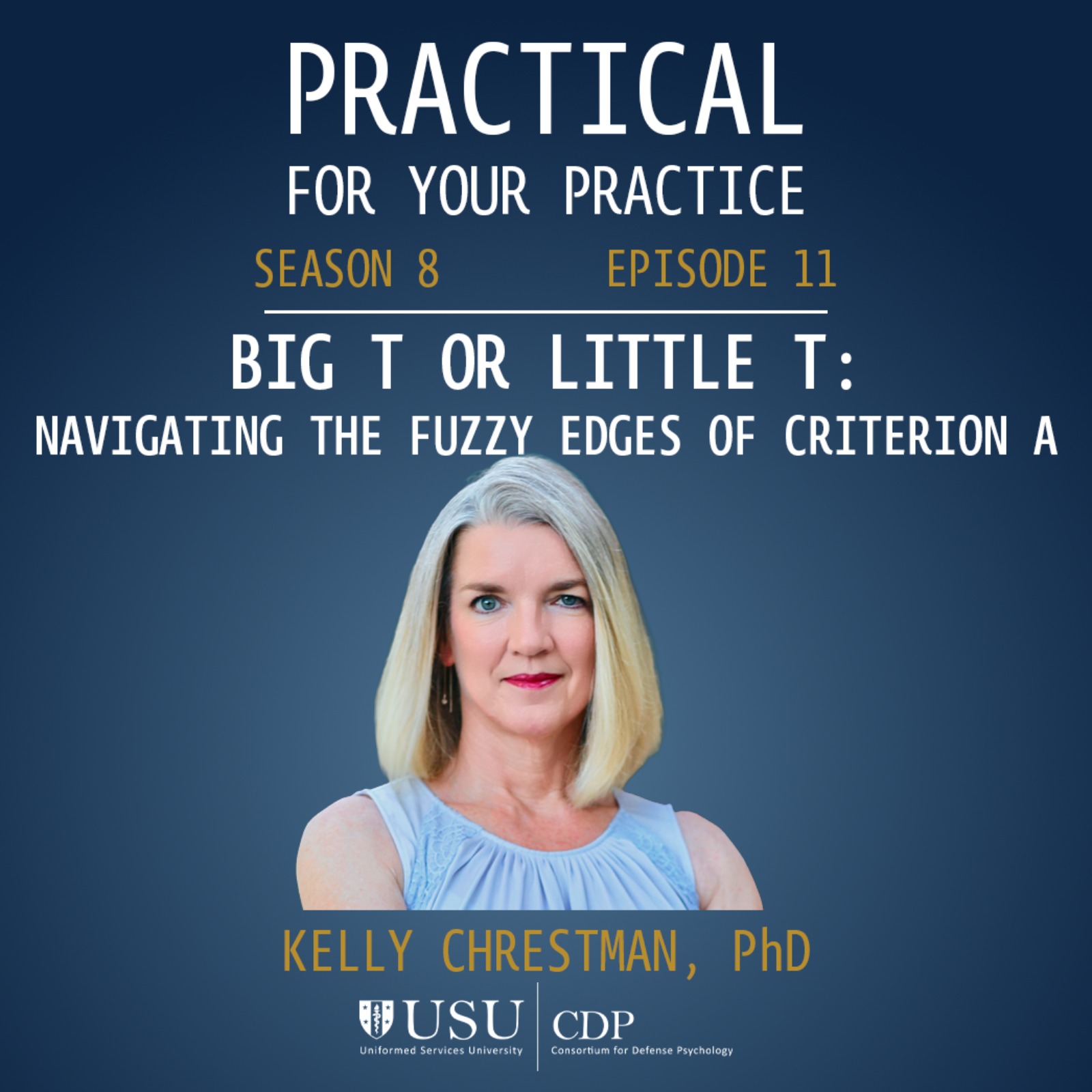
Accurately diagnosing PTSD is the first step in getting a patient connected with the best care. But understanding and applying Criterion A (of the DSM-5) can be a challenge for even the most experienced clinician. The process can give Goldilocks vibes: are you being too lenient or too strict with the definition of “trauma?” On this episode, Drs. Carin Lefkowitz and Kevin Holloway are joined by Dr. Kelly Chrestman, a subject matter expert in PTSD. She helps us navigate the blurry edges of Criterion A as we try to get it “just right.”Kelly Chrestman, Ph.D., is a clinical psychologist with over 30 years of experience specializing in evidence-based treatments for trauma and stress-related conditions. As a Senior Military Mental Health Psychologist at the Consortium for Defense Psychology (CDP), she provides consultation and training both domestically and internationally, concentrating on stress and trauma, Cognitive Behavioral Therapy (CBT), and Prolonged Exposure Therapy.She is co-author of Prolonged Exposure for Adolescents with PTSD and co-developed the PTSD Learning Center and Operation AVATAR, an immersive learning platform hosted in Second Life. Her work merges rigorous scientific research with culturally informed practices, aiming to translate psychological principles into practical, actionable, and accessible tools for practitioners.Resources mentioned in this episode: Brewin, C.R., Lanius, R.A., Novac, A., Schnyder, U., Galea, S., 2009. Reformulating PTSD for DSM-V: life after criterion A. J. Trauma Stress 22 (5), 366–373. https://doi.org/ 10.1002/jts.20443.Gradus, J.L., Galea, S., 2022. Reconsidering the definition of trauma. Lancet Psychiatry 9 (8), 608–609. https://doi.org/10.1016/S2215-0366(22)00196-1.Gradus, J.L., Galea, S., 2023. Moving from traumatic events to traumatic experiences in the study of traumatic psychopathology. Am. J. Epidemiol. 192 (10), 1609–1612. https://doi.org/10.1093/aje/kwad126.Marx, B.P., Hall-Clark, B., Friedman, M.J., Holtzheimer, P., Schnurr, P.P., 2023. The PTSD Criterion A debate: a brief history, current status, and recommendations for moving forward. J. Trauma Stress 37 (1), 5–15. https://doi.org/10.1002/jts.23007.Saraiya, T. C., Bauer, A. G., Banks, D. E., Brown, D. G., Jarnecke, A. M., Ebrahimi, C. T., & Bernard, D. L. (2025). Are we gatekeeping trauma? A conceptual model to expand criterion A for invisible, identity-based, and systemic traumas. Social Science & Medicine, 375, 118090. https://doi.org/10.1016/j.socscimed.2025.118090 Calls-to-action: Join us for consultation as you navigate the fuzzy edges of criterion A in your practice. https://cdp.usuhs.edu/resources/consultation-servicesShare your impactful moment in the comments or via https://www.speakpipe.com/cdpp4pSubscribe to the Practical for Your Practice Podcast

In this episode, hosts Drs. Jenna Ermold and Carin Lefkowitz welcome occupational therapists Staci Molinar and Michelle Luken for the podcast's very first deep dive into the world of Occupational Therapy (OT). Moving far beyond traditional views of OT as purely physical rehabilitation, Staci and Michelle reveal how OT acts as a powerful, practical bridge for mental health care, helping Service members and Veterans translate psychological skills into daily habits, routines, and real-world environments.The discussion spotlights the Burn In Model, a contemporary framework co-created by Michelle that reimagines burnout through the metaphor of a fire. Rather than viewing wellness as a passive state, the model focuses on actively stoking your inner flame by creating alignment across three core pillars: Being, Doing, and Belonging. Whether addressing transition out of military service, deployment stress, or provider fatigue, this conversation offers a refreshing, highly actionable approach to sustainable wellbeing and interdisciplinary care. There’s no single way to recover from burnout and stoking your fire starts with intentional, everyday choices like listening in and following Practical for Your Practice! Dr. Michelle Luken is an occupational therapist, scientist, and Military Veteran. She served for 10 years in the U.S. Army, including time as a Combat and Operational Stress Control OT supporting service member behavioral health, readiness, and human performance. Michelle is also the co-creator of The Burn In Model, a contemporary framework that helps people and organizations understand burnout, alignment, and what supports sustainable engagement in life and work. Staci Molinar is an occupational therapist, educator, and officer in the United States Army Reserve. Throughout her 13-year Army career, she has served primarily in the Combat and Operational Stress Control and Holistic Health and Fitness missions, including three overseas deployments supporting service member readiness and performance through behavioral health and wellness initiatives. Staci is currently a faculty member in the U.S. Army-Baylor Occupational Therapy Doctorate Program. Resources mentioned in this episode: https://www.burninnotout.com/ Calls-to-action: Share your impactful moment in the comments or via https://www.speakpipe.com/cdpp4pSubscribe to the Practical for Your Practice PodcastSubscribe to The Consortium for Defense Psychology Monthly Email

“Neurodiversity” sounds like a recent buzzword, but it’s just a succinct way to capture what we all know: everyone does not process information the same way. Many formal diagnoses fall under the umbrella of neurodivergence, including ADHD, autism spectrum disorders, and learning disabilities. But knowing the specific diagnosis is not necessarily as important as understanding how a person thinks, especially in the context of trauma recovery. Today we are joined by Shealyn Clinger, LCSW, who invites us to think about neurodiversity from a strengths-based and trauma-informed perspective. We start the conversation by defining neurodivergence before discussing the interplay with trauma exposure and suggestions for how to help patients on their path to trauma recovery. As always, we end with Actionable Intel to help listeners hone their skills.Shealyn Clinger, LCSW, is a licensed clinical social worker and Data Manager II at the Consortium for Defense Psychology, where she supports program evaluation and the translation of research into clinical practice. She is also the founder of Cerebral Counseling & Consulting, a private practice specializing in trauma and neurodiversity-affirming care. As a military spouse with both clinical expertise and lived experience, Shealyn is passionate about improving care for neurodivergent individuals and military-connected communities through practical, evidence-informed approaches.Resources mentioned in this episode: ADDitude Magazine: ADDitude - ADD & ADHD Symptom Tests, Signs, Treatment, Support Understood: Understood - For learning and thinking differencesNeurodivergent Insights: https://neurodivergentinsights.com/ Calls-to-action: Shift your perspective from “what’s wrong with this patient?” to “how do they process the world and how can I help them heal?”Conduct a comprehensive assessment for each patient, including a thorough review of developmental historyShare your impactful moment in the comments or via https://www.speakpipe.com/cdpp4pSubscribe to the Practical for Your Practice PodcastSubscribe to The Center for Deployment Psychology Monthly Email

Behavioral strategies get a lot of attention in the insomnia field, and with good reason – sleep restriction and stimulus control work quickly to get patients sleeping better. But what about those pesky thoughts that get in the way of good sleep? “I’ll be useless tomorrow!” “I’ll never be able to sleep normally!” “If I fall asleep right now, I’ll only get 4 hours of sleep!” Unhelpful cognitions fuel poor sleep and we’re ignoring a critical part of the equation if we don’t intervene with them. In fact, research suggests that working on sleep-related cognitions help patients maintain the benefits they make through behavioral interventions. Today we’re joined by Dr. Allison Harvey, an expert in the field of sleep disorders. She outlines strategies for how to intervene with the most common sleep-interfering cognitions. Join in as Carin and Dr. Harvey try to convince Kevin that insomnia treatment is fun!Allison G. Harvey, PhD, is a Professor, Licensed Clinical Psychologist and Director of The Golden Bear Sleep and Mood Research Clinic in the Department of Psychology, University of California, Berkeley. Dr. Harvey is a treatment development researcher who conducts research focused on understanding and treating sleep and circadian problems, mental health, and behavior change processes. She has published over 300 peer reviewed papers and chapters and authored three books. Her research is funded by the National Institute of Health. Dr. Harvey is a recipient of numerous awards including from an Honorary Doctorate from the University of Orebro, Sweden as well as the Lifetime Achievement Award from the Sleep Research Society and the Society for Behavioral Sleep Medicine.Resources mentioned in this episode: Dr. Harvey’s chapter introducing her cognitive model of insomnia. Harvey, A.G. (2002). A Cognitive Model of Insomnia. Behaviour Research and Therapy, 40, 869–893The Beck Institute for training in general cognitive therapy skills: www.beckinstitute.org Dr. Christine Padesky’s educational content on cognitive therapy: www.padesky.comPractical for Your Practice Podcast, S6E2: Don’t Attach Your Sleep Tracker to Your Ceiling Fan (and Other Helpful Tips from Insomnia Experts): https://cdp.usuhs.edu/podcast/practical-for-your-practice-don-t-attach-your-sleep-tracker-to-the-ceiling-fan-and-other-helpful-tips-from-insomnia-expertsDr. Bennet-Levy’s book on behavioral experiments: Bennett-Levy, J., Butler, G., Fennell, M. J. V., Hackmann, A., Mueller, M., & Westbrook, D. (Eds.). (2004). Oxford guide to behavioural experiments in cognitive therapy. Oxford University Press Calls-to-action: Share your impactful moment in the comments or via https://www.speakpipe.com/cdpp4pSubscribe to the Practical for Your Practice PodcastSubscribe to The Center for Deployment Psychology Monthly Email

The first 12 months after leaving the military can be an incredible window of opportunity, but it is also a uniquely high-risk time for a service member’s mental health. When the uniform comes off, Veterans don't just leave a job; they lose a built-in mission, a tight-knit community, and a structured way of living. In this episode, hosts Dr. Jenna Ermold and Dr. Kevin Holloway sit down with licensed psychologist and researcher Dr. Shannon Blakey to flip the script on how we support transitioning veterans. Instead of waiting for clinical distress or pathology to surface, Dr. Blakey shares how clinicians can use Behavioral Activation (BA) as a proactive super-tool for wellness promotion. Tune in to discover how to help Veterans build an internal "compass," translate rigid military strengths into civilian life, and navigate the unexpected identity shifts of life after service. Shannon Blakey, PhD, is a Research Clinical Psychologist at RTI International and co-founder of Redstart Psychological Services, PLLC. Dr. Blakey’s research focuses on thenature, prevention, and treatment of mental health problems and suicide risk, especiallyamong military and veteran populations. Her research has been supported by theNational Institutes of Health and U.S. Department of Defense (DoD), including anongoing DoD-funded project to adapt Behavioral Activation strategies into an upstreamwell-being promotion and suicide prevention program for use during the military-to-civilian transition. Dr. Blakey has published over 100 scientific articles and bookchapters and serves on multiple journal editorial boards. She is a North CarolinaLicensed Psychologist and maintains an active clinical practice delivering evidence-based psychotherapies to veterans and service members.Resources mentioned in this episode: Blakey, S. M., et al (2026, September 16). How to improve military transition outcomes through values-based activities. Blakey, S. M., et al (2025). Bringing veteran mental health promotion and suicide prevention efforts upstream: The THRiVE study protocol. Contemporary Clinical Trials, 158, 108100. Castro, C. A., & Dursun, S. (Eds.). (2019). Military veteran reintegration: Approach, management, and assessment of military veterans transitioning to civilian life. Academic Press. Lejuez, C. W., et. al (2011). Ten year revision of the brief behavioral activation treatment for depression: Revised treatment manual. Behavior Modification, 35(2), 111–161. Calls-to-action: Share your impactful moment in the comments or via https://www.speakpipe.com/cdpp4pSubscribe to the Practical for Your Practice PodcastSubscribe to The Center for Deployment Psychology Monthly Email

Comments

Download from Google Play

Download from App Store
 United States