


 Claim Ownership
Public Lectures from the Faculty of Law, University of Cambridge
Subscribed: 2,059Played: 85,485
Subscribe

© Faculty of Law, University of Cambridge
Description
The Faculty of Law has a thriving calendar of lectures and seminars spanning the entire gamut of legal, political and philosophical topics. Regular programmes are run by many of the Faculty's Research Centres, and a number of high-profile speakers who are leaders in their fields often speak at the Faculty on other occasions as well.
Audio recordings from such events are published in our various podcast collections. Video recordings are available via YouTube.
Audio recordings from such events are published in our various podcast collections. Video recordings are available via YouTube.
498 Episodes
Reverse

On Friday 28 November 2025, The Professor Trevor Allan FBA delivered the 202 Sir David Williams Lecture entitled "Neither Parliamentary Sovereignty nor Judicial Supremacy: The Rule of Law as the Rule of Common Right and Reason".The lecture begins at: 07:27The Sir David Williams Lecture is an annual address delivered by a guest lecturer in honour of Sir David Williams, Emeritus Rouse Ball Professor of English Law and Emeritus Vice-Chancellor of Cambridge University.More information about this lecture, including photographs from the event, is available from the Centre for Public Law website at:https://www.cpl.law.cam.ac.uk/sir-david-williams-lectures
Speaker: Professor Daniele Gallo, Luiss University, ItalyAbstract: The seminar, building upon Professor Gallo’s book, Direct Effect in EU Law (EU Law Library Series, OUP, 2025), will explore the uneasy trajectories of a transformative doctrine such as direct effect. By reassessing both the present and future of this legal and political construct, it will argue that such chameleon-like principle has evolved into a broader legal category than it was at the outset of the European integration process and that this development has been only partially captured by the CJEU. In doing so, Professor Gallo will revisit the no horizontal direct effect rule of contemporary directives and argue for its overcoming in light of the text, scope, and objectives of legal acts that are substantially different from those envisaged by Article 288 TFEU.For more information see:https://www.cels.law.cam.ac.uk/weekly-seminar-series
Is modern left-wing progressive politics to blame for the current rise of the far-right?This event was held by the Cambridge University Human Rights Law Society (CUHRLS) and Clare Politics Society, who hosted renowned human rights campaigner Peter Tatchell, best known for his decades-long work with LGBTQ+ and other global social justice movements which has shaped contemporary activism. Peter discussed the rising tide of the far right and why progressive politics has struggled to stem this tide and safeguard human rights in response.Peter Tatchell is one of the UK’s best-known human rights campaigners, with more than fifty years of work across LGBTQ+ rights, anti-racism, democracy, and social justice. Throughout his career he has taken on governments and institutions around the world, often using bold direct action to highlight abuses and push for reform: he helped found ‘OutRage!' in the 1990s and most recently leads the Peter Tatchell Foundation.For more on Clare Politics Society see their Instgram page. For CUHRLS see their Instagram page.
On 25 November 2025 Dr Susanne Brand delivered the CELH annual lecture on the topic 'Outlawry and its Consequences in Later Medieval English Law and Practice'.The Centre for English Legal History (CELH) was formally established in 2016 to provide a hub for researchers working in legal history across the University of Cambridge. The Centre holds regular seminars during academic terms, and an annual centrepiece lecture.To find out more, and download the accompanying presentation, please refer to:http://www.celh.law.cam.ac.uk/lectures
Speaker: Professor Catherine Malecki (University of Rennes)Even in the context of the future EU Omnibus Package and the EU Directive n°2025/794 of 14 April 2025 'Stop-the-Clock', Companies and there directors must face an increasing climate litigation and this change cannot go back 20 years of progress in Sustainable Corporate Governance which is on the way on both sides of the Atlantic Ocean and in Asia. Indeed, the European Commission has been releasing innovative and often complex regulations at a breakneck speed since 2018 (CSRD, CS3D, Taxonomy, to name a few) and it would be inconceivable to come back to 2001 at the time of the first European Recommendation on CSR and to ignore the EU Green Deal of 2019.Directors have to take into account negatives externalities and stringent obligations such as the Transition Plans. Even if the the next generation of sustainable board directors is well aware of Climate risks, several questions may arise : is there a need to reshape the board despite the EU Directive WoB Women in board of 23 November 2022? What about the pressure of the Stakeholders and the pressure of the Sustainable Strategy ? In France, in the wake of the Due Diligence Law of 27 March 2017, climate litigation is also increasing (for example TotalEnergies, CA Paris, 18 June 2024) and France was the first State Member for having implemented the CSRD in December 2023. Didn't all this happen too quickly ? Can we stop European time when tackling Climate change is rather a race against time? La Fontaine famous fable " the Hare and the Tortoise" is full of wisdom.Biography: Catherine Malecki is Professor of Private Law Rennes 2 University France and Member of the IUF (Institut universitaire de France) Fundamental Chair.For more information see the Centre for Corporate and Commercial Law website:http://www.3cl.law.cam.ac.uk/
Speaker: Professor Lilian Edwards, Emeritus Professor of Law, Innovation & Society, Newcastle Law School Biography: Lilian Edwards is a leading academic in the field of Internet law. She has taught information technology law, e-commerce law, privacy law and Internet law at undergraduate and postgraduate level since 1996 and been involved with law and artificial intelligence (AI) since 1985. She is now Emerita Professor at Newcastle and Honorary Professor at CREAte, University of Glasgow, which she helped co-found. She is the editor and major author of Law, Policy and the Internet, one of the leading textbooks in the field of Internet law (Hart, 2018, new edition forthcoming with Urquhart and Goanta, 2026). She won the Future of Privacy Forum award in 2019 for best paper ("Slave to the Algorithm" with Michael Veale) and the award for best non-technical paper at FAccT in 2020, on automated hiring. In 2004 she won the Barbara Wellberry Memorial Prize in 2004 for work on online privacy where she invented the notion of data trusts, a concept which ten years later has been proposed in EU legislation. She is a former fellow of the Alan Turing Institute on Law and AI, and the Institute for the Future of Work. Edwards has consulted for inter alia the EU Commission, the OECD, and WIPO.Abstract: The right to an explanation is having another moment. Well after the heyday of 2016-2018 when scholars tussled over whether the GDPR ( in either art 22 or arts 13-15) conferred a right to explanation, the CJEU case of Dun and Bradstreet has finally confirmed its existence, and the Platform Work Directive has wholesale revamped art 22 in its Algorithmic Management chapter. Most recently the EU AI Act added its own Frankenstein-like right to an explanation (art 86) of AI systems .None of these provisions however pin down what the essence of the explanation should be, given many notions can be invoked here ; a faithful description of source code or training data; an account that enables challenge or contestation; a “plausible” description that may be appealing in a behaviouralist sense but might be actually misleading when operationalised eg to generate a medical course of treatment. Agarwal et al argue that the tendency of UI designers, and regulators and judges alike to lean towards the plausibility end, may be unsuited to large language models which represent far more of a black box in size and optimisation than conventional machine learning, and which are trained to present encouraging but not always accurate accounts of their workings. Yet this is also the direction of travel taken by CJEU Dun & Bradstreet , above. This paper argues that explanations of large model outputs may present novel challenges needing thoughtful legal mandates.For more information (and to download slides) see: https://www.cipil.law.cam.ac.uk/seminars-and-events/cipil-seminars
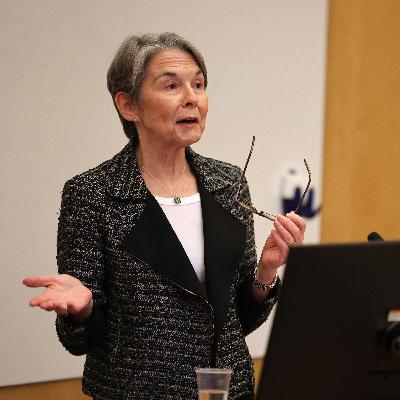
On Wednesday 12 November 2025 Professor Dame Sarah Worthington DBE, KC (Hon), FBA, FRSA delivered the second of three 2025 Hamlyn Lectures at the Faculty.The Hamlyn Lectures are normally delivered in the autumn and the annual Hamlyn Seminar, which marks the publication of the lecture, is usually held in London in the following spring.The lecture was on the title: 'The Paradoxes of Property: What do we Own and What can we Own?'For more about the Hamlyn Lectures see: https://law.exeter.ac.uk/about/thehamlyntrust/lectures/
Speaker: Dr Raphaële Xenidis, Sciences Po Law School, FranceAbstract: EU anti-discrimination law has been a subject of choice for critiques from various disciplines. One influential motif that has durably structured the critical analysis of EU anti-discrimination law is the distinction between formal and substantive equality. Substantive approaches seek to diagnose and remedy the disjunctions between formal equality frameworks and social realities. Yet, such critiques often remain implicit in their engagement with social theory, leaving the very notion and construction of ’social realities’ largely unexamined. This paper thus asks: How does the principle of non-discrimination mediate and produce specific forms of individual subjectivity, interpersonal relationships, institutional arrangements, material and spatial organisation and ultimately social order? How does it authorise the existence of certain subjects and groups while excluding and rendering others invisible? What 'forms of life' does EU anti-discrimination and its jurisprudential construction by the Court enable or preclude?For more information see:https://www.cels.law.cam.ac.uk/weekly-seminar-series
Speaker: Professor Ernest Lim (National University of Singapore)This presentation explores the external dimension of directors’ duties—whether directors can and should address climate impacts and other externalities even absent financial benefits to the company’s shareholders—in contrast to the shareholder value maximisation focus. Its significance stems from universal investors, the EU due diligence regime, and high emitting SOEs. I examine three arguments: UK nature clauses are constrained by shareholder primacy; US shareholder preference claims are undermined by financially driven activism; and SOE directors’ duties can align with state ownership (as shown in China).3CL runs the 3CL Travers Smith Lunchtime Seminar Series, featuring leading academics from the Faculty, and high-profile practitioners.For more information see the Centre for Corporate and Commercial Law website:http://www.3cl.law.cam.ac.uk/
Lecture summary: Over centuries and across continents, authoritarian governments have demonstrated a large appetite for international cooperation to target political opponents across borders. As the world’s premier body for international police cooperation, Interpol is not supposed to facilitate this kind of transnational repression -- and yet, in recent years, there is growing concern that authoritarian governments are abusing Interpol's tools. Interpol has taken meaningful steps to curb such abuse, but the durability of those protections is in doubt given the rising influence of authoritarian governments in that organization. The looming question is at what point universal multilateral cooperation with respect to law enforcement might cease to be viable.Kristina Daugirdas is the Francis A. Allen Collegiate Professor of Law at the University of Michigan Law School. She teaches and writes primarily in the fields of international law and institutions.Her scholarship currently focuses on international organizations, accountability mechanisms, and the ongoing evolution of the international legal system. She is a member of the editorial board of the International Organizations Law Review and the State Department’s Advisory Committee on International Law. She also serves as an adviser to the American Law Institute’s Restatement (Fourth) of Foreign Relations Law.In 2016–2017, Daugirdas was a visiting fellow at the Graduate Institute of International and Development Studies in Geneva and served as a consultant on public international law issues for the World Intellectual Property Organization. From 2014 to 2017, she co-authored the Contemporary Practice of the United States Relating to International Law: A section of the American Journal of International Law. In 2014, she was awarded the Francis Deák Prize for an outstanding article published in the American Journal of International Law by a younger author.Daugirdas has taken on significant leadership roles at the law school, including serving as Associate Dean for Academic Programming from 2021 to 2024. She also led a subcommittee of the Advisory Committee on the University of Michigan Principles on Diversity of Thought and Freedom of Expression.Prior to entering academia, Daugirdas was an attorney-adviser at the State Department’s Office of the Legal Adviser, receiving multiple honors for her service. As an attorney-adviser, she provided guidance on the negotiation and implementation of UN Security Council sanctions and amicus participation by the US government in lawsuits with foreign policy implications.Chair: Prof Fernando Lusa BordinThis lecture was given on 7 November 2025 and is part of the Friday Lunchtime Lecture series at the Lauterpacht Centre.
Speaker: Professor Bhamati Viswanathan, Visitor, Cambridge Law Faculty and Fellow at the Kernochan Center for Law, Media and the Arts at Columbia Law School Biography: Bhamati Viswanathan is a Senior Visitor at the University of Cambridge Faculty of Law and a Fellow (Non-Resident) at the Kernochan Center for Law, Media and the Arts at Columbia Law School (New York). Prior to joining the Cambridge Faculty of Law, she was Assistant Professor at New England Law | Boston, where she taught copyright law, artificial intelligence and the law, law and the visual arts, intellectual property law, and U.S. Constitutional law. She is the author of “Cultivating Copyright: How Creative Industries Can Harness Intellectual Property to Survive the Digital Age” (Routledge/Taylor & Francis Press). She currently holds an Edison Fellowship from the Intellectual Property Policy Institute at University of Akron Law School, under whose aegis she is writing a series of articles on the disparate impact of copyright law on women creators and women-centric work. She is also planning a book on the nexus of intellectual property and arts/culture in the age of artificial intelligence.Bhamati serves as Chair of the American Bar Association Intellectual Property Section: Visual and Dramatics Works Committee. She is a Faculty Advisor on the Copyright Alliance Academic Advisory Board. She serves as Faculty Partner to the News/Media Alliance. She is Education Advisor to the Volunteer Lawyers for the Arts (VLA)/ Massachusetts Arts and Business Council. She is also a Faculty Advisor to the Journal of the Copyright Society; and she was a Trustee of the Copyright Society, as well as Chair of its New England Chapter. She holds an S.J.D./LL.M. from University of Pennsylvania Law School; a J.D. from University of Michigan Law School; and a B.A. from Williams College. She is a competitive figure skater, violinist, and published poet/translator and lives in Boston.Abstract: The training of generativeAI models on ingested work is a hotly contested area of U.S. copyright law. In this Seminar, I will inquire whether such training may constitute “fair use” under the nonexclusive four-factor test of the U.S. Copyright Act. Currently, courts are wrestling with the fair use defense in several major cases, including Thompson Reuters v. ROSS Intelligence; Bartz v. Anthropic; Kadrey v. Meta; and the consolidated litigation of In re: OpenAI.Another open question is whether AI outputs infringe copyright in other works. Here, plaintiffs must establish that AI outputs infringe their works by passing the threshold of the “substantial similarity” test. I will discuss the test in the context of AI litigation, and will suggest that the relatively novel “market dilution” theory, focusing on harm caused by stylistically similar outputs, might be applied to weigh against a fair use defense for GenAI training. I will also address whether the theory of “vicarious liability” might be fruitfully brought to bear against certain genAI companies. Lastly, I will ask what action Congress can, or should, take, with a view to striking a fair balance between meeting the needs of innovative technologies and securing the rights of creative industries and creators. As an example, I will raise a recent proposal (in which I was involved) that Congress explicitly prohibit GenAI training on materials derived from digital repositories of unlicensed materials (so-called “shadow libraries”).For more information (and to download slides) see: https://www.cipil.law.cam.ac.uk/seminars-and-events/cipil-seminars
Speaker: Associate Professor Dora Neo (National University of Singapore)With the advancement of technology, delivery of financial services, such as payment services, can be achieved almost instantaneously. In the area of trade finance, however, banks have been less quick to harness technology for trade digitalisation. An important reason is that trade financing has historically been heavily dependent on the use of paper. While digitisation of trade documents is easily done, the digitalisation of trade finance requires a supportive legal framework to ensure that concepts like possession, which were developed in relation to tangible documents, can operate in the digital world. In the UK, this framework is now provided by the Electronic Trade Documents Act 2023 which has been described to be "one of the most important bills you have never heard of". Singapore instituted a similar framework by amending its Electronic Transactions Act in 2021. These legislative developments were based on the UNCITRAL Model Law on Electronic Transferable Records (MLETR), which has gained increasing global influence since its adoption in 2017. This seminar discusses how the landscape of trade financing affects the use of technology, analyses recent legal developments relating to electronic trade documents, and identifies remaining challenges for trade digitalisation.Biography: Dora Neo is an Associate Professor at the Faculty of Law, National University of Singapore. She was the founding Director of the Faculty’s Centre for Banking & Finance Law, which she led for some ten years from 2013. Her areas of focus include the modernisation of trade finance law, global developments in secured transactions law, consumer protection in the finance industry and contract law. Her publications include Trade Finance: Technology, Innovation and Documentary Credits (co-edited with C Hare, Oxford University Press); The Law and Practice of Documentary Letters of Credit (co-authored with E P Ellinger, Hart Publishing);Secured Transactions Law in Asia: Principles, Perspectives and Reform (co-edited with L Gullifer, Hart Publishing) and Studies in the Contract Laws of Asia V: Ending and Changing Contracts (co-edited with M Chen-Wishart and S Vogenauer, Oxford University Press, forthcoming). In Michaelmas Term 2025, she is an academic visitor at the Cambridge Law Faculty under the sponsorship of the Centre for Corporate and Commercial Law (3CL), and a Visiting Fellow at Wolfson College.3CL runs the 3CL Travers Smith Lunchtime Seminar Series, featuring leading academics from the Faculty, and high-profile practitioners.For more information see the Centre for Corporate and Commercial Law website:http://www.3cl.law.cam.ac.uk/
The Centre for European Legal Studies (CELS) hosts an annual public lecture in honour of Lord Mackenzie-Stuart, the first British Judge to be President of the Court of Justice. Among the eminent scholars of European legal studies invited to give the lecture are Professor Joseph Weiler, former Judge David Edwards of the European Court of Justice, and Advocate-General Francis Jacobs of the European Court of Justice. The texts of the Mackenzie-Stuart Lectures are published in the Cambridge Yearbook of European Legal Studies.The 2025-26 Mackenzie-Stuart Lecture was delivered by Professor Anand Menon, Director, UK in a Changing Europe, on the title 'Reflections on the Brexit Revolution' on 3 November 2025.Anand Menon is Director of the UK in a Changing Europe and Professor of European Politics and Foreign Affairs at King’s College London. He has written widely on many aspects of EU politics and policy and on UK-EU relations. He is a frequent contributor to the media on matters relating to British relations with the EU.Abstract: The outcome of the Brexit referendum was driven by many forces, including increasing frustration at an economic and political model that seemed to be failing far too many people. And the vote to Leave in fact provided a unique opportunity for this discontent to be addressed. The fact that it was not has merely contributed to the growing appeal of populism. And along the way, many of the things we took for granted about our country and the way it is governed have been challenged.Lecture begins at 03:52The slides are available at:PDF: https://resources.law.cam.ac.uk/cels/MSL_2025_26_slides.pdfPowerpoint: https://resources.law.cam.ac.uk/cels/MSL_2025_26_slides.pptxMore information about this lecture, including photographs from the event, is available from the Centre for European Legal Studies website at:https://www.cels.law.cam.ac.uk/mackenzie-stuart-lectures
Lecture summary: Most observers – at least in the West – agree that the twenty-first century has been particularly tumultuous. But while some explain the volatility of our times by reference to historical analogies, e.g. moments of power transition in the twentieth century, others claim that we are in a moment of polycrisis for which there is no precedent. In this talk I split the difference: mainstream International Relations is wrong to assume the twenty-first century will resemble the twentieth century, but there are other historical precedents we can use to better think about our current predicament.Ayşe Zarakol is Professor of International Relations at the University of Cambridge (Emmanuel College). She is the author of After Defeat: How the East Learned to Live with the West (Cambridge UP, 2011) and Before the West: The Rise and Fall of Eastern World Orders (Cambridge UP, 2022), and the editor of Hierarchies in World Politics (Cambridge UP, 2017). Before the We has won six awards, including the SSHA and ISA annual best book prizes. In 2024, she was elected to fellowship in the British Academy and the Academia Europea. Also in 2024, she received an Honorary Doctorate from the University of Copenhagen. At the moment, Zarakol is overseeing an international research collaboration on Global Disorder funded by a British Academy Knowledge Frontiers Grant. She is also one of the two Associate Editors of International Organization. Her next book, Ozymandias, is a world history of strongmen, aimed at a general audience. This book is under contract with William Collins (UK) and Grove Atlantic (US). Chair: Prof Surabhi RanganathanThis lecture was given on 31 October 2025 and is part of the Friday Lunchtime Lecture series at the Lauterpacht Centre.
Speaker: Dr Yin Harn Lee, Senior Lecturer in Law at the University of BristolBiography: Dr Yin Harn Lee is a Senior Lecturer in Law at the University of Bristol. Her research interests lie primarily in copyright law. A significant part of her research focuses on copyright and videogames, and she is also interested in historical aspects of copyright as well as the interface between intellectual property and personal property.Abstract: The exclusive right to control the copying or reproduction of a work has been described by one leading copyright treatise as ‘the most fundamental, and historically the oldest, right of a copyright owner’. The first British copyright statute, the 1710 Statute of Anne, conferred on rightholders the exclusive right to print and reprint their books. Since then, the right has expanded far beyond its legislative origins, and now encompasses acts of copying in both digital and analogue form, those that are both temporary and permanent, and those that are merely incidental to the use of the work. Scholars have expressed concern about the now-expansive scope of the right, and there have been calls to restrict the right (e.g. by removing ‘non-expressive copying’ and copying that does not enable the use of the material in question ‘as a work’) or to replace it altogether with a broad right of ‘commercial exploitation’.This paper will show that, while these proposals are laudable and inventive, they nevertheless encounter the same pitfalls as those faced by English courts in the eighteenth and nineteenth centuries when called upon to define the scope of what constitutes ‘copying’. It will argue that the root of the problem lies in the absence of stable, developed principles for defining the legitimate scope of the rightholder’s market, and that attempts at framing this as a question of statutory interpretation only obscure this fundamental fact.For more information see: https://www.cipil.law.cam.ac.uk/seminars-and-events/cipil-seminars
Harro van Asselt is the Hatton Professor of Climate Law with the Department of Land Economy, a Fellow and Director of Studies at Hughes Hall, and a Fellow with the Lauterpacht Centre for International Law, University of Cambridge. He is also Professor of Climate Law and Policy at the University of Eastern Finland Law School, and an Affiliated Researcher with the Stockholm Environment Institute.The Hatton Chair is the first endowed professorship in climate law in the United Kingdom. The aim of the Chair is to advance research and teaching with a view to strengthening legal responses to the ongoing climate crisis.The lecture was followed by a panel on 'The Prospects of Global Climate Law'Co-organised by the University of Cambridge and LUISS.
Speaker: Dr Julian Ghosh, Cambridge University Abstract: In this seminar Dr Ghosh will address what, post-Lipton are the rules for REUL/AL; examples of UK Court decisions which should but do not apply REUL/AL and will provide a useful template for future litigation.For more information see:https://www.cels.law.cam.ac.uk/weekly-seminar-series
Speaker: Professor Marc Steinberg (SMU Dedman School of Law)This presentation, based on Professor Steinberg’s June 2025 Oxford University Press book Corporate Director and Officer Liability — “Discretionaries” Not Fiduciaries, posits that corporate directors and officers are not fiduciaries. In fact, the liability standards that normally apply are too lenient to be identified as fiduciary. This mischaracterization is detrimental to the rule of law, contravenes reasonable investor expectations, and impairs the integrity of the financial markets. Therefore, Professor Steinberg calls for the removal of fiduciary status replaced with the adoption of a new and neutral term that conveys an accurate description: corporate directors and officers are “discretionaries”. This term accurately portrays the status of corporate directors and officers who held to varying standards of liability depending on the applicable facts and circumstances. From this perspective, Professor Steinberg’s presentation will address a broad range of important issues, including the duty of care, the business judgment rule, exculpation statutes, the duty of good faith, and the duty of loyalty. To date, this book has received excellent reviews and is generating thoughtful discussion on the propriety of continuing to view corporate directors and officers as fiduciaries.3CL runs the 3CL Travers Smith Lunchtime Seminar Series, featuring leading academics from the Faculty, and high-profile practitioners.For more information see the Centre for Corporate and Commercial Law website:http://www.3cl.law.cam.ac.uk/
Speaker: Professor Andrew Christie, University of MelbourneBiography: Professor Andrew Christie was the foundation appointment to the Chair of Intellectual Property at the University of Melbourne in 2002.He holds BSc and LLB (Hons) degrees from the University of Melbourne, a LLM from the University of London, and a PhD from the University of Cambridge (Emmanuel College). Admitted to legal practice in Australia and the United Kingdom, he has worked in the intellectual property departments of law firms in Melbourne and London. He is a former Fulbright Senior Scholar, and has held research and teaching appointments at the University of Cambridge, Duke University, the National University of Singapore, and the University of Toronto.Awarded 12 Australian Research Council grants and instrumental in winning other research funding in excess of $11 million, he has authored more than 120 publications, and delivered by invitation more than 180 public addresses in 20 countries, across all areas of intellectual property law. He has served on all of the Australian government’s advisory committees on intellectual property – the Copyright Law Review Committee, the Advisory Council on Intellectual Property, and the Plant Breeder’s Rights Advisory Committee – and has been an expert advisor to World Intellectual Property Organization on a number of occasions. He currently chairs the Trans-Tasman IP Attorneys Board, the regulator of the Australian and New Zealand patent attorney profession.Abstract: With more than 18 million patents for inventions in force across 140 jurisdictions, patents are a significant area of the law. However, the traditional justifications for having a patent system are incomplete, and do not take full account of developments in economic thinking that recognise the primary purpose of economics is to enhance human wellbeing. The primary purpose of patents should be likewise. There is sparse academic and policy literature on the relevance of wellbeing economics to patent policy, and what exists leaves unanswered many questions about how the patent system can be used to achieve this policy objective. This presentation answers those questions, by tracing the evolution of wellbeing economics, identifying the doctrinal levers available to implement patent policy, and providing practical examples of the application of those levers to ensure the patent system incentivises innovations that advance wellbeing.For more information see: https://www.cipil.law.cam.ac.uk/seminars-and-events/cipil-seminars
International organizations law has always revolved around the relationship between the organization and its member states. This has proven to be of some use, but leaves important gaps unaddressed. What, e.g., about purely international affairs (think judicial review, think relations between organs)? And it ignores the existence of a vast external world. By concentrating solely on the relations with member states, it proves difficult, perhaps impossible, to hold international organizations to account for their acts affecting third parties, and equally difficult to make sense of relations between international organizations inter se. By shifting the perspective to relations with the private sector, perhaps it might be possible to come to a better, more comprehensive understanding of international organizations than is currently provided by both law and theory.Jan Klabbers was educated in international law and political science at the University of Amsterdam, where he also defended his doctoral thesis. In 1996 he was appointed professor of international law at the University of Helsinki, a position he recently left to take up the Whewell Chair in Cambridge. His research focuses mostly on the law of treaties and the law of international organizations – today’s talk taps into his current, ERC-sponsored PRIVIGO project.Chair: Prof Surabhi Ranganathan, Centre Deputy DirectorThis lecture was given on 10 October 2025 and part of the Friday Lunchtime Lecture series at the Lauterpacht Centre.

Comments

Download from Google Play

Download from App Store
 United States