Discover
Red Planet Live
Red Planet Live
Author: The Mars Society - Red Planet Live
Subscribed: 13Played: 225Subscribe
Share
© The Mars Society - Red Planet Live
Description
A raw, off-the-cuff look into all things Mars. We will talk with planetary scientists, STEM field experts, commercial space representatives, and space advocates who all have a deep passion for Mars.
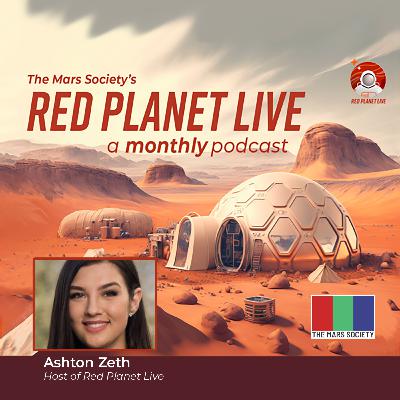
Ashton Zeth is the new host of our 60-minute video broadcast on behalf of the Mars Society and will lead and moderate tantalizing discussions with our virtual guests as we delve into the questions and work being done in order to make the human exploration and settlement of the Red Planet a reality.
For more information about the Mars Society, visit www.MarsSociety.org
Ashton Zeth is the new host of our 60-minute video broadcast on behalf of the Mars Society and will lead and moderate tantalizing discussions with our virtual guests as we delve into the questions and work being done in order to make the human exploration and settlement of the Red Planet a reality.
For more information about the Mars Society, visit www.MarsSociety.org
51 Episodes
Reverse
The Mars Society's live podcast, RedPlanetLive interviews the people instrumental to settling and exploring Mars. In this episode Ashton Zeth interviews a panel from the University Rover Challenge 2023.
Ashton interviews Kevin Sloan, the director of The University Rover Challenge for the Mars Society.
The Mars Society's live podcast, RedPlanetLive interviews the people instrumental to settling and exploring Mars. In this episode Ashton Zeth interviews Emily Calandrelli, an American science communicator, former MIT engineer, and the host and an executive producer of Xploration Outer Space and Emily's Wonder Lab.
The Mars Society's live podcast, RedPlanetLive interviews the people instrumental to settling and exploring Mars. In this episode Ashton Zeth interviews Marcia Rieke, the Principal Investigator of the NirCam James Webb Space Telescope and Regents Professor of Astronomy at the University of Arizona.
he Mars Society's live podcast, RedPlanetLive interviews the people instrumental to settling and exploring Mars. In this episode Ashton Zeth interviews James Burk, the Executive Director of the Mars Society.
James Burk, Executive Director, The Mars Society
James Burk is the Executive Director of the Mars Society, which is the largest and most active Mars advocacy group in the world. He has volunteered with the Mars Society for over 25 years and has occupied the role as Executive Director for the past year and a half. James is also a member of the organization's steering committee and served as Director of Information Technology from 2011 through 2022. As part of this, he helped create the group's MarsVR project, a digital twin VR environment of Mars Desert Research Station (MDRS) in Utah.
In addition, James is a veteran analog astronaut, having served on multiple crew missions at MDRS and is currently commanding Crew 261 at the facility until May 13th, so he'll be providing us with a firsthand account of and taking your questions about his recent visit "to Mars" during our May 16th podcast.
On our 4th episode of the Red Planet Live reboot, we will interview Jim Green live with audience Q&A.
We invite you to submit your questions to Dr. Green during the podcast. He's ready to answer anything NASA related, having spent 40 years working in senior positions at the agency.
James Green, Chief Executive Officer, Space Science Endeavors LLC
Jim Green has worked at NASA for 42 years before retiring in December 2022. He received his Ph.D. in Physics from the University of Iowa in 1979 and worked at Marshall Space Flight Center, Goddard Space Flight Center, and NASA Headquarters.
During Jim’s long career at NASA, he has been NASA’s Chief Scientist and was the longest serving director of the Planetary Science Division with the overall programmatic responsibility for the New Horizons spacecraft flyby of Pluto, the Juno spacecraft to Jupiter, and the landing of the Curiosity rover on Mars, just to name a few. Jim has received the NASA Exceptional Achievement Medal for the New Horizons flyby of the Pluto system and NASA’s highest honor, the Distinguish Service Medal.
He has written over 125 scientific articles in refereed journals and over 80 technical and popular articles. In 2015, Jim coordinated NASA’s involvement with the film The Martian. In 2017 Asteroid 25913 was renamed Jamesgreen in his honor.
RED PLANET LIVE is a monthly live podcast from The Mars Society--Ashton Zeth interviews the people instrumental in exploring and settling Mars. The show will focus on a wide variety of topics, including Mars and space exploration, STEM education, technology, women in science, and much more, with exciting and open discussions involving experts in these respective fields.
The Mars Society's live podcast, RedPlanetLive interviews the people instrumental to settling and exploring Mars. In this episode Ashton Zeth interviews Kristine L Ferrone, the commander of MDRS Crew 269 (Aerospace Corporation) and some crew members about their MDRS mission and more!
The Mars Society's live podcast, RedPlanetLive interviews the people instrumental to settling and exploring Mars. In this episode Ashton Zeth interviews Rick Tumlinson from Earthlight Foundation.
RED PLANET LIVE is a monthly live podcast from The Mars Society--Ashton Zeth interviews the people instrumental in exploring and settling Mars. The show will focus on a wide variety of topics, including Mars and space exploration, STEM education, technology, women in science, and much more, with exciting and open discussions involving experts in these respective fields.
On our first episode of the reboot of Red Planet Live, our host, Ashton Zeth, will interview Dr. Sarah Milkovich from JPL about her work on a variety of exciting space missions and more!
Dr. Sarah Milkovich is a NASA-JPL planetary geologist & systems engineer who currently works on the Mars Perseverance rover mission. She specializes in the science operations of robotic spacecraft and has spent over 15 years exploring the solar system with a variety of spacecraft.
Ashton Zeth is the host of the Mars Society's video podcast Red Planet Live. She serves as a Mars Society Ambassador and is a long-time space enthusiast with a background in strategic communications, sales, business development and public speaking.
Bring your questions for Dr. Milkovich about all things related to Mars Perseverance rover and robotic spacecraft, as well as how we can use robotics on the Red Planet for our next RPL broadcast on January 17th.
In this episode Ashton Zeth hosts an interview with Dr. Robert Zubrin, Founder and President of the Mars Society. Dr. Robert Zubrin announces the formation of the Mars Technical Institute and is interviewed by Alan Boyle of GeekWire.
🚀 In this episode: Ashton Zeth sits down with Casey Dreier — Chief of Space Policy at The Planetary Society — joins us to dig into why the search for life should be the guiding star of U.S. space policy. Casey breaks down how advocacy actually works in Washington, how NASA’s science budget is hanging in the balance, and what space lovers can do right now to help protect the future of exploration.We cover:🌌 Search for life as policy: Why astrobiology and exploration aren’t just cool science — they are the most enduring driver of public and political support for NASA.⚖️ Politics & NASA leadership: What it means that Jared Isaacman may bring energy and big expectations to the NASA Administrator role, and the real dynamics of confirmation and bipartisan support.🧠 People pleasing and political strategy: How leaders navigate both sides of the aisle — including big personalities and unexpected allies.📉 NASA Science under threat: From proposals to cut nearly half of NASA’s science funding to grassroots advocacy, we talk real numbers and real stakes. The Planetary Society’s Save NASA Science campaign has mobilized hundreds of advocates and worked with dozens of partner organizations to bring space science defenders to Capitol Hill.Planetary Society : https://www.planetary.org/📣 Planetary Society advocacy tools:2025 Planetary Society Impact Report --➡️ 🔗 https://www.planetary.org/about/our-impact/2025-impact-report➡️ 🔗 Save NASA Science Action Hub — https://www.planetary.org/save-nasa-s...➡️ 🔗 NASA Science Spending Tracker (interactive map) — https://dashboards.planetary.org/nasa...➡️ 🔗 Planetary Radio: Space Policy Edition — (check ThePlanetary.org for latest episodes & archives)➡️ 🔗 The Space Advocate Newsletter — sign up at https://www.planetary.org/space-advocate📆 DAY OF ACTION APRIL 19th-20th, 2026: In Washington, D.C., an annual advocacy event where space enthusiasts meet with Congress members to push for strong space science funding and exploration, with registration opening with early bird discounts and offering training and organized meetings with lawmakers. 🎙️ Don’t forget — subscribe to Casey’s Planetary Radio: Space Policy Edition and sign up for the monthly policy newsletter to stay informed and get involved. Your voice matters in shaping America’s space future!👇 Hit like, comment your biggest takeaway, and subscribe for more space policy insights!
Dr. Robert Zubrin returns to Red Planet Live with major updates from the Mars Society and unfiltered insight into the future of space exploration. In this wide-ranging conversation, Zubrin shares his candid perspective on incoming NASA Administrator Jared Isaacman and raises serious concerns about what he describes as an ongoing assault on science—examining the implications for cornerstone missions including Hubble, the James Webb Space Telescope, Voyager, and more.The discussion also explores the state of Mars analog research, with updates on Flashline Mars Arctic Research Station, the Mars Desert Research Station (MDRS), and the newly established HOPE analog station in Ladakh, India. Zubrin closes by previewing the 2026 International Mars Society Convention, returning to USC in Los Angeles.Bold ideas, hard truths, and a relentless focus on the road to Mars. Onto Mars! 🚀
🎙️ Exclusive ESCAPADE Mission Update with Rocket Lab’s Morgan ConnaughtonIn this episode, we sit down with Morgan Connaughton, Rocket Lab’s Vice President of Communications, for a wide-ranging and inspiring conversation about storytelling in spaceflight—and she brought us an EXCLUSIVE update straight from the ESCAPADE mission to Mars.Morgan shares the behind-the-scenes excitement as Rocket Lab successfully completed a brand-new 13-second trajectory correction burn on the Blue spacecraft, with Gold scheduled for December 8. She walks us through how her team plans communications years in advance, and how you can be intimately involved in the success of a mission without ever touching a piece of hardware.We explore Rocket Lab’s famously lean comms team—just seven people creating videos, graphics, mission names, PR, and social content with the same intensity as the engineers designing the rockets. Morgan also talks about the joy and chaos of going public, the challenge of maintaining culture across 3,000+ employees, and the values that guide Rocket Lab’s approach: fierce efficiency and doing the impossible.She reflects on the art of mission storytelling, the importance of visuals in space history (including why the Moon landing broadcast still matters), and the rise of aspiring rocket photographers in New Zealand capturing Electron’s launches.We also dive into fan-favorite topics like:How her team comes up with Rocket Lab’s legendary mission namesThe adrenaline of the helicopter catch attemptESCAPADE’s twin spacecraft, Blue and Gold, and their journey to study Mars’ magnetosphereMorgan’s path is a testament to creating opportunity through passion, vision, and storytelling.This is one of our most inspiring episodes yet—and Rocket Lab’s ESCAPADE exclusive makes it one for the history books.Morgan Connaughton's LinkedIN:https://nz.linkedin.com/in/morgan-connaughton-4a211835Rocket Labhttps://rocketlabcorp.com/Escapadehttps://science.nasa.gov/mission/escapade/
Exploring New Worlds: Dr. Sara Seager on Venus, Exoplanets, and Life Among the CloudsIn this episode of Red Planet Live, MIT astrophysicist Dr. Sara Seager takes us on a breathtaking journey through the frontiers of planetary science—from the acid clouds of Venus to the icy oceans of Enceladus, and even the methane lakes of Titan.Dr. Seager reveals why Venus, often overlooked, is one of the most thrilling destinations for future missions. She discusses the possibility of life within its sulfuric acid clouds, where stable biomolecules could persist despite the harsh chemistry. Her team’s latest findings continue to show a phosphine signal with 4.8-sigma confidence, renewing excitement about potential biological activity in our neighboring planet’s skies.We also explore the power of small but mighty missions, including Rocket Lab’s upcoming Venus probe and Asteria, the CubeSat that proved precision astronomy can thrive on a shoestring budget. Dr. Seager shares her insights on TESS, the Transiting Exoplanet Survey Satellite, which at its peak was discovering up to 100 planet candidates a month—a quiet revolution in the search for other worlds.From Sub-Neptune exoplanets like K2-18b, showing signs of life with dimethyl sulfide in its hydrogen-rich atmosphere, to her visionary idea of Starshade, a large space telescope, Dr. Seager paints a hopeful picture of humanity’s search for life beyond Earth.We also touch on her Seager Equation—a parallel to the Drake Equation—and her book The Smallest Lights in the Universe, which reminds us that discovery is as much about human connection as it is about science.Join us as we uncover why the most “underdog” worlds—and missions—often hold the brightest potential for discovering life in the cosmos.Dr. Sara Seager's Links:https://www.saraseager.com/professionalbiographyVenus : https://www.morningstarmissions.space/https://www.projectstarshade.com/Sara's memoir The Smallest Lights in the Universe: A Memoirhttps://www.amazon.com/Smallest-Lights-Universe-Memoir/dp/0525576258
🎙 Ashton Zeth sits down with James Burk, Executive Director of the Mars Society, to share updates on the newest analog station HOPE in Ladakh, India (with ISRO as partners), record participation at MDRS, plans for the upcoming 2025 Mars Society Convention at USC, the launch of the new Mars Society Research Journal, and exciting developments from the Mars Technology Institute.🌍 Highlights:Massive participation at MDRS this seasonLaunch of the HOPE Analog in LadakhMars Society Convention 2025 — October 9–11 at USC (don’t miss Rob Manning at the Friday Night Banquet!)Updates from the Mars Technology Institute and new collaborations like Purdue UniversityDiscussing what's next in Mars exploration📅 Preliminary Convention Schedule (subject to change): View Here---Links --Journal of Space Analog Researchhttps://jsar.spaceHOPE analog Announcement:https://www.marssociety.org/news/2025/09/16/indias-first-crewed-mars-analog-launches-with-protoplanet-isro-the-mars-society/The Mars Society Convention 2025https://www.marssocietyconference.orgSponsor the upcoming convention in October: https://www.marssocietyconference.org/sponsorsFour Sponsorship Levels:GoldSilver BronzeLogo Only!Flashline Analog in the Arctichttps://fmars.marssociety.org/
In this episode, we sit down with Dr. Bhavya Lal, space policy leader, MIT alum, PhD from George Washington University, and recipient of NASA’s Distinguished Service Medal. After serving in senior leadership at NASA, Dr. Lal returned to RAND: School of Policy to continue shaping the conversation on national space strategy.Our discussion spans some of the most urgent issues in space today: the growing orbital debris problem, the need for a shared global dataset, and the tension between America’s resources and ambitions in space. She emphasizes why strategic coherence and bipartisan commitment are essential for credibility and long-term success.We also talk about the power of books to shape perspective, highlighting George R. Stewart’s Earth Abides — a life-changing novel that offers an “anti-history” of collapse and resilience, and what it teaches us about humanity’s fragile place on the cosmic shore.
🚀 Episode: Matt Gjertsen – From the Flightline to SpaceX to StartupsMatt Gjertsen has lived a life that blends military discipline, startup hustle, and a love for space. From early dreams of going to Mars, to serving as an Air Force instructor pilot, to shaping HR and training during SpaceX’s Crew Dragon era — his path has been anything but ordinary.Now, through his own leadership courses and podcast, Matt explores what makes great teams tick — from the grind of late nights at startups to mission-focused endeavors. In this conversation, he shares how his military background gave him unique insights into building high-performing teams, why space still pulls at his heart, and how we can intrigue the world beyond the space bubble.🌌 Expect talk of leadership, resilience, space stations, and the culture that pushes humanity further.🎧 Tune in if you want to know what it takes to lead where it matters most — whether in the cockpit, the boardroom, or orbit.Matt's Links:https://www.linkedin.com/in/matthewgjertsenhttps://bettereverydaystudios.com/Host / Producer of Leadership Launchpad Podcasthttps://leadershiplaunchpad.captivate.fm/listen
In this episode, space expert Leonard David dives into the evolving landscape of space law on the Moon, highlighting growing conflicts—especially with China—and framing it as the new space race. He shares insights from his unique background working near the historic Atlas rocket and discusses the impact of funding cuts during the Trump administration on space exploration. Leonard also breaks down the latest news about plans to deploy a nuclear reactor on the Moon and what this means for future lunar missions. Don’t miss this timely conversation on the challenges and ambitions shaping humanity’s next giant leap.
A Stellar Chat with Ad Astra Su, Galactic Gal, and Astro AlexandraJoin us for a captivating journey back to our July 15th episode, featuring an incredible trio of space communicators: Ad Astra Su, Galactic Gal, and Astro Alexandra! This special conversation offered a unique glimpse into the world of an engineer working on lunar payloads at a top aerospace company, exploring the delicate balance of privacy while maintaining a prominent social media presence. Our guests also shared exciting insights into their next big adventures, both on Earth and beyond. Tune in for an inspiring and educational discussion that truly explored the vastness of the universe and the personal journeys within it.Find them on Social Media & the web:https://www.thegalacticgal.comhttps://www.astroalexandra.comhttps://www.instagram.com/adastrasu/?hl=en
Join us for this fascinating episode recorded July 1st, where we sit down with Crew 315 from the Mars Desert Research Station (MDRS). Our guests —🌟 Dave Laude (Commander)🔧 Michael Andrews (Crew Engineer)🩺 Urban Koi (Health & Safety Officer)🎨 Tim Gagnon (Crew Artist; also a KSC Artist — kscartist.com)— share their personal inspirations and reflections from their two-week analog Mars mission.👨🚀 What you'll hear in this episode:🚀 The story behind the 100cameras experiment — a unique photography initiative fostering connection, reflection, and community through images captured during isolation and confinement.👨🍳 How the crew bonded over taking turns cooking meals and navigating life in close quarters under Martian simulation.📸 Tim Gagnon’s insights on blending art, science, and space exploration as part of NASA’s creative community.🤝 Tales of teamwork: Helping a stranded van in the Utah desert while maintaining sim integrity.🌱 Urban Koi tells us about receiving NASA funding for her MUSHROOM FORGE initiative.👉 Learn more about Crew 315’s mission:🔗 Final Mission Summary – MDRS Crew 315🔗 Tim Gagnon’s KSC Artist Site🔗 Urban Koi's Instagram
From Pathfinder to Perseverance: A Planetary Scientist’s Journey 🔍 Origin Story: A Spark from the MuseumA childhood visit to the Air and Space Museum sparked a lifelong love of space. Inspired by the Pathfinder mission and an exhibit on the Moon. Declared: “I’m going to discover water on the Moon.” Katie determined: “I want to work on another planet.” From Caltech to JPL, now as acting project scientist for Perserverance. Katie has been working on Perseverance rover, now 4.5 years into the mission.Carries ~40 sample tubes.32 filled, 7 left—final stages of a historic sample collection.Decisions now more deliberate with remaining tubes.Once a lake with rivers, Jezero Crater offers strong evidence for past water.Home to sedimentary rocks, excellent for preserving signs of ancient environments.Special focus on carbonates—formed from surface water + CO₂:Preserve unique environmental signals.Key to understanding Mars’ paleoclimate.Sample with "leopard spots"—dark rims, light interiors.Possible signs of oxidation-reduction reactions.These could hint at the presence of microbial life.And much more ! Tune into this episode to hear more from the Acting Project Scientist for the Perserverance rover at NASA's JPL.