


 Claim Ownership
Red Thread Toolbox with Jenna Redfield
Subscribed: 35Played: 850
Subscribe

© Jenna Redfield
Description
How to optimize your life from the inside out! The tools, tactics & techniques to constantly improve your life, business and marketing.
Sharing extended interviews from the Jenna Redfield YouTube channel, this podcast will deep dive into systems and tools to help you organize your online life.
jennaredfield.substack.com
Sharing extended interviews from the Jenna Redfield YouTube channel, this podcast will deep dive into systems and tools to help you organize your online life.
jennaredfield.substack.com
265 Episodes
Reverse
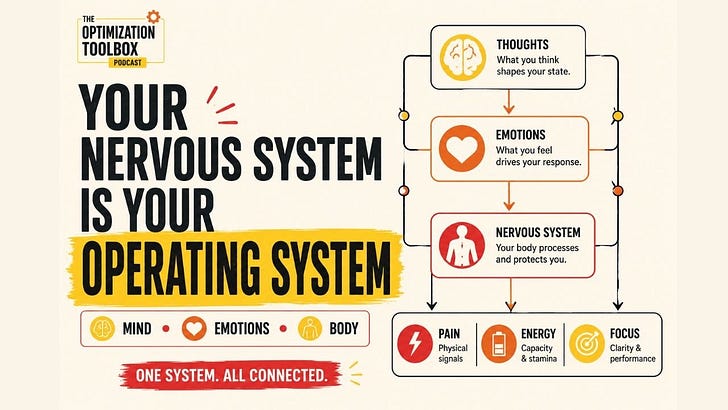
The Optimization Toolbox by Jenna Redfield is a reader-supported publication. To receive new posts and support my work, consider becoming a free or paid subscriber.Before I forget, tomorrow is this month’s Notion Workshop all about creating your Notion DashboardGet Tix hereIf you are a paid member, get the discount code in last week’s issueHey friends — welcome back to Optimization Toolbox.I want to talk about something I’ve been circling for a while: we’re so good at treating life like a technical problem.If something hurts, we want the fix.If something feels hard, we want the hack.If our brain feels messy, we want the system.But a lot of what we’re dealing with isn’t “technical.” It’s nervous system.It’s stress that didn’t finish its cycle.It’s emotion we didn’t have space to feel.It’s our bodies doing their job: protecting us, bracing for impact, storing what we couldn’t process in the moment.And that’s why today’s episode felt worth sharing — because it’s a reminder that sometimes the most helpful “tool” isn’t another strategy.Sometimes it’s learning how to listen to what your body has been carrying.Here’s what you’ll get in this issue:* why I brought Kevin Miles on the podcast* what his work is* the biggest takeaways to listen for when you hit play* how this connects to my ADHD → health → genetics rabbit hole (and why it changed my life)Why this conversation belongs on Optimization ToolboxOptimization Toolbox has always been about tools — not just apps and templates, but tools that make neurodivergent life feel more navigable.And one of the “tools” I don’t see talked about enough in neurodivergent spaces is body work.Not in a spa-day way.In a nervous system support way.In a “my body is carrying stress I can’t talk myself out of” way.So when I say I want better systems, what I really mean is: I want supports that help me live inside a sensitive system without constantly white-knuckling it.That’s why I wanted this episode to exist publicly — because if you haven’t already fallen down the somatic / nervous system rabbit holes, you might not even know this kind of work exists.How I met Kevin (and why I brought them on the show)This week’s podcast episode is with Kevin Miles — someone I met at a networking event and immediately started nerding out with about health.And I know you’ve seen me on a health journey the last couple of years, so you know I’m always collecting new frameworks and asking a million “wait, but what about this?” questions.Kevin became one of those people I kept coming back to — not just as a practitioner, but as someone I wanted to talkto about health.At some point I booked a session with them… and it completely blew my mind.I kept coming back. And back. And back.And now I just feel like I have to share them with you — because Kevin is genuinely wise and valuable, not only here in the Twin Cities (they’re in Edina) but also for the broader internet community.What Kevin actually does (in real-life terms)I think the best way I can describe Kevin’s work is this:It’s not chiropractic.It’s not Reiki.It’s not therapy — but it can be emotional.It’s somatic work in the sense that your body participates. Your nervous system participates. Your emotions (even the ones you’ve outgrown intellectually) participate.One of the core ideas in the episode is that your muscles can be used as information—a way of checking what your nervous system is doing under the surface.Kevin describes it as a kind of interpretation work:* your body is already running protection programs (tightness, shutdown, pain, fatigue, inflammation)* sometimes the “problem” isn’t where the pain is* and sometimes what looks physical has a big emotional component (because the nervous system doesn’t separate them neatly)I used to jokingly call Kevin “my healer,” but honestly a more accurate description is:someone who helps you interpret what your body is doing.Because the vibe isn’t “Kevin fixes you.”The vibe is: “Let’s pay attention to the signals and see what your system is responding to.”And honestly? That framing alone has changed how I treat my own symptoms. Not as enemies. Not as inconveniences. As communication.What I’m taking from Kevin (and what to listen for in the episode)If you listen to the episode, here are a few of the biggest lessons Kevin shared that I keep coming back to:* You’re not broken — you’re getting signals. A symptom is often the body trying to protect you, not punish you.* Pain is pain. Your brain doesn’t neatly separate emotional pain from physical pain — it responds to “threat” either way.* The body keeps the receipt. Things can be buried/subconscious and still show up as tension, inflammation, tightness, fatigue, shutdown.* Healing needs permission. If your nervous system doesn’t feel safe, it won’t accept change — even if your brain “wants” it.* Root cause > band-aids. Quick fixes can mute the signal, but they don’t always resolve why the system is flaring in the first place.* The goal isn’t intensity — it’s regulation. Sometimes the most powerful shift is a small downshift (a sigh, a swallow, a softening).As you listen, notice how often Kevin is basically doing one thing: helping people learn the language their body is already speaking.The thing somatic work keeps reminding me: your body is holding the storyOne of the simplest things Kevin said is the thing that keeps echoing in my head:Your brain doesn’t really differentiate between emotional pain and physical pain — it just registers pain.And I keep thinking about how much of our culture is trained to chase the technical explanation first.What’s the diagnosis. What’s the protocol. What’s the supplement. What’s the productivity system.But so many of the things that run our lives aren’t “technical problems” — they’re unseen emotional experiences that never got felt all the way through.And when they don’t get felt, they don’t disappear. They just get stored.Tension. Tightness. Inflammation. Shutdown. Fatigue. “Random” symptoms that keep showing up no matter how many to-do lists we perfect.Because if you’ve ever been told “it’s all in your head,” the rebuttal isn’t “no it isn’t.”The truth is more annoying and more hopeful:Your head is in your body.Somatic work is one of the first things that helped me take that sentence seriously — not as a metaphor, but as a map.In the same way a chiropractor can adjust what’s out of alignment in your spine, sometimes what’s out of alignment is emotional.Sometimes you don’t need another explanation — you need an emotional release. An adjustment. A nervous system “exhale.”That’s what I mean when I say this kind of work is less about “fixing you” and more about helping your system finally process what it’s been carrying.This is also why the “permission” part matters so much.Not forcing change.Not muscling your way into healing (pun intended).Permission.Because if your nervous system doesn’t feel safe, it won’t accept the update.And then — from that place — you can actually get to root cause instead of just adding another band-aid on top of a signal.Neurodivergence, stress, and nervous system dysregulationThis is where I want to speak directly to the neurodivergent folks reading.A lot of us are walking around with nervous systems that are:* more sensitive to stimulation* more reactive to stress* more likely to get stuck in overwhelm* better at noticing pattern… and also better at noticing threatWhich means a “small” stressor can become a full-body event.Not because you’re dramatic.Because your system is tuned differently.And when you’ve spent years coping (masking, pushing through, over-functioning, under-resting), your body can slip into dysregulation faster — and stay there longer.So you don’t just get anxious — you get tense. You don’t just feel stressed — you get inflamed. You don’t just feel overwhelmed — you get shut down.We are electric beings. Chemical beings. Pattern-recognition beings.And when the system is overloaded, it doesn’t only show up as thoughts. It shows up as sensations.My genetics rabbit hole (and why it actually made me feel kinder to myself)If I had to timestamp this era of my life, it starts in 2020.That’s when I went down the ADHD / neurodivergent rabbit hole — trying to understand my brain, my patterns, my coping strategies, and why certain things felt so much harder for me than they seemed to be for other people.Then in 2022, my body basically raised its hand like: “Hey. We need to talk.”Health issues started showing up, and what I thought were separate categories — brain stuff over here, body stuff over there — started to blur into one tangled, very personal ecosystem.That’s what sent me into genetics.I did genetic variant testing and started learning about how my body is wired. And I’m still, to this day, a big fan of this lens — not because it’s trendy, but because it helped me stop treating everything as a character flaw.Here’s the bridge I didn’t expect:somatic work taught me to listen; genetics helped me understand what my body had been trying to say.It’s also why I’ve gotten so interested in nutrigenomics — how food, nutrients, and environment interact with your unique biology. I’m hoping to share more of that on my other blog, The Optimization Lab, which is the more health-focused space.Learning more about genetics didn’t make me feel doomed.It made me feel relieved.Because it gave me language for things I thought were moral failings:* why certain foods wreck me* why stress hits me so physically* why “normal” routines don’t always work for me* why I can be incredibly high-functioning… until I’m notAnd it wasn’t just theory. It started changing what I did in real life.Over the last year, I’ve gone gluten-free and dairy-free, started paying attention to the “non-toxic” side of things, and basically rebuilt my health habits from the ground up — not because I wanted a perfect lifestyle, but because I was trying to stop living in a body that was quietly doing hard things in the background.I also
The Optimization Toolbox by Jenna Redfield is a reader-supported publication. To receive new posts and support my work, consider becoming a free or paid subscriber.This episode is part of what I call this podcast the Optimization Toolbox — practical systems for neurodivergent brains.Because so many of us have the same frustrating experience: you meet someone, you have a genuinely great conversation… and then five minutes later you can’t remember their name.It’s not because you don’t care. It’s not because you’re “bad at networking.” It’s because names are basically the worst possible input for an ADHD brain: random, context-free information delivered while you’re also trying to manage eye contact, read social cues, and not black out from overstimulation.And I wanted to talk about it because I think remembering people is a branding skill — not in a fake, “personal brand” way, but in the real way: how people feel after they interact with you. Being remembered (and remembering others) builds trust faster than almost anything.My angle on “memory” usually lives in the world of messaging and marketing — making ideas memorable, making offers clear, making your brand easy to recognize.But today’s guest, Bob Miller — former magician, memory speaker, and author of Remember the Room — focuses on something even more human: memorizing people’s names.We recorded in person at the amazing PodcastCrewMN in Robbinsdale MN.And instead of giving me “try harder” advice, he gave me what I actually want: a system.It’s a skill, not a personality flawThe first thing Bob said when I called remembering names a “gift” — he corrected me immediately.“It’s a skill,” he said. “I can forget stuff as easily as anybody.”That matters because most of us have spent years training ourselves to say:“I’m bad at names.”“I’m awkward.”“I’m not a networking person.”“My brain just doesn’t do that.”But neurodivergence isn’t a character flaw. It’s an operating system.And what Bob gave me was essentially this reframe:If your brain won’t do it automatically, you don’t need more willpower. You need a workflow.The Look → Listen → Link framework (aka: giving your brain something it can actually hold)Here’s Bob’s system, and once you hear it, it’s almost annoyingly obvious in the best way.Look → Listen → LinkStep 1: LOOKWe think we look at people, but we don’t.When you meet someone, choose one striking feature — the thing that stands out most about their face.Not clothing. Clothing changes. Faces (mostly) don’t.This matters for ADHD brains because attention is selective. If you don’t choose a focus point on purpose, your brain will focus on whatever is loudest/fastest/newest — which is usually your own internal monologue.So: pick the anchor.Step 2: LISTENBob said something that made me laugh because it’s so true:Names are basically nonsense words.What is a Jenna? What is a Bob?Your brain can’t hold onto a random, abstract sound — especially when you’re also juggling social anxiety, overstimulation, or five competing thoughts.So the moment you hear a name, your job is to convert it into something visual:* Bob → a fishing bobber* Sally → a salad* Doug → a dogIs it logical? Not always.Is it sticky? Yes.And for a neurodivergent brain, “sticky” beats “proper” every time.Step 3: LINKNow connect the two.Take the image you made for the name and mentally attach it to their striking feature — in the most ridiculous, vivid way you can imagine.Bob’s rule: weird is memorable. Boring isn’t.This is so important, because a lot of us try to remember names by being serious about it.But ADHD brains don’t remember what’s serious.They remember what’s distinct.So make it strange on purpose.The 3 pre-event rituals (because your brain needs a runway)Before you even walk into a networking event, Bob recommends three things:Make the decision.Decide ahead of time: I’m going to work on remembering names today.Neurodivergent brains do better with intentional “modes.” (Otherwise your brain defaults to survival mode.)Use the name immediately.When someone tells you their name, say it back once or twice:“Nice to meet you, Jenna.”You’re creating a memory of saying it, not just hearing it.Review while you’re still there.Before you leave, scan the room and mentally recite the names of the people you met.ADHD brains need repetition closer to the moment or it evaporates.Memory is the tool. Connection is the goal. (And this is the part ND folks deeply get)This was the line that stuck with me most:“The memory is just the tool that allows you to make that connection.”Because if you’re neurodivergent, you probably don’t struggle with caring about people.You struggle with the mechanics:* recall* follow-up* consistency* the “admin work” of relationshipsYou can be warm and brilliant and genuine… and still forget someone’s name five minutes later.So the goal isn’t “be a person who always remembers names.”The goal is: build a system that makes people feel remembered.My Notion CRM “database move” (because I don’t want my brain to be the storage unit)Bob told me that after events he collects business cards and puts notes into a database:* name* striking feature* key facts they shared* any context for follow-upHe said:“I can forget it once it’s in my database.”And I felt personally called out, because… same.This is exactly why I use Notion as a CRM. Not because I’m trying to be “optimized,” but because I’m trying to be kind to my future self.Here’s what’s true for my ADHD brain:If it lives in my head, it will disappear.If it lives in a system, it becomes reliable.So after I meet someone, I do a quick “capture” inside Notion:* who they are* how we met* what they do* anything personal they shared* what I want to follow up about* and (this is key) when I want to follow upNotion becomes the second brain for my relationships — which means my relationships don’t have to depend on perfect memory.The part nobody tells you: follow-up is a neurodivergent superpower when it’s systemizedA lot of people think networking is about being charismatic.I think networking is about being consistent.And consistency is hard when your brain is:* time blind* novelty-seeking* easily overwhelmed* allergic to “I’ll do it later”So instead of trying to become a different person, I build systems that do the remembering for me.That’s what a CRM is supposed to be.Not “salesy.” Not corporate.Just: a way to continue the conversation like a human.Try this todayNext time you meet someone:* Convert their name into an image (Listen)* Anchor it to one feature (Look)* Make it weird (Link)Afterward: write one line somewhere external(your Notes app, a Post-it, Notion, whatever)Because the win isn’t “remember forever.”The win is: don’t lose the connection.Want my Notion setup for this?If you’ve been thinking, “Okay I love this… but I need the system,” that’s exactly why I built Tabstack — my Notion template for tracking content + follow-ups in a way that actually works for a neurodivergent brain.It’s designed to help you capture people + context quickly, keep your relationship momentum, and stop relying on your memory to do the heavy lifting.If you want to turn “I should follow up with them” into an actual workflow, check out Tabstack here: https://course.jennaredfield.com/life-tracker/The Optimization Toolbox by Jenna Redfield is a reader-supported publication. To receive new posts and support my work, consider becoming a free or paid subscriber. Get full access to Red Thread Toolbox by Jenna Redfield at jennaredfield.substack.com/subscribe
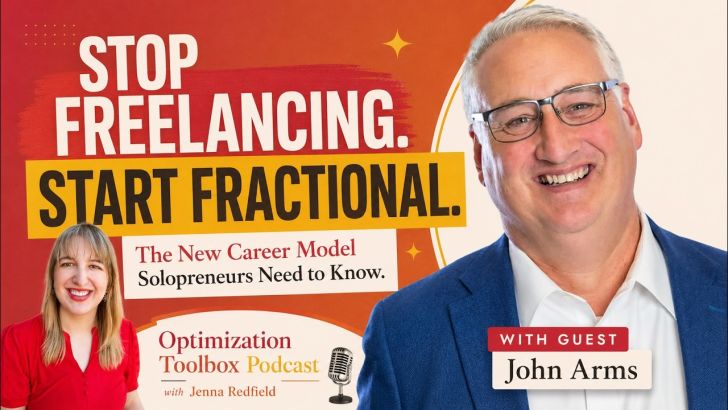
The Optimization Toolbox by Jenna Redfield is a reader-supported publication. To receive new posts and support my work, consider becoming a free or paid subscriber.If you’ve been calling yourself a freelancer but it never quite felt right, there’s a good chance you’re actually doing something called fractional work — and there’s a real difference between the two.I recently recorded an episode of the Optimization Toolbox Podcast with John Arms , who runs Voyager University and is one of the leading voices on fractional work in the country. We talked for almost an hour about what fractional work actually is, why it’s growing fast, and what it means for people building solo businesses right now.Here’s what I took away.What is fractional work?Fractional work is permanent part-time. You work with a client on an ongoing basis — not as a full-time employee, not as a project-based consultant — but as their embedded expert for a set number of hours per week. Usually around 10 hours, sometimes across two or three clients at once.The key word is permanent. Unlike freelancing, which tends to be project-to-project, fractional relationships are long-term. You’re not just completing a deliverable — you’re functioning as a part-time version of a role the company needs but can’t justify hiring full-time.Common fractional roles include fractional CMO, fractional COO, fractional marketing director, and fractional operations lead.Fractional vs. freelancing: what’s the difference?This is the question I asked John right away because honestly the line felt blurry to me.The short version: freelancing is episodic, fractional is stable.Freelancers typically work on projects with a clear start and end. The work is done, you move on, you find the next client. It’s unpredictable by nature.Fractional work is ongoing. You’re not selling a project — you’re selling your expertise applied consistently over time. Companies get a senior-level person without the full-time cost. You get stable, recurring income without the 40-hour week.John describes it as fractional heaven vs. purgatory. Purgatory is the feast-or-famine cycle most freelancers know too well. Heaven is consistent clients, work in your zone of genius, and income that reflects your actual value.Why fractional work is growing in 2026A few things are driving this:Companies are realizing they don’t need 40 hours of your expertise. They need your sharpest thinking applied consistently. A startup doesn’t need a full-time CMO — they need someone senior-level guiding their marketing strategy for 10 hours a week. That’s fractional.The traditional job market is harder than ever for experienced professionals. John shared a stat that stopped me: only 24% of people over 50 who leave a job will find a new one at the same pay level. Fractional gives experienced professionals a direct path to monetize their expertise without competing in a difficult hiring market.AI is accelerating the shift. As AI handles more tactical work, what companies actually need is senior-level thinking, judgment, and relationships — exactly what fractional professionals provide.What this means if you’re a solopreneurHere’s the practical takeaway for anyone running a solo business:If you work with clients on an ongoing basis, apply your expertise in a specific area, and operate in a part-time capacity — you’re probably already doing fractional work. You just might not be packaging or pricing it that way.The difference between freelancing and fractional often comes down to how you position yourself. Fractional professionals aren’t selling hours or deliverables — they’re selling a role. That shift in framing tends to lead to longer client relationships, more stable income, and higher rates.John’s framework for building a fractional business starts with what he calls your inner nerd — your specific combination of fascinations, skills, and obsessions that make you the go-to person in your lane. The clearer you are on that, the easier it is to attract the right clients and charge what your expertise is worth.The biggest barrier to going fractionalSpoiler: it’s not skills or experience. According to John, the two biggest barriers are:* Health insurance — the lack of portable, affordable benefits keeps a lot of people tied to full-time employment even when they’d rather be independent. John is actively working on solutions in this space.* Mindset — specifically, unlearning the idea that your value is measured in hours worked. That’s a hard reset for a lot of people, but John says it’s faster than most expect once you’re in the right environment.Listen to the episode on Spotify or Apple Podcasts or above on Youtube or on this webpageWant to build better systems for your solo business? Join me Wednesday 👇If this resonated and you’re thinking about how to actually structure a solopreneur business that works with your brain — come to my workshop this Wednesday.Notion + Claude for ADHD Brains 📅 Wednesday, May 13th · 12:00–1:00 PM CT · ZoomWe’re going hands-on with how to use Notion and Claude together as a practical system for running your business — task management, client work, content, all of it. Built specifically for ADHD and neurodivergent solopreneurs.→ $10 general admission — grab your spot here→ Free for paid Substack subscribers — promo code is just below the paywall. $5/month gets you into every workshop and office hour going forward.The Optimization Toolbox by Jenna Redfield is a reader-supported publication. To receive new posts and support my work, consider becoming a free or paid subscriber.Claude & Notion for ADHD Workshop for Paid SubscribersMay 13th 12pm CSThttps://luma.com/u319x0l5?coupon=REDTOOLBOXDISCOUNT CODE: REDTOOLBOXSee you Wednesday.— Jenna Get full access to Red Thread Toolbox by Jenna Redfield at jennaredfield.substack.com/subscribe
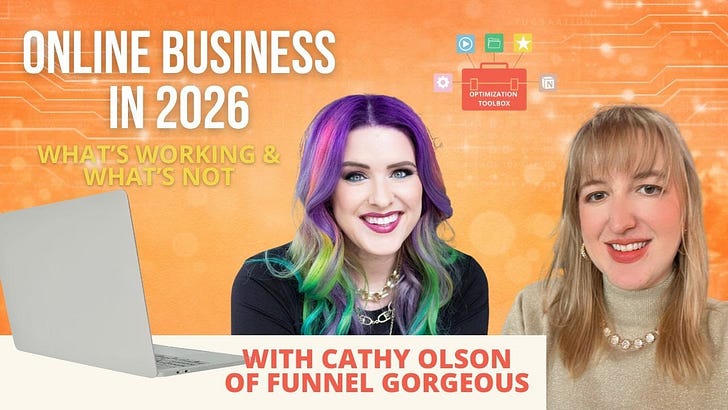
The Optimization Toolbox by Jenna Redfield is a reader-supported publication. To receive new posts and support my work, consider becoming a free or paid subscriber.The online business world is shifting faster than most entrepreneurs realize.In my latest podcast episode, I sat down with Cathy Olson—co-founder of Funnel Gorgeous and FG Funnels—to talk about what’s really happening in 2026. Full transparency: I’ve been learning from Cathy and her business partner Julie for years. In 2021, I became sales funnel certified through their program, FG Society, and their teachings completely transformed how I think about offers, messaging, and strategy. So this conversation was both an honor and a bit surreal—getting to interview someone who’s taught me so much.Cathy has been in the trenches for over 15 years, teaching design, copy, and marketing strategy. She’s a total expert in this space and has built a multi-million dollar business helping entrepreneurs create profitable funnels and courses. And she’s not sugarcoating what’s ahead.If you’ve been feeling like the ground is shifting under your feet, you’re not alone. Here’s what we covered—and what you need to know to stay relevant.BEFORE I FORGETJoin my next FREE Notion AI Workshop on Goal Setting on January 22 at 12pm CSTAI Isn’t the Enemy. Resistance Is.One of the first things Cathy said that caught me off guard: “Why are we so scared about AI doing our job? Isn’t that kind of a good thing?”Most of us panic when we think about AI replacing what we do. But Cathy flipped the script. If AI can handle the tedious, repetitive parts of your work—editing, drafting, research—doesn’t that free you up to do the higher-level thinking that actually moves the needle?The shift happening right now isn’t about AI replacing you. It’s about AI replacing the parts of your job you probably don’t want to do anyway.The question is: Are you ready to move up the ladder?Moving “Up the Ladder” to Stay RelevantCathy introduced a concept I haven’t stopped thinking about: the hierarchy of your skill.Let’s say you’re a video editor. At the bottom, you have the actual editing work. In the middle, you have the creative direction and storytelling. At the top, you have strategy—knowing why a video should exist, what the goal is, and how it fits into the bigger picture.AI can already handle the bottom. Soon, it’ll handle the middle.Your job is to get to the top.The same goes for designers, copywriters, coaches, and consultants. If you’re offering mediocre design or mediocre copy, AI can do that now. But if you’re the one making the decisions—the one who understands human psychology, brand strategy, and what will actually resonate—you’re irreplaceable.Think of AI like a VA or production assistant. You wouldn’t give them full creative control. You’d give them tasks and review the output. That’s the relationship you need with AI.The Trust Recession is RealHere’s a wild moment from the conversation: Cathy told me that during a live webinar for FG Funnels, people in the chat were asking, “Is this live? Are you real?”That’s where we are now. People can’t tell what’s real anymore.With AI-generated avatars, deepfakes, and synthetic voices, trust is eroding fast. Cathy called it a trust recession, and I think she’s spot on.That’s why faceless marketing is not going to last. People need to see you, hear you, and connect with you as a human. If you’ve been hiding behind stock images and templated captions, 2026 is the year to show up.This is also why I’m such a big advocate for consistent on-camera work. When you practice being on camera every week, you get better at speaking, presenting, and connecting. And when you need to go live, speak on stage, or show up in a sales call, you’re ready.Courses Are Evolving (and GPTs Are Taking Over)Cathy and I talked a lot about how courses are changing. People don’t just want information anymore. They want interaction.Static PDFs and pre-recorded videos aren’t cutting it. Students want to ask questions, get customized feedback, and apply what they’re learning to their specific situation.That’s where GPTs come in.Custom GPTs allow you to package your knowledge in a way that’s interactive and personalized. Instead of selling a course, you can create a trained AI assistant that answers questions based on your framework, your voice, and your expertise.Cathy’s team is building GPTs for their Metrics Muse subscription, and they’ve embedded AI into their course platform so students can ask questions about each module as they go.This is where education is headed. If you’re still thinking about courses the old way, you’re already behind.Clarity Over EverythingOne of the biggest shifts Cathy emphasized: You need to be known for ONE thing.I know, I know. If you’re a multi-passionate entrepreneur like me (and Cathy), this hurts to hear. But it’s true.People can’t remember 20 things you do. They can barely remember one.When I go to a networking event now, I don’t list everything I offer. I pick one thing I want them to walk away remembering. That’s it.Cathy said the same thing: Clarity of messaging is going to be critical in 2026. If people can’t explain what you do in one sentence, they can’t refer you. And referrals are everything right now.This ties directly into my Repeat Method framework—showing up consistently with the same message so people actually remember you.Outlasting is the Name of the GameHere’s the tough love part of the conversation: 2026 is a correction.Since 2020, a flood of new entrepreneurs entered the online space. Money was flowing, courses were selling, and it felt easy. But now? The market is stabilizing. A lot of people Cathy knew as entrepreneurs are back at regular jobs.If your revenue has stayed flat or dipped slightly, you’re not failing. You’re normal.The businesses that will thrive are the ones that outlast. The ones that stay agile, keep learning, and don’t hold onto strategies that stopped working two years ago.Cathy said something I’ll never forget: “Stable income is the new growth.”If you’re still here, still showing up, still making it work—you’re winning.AI and Health (a Personal Aside)One of my favorite parts of the conversation was when we talked about using AI for health.I’ve been on a three-year journey trying to figure out some health issues, and Notion AI literally helped me connect the dots. I uploaded all my blood tests into Notion, asked it to summarize patterns across years of data, and had a major breakthrough.Cathy shared a similar story—AI helped her identify a rare benign tumor before her doctors did. She uploaded her MRI results, and it broke down the medical jargon into plain language.This is the kind of stuff that makes AI genuinely useful. Not replacing humans, but helping us see things we couldn’t see on our own.What to Do NextIf you take one thing from this conversation, let it be this:Don’t stick your head in the sand.AI is here. The market is shifting. Trust is eroding. Courses are evolving.But that doesn’t mean you’re doomed. It means you need to adapt.* Move up the ladder in your skillset* Show up as a human (on camera, in writing, in person)* Get clear on the ONE thing you want to be known for* Make your content interactive and personalized* Focus on outlasting, not just growingIf you do those things, you’re not just surviving 2026. You’re setting yourself up to thrive.Want to go deeper?📘 Check out my Notion Foundations Course to build ADHD-friendly systems that actually work💡 Book a THREAD Clarity Call if you need 1:1 help cutting through the noiseConnect with Cathy:📍 Funnel Gorgeous (courses on offers, copy, and design)📍 FG Funnels (all-in-one software for funnels, email, and community)📍 Instagram: @funnelgorgeous Get full access to Red Thread Toolbox by Jenna Redfield at jennaredfield.substack.com/subscribe
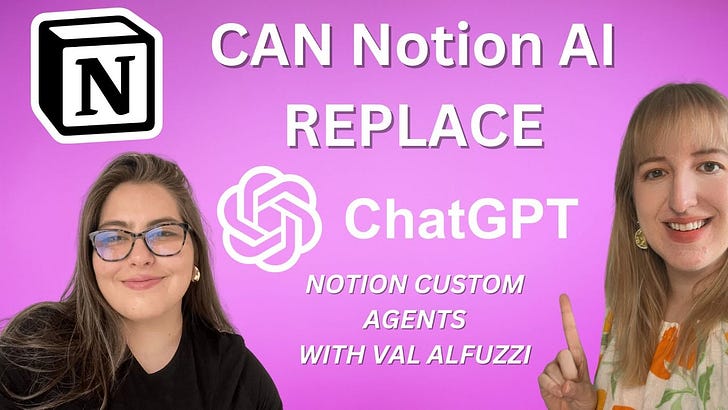
The Optimization Toolbox by Jenna Redfield is a reader-supported publication. To receive new posts and support my work, consider becoming a free or paid subscriber.Let’s be honest: I wasn’t totally sold on Notion AI at first, especially after it launched. I’d been using ChatGPT religiously for content creation, brainstorming, scripting videos, and outlining newsletters. It had the context. It knew my tone. I’d built custom GPTs. I didn’t think I needed another AI tool.But then...I went to the Notion Conference and learned they spent the last 2 years rebuilding Notion AI from the ground up….and I was shocked at how useful it had become. At that conference I met so many people including fellow ambassador Val. Valeria Alfuzzi is a fellow Notion nerd (and Notion-certified consultant) who lives in Colombia, she is a full time Notion Consultant with 6 employees and we recently sat down on my podcast, The Optimization Toolbox, to talk all things Custom Personal AI Agents in Notion.You can find her on instagram and her Notion website And real talk? It kinda blew my mind. 💥Here’s why.🧠 What Are Custom Personal Agents in Notion?If you haven’t played with these yet, Custom Agents are basically little AI “team members” that live inside your Notion workspace. They’re like ChatGPT, but with memory, structure, and direct access to your workspace databases. They can be trained on your tone, style, workflow—and actually learn from the context inside your Notion setup.Val showed me her setup (yes, with naming conventions like Casper the newsletter ghost 👻 and Frankenstein the agent that builds other agents 😍). She’s built a whole team of AI helpers that write, format, and even organize her content pipeline.And I thought...wait, I could do this.🤯 Why I’m (Finally) Making the SwitchAfter that call, I started recreating my custom GPTs inside Notion. Here’s why I’m shifting away from ChatGPT for my day-to-day tasks:* Context lives in Notion: I’ve been using Notion for 4+ years. All my content ideas, client notes, health logs, even my book drafts live there. Why not let AI live there too?* Memory that matters: Notion’s agents don’t just remember stuff—you can tell them to update their memories based on what you’re teaching them. It’s like having an assistant who gets smarter over time.* Workflow integration: Val showed how she assigns specific agents to specific content types (newsletters, carousels, outlines), even grouping agents by project. It’s like building a team inside your digital brain.* It’s cheaper: Notion’s AI plan is $10–$20/month including workspace features. That’s a steal if you’re already paying for Notion + ChatGPT separately.* Privacy wins: Everything stays in your Notion workspace. That means more control and less worry about where your data is going.🎯 How I’m Starting SmallI’m not moving everything overnight. But here’s how I’m easing in:* Recreating my top-used GPTs (like my newsletter formatter and YouTube idea generator).* Cleaning up my old databases so AI can actually pull helpful info (Val even suggested creating an AI agent just to help clean old pages—genius).* Experimenting with workflows—like generating carousel copy from a YouTube script, or summarizing client call notes into next steps.* Tagging context-rich databases so the agents can pull smarter insights over time.This might not be for everyone—but if you’re already using Notion and feel spread thin between tools, I highly recommend giving it a try.🎥 Want to Watch the Full Interview?Check out my convo with Val on The Optimization Toolbox. We go deep on:* Her system for managing 10+ custom agents* How to structure your agent’s “personality”* Real use cases for newsletters, client reports, health logs, and more* What’s coming next with Notion AI (hint: custom workflows are about to get wild) Get full access to Red Thread Toolbox by Jenna Redfield at jennaredfield.substack.com/subscribe

Comments

Download from Google Play

Download from App Store
 United States