


 Claim Ownership
Responsible Innovation 100
Subscribed: 0Played: 25
Subscribe

© Centre for Responsible Innovation (CforRI)
Description
Responsible Innovation 100 (RI 100) is a global discussion program designed to inspire and provide best practice examples of responsible innovation. From VCs to responsible innovation researchers and entrepreneurs, each episode will run for around 40 minutes to an hour.
Come join the conversation.
Come join the conversation.
18 Episodes
Reverse
Emad Yaghmaei, Senior Researcher, TU Delft and Managing Director of consulting firm (YAGHMA B.V.) provides a deep dive into non-financial (responsible) innovation impact assessment and monitoring methods, including:
Timestamp:
00:03:24 Emad's career journey to responsible innovation
00:04:57 What is responsible innovation?
00:07:25 How has Emad's approach to Responsible Innovation changed over the years?
00:09:48 What are the macro, management and product level trends in responsible innovation management?
00:13:50 What are the key steps and milestones of a responsible innovation project?
00:18:03 How can we navigate value differences between different stakeholders?
00:19:37 How can we assess and improve the social performance of innovation?
00:24:27 Monitoring Responsible Innovation: the importance of understanding forward-looking and backward-looking KPIs
00:28:00 How can responsible innovation support existing business initiatives including corporate social responsibility (CSR) and Environmental, Social, and Governance (ESG)?
00:31:08 What is the Materiality Matrix? Why could it be useful for responsible innovation?
00:36:20 What is the CWA 17796 Responsibility By Design pre-standard?
------------------------
About Emad:
Emad Yaghmaei is a Senior Researcher at the Faculty of Technology, Policy and Management at the Delft University of Technology and Managing Director of YAGHMA B.V. His research interests cover innovation management issues arising from the intersections of science, technology, and society. The emphasis of his research and consulting works is on innovation and technology management of emerging technologies such as Artificial Intelligence (AI) to identify and work on the social impacts of those technologies. He has been working on monitoring companies’ business innovation across their non-financial issues and creating real value for their business, customers, and business partners. He is currently focusing on UN Sustainable Development Goals (SDGs) and EU Responsible Research and Innovation (RRI) principles in an industrial context to demonstrate how the industry can work productively together with societal actors and integrate methodologies of RRI and business disclosures of SDGs into research and innovation processes.
*Professional profile: https://www.tudelft.nl/tbm/onze-faculteit/afdelingen/values-technology-and-innovation/people/postdocs/dr-e-emad-yaghmaei
*Linkedin: https://www.linkedin.com/in/emad-yaghmaei-0981a935/
*YAGHMA B.V.: http://yaghma.nl/
Resources:
*Book: “Assessment of Responsible Innovation, methods and practices, edited by Emad Yaghmaei and Ibo van de Poel”: https://www.routledge.com/Assessment-of-Responsible-Innovation-Methods-and-Practices/Yaghmaei-Poel/p/book/9780367654870
*CWA 17796 Responsibility-by-design standard: https://www.nen.nl/cwa-17796-2021-en-288066
*Research papers:
1) The Responsible Research and Innovation (RRI) Maturity Model: Linking Theory and Practice: https://www.mdpi.com/2071-1050/9/6/1036
2) Learning to do responsible innovation in industry: six lessons: https://www.tandfonline.com/doi/full/10.1080/23299460.2020.1791506#:~:text=These%20lessons%20are%3A%20(1),industry
3) Responsible research and innovation key performance indicators in industry - A case study in the ICT domain:
https://www.researchgate.net/publication/324981770_Responsible_research_and_innovation_key_performance_indicators_in_industry_A_case_study_in_the_ICT_domain
------------------------
Responsible Innovation 100
Hosted by: Xiao Han Drummond, Founder & CEO
Centre For Responsible Innovation
https://www.cforri.com/https://www.linkedin.com/company/centreforresponsibleinnovation
Twitter: @Centre_RI
For all Responsible Innovation 100 episodes:
*Spotify: https://open.spotify.com/show/13ohHADS9hHnP3sUm2Wo0D?si=b7a13bc44555468d
*Apple Podcast: https://podcasts.apple.com/au/podcast/responsible-innovation-100/id1648058632
*YouTube: https://www.youtube.com/channel/UCHdGQyJUMz65c0Isxfz8dfQ
Step into the world of sustainability and decarbonisation with Megan Fisher, Director & CEO of EnergyLab.
00:00:00 Introduction
00:03:04 Q1.1_What motived the founding of the EnergyLab?
00:04:38 Q1.2_How has EnergyLab's mission evolved?
00:07:28 Q2_Can you share some examples of successful clean energy startups that EnergyLab has supported over the years. What do you think has been key to their success?
00:10:52 Q3_How does EnergyLab identify and select the startups it works with, and what qualities do you look for in entrepreneurs and their ideas?
00:12:11 Q4_What are some of the biggest challenges facing the clean energy industry in Australia today, and how is EnergyLab working to address them?
00:17:24 Q5.1_How has EnergyLab worked with communities to drive impact?
00:20:11Q5.2_Who are the key industry players?
00:22:25 Q6_How can communities be better engaged in the clean energy transition, and what role do you see for startups and entrepreneurs in this process?
00:26:22 Q7_How has EnergyLab foster diversity and inclusion within the startups it works with?
00:32:35 Q8.1_How can we ensure that the benefits of the clean energy transition are shared equitably across all communities?
00:35:14 Q8.2_How can regulation assist in fairer distribution of benefits of innovation?
00:36:09 Q9_On indigenous leadership in inclusive innovation
00:37:58 Q10.1_What are the two valleys of death for Australian startups?
00:42:00 Q10.2_Unlocking local capital to help Australian startups
00:43:21 Q10.3_Lessons from other innovation ecosystems
00:45:18 Q11_How can startups mitigate the risks associated with the two valleys of death?
00:47:10 Q12.1_How can established companies foster a culture of innovation and risk-taking, while also maintaining their core business operations?
00:51:42 Q12.2_How can corporates embed impact at the centre of innovation and business activities?
00:53:53 Q13_Tell is a story only you can tell.
00:57:29 Q14_Teach us a lesson only you can teach.
00:59:20 Q15_Envision 2050: what would you hope it to look like, feel like and sound like?
———————
About Megan:
Megan is the Director and CEO at EnergyLab - Australia and New Zealand's largest climate tech startup accelerator and innovation network dedicated to reaching net zero emissions. EnergyLab supports talented founders in clean energy and climate tech and connects them to the mentors, advisors, partners, peers, and investors they need to succeed.
With a background in product development and innovation Megan has experience commercialising, developing, and scaling products plus driving novel technology initiatives from pilot to adoption. Megan has worked in several industries in the midst of digital disruption as well as the enormous transition as the energy industry moves to renewables.
Megan made the move from corporate to not for profit to have a positive impact on the climate tech startup ecosystem in Australia after engaging in the more advanced international clean energy startup ecosystems.
More about Megan:
*LinkedIn: https://www.linkedin.com/in/megansfisher/
*Megan named as one of the 100 Green Power Players for 2023 in The Australian: https://www.theaustralian.com.au/business/renewable-energy-economy/green-power-players-list
More about EnergyLab:
*EnergyLab’s website: https://energylab.org.au
*EnergyLab’s blog: https://energylab.org.au/blog/
*EnergyLab’s YouTube channel: https://www.youtube.com/@energylabaustralia895/videos
------------------------
Responsible Innovation 100
Hosted by: Xiao Han Drummond, Founder & CEO
Centre For Responsible Innovation
https://www.cforri.com/https://www.linkedin.com/company/centreforresponsibleinnovation
Twitter: @Centre_RI
For all Responsible Innovation 100 episodes:
*Spotify: https://open.spotify.com/show/13ohHADS9hHnP3sUm2Wo0D?si=b7a13bc44555468d
*Apple Podcast: https://podcasts.apple.com/au/podcast/responsible-innovation-100/id1648058632
*YouTube: https://www.youtube.com/channel/UCHdGQyJUMz65c0Isxfz8dfQ
Dr. Fern Wickson is an Australian citizen living and working in Norway for 15 years. With a PhD across natural and social sciences and a keen interest in how we think about, talk about and enact the relationship between humanity and nature, Fern identifies as a transdisciplinary ecologist. Her work aims to advance sustainable and resilient futures for the whole community of life on Earth through understanding and facilitating interactions between science, ethics and politics in environmental conservation and management. Fern is currently the Scientific Secretary of NAMMCO (the North Atlantic Marine Mammal Commission) - an intergovernmental organisation that provides advice on the conservation and management of whales and seals. Previously, she worked as a Research Professor of environmental governance, leading a group on the sustainable and responsible development of emerging technologies (i.e., biotechnologies and nanotechnologies). As a Lead Facilitator for Homeward Bound, a global leadership initiative for women in STEMM, Fern has participated in the largest all-female expedition to Antarctica, twice. She is also a yoga and meditation teacher running her own studio, The Peaceful Wild, in northern Norway.
When she is not working, Fern enjoys hiking, snowboarding, kayaking, reading, and hanging out with her pets.
NOTE: This interview was originally published on 22 May 2021. Fern is now a Professor at UiT, The Arctic University of Norway.
Learn more about Fern: www.fernwickson.com
---------
Topics:
-Fern's journey from Australia to Norway
-Social & economic aspects of innovation (example: genetically modified maise)
-Why we must assess innovation in the context of practice (Example: beekeeping)
-Tools and methods for mapping innovation impact
-Connecting science and politics at the North Atlantic Marine Mammal Commission
-Fern: "Balancing political, scientific and ethical interests is a creative opportunity."
-What to think about when we land on mars?
-Emerging technologies - which should we worry about?
-Environmental sustainability & resilience: "our fate is entangled."
-Fern's key message
---------
Responsible Innovation 100
Hosted by:
Xiao Han Drummond, Founder & CEO
Centre For Responsible Innovation
Website: www.cforri.com
YouTube: https://youtube.com/channel/UCHdGQyJUMz65c0Isxfz8dfQ
LinkedIn: https://www.linkedin.com/company/centreforresponsibleinnovation/
Twitter: @Centre_RI
Spotify: https://open.spotify.com/show/13ohHADS9hHnP3sUm2Wo0D?si=e4ef143cadd24152
Apple Podcasts: https://podcasts.apple.com/au/podcast/responsible-innovation-100/id1648058632
Google Podcasts:https://podcasts.google.com/u/1/feed/aHR0cHM6Ly9hbmNob3IuZm0vcy9iOWNlYmZlNC9wb2RjY XN0L3Jzcw?sa=X&ved=0CAcQrrcFahcKEwjI7L-3mKz7AhUAAAAAHQAAAAAQL
In this episode, we take a step back and look at the entire system we operate within – the free-market economy. Mario shares his views on how we got here, where we are going and whether we need to reimagine our economic system to achieve true sustainable prosperity in a world where our resources are finite.
About Mario:
Dr. Mario Pansera's work focuses on Responsible Research and Innovation (RRI) and Innovation for Sustainability.
He is a Distinguished Researcher at the University of Vigo (UVIGO) in Spain, Honorary Research Fellow of the University of Bristol, visiting researcher at the Universitat Autonoma de Barcelona and international faculty at the Graduate School of Business of the University of Cape Town in South Africa where he teaches Responsible Innovation in the ExeMBA.
In July 2020 he was awarded a European Research Council (ERC) Starting Grant for the project PROSPERA (947713), centring on the topic "Prospering without growth: Science, Technology and Innovation in a post-growth era". Mario leads the post-growth innovation lab at the Pontevedra Campus of UVIGO and is also the Work Package (WP) leader for the ITN Marie-Curie ReTrace on Circular Economy initiative.
Find out more about Mario's work: https://postgrowth-lab.webs.uvigo.es/
------------------------
Topics:
-What are the core drivers of the market economy?
-Strengths vs Weaknesses of market economy
-How can we improve our market economy?
- What is the post-growth economy? (trends in Italy, Spain, Catalonia, South Africa, China and New Zealand)
-What would a post-growth company look like?
-What are the KPIs for a post-growth company, economy?
-From market economy to post-growth economy: a realistic transition plan?
-Post-growth leaders? Who is doing post-growth well?
-Mario's view on the circular economy & sharing economy
-Mario: post-growth is a political discourse
-Key lessons
------------------------
Responsible Innovation 100
Hosted by:
Xiao Han Drummond, Founder & CEO
Centre For Responsible Innovation
Website: www.cforri.com
YouTube: https://youtube.com/channel/UCHdGQyJUMz65c0Isxfz8dfQ
LinkedIn: https://www.linkedin.com/company/centreforresponsibleinnovation/
Twitter: @Centre_RI
Spotify: https://open.spotify.com/show/13ohHADS9hHnP3sUm2Wo0D?si=e4ef143cadd24152
Apple Podcasts: https://podcasts.apple.com/au/podcast/responsible-innovation-100/id1648058632
Google Podcasts:https://podcasts.google.com/u/1/feed/aHR0cHM6Ly9hbmNob3IuZm0vcy9iOWNlYmZlNC9wb2RjY XN0L3Jzcw?sa=X&ved=0CAcQrrcFahcKEwjI7L-3mKz7AhUAAAAAHQAAAAAQLA
How can we drive innovations toward socially desirable outcomes? Moreover, how can we improve the structure of our innovation systems to incentivise collaboration and meaningful innovation that address pressing global challenges? In episode 6 of Future Up Close, René von Schomberg* (Brussels, Belgium) kindly shares his experience and the latest on innovation policies and programmes designed to improve the quality of our innovation systems and encourage us to become agents of socially desirable change.
About René von Schomberg*:
Dr. Dr.phil. René von Schomberg is a philosopher and an STS scholar. He graduated as an agricultural scientist in Wageningen, the Netherlands, and was a European Union Fellow at George Mason University, the USA, in 2007. René has been with the European Commission since 1998 and is currently a Guest Professor at the Technical University of Darmstadt in Germany. René is the author/editor of 15 books, and his publications have appeared in half a dozen languages. He is the first editor of the most comprehensive book on responsible innovation to date: The International Handbook on Responsible Innovation. A global resource (Edward Elgar, 2019). René runs a blog that hosts a diverse range of free downloadable documents on responsible innovation, socio-economic aspects of emerging technologies, ethics and open science.
Learn more about René: https://renevonschomberg.wordpress.com
-----------------------
Topics:
-René von Schomberg's responsible innovation journey
-What responsible innovation symbolises for René at this point in history
-Improving the rewards and incentives of research systems through Open Science at the European Commission
-Tools for Open Science - what are they?
-How can we ensure that the direction we give to innovations aligns with changing local values?
-Why should we build innovation systems where commercial success and social desirability go hand-in-hand? e.g. COVID
-Role of education: citizens as co-creators not "receivers" of innovation
-Why public governance is key to improving the "Responsiveness" of responsible innovation
-What can we learn from past crises (e.g. global financial crisis) to better prepare for future crises in AI, biotech, social media & other more "intimate" technologies?
-How can we ensure that the S&T policies we introduce are responsible?
-Key innovation policies and changes that business leaders should watch out for
-Closing question: what's one thing that René would like to see happen during his career?
-----------------------
Interview disclaimer from René: *The interview was conducted in a personal capacity. The views expressed here are those of the author and may not be regarded as stating an official position of the European Commission.
------------------------
Responsible Innovation 100
Hosted by:
Xiao Han Drummond, Founder & CEO
Centre For Responsible Innovation
Website: www.cforri.com
YouTube: https://youtube.com/channel/UCHdGQyJUMz65c0Isxfz8dfQ
LinkedIn: https://www.linkedin.com/company/centreforresponsibleinnovation/
Twitter: @Centre_RI
Spotify: https://open.spotify.com/show/13ohHADS9hHnP3sUm2Wo0D?si=e4ef143cadd24152
Apple Podcasts: https://podcasts.apple.com/au/podcast/responsible-innovation-100/id1648058632
Google Podcasts:https://podcasts.google.com/u/1/feed/aHR0cHM6Ly9hbmNob3IuZm0vcy9iOWNlYmZlNC9wb2RjY XN0L3Jzcw?sa=X&ved=0CAcQrrcFahcKEwjI7L-3mKz7AhUAAAAAHQAAAAAQLA
Professor Dr. Ibo van de Poel is an Anthoni van Leeuwenhoek Professor in Ethics and Technology of the Department of Values, Technology and Innovation in the Faculty of Technology, Policy and Management at TU Delft, the Netherlands. Ibo has published various research papers and is the editor of books covering engineering ethics, moral acceptability of technological risks, design for values, responsible innovation, moral responsibility in research networks, ethics of newly emerging technologies, and the idea of new technology as a social experiment. For three years (2016- 2019), Ibo led a Horizon 2020 project called PRISMA, where he worked with eight businesses to integrate responsible innovation into daily business innovation activities. He currently holds an ERC Advanced grant for "Design for Changing Values: A Theory Of Value Change in Sociotechnical Systems". In this conversation, we will discuss PRISMA, in particular, how innovators can translate the learnings from PRISMA to achieve their pursuit of innovation success.
More about Ibo:
1) Current main project: www.valuechange.eu
2) PRIMSA website: https://www.rri-prisma.eu/
3) PRIMSA video overview: https://www.youtube.com/watch?v=h-wF3IcCFH0
------------------------
Topics:
-PRISMA project - purpose, preparation activities & key learnings
-The biggest gap between responsible innovation theory and practice
-Importance of building trust: why providing RI tools only is not enough for RI success
-Responsible innovation: benefits for businesses (RI vs CSR, for example, Hub of All Things)
-What would Ibo do differently with new business projects?
-Four core capability pillars of a "responsible innovation-fied" company
-Measuring and improving RI capabilities: Start-up vs large organisations
-Living Labs, lead users & regulatory-free zones: how can innovators use these to commercialise disruptive products and services (with drone company example)
-How to avoid adverse effects of responsible innovation KPIs (Key Performance Indicators)
-Biggest challenges of applying RI for businesses & how to overcome these
-Responsible Innovation for purpose-driven innovators: a holistic and structured approach to turn commitment to do good into daily decisions, innovation process
-Key career learning from Ibo: the importance of understanding motivations
------------------------
Responsible Innovation 100
Hosted by:
Xiao Han Drummond, Founder & CEO
Centre For Responsible Innovation
Website: www.cforri.com
YouTube: https://youtube.com/channel/UCHdGQyJUMz65c0Isxfz8dfQ
LinkedIn: https://www.linkedin.com/company/centreforresponsibleinnovation/
Twitter: @Centre_RI
Spotify: https://open.spotify.com/show/13ohHADS9hHnP3sUm2Wo0D?si=e4ef143cadd24152
Apple Podcasts: https://podcasts.apple.com/au/podcast/responsible-innovation-100/id1648058632
Google Podcasts:https://podcasts.google.com/u/1/feed/aHR0cHM6Ly9hbmNob3IuZm0vcy9iOWNlYmZlNC9wb2RjY XN0L3Jzcw?sa=X&ved=0CAcQrrcFahcKEwjI7L-3mKz7AhUAAAAAHQAAAAAQLA
Countries with the strongest economies today often also have the most vibrant science and technology (STI) sectors in the world. Building such vibrant innovation ecosystems require collaboration among start-ups, SMEs, large corporates, policymakers, NGOs, the public and other innovation stakeholders. Good science and technology (S&T) policies provide these diverse groups with a framework for working together locally or abroad. In this episode, Dr. Miltos Ladikas will take us into national and global S&T policy development. Through the lens of Technology Assessment (TA), he will discuss and compare centralised and decentralised policy development systems across, in particular, European countries and China using examples including genetically modified (GM) foods and nanotechnology developments.
About Miltos:
Dr. Miltos Ladikas is a senior researcher at the Institute of Technology Assessment and Systems Analysis, Karlsruhe Institute of Technology, Germany. He had studied Social Psychology at the London School of Economics (M.Sc., PhD), focusing on Societal Aspects in Biotechnology Developments. Since 1996, he has held research positions in the UK and Germany, specialising in science and society issues. Miltos has coordinated several international projects in the areas including science and technology policy, technology assessment, ethics of scientific developments, public perceptions of science and technology, genetically modified foods and access to pharmaceuticals. Miltos advises the European Commission, the European Research Council, the European & Developing Countries Clinical Countries Partnership, and several National Research Funds on social-ethical issues in research. His current work focuses on Global aspects of Technology Assessment, Responsible Innovation, Ethics in Science and Technology Policy and Science Diplomacy.
For more details see: http://www.itas.kit.edu/english/staff_ladikas_miltos.php
------------------------
Topics:
-What makes a "good" S&T policy or process?
-S&T policies - stakeholders for values development
-EU values vs national values? How did countries reach a consensus?
-What is Global TA?
-Is it possible to develop fair Global S&T policies?
-How to build capacity for Global TA
-UN Criteria used to choose TA Countries
-Who are the stakeholders of global S&T policy development?
-How are common values, needs and interests integrated into S&T policies? (importance of dialogue and willingness to change)
-Participatory Technology Assessment in China vs Europe: similar systems, different culture
-Impact of geo-political tensions on global S&T policies and innovations
-How to navigate geopolitical tensions for critical tech solutions?
-Global governance - our biggest “Grand Challenge”?
-Which international organisations are leading global S&T policy development?
-Role of UN in S&T policy development
-Impact of TA and RI on economic growth?
-Is there an optimum balance between incentives and punishment for RI?
-S&T policy development in China: what surprised Miltos the most?
-S&T policy development in China: two Examples: Genetically Modified (GM) Foods & Nanotech
-S&T policy development in China: the role of government and media in public dialogue
-Miltos' RRI projects
-What's next for Miltos and Global TA
------------------------
Responsible Innovation 100
Hosted by:
Xiao Han Drummond, Founder & CEO
Centre For Responsible Innovation
Website: www.cforri.com
-----------------------
Key to success - whether a project, business, career or life - is about making the best decisions we can, over time. In this episode of Future Up Close, Associate Professor Dr. Erik Fisher walks us through "STIR" (Socio-Technical Integration Research), a practical, effective and adaptive process he developed for boosting our human capacity for making better decisions while we work.
--------------
About Erik:
Erik Fisher is an Associate Professor at Arizona State University’s School for the Future of Innovation in Society within the College of Global Futures. He directs the Center for Responsible Innovation (USA) and is Editor-in-Chief of the Journal of Responsible Innovation. Fisher has held visiting appointments at Delft Technical University, Karlsruhe Institute of Technology, the Norwegian University of Science and Technology, and the University of Twente. Fisher studies the multi-level governance of emerging science and technology from the lab to the legislature. He developed the interdisciplinary, collaborative approach of Socio-Technical Integration Research (STIR), which has been applied in dozens of organizations around the world to build human capacity and creatively address socio-technical problems at an early stage. STIR has been supported and recognized by numerous bodies including the U.S. National Science Foundation, the European Commission, and the U.S. Presidential Commission for the Study of Bioethical Issues. Fisher’s research has appeared in various outlets including Research Policy; Science, Technology and Human Values; and Science and Public Policy.
More about Erik's STIR: http://cns.asu.edu/research/stir
--------------
Responsible Innovation 100
Hosted by:
Xiao Han Drummond, Founder & CEO
Centre For Responsible Innovation
Website: www.cforri.com
YouTube: https://youtube.com/channel/UCHdGQyJUMz65c0Isxfz8dfQ
LinkedIn: https://www.linkedin.com/company/centreforresponsibleinnovation/
Twitter: @Centre_RI
Spotify: https://open.spotify.com/show/13ohHADS9hHnP3sUm2Wo0D?si=e4ef143cadd24152
Apple Podcasts: https://podcasts.apple.com/au/podcast/responsible-innovation-100/id1648058632
Google Podcasts:https://podcasts.google.com/u/1/feed/aHR0cHM6Ly9hbmNob3IuZm0vcy9iOWNlYmZlNC9wb2RjY XN0L3Jzcw?sa=X&ved=0CAcQrrcFahcKEwjI7L-3mKz7AhUAAAAAHQAAAAAQLA
Armin Grunwald is a Full Professor of Philosophy at Karlsruhe Institute of Technology (KIT), Germany. There, he is also the Director of KIT's Institute for Technology Assessment and Systems Analysis at KIT (ITAS). Since 2002, Armin has been serving as the Director of the Office of Technology Assessment at the German Bundestag.
Armin's professional background includes technology assessment, ethics of philosophy, theory of sustainable development, and the epistemology of inter- and transdisciplinary research.
In his professional work, Armin is a member of several advisory commissions and committees in various fields of technological advance.
In his research work, he is developing a theory of technology assessment in conjunction with applications in the fields of the transformation of the energy system, ongoing digitalization and new and emerging technologies such as synthetic biology and human enhancement.
Armin is an author and editor of multiple professional and research publications, among them “Technology Assessment in Practice and Theory” (Routledge 2019) and “The Hermeneutic Side of Responsible Research and Innovation” (Wiley 2016).
Armin's professional webpage is: www.itas.kit.edu/english/staff_grunwald_armin.php
------------------------
Responsible Innovation 100
Hosted by:
Xiao Han Drummond, Founder & CEO
Centre For Responsible Innovation
Website: www.cforri.com
YouTube: https://youtube.com/channel/UCHdGQyJUMz65c0Isxfz8dfQ
LinkedIn: https://www.linkedin.com/company/centreforresponsibleinnovation/
Twitter: @Centre_RI
Spotify: https://open.spotify.com/show/13ohHADS9hHnP3sUm2Wo0D?si=e4ef143cadd24152
Apple Podcasts: https://podcasts.apple.com/au/podcast/responsible-innovation-100/id1648058632
Google Podcasts:https://podcasts.google.com/u/1/feed/aHR0cHM6Ly9hbmNob3IuZm0vcy9iOWNlYmZlNC9wb2RjY XN0L3Jzcw?sa=X&ved=0CAcQrrcFahcKEwjI7L-3mKz7AhUAAAAAHQAAAAAQLA
Professor Dr. Swierstra is the Head of the Department of Philosophy of the Faculty of Arts and Social Sciences at Maastricht University (Maastricht, the Netherlands). He is also currently an adjunct professor at the Norwegian University of Science and Technology (NTNU)(Trondheim, Norway). Tsjalling’s field of expertise is in the ethics and politics of new and emerging science and technology (NEST). He has published numerous research papers and reports covering moral controversies of immerging innovations including cloning, new reproductive technologies, genomics, food technologies, nanotechnology, synthetic and system biology, artificial gametes, neuroscience, and converging technologies. His work has received ongoing funding from organisations including the Dutch Rathenau Institute, NOW, the Centre of Excellence for Technology Ethics, ZON-MW, STW and UM.
------------
Timecode:
00:19 Introducing Tsjalling Swierstra
00:59 Tsjalling Swierstra's Journey to Responsible Innovation (Q1/10)
04:06 What made Responsible Innovation scale Europe-wide? (Q2/10)
10:41 Facebook Broadening Ethical Agenda (Q3/10)
16:24 What is Responsible Innovation? (Q4/10)
23:53 Responsible Innovation: Envision Future Better (Q5/10)
25:34 Responsible Innovation Example - Nanotechnology in the Netherlands (Q6/10)
30:09 Hard vs Soft Impacts of Innovation - e.g. Smartphone (Q7/10)
34:02 Applying Responsible Innovation: Challenges and Opportunities (Q8/10)
40:04 What's Next for Responsible Innovation? (Q9/10)
43:18 What surprised Tsjalling Swierstra the most after introducing RI to businesses? (Q10/10)
------------------------
Responsible Innovation 100
Hosted by:
Xiao Han Drummond, Founder & CEO
Centre For Responsible Innovation
Website: www.cforri.com
YouTube: https://youtube.com/channel/UCHdGQyJUMz65c0Isxfz8dfQ
LinkedIn: https://www.linkedin.com/company/centreforresponsibleinnovation/
Twitter: @Centre_RI
Spotify: https://open.spotify.com/show/13ohHADS9hHnP3sUm2Wo0D?si=e4ef143cadd24152
Apple Podcasts: https://podcasts.apple.com/au/podcast/responsible-innovation-100/id1648058632
Google Podcasts:https://podcasts.google.com/u/1/feed/aHR0cHM6Ly9hbmNob3IuZm0vcy9iOWNlYmZlNC9wb2RjY XN0L3Jzcw?sa=X&ved=0CAcQrrcFahcKEwjI7L-3mKz7AhUAAAAAHQAAAAAQLA
A 2-minute update from our program host Xiao Han Drummond.
Hi all, we hope you are enjoying the RI100 discussions. We are in the process of arranging new interviews for 2023 and would love to get your input and feedback to improve our program and make it as relevant and interesting as possible for you:
1) What other RI-related subjects would you like us to cover?
2) Which companies have you seen doing great RI work and should be featured on our program?
3) How is the length of our interviews?
4) Anything else you'd like us to know?
You can email us/connect with us: community@cforri.com
In the meantime, we will be posting interviews from our pilot season for the remainder of the year. When we recorded our pilot episodes, our program was called "Future Up Close" so you will hear our host Xiao Han using this name for these earlier interviews. We will be back with brand-new episodes early next year.
------------------------
Responsible Innovation 100
Hosted by:
Xiao Han Drummond, Founder & CEO
Centre For Responsible Innovation
https://www.cforri.com/
https://www.linkedin.com/company/centreforresponsibleinnovation
Twitter: @Centre_RI
Spotify: https://open.spotify.com/show/13ohHADS9hHnP3sUm2Wo0D?si=bf4a446c8a8b4176
Apple Podcast: https://podcasts.apple.com/au/podcast/responsible-innovation-100/id1648058632
Google Podcast: https://podcasts.google.com/feed/aHR0cHM6Ly9hbmNob3IuZm0vcy9iOWNlYmZlNC9wb2RjYXN0L3Jzcw
Charlie Macdonald, Investment Manager of Giant Leap invites us into the world of impact venture capital.
About Charlie:
Charlie Macdonald is an Investment Manager at Giant Leap, an impact venture capital fund backing mission-driven founders addressing our most pressing challenges. Here, he is responsible for running the investment process, producing useful tools for impact founders, and impact measurement. Previously, Charlie helped early-stage founders find their first customers at Playbook Media and completed an MBA at Melbourne Business School.
Learn more about Charlie:
*Charlie Macdonald LinkedIn: https://www.linkedin.com/in/charlie-macdonald/
*Giant Leap website: https://www.giantleap.com.au/
*Giant Leap LinkedIn: linkedin.com/company/giantleap-vc/
------------------------
Responsible Innovation 100
Hosted by:
Xiao Han Drummond, Founder & CEO
Centre For Responsible Innovation
https://www.cforri.com/
https://www.linkedin.com/company/centreforresponsibleinnovation
Twitter: @Centre_RI

In 2009, best friends Adam McCurdie and Joshua Ross went hiking in Sri Lanka. Sitting under a starry night, they made a pact to keep each other accountable for pursuing a purposeful life. In this episode of Responsible Innovation 100, Josh takes us through how Humanitix began, the challenges they've faced and their vision for 2050. At the heart of this conversation is also a wonderful story of friendship, duty and perseverance.
-------------
About Josh:
Josh Ross is the Co-CEO and Founder of Humanitix.
"Prior to co-founding Humanitix, Josh spent 7 years in the investment team at one of Sydney’s leading hedge funds where he was offered a partnership at the age of 26. Whilst in funds management Josh became a Chartered Financial Analyst (CFA) and managed a range of public investments across multiple industries. Josh left funds management at the age of 27 to start Humanitix with his best friend Adam. Separate to Humanitix, Josh is an activist retail shareholder and played a role in disrupting and blocking AGL’s demerger in 2022 (AGL is Australia’s largest climate polluter and a publicly listed utility, the demerger would have been a disastrous outcome for the environment)."
Learn more about Josh:
*Josh Ross LinkedIn: https://www.linkedin.com/in/joshua-ross-humanitix/
*Humanitix website: https://humanitix.com/au
*Humanitix LinkedIn: https://www.linkedin.com/company/humanitix
------------------------
Responsible Innovation 100
Hosted by:
Xiao Han Drummond, Founder & CEO
Centre For Responsible Innovation
https://www.cforri.com/
https://www.linkedin.com/company/centreforresponsibleinnovation
Twitter: @Centre_RI
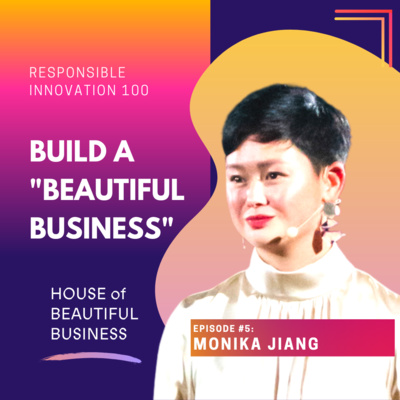
In episode #5 of Responsible Innovation 100, Monika Jiang takes us to the future of work. We will discuss how business leaders can genuinely create spaces of meaning, purpose and belonging across the narrative, process, leadership and structural levels of business.
---------------
About Monika:
Monika Jiang is the head of curation and community at the House of Beautiful Business, a global community to make business more beautiful. A highly intuitive, fantastical soul, temporarily unfinished and forever wanting to play, she reaches to the margins, asks essential questions, and gently steps into the reality of others to make more feelings known, more faces seen, more voices heard. Because another world is not only possible—it exists.
Learn more about Monika:
*LinkedIn: https://www.linkedin.com/in/monika-jiang
*House of Beautiful Business (HOBB): https://houseofbeautifulbusiness.com/
*House Residency: https://houseofbeautifulbusiness.com/house-residency
*Full video of HOBB's Lisbon event: https://youtu.be/DyMvDE2RzwA
Thank you to HOBB for sharing with us the wonderful behind-the-scenes photographs and video segments from your Lison event.
------------------------
Responsible Innovation 100
Hosted by:
Xiao Han Drummond, Founder & CEO
Centre For Responsible Innovation
https://www.cforri.com/
https://www.linkedin.com/company/centreforresponsibleinnovation
Twitter: @Centre_RI

Dr. Andrew Maynard (Arizona State University) and Xiao Han Drummond (Centre for Responsible Innovation) share a wonderful conversation about the changing nature of innovation, "risk innovation" and the power of wonder and awe in driving breakthrough science and innovation. They also discuss the role of science fiction in enriching human imagination and possibilities.
About Andrew:
Andrew Maynard is a professor in the Arizona State University School for the Future of Innovation in Society and Director of the ASU Risk Innovation Lab. Trained as a physicist, his work cuts across disciplinary boundaries as it focuses on the ethical and socially responsible development and use of new technologies. He is an elected Fellow of the American Association for the Advancement of Science, serves as co-chair of the Institute for the Advancement of Nutrition and Food Science (IAFNS) Board of Trustees, is a member of the Canadian Institute for Advanced Research President’s Advisory Council, has served on a number of National Academies of Sciences committees, and has testified before congressional committees on several occasions. Since 2008 he has also worked closely with the World Economic Forum in a number of capacities, including chairing and serving on Global Agenda Councils/Global Future Councils and contributing to the WEF annual list of top ten emerging Technologies.
In addition to his academic writing, Andrew is known for his work on communicating with broad audiences around complex issues. As well as his two books, Films from the Future and Future Rising, his work has appeared in publications ranging from The Washington Post and Scientific American, to Slate, Salon, and OneZero. He also co-hosts the podcast Mission: Interplanetary.
Find out more about Andrew:
*Personal/professional website: https://andrewmaynard.net/about/
*ASU: https://isearch.asu.edu/profile/2670673
*LinkedIn: https://www.linkedin.com/in/andrewdmaynard/
*Mission: Interplanetary podcast (a ground-breaking podcast hosted by astronaut Cady Coleman and scientist/author Andrew Maynard exploring the future of humans in space!): https://missioninterplanetary.com/
------------------------
Responsible Innovation 100
Hosted by: Xiao Han Drummond, Founder & CEO
Centre For Responsible Innovation
Website: https://www.cforri.com/
LinkedIn: https://www.linkedin.com/company/centreforresponsibleinnovation
Twitter: @Centre_RI

In this episode of Responsible Innovation 100, René discusses why great innovation policies unleash human agency - and how this relates to trust in society.
About Rene:
Dr Dr.Phil. René von Schomberg is a philosopher and an STS scholar. He graduated as an agricultural scientist from Wageningen University, was a European Union Fellow at George Mason University (USA) in 2007, and was with the European Commission from 1998 to 2021. René is currently a senior research fellow at the Kate Hamburger Kolleg, International Centre for advanced studies: Cultures of Research, RWTH university of Aachen, Germany. He is also a Guest Professor at the Technical University of Darmstadt.
René is the author/editor of 15 books, and his publications appeared in a half dozen languages. He is the first editor of the most comprehensive book on responsible innovation to date: The International Handbook on Responsible Innovation. A global resource (Edward Elgar, 2019). He also runs a blog, which provides various free downloadable documents on responsible innovation, socio-economic aspects of emerging technologies, ethics and open science.
Find out more about René:
*Personal website/responsible innovation blog: https://renevonschomberg.wordpress.com
*Previous interview (YouTube): https://youtu.be/whzOZAVFuc0
*LinkedIn: https://www.linkedin.com/in/renevonschomberg/
------------------------
Responsible Innovation 100
Hosted by: Xiao Han Drummond, Founder & CEO, Centre For Responsible Innovation
Website: https://www.cforri.com/
LinkedIn: https://www.linkedin.com/company/centreforresponsibleinnovation
Twitter: @Centre_RI

Liselotte Engstam is a transformative board leader based in Sweden. We discuss responsible innovation from the board perspective, in addition to personal experiences that helped forge Liselotte's career.
About Liselotte:
Liselotte Engstam has a background in executive leadership positions in European, American, and Indian companies in the technology and services industries. Building on digital innovation and international leadership experience, she contributes to developing more sustainable businesses with broader value creation. Ms Engstam serves as Non-Executive Chair and Board Director at four listed companies (TietoEvry, Zalaris, Transtema Group, and Cint Group), at two private companies (Ografy and BoardClic), and as a board member at the Climate Governance Initiative in collaboration with World Economic Forum, and as Chair of the Nordic Chapter; Boards Impact Forum. She is a founder of the Think Tank Digoshen and engages in academic research, insight development, hosting board networks and advising on modern leadership and board practices. Ms Engstam advised European Commission on Digitalisation of Corporate Governance, and she is the co-author of ”Leading a Board - Chairs' practices across Europe”, of “AI Leadership for Boards” and a forthcoming book on "Governance for Corporate Renewal, Innovation and Sustainability”. Ms Engstam has a Master of Science in Engineering and Sustainability and is a certified international board director IDP-C from INSEAD. She is a Fellow at the Institute of Coaching, Harvard Medical School. Ms Eng
Learn more about Liselotte:
*Personal/Work portfolio: https://liselotteengstam.com/about/
*LinkedIn: https://www.linkedin.com/in/liselotteengstam/
*Digoshen: https://digoshen.com/
*Board Impact Forum: https://boardsimpactforum.com/
------------------------
Responsible Innovation 100
Hosted by: Xiao Han Drummond
Founder & CEO Centre For Responsible Innovation
Website: https://www.cforri.com/
LinkedIn: https://www.linkedin.com/company/centreforresponsibleinnovation
Twitter: @Centre_RI
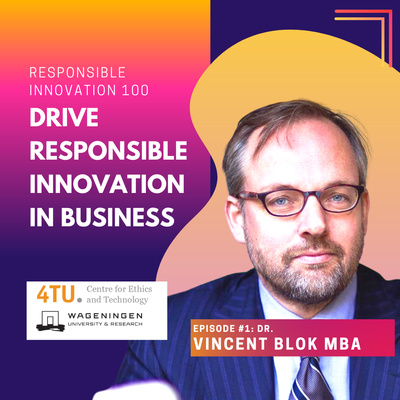
Today, innovation is largely seen as inherently good and the panacea to many of our grand societal challenges. However, did you know innovators and their innovations were not always seen as a positive force for society? Welcome to Responsible Innovation 100, an interview program for those wishing to maximise their innovation impact through responsible innovation. Our program will feature a diverse range of guests including investors, business leaders, entrepreneurs, policymakers, and educators. Each guest will spend an hour with Xiao Han Drummond, our program host, to share how they are driving responsible innovation in their respective areas of work, and their vision for 2050.
In our opening episode, we speak with Dr. Vincent Blok MBA, a Dutch philosopher working as an associate professor at Wageningen University (The Netherlands). He is also the director of the 4TU.Ethics Graduate School in The Netherlands. In 2005 he received his PhD degree in philosophy at Leiden University with a specialization in philosophy of technology. From 2006-2010, he was CEO of an international research institute in the field of sustainable agriculture, nutrition and health care. Together with seven PhD candidates and four Post-docs, he reflects on the meaning of disruptive technologies for the human condition and its environment from a continental philosophical perspective. His books include Ernst Jünger’s Philosophy of Technology. Heidegger and the Poetics of the Anthropocene (Routledge, 2017), Heidegger’s Concept of philosophical Method (Routledge, 2019), The Critique of Management. Toward a Philosophy and Ethics of Business Management (Routledge, 2021), From World to Earth. Philosophical Ecology of a threatened Planet (Boom, 2022 (in Dutch)). Blok published over a hundred articles in high-ranked philosophy journals like Environmental Values, Business Ethics Quarterly, Synthese and Philosophy & Technology, and in multi-disciplinary journals like Science, Journal of Cleaner Production, Public understanding of Science and Journal of Responsible Innovation.
Comments

Download from Google Play

Download from App Store
 United States