


 Claim Ownership
Right Of Way
Subscribed: 4Played: 52
Subscribe

© 2025 All Rights Reserved
Description
No Trespassing. Private Road. No Parking.
These are the signs that are more and more frequently seen along Nova Scotia’s coastline. As Canadians access the shore for recreation, science, or even just to take in the natural beauty of the coast, they are being increasingly met with physical barriers to the beach, few options to park or use public transportation to get to the coast, and problems with litter and marine debris in the areas they can access.
Private property ownership dominates Nova Scotia’s coastline, and while the public wants access, property owners also want to enjoy privacy and avoid the degradation of their land. In other words, in a province known as Canada’s Ocean Playground, people are increasingly asking – a playground for who?
In Nova Scotia, we have a right to be on the coastline below the high water mark, but no protected right to get there. But should we? Right of Way is a podcast that explores the issue of coastal access in Nova Scotia (and Canada more broadly) through the stories of property owners, communities, scientists, policy makers, environmental activists, surfers, hikers, and more. Join us weekly for new episodes.
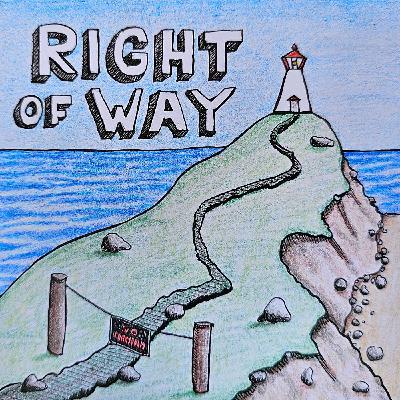
Right of Way is recorded, produced, and hosted by Nicolas Winkler (www.nicolaswinkler.com) and Hannah Harrison (www.hannahharrison.ca). Funding for this podcast is generously provided by the Royal Canadian Geographic Society (www.rcgs.org) and the Social Sciences and Humanities Research Council of Canada (www.sshrc-crsh.gc.ca). Podcast artwork by Laura Bonga (@bongas.art). Sound editing by Podstarter (www.podstarter.io). Learn more by visiting www.coastalaccessproject.com.
13 Episodes
Reverse
Less than 6% of Nova Scotia's population owns our coastline. Squeezed between a rapidly changing coastline and the rigidity of an increasingly impermeable wall of private property, Nova Scotia must act now to preserve, maintain, and prioritize coastal access in our province. In this final episode of Right of Way, we talk through the lessons learned in this podcast and hear some listener feedback from the summer.You can learn more about the Coastal Access Project and share your coastal access story with us on our website: www.coastalaccessproject.com. Special thanks to the Royal Canadian Geographic Society and the Social Sciences and Humanities Research Council of Canada for their support of this project. Thanks also to the Marine Affairs Program at Dalhousie University for additional support, editing and sound design by Podstarter (https://www.podstarter.io/), and cover art from Laura Bonga.
What would it take to have a right to roam in Nova Scotia? In this episode, we hear about efforts to get people to the coast through legislation and legwork, and contemplate what a right to roam would look like in Atlantic Canada. Special thanks to our guests in this episode, Dr. Andrew Weaver and Hannah Solway.In this episode, you heard about:Bill M 223 - 2017: Right to RoamSurfrider AtlanticSurfrider Foundation (Worldwide)You can learn more about the Coastal Access Project and share your coastal access story with us on our website: www.coastalaccessproject.com. Special thanks to the Royal Canadian Geographic Society and the Social Sciences and Humanities Research Council of Canada for their support of this project. Thanks also to the Marine Affairs Program at Dalhousie University for additional support, editing and sound design by Podstarter (https://www.podstarter.io/), and cover art from Laura Bonga.
We've all had the experience of seeing a photo of a beautiful place and thinking, "Wow, I'd like to go there!" But what happens when whole digital cultures develop around visiting natural landscapes in order to get a photo and stake out a piece of it for ourselves? As we lose access to our own coast lines in Nova Scotia, are we recreating the problem of tourism-oriented coastal development in the countries we visit? In this episode, we hear about the benefits and consequences of when treasured coastal spaces are 'liked' to death. Special thanks to our guests in this episode, Andre Bourgeois and Andre Joseph-Witzig.In this episode you heard from:Jamaica Beach Birthright Environment MovementVox "What happens when nature goes viral?" AlJazeera "Why Can't Jamaicans Access Their Own Beaches?"Grenada Land ActorsCape Breton Highlands National Park You can learn more about the Coastal Access Project and share your coastal access story with us on our website: www.coastalaccessproject.com. Special thanks to the Royal Canadian Geographic Society and the Social Sciences and Humanities Research Council of Canada for their support of this project. Thanks also to the Marine Affairs Program at Dalhousie University for additional support, editing and sound design by Podstarter (https://www.podstarter.io/), and cover art from Laura Bonga.
Nova Scotians experiencing coastal access problems, whether land owners or the general public, have reported over and over that they struggle to get in touch with public servants or decision-makers and that finding meaningful and timely information about their situation is a constant challenge. These frustrating experience leave people feeling unheard and unsure about where to turn for help. But what is the experience like from the public servant point of view? Special thanks to our guest Halifax City Councillor Patricia Cuttell.HRM 2024 district boundariesYou can learn more about the Coastal Access Project and share your coastal access story with us on our website: www.coastalaccessproject.com. Special thanks to the Royal Canadian Geographic Society and the Social Sciences and Humanities Research Council of Canada for their support of this project. Thanks also to the Marine Affairs Program at Dalhousie University for additional support, editing and sound design by Podstarter (https://www.podstarter.io/), and cover art from Laura Bonga.
In Eagle Head Bay, access to the beach, coastal trails or roads, and the protective qualities of wetlands is being eroded. In this episode, we learn about the intersection between coastal development and coastal access and what happens when fights over coastal access and environments bring communities together, and tear them apart. Special thanks to our guests Peter Leslie, Cathie Mourre, and Brian Mourre.Nova Scotia Wetland Conservation PolicyEcology Action Centre's activism on wetland policy changesCoastal Protection Act scrappedGlobal News - Eagle Head residents sue former Halifax MayorYou can learn more about the Coastal Access Project and share your coastal access story with us on our website: www.coastalaccessproject.com. Special thanks to the Royal Canadian Geographic Society and the Social Sciences and Humanities Research Council of Canada for their support of this project. Thanks also to the Marine Affairs Program at Dalhousie University for additional support, editing and sound design by Podstarter (https://www.podstarter.io/), and cover art from Laura Bonga.

Comments

Download from Google Play

Download from App Store
 United States