


 Claim Ownership
RobTalk
Subscribed: 2Played: 9
Subscribe

© RobCo GmbH
Description
RobTalk. The autonomous robotics podcast from RobCo.
Real talks on Physical AI. What works. What breaks.
From first deployments to systems that handle real-world complexity.
Insights for engineers, operations leaders, and robotics enthusiasts.
New episodes every month. Subscribe on Spotify, Apple Podcasts, or wherever you listen.
Real talks on Physical AI. What works. What breaks.
From first deployments to systems that handle real-world complexity.
Insights for engineers, operations leaders, and robotics enthusiasts.
New episodes every month. Subscribe on Spotify, Apple Podcasts, or wherever you listen.
11 Episodes
Reverse

Physical AI is everywhere right now. Most definitions sound right, but almost none of them help you decide what to do on your own shop floor.
So this RobTalk episode takes the opposite approach. Instead of describing what Physical AI could be, Clemens Marschner from RobCo shares what it is not, and what that means for your first project.
Every week, Clemens reviews real customer requests with RobCo’s sales engineers and product managers. Clear patterns have emerged from those conversations. This episode shares them, together with two hands-on experiments: the tong test and an ice bath that takes away the sense of touch.
Made for CIOs, COOs, production managers and anyone with an AI budget who is asking: where do we start?
What Physical AI is not:
Not a large language model with a robot attached
Not a humanoid that can do everything a human can
Not a replacement for every human job
Not the answer to every automation problem
Not something you unpack and switch on
And not a reason to wait
You’ll gain insights into:
The tong test: a simple first check for any task you want to automate
What an ice bath reveals about touch, sensors and robot grippers
Why mechanics, not AI, is now the bottleneck in many applications
Why a robot runs on half a gaming GPU while a chatbot query runs on a data center
When classic automation wins and when AI-based robotics makes sense
Safety today: industrial standards, cobots and humanoids
Why a small first project sets you up for long-term success
More about RobCo:
Website: https://www.rob.co
LinkedIn: https://www.linkedin.com/company/robco-therobotcompany/
Instagram: https://www.instagram.com/robco_therobotcompany/
Timestamps:
01:00 What Physical AI is not: the real-world episode
02:23 Patterns from real customer requests
03:55 Can a robot replace a plumber?
05:40 From needles to buckets: orders of magnitude
06:45 AI hype vs. robots on the shop floor
09:43 Imagine the AI is solved: why humanoids deceive us
10:55 A world built for humans
13:00 Why the gripper comes first
14:08 The tong test: paper, pens and a can
16:05 The ice bath experiment: life without touch
18:20 Why touch is so hard for robots
20:25 AI vs. classic automation
22:45 A mental model for AI-based robots
25:40 Start small: packages vs. 8,000 products
27:45 Why ChatGPT doesn’t fit into a robot
33:08 Safety and humanoid standards
34:55 Cobots: only half the solution
36:30 Deployment: jobs vs. programs
39:25 Data, connectivity and your IT department
42:30 How to set up your first project for success
44:00 Why waiting is the bigger risk
45:40 Wrap-up
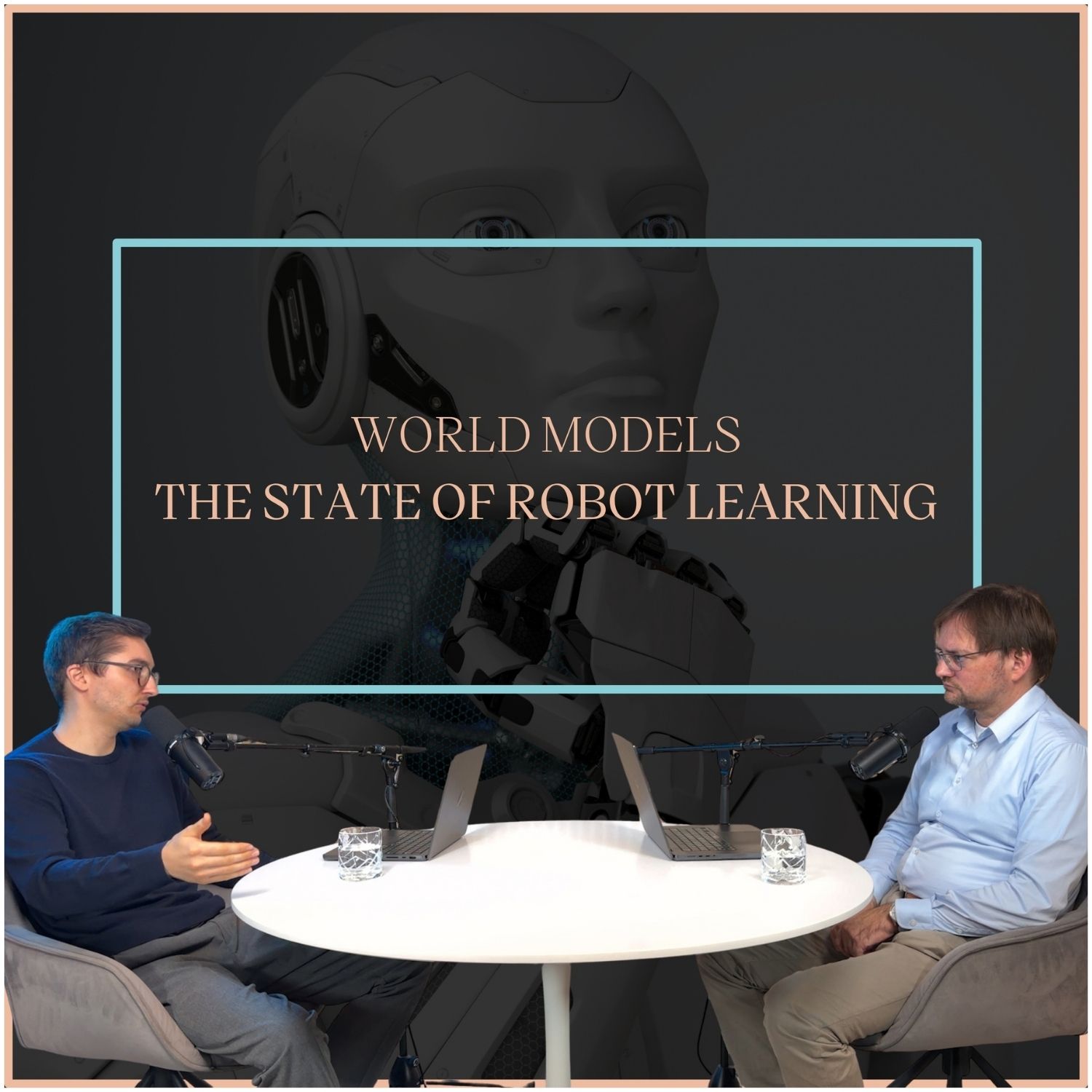
Is 2026 the year world models make Physical AI real?
Vision-Language-Action models have become the standard approach to robot learning over the last few years. In this episode, Felix Frank from our Robot Intelligence team explains why the next shift is already underway: world models that predict what happens next before a robot decides what to do.
We cover how the field moved from small, task-specific models to large pretrained architectures, why memory and context work differently in robotics than in language models, and why robots still need to run at high frequency with very limited context per decision.
We also break down the two competing approaches to building a world model: one that generates full video in pixel space, and one that predicts directly in a compressed latent space, closer to the JEPA approach.
Finally, we talk about where world models actually help today: generating synthetic training data, predicting the action needed to reach a desired future state, and simulating multiple possible outcomes before choosing one to execute.
You'll gain insights into:
- Why Vision-Language-Action models became the default approach in robotics
- How robots handle memory and context differently than language models
- Why control frequency, not context length, is the real constraint in robotics
- Two different ways to build a world model, and the trade-offs between them
- Why touch and force sensing matter as much as vision for some tasks
- Why mechanical and electrical engineering remain the next big bottleneck
More about RobCo:
Website: https://www.rob.co
LinkedIn: https://www.linkedin.com/company/robco-therobotcompany/
Instagram: https://www.instagram.com/robco_therobotcompany/
#physicalAI #robco #robotics #autonomy #podcast #worldmodels
01:38 The 2026 state of Physical AI
02:50 From task-specific models to the ChatGPT moment
07:09 The data bootstrapping problem in robotics
09:21 What goes into a Vision-Language-Action model
11:15 Why "state" matters, and the Markov assumption
17:10 Context length: robotics vs. language models
18:43 Inside the control hierarchy: motors to orchestration
20:05 Onboard GPUs vs. cloud compute
20:44 The human latency baseline
21:11 What is a world model, really?
22:34 Video generation as a world model
25:30 Is a language model already a world model?
27:02 Two ways to build a world model
30:48 Three ways world models help robots today
34:08 What happens in the next six to twelve months
35:35 Handling multiple possible futures
37:52 Beyond vision: touch and force sensing
39:19 The real bottleneck: mechanical engineering
40:46 How fast the field moves, and RobCo's 24/7 goal
42:36 Inside RobCo's experimentation framework

Is legged locomotion actually a solved problem?
In this episode of RobTalk, Felix Frank from our Robot Intelligence team explains how legged robots learn to walk, and why going from an impressive stage demo to a reliable real-world deployment is still one
of the hardest open problems in robotics.
You'll gain insights into:
- Why footstep planning used to mean months of hand-engineered optimization
- How GPU-parallelized simulation and domain randomization changed the entire approach
- What retargeting means, and why human motion data now trains robot policies
- The difference between imitation learning and adversarial motion priors
- Why legged robots face real safety and power challenges that fixed robots don't
- What is still unsolved: combining blind whole-body control with real terrain understanding
More about RobCo:
Website: https://www.rob.co
LinkedIn: https://www.linkedin.com/company/robco-therobotcompany/
Instagram: https://www.instagram.com/robco_therobotcompany/
01:14 – Rob Talk intro & welcoming Felix Frank
01:49 – Felix's background
02:38 – Breakout projects at VW (e.g., compressed air control)
03:45 – Move into humanoid robotics (US startup, whole-body control)
04:23 – The classical engineering approach: footstep planning & online optimization
06:33 – Sensor fusion: IMUs, contact sensors & Kalman filtering
08:39 – What is a kinematic tree?
10:08 – Limits of the classical approach (door opening, manipulation)
12:19 – The optimization problem: cost functions & constraints
14:40 – Boston Dynamics' Atlas & the limits of hand-engineering
17:18 – The paradigm shift: GPU-parallel simulation & the Unitree G1
18:11 – Reinforcement learning explained: reward functions & domain randomization
23:50 – Domain randomization in depth
25:26 – Building robustness through external perturbations in training
26:23 – Motion imitation: mocap, retargeting & DeepMimic (2018)
30:57 – The data-centric approach: large-scale datasets & NVIDIA Sonic
33:39 – Why the humanoid form makes sense (locomotion vs. manipulation)
34:54 – Blind locomotion: how far can you get without perception?
36:35 – Terrain awareness & planner components
39:20 – Legged vs. wheeled robots: safety & fail-safe behavior
Do dancing robots we see prove that autonomous robotics has been solved?
Autonomous Robotics are becoming more impressive every year. They can dance, run marathons and perform movements that seemed impossible just a few years ago.
But does that mean they’re ready for real industrial applications?
This episode takes an honest look at where the technology actually stands, what those demos can and cannot do, and what the next real milestone looks like.
You’ll gain insights into:
- Viral robot videos being scripted,, and what that means
- Robots having gone from not being able to stand 10 years ago to running marathons today
- Movement vs. understanding: the gap nobody talks about
- What would actually impress an engineer instead of seeing a backflip
- How close we are to robots working in factories for eight hours straight
More about RobCo:
Website:https://www.rob.co
LinkedIn: https://www.linkedin.com/company/robco-therobotcompany/
Instagram: https://www.instagram.com/robco_therobotcompany/
Chapter markers
00:00 Dancing robots: milestone or marketing?
03:15 Why did it take 30 years to get here?
07:02 What finally changed the game
15:49 Can robots do more than just move?
19:00 Where does movement end and intelligence begin?
24:07 What is actually holding robots back?
26:17 How far away is real factory deployment?
Industry 5.0 is not a tech upgrade. It is a different question entirely.
Where Industry 4.0 asked what machines can do, Industry 5.0 asks where we want to be as a society. That shift changes everything: Who writes the standards, what factories are optimized for, and what the real role of AI and robotics actually is.
You'll gain insights into:
- what Industry 5.0 really is, why it comes from a completely different place than 4.0, and what that means for how technology is built and used
- the three pillars that define it: human centricity, sustainability and resilience
- how RobCo is already putting these principles into practice
More about RobCo:
Website:https://www.rob.co
LinkedIn: https://www.linkedin.com/company/robco-therobotcompany/
Instagram: https://www.instagram.com/robco_therobotcompany/
Chapter markers
00:00 Industry 5.0: Rebranding or real shift?
02:26 Industry 1.0
08:07 Industry 2.0
15:09 Industry 3.0
18:20 Industry 4.0
25:49 Industry 5.0
33:40 Why robots are the only path forward
35:16 RobCo's role in Industry 5.0
41:51 What's happening next?

Comments

Download from Google Play

Download from App Store
 United States