


 Claim Ownership
SCOTUS Intelligence
Subscribed: 0Played: 2
Subscribe
© 2026 Brian Dennison
Description
SCOTUS Intelligence” delivers sharp, AI-assisted analysis of the latest decisions from the U.S. Supreme Court. With the help of Notebook LM, we don’t just summarize—we interrogate. We track shifts in doctrine, spotlight ideological undercurrents, and extract the quiet signals embedded in every concurrence and dissent. Perfect for lawyers, educators, and the legally curious, this podcast brings you intelligence—not just information—on how the High Court is shaping American life.
27 Episodes
Reverse

In the unanimous decision of Case v. Montana, the Supreme Court of the United States affirmed that police may enter a residence without a warrant to provide emergency assistance. The Court clarified that such entries are lawful if officers have an objectively reasonable basis to believe an occupant is in immediate danger, a standard that does not require the higher threshold of probable cause. In this specific instance, the Court found the entry justified because officers reasonably believed the petitioner was suicidal and potentially already injured. While the majority focused on this reasonableness standard, Justice Sotomayor’s concurrence highlighted the risks of escalation in mental health crises, and Justice Gorsuch’s concurrence linked the ruling to common-law traditions regarding property and safety. Ultimately, the ruling maintains the sanctity of the home while ensuring officials can act swiftly to preserve human life during dire emergencies.
In the legal case of Berk v. Choy, the Supreme Court of the United States determined that a Delaware state law requiring medical malpractice plaintiffs to file an affidavit of merit does not apply in federal court. Writing for the majority, Justice Barrett concluded that Federal Rule of Civil Procedure 8 already dictates what a plaintiff must provide at the start of a lawsuit, and this federal standard displaces conflicting state requirements. The Court clarified that while states may impose evidentiary hurdles, federal courts must follow the Rules Enabling Act, which prioritizes uniform federal procedural rules over state laws that demand more than a "short and plain statement" of a claim. Although Justice Jackson concurred with the final judgment, she argued that the state law actually conflicts with Federal Rules 3 and 12 rather than Rule 8. Ultimately, the decision ensures that plaintiffs in diversity jurisdiction cases are not subjected to state-level pleading burdens that exceed federal standards. This ruling reinforces the principle that federal procedural law governs the commencement and sufficiency of lawsuits brought in federal district courts.

This Supreme Court syllabus and opinion from Bost v. Illinois State Board of Elections addresses whether political candidates have Article III standing to challenge state election rules. The petitioners argued that Illinois’s policy of counting mail-in ballots received after election day violated federal law, but lower courts dismissed the case for lack of a specific injury. The Supreme Court reversed this decision, ruling that a candidate's personal stake in an election is inherently different from that of the general public. Writing for the majority, Chief Justice Roberts established that candidates possess a particularized interest in the fairness and legality of the results, regardless of whether a rule change would definitively cause them to lose. The Court reasoned that forcing candidates to prove a substantial risk of defeat would improperly turn judges into political forecasters and delay essential legal resolutions. While a concurrence suggested standing should rest on financial costs like hiring poll watchers, the majority held that the integrity of the process itself constitutes a cognizable interest for those seeking office.

📔 Untitled notebook This legal petition asks the Supreme Court to review a federal appeals court decision that struck down Presidential tariffs on foreign goods. The executive branch justifies these taxes using the International Emergency Economic Powers Act (IEEPA), claiming they are vital to ending trade deficits and stopping the flow of illegal narcotics. While the government argues the President has broad discretion to manage national security and foreign policy, lower courts ruled that these specific financial levies exceed his statutory authority. Opponents, including private importers and several states, contend that the law allows the regulation of trade but does not grant the power to impose unilateral taxes. The case centers on whether the separation of powers prevents the executive from using emergency economic laws to bypass congressional taxation authority. This dispute highlights a significant conflict between presidential emergency powers and the legislative branch’s control over international commerce.
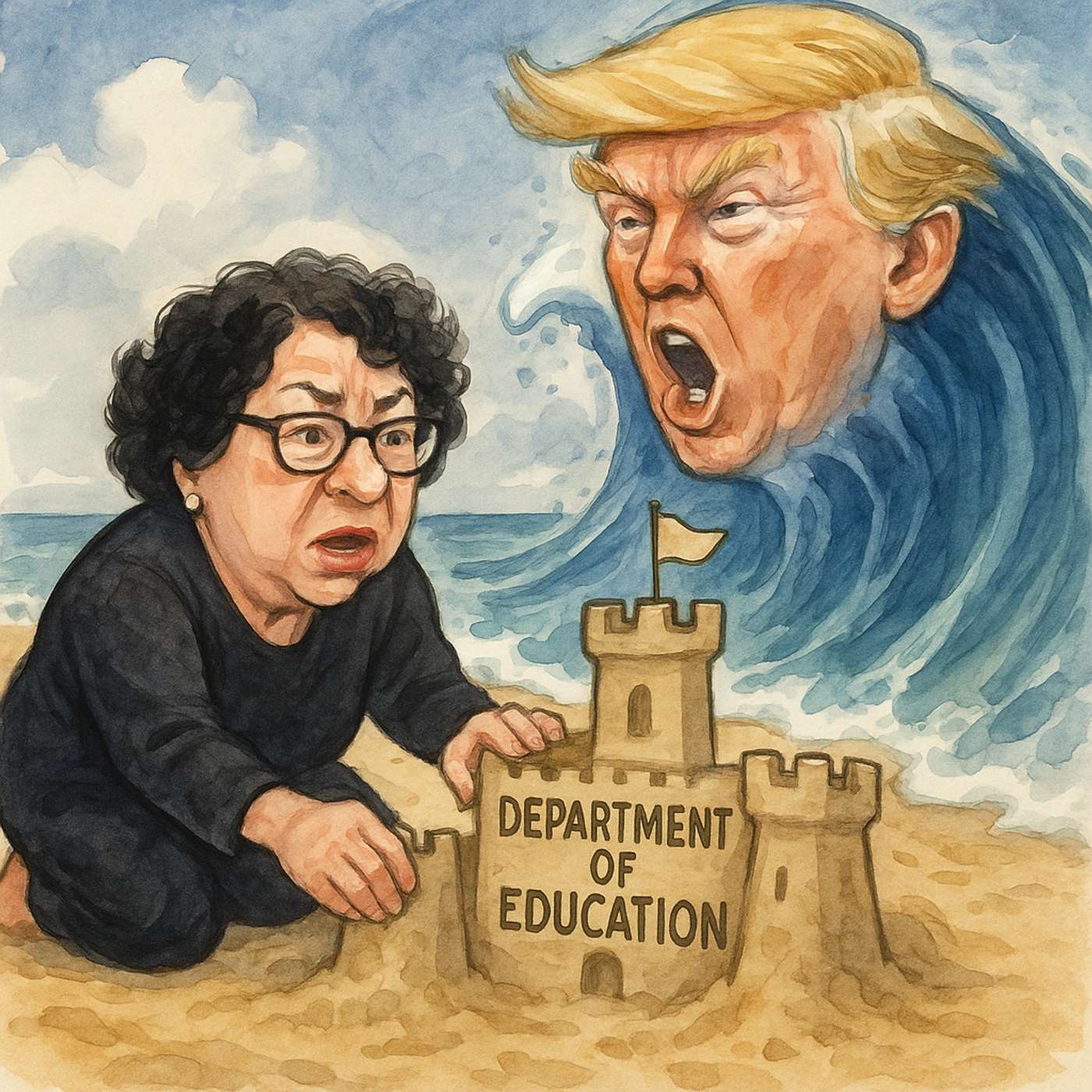
This document presents a dissenting opinion from Justice Sotomayor, joined by Justices Kagan and Jackson, regarding the Supreme Court's decision to grant a stay in the case of Linda McMahon, Secretary of Education, et al. v. New York, et al.The core of the dissent is a strong objection to the Executive Branch's unilateral efforts to dismantle the Department of Education through actions like mass terminations of staff and a subsequent Executive Order. Justice Sotomayor argues that only Congress has the authority to abolish a Cabinet-level agency and that the Executive's actions violate the separation of powers and the Take Care Clause of the Constitution. The opinion highlights the critical functions the Department of Education performs, such as administering student aid and enforcing civil rights laws, and details the harms already experienced or anticipated by states and educational institutions due to the Department's reduction in force, concluding that the majority's decision is an unjustified intervention that rewards executive overreach.
The provided text presents a Supreme Court decision regarding a stay application in the case of Donald J. Trump, President of the United States, et al. v. American Federation of Government Employees, et al. The majority opinion grants a stayof a preliminary injunction, indicating that the Government is likely to succeed in arguing the legality of an Executive Order and joint memorandum concerning federal agency reorganization and reductions in force. Conversely, Justice Sotomayor's concurring opinion emphasizes that the Executive Order directs reorganizations "consistent with applicable law," leaving the lower court free to assess the legality of specific plans. Justice Jackson's dissenting opinion argues that the President's Executive Order is an unprecedented, unilateral attempt to restructure the federal government without Congressional authorization, historically required for such large-scale changes, highlighting the potential for significant harm and disputing the majority's disregard for the District Court's factual findings that indicated the Executive Order was a fundamental transformation, not merely minor workforce adjustments.

A Notebook LM generated case review of a United State Supreme Court decision including opinion, the majority opinion, concurring opinion by Justice Thomas, and concurring opinion by Justice Jackson, that centers on a case where Catholic Charities Bureau, Inc., and its sub-entities challenged Wisconsin's unemployment compensation tax exemption. The core issue is whether Wisconsin's interpretation of a state statute, mirroring a federal law, violates the First Amendment by differentiating among religious organizations based on their theological practices, such as proselytization or serving only co-religionists, when determining eligibility for tax exemption. The Court ultimately reversed the Wisconsin Supreme Court's decision, finding that its application of the statute created an unconstitutional denominational preference, which failed to survive strict scrutiny. Justice Thomas’s concurrence further argues that the Wisconsin court erred by failing to defer to the church’s self-definition of its internal structure, while Justice Jackson’s concurrence interprets the relevant federal statute as focused on an organization's function rather than its motivation, aiming to avoid government entanglement with religious doctrine.
A Notebook LM generated review of a 2025 United States Supreme Court opinion concerning a lawsuit brought by the Government of Mexico against several American gun manufacturers. The core issue revolves around the Protection of Lawful Commerce in Arms Act (PLCAA), a federal law that generally bars lawsuits against firearm manufacturers for harm caused by the criminal misuse of their products by third parties. The specific question addressed is whether Mexico's complaint plausibly alleged that the manufacturers aided and abetted unlawful gun sales, which would activate a "predicate exception" allowing the lawsuit to proceed despite PLCAA. The Court ultimately ruled against Mexico, finding that its allegations of the manufacturers' knowledge, inaction, and marketing decisions did not meet the high legal standard for aiding and abetting under federal law, thus concluding that PLCAA indeed prevents the suit from advancing.
A Notebook LM generated review of a United States Supreme Court opinion in the case of Ames v. Ohio Department of Youth Services, along with a concurring opinion. The Syllabus and Opinion of the Court address the "background circumstances" rule, which required majority-group plaintiffs in Title VII discrimination cases to meet a heightened evidentiary standard. The Court unanimously rejects this rule, stating it contradicts Title VII's text, which prohibits discrimination against "any individual" regardless of majority or minority status, and the Court's precedents. The concurring opinion further criticizes this judge-made rule and also questions the continued use of the McDonnell Douglas framework, another judge-made tool for evaluating Title VII claims, in the summary-judgment context.

Notebook LM review of United States Supreme Court opinion in the case of A. J. T. v. Osseo Area Schools, Independent School District No. 279, et al., decided in June 2025. This document, including the Syllabus and the Court's opinion delivered by Chief Justice Roberts, along with concurring opinions by Justices Thomas and Sotomayor, addresses the legal standards for disability discrimination claims in the context of public education. Specifically, the Court examines whether schoolchildren bringing claims under the Americans with Disabilities Act (ADA) and Section 504 of the Rehabilitation Act must prove "bad faith or gross misjudgment" by school officials, a heightened standard previously applied by some courts. The Court ultimately rejects this higher burden of proof, ruling that claims related to educational services should be subject to the same standards as other disability discrimination cases, which generally require a showing of "deliberate indifference" for compensatory damages and no intent for injunctive relief. The concurring opinions further explore the implications of this decision and the broader interpretation of intent requirements under these federal statutes.

The provided text consists of excerpts from a Supreme Court syllabus and opinion in the case of Martin v. United States, decided in 2025. The core of the case concerns the Federal Tort Claims Act (FTCA), specifically addressing two points of law disputed by the Eleventh Circuit. First, the Court clarifies that the FTCA's "law enforcement proviso" only overrides the intentional-tort exception within its specific subsection, not other exceptions like the discretionary-function exception. Second, the Court rejects the Eleventh Circuit's unique interpretation that the Supremacy Clause provides the U.S. government with a defense in FTCA suits. The case is remanded for reconsideration under these clarified legal principles, particularly regarding the application of the discretionary-function exception to the plaintiffs' claims stemming from a wrongful FBI raid on their home.

A Notebook LM generated review of a June 2025 United States Supreme Court opinion and accompanying dissenting opinion address Commissioner of Internal Revenue v. Zuch, a case concerning the jurisdiction of the United States Tax Court. The majority opinion holds that the Tax Court's authority to review a Collection Due Process (CDP) hearing ends once a proposed levy by the IRS is abandoned, even if the taxpayer still disputes the underlying tax liability. This is because the Tax Court's jurisdiction under §6330 is limited to reviewing the IRS's "determination" regarding the appropriateness of a levy. The dissenting opinion argues that this interpretation improperly restricts the Tax Court's jurisdiction, contending that its review should extend to all issues resolved in the initial "determination," including the underlying tax liability, regardless of whether a levy remains active. The dissent warns that the majority's decision grants the IRS an unjust advantage, allowing it to circumvent judicial review by dropping a levy when a ruling appears unfavorable to the agency.
A Notebook LLM review of a June 2025 United States Supreme Court syllabus and opinion in the case of Rivers v. Guerrero. This case addresses a crucial point in federal habeas corpus law, specifically defining when a second-in-time habeas petitionis considered "second or successive" under the Antiterrorism and Effective Death Penalty Act of 1996 (AEDPA). The Court's unanimous decision establishes that such a petition generally triggers the strict procedural requirements of AEDPA once a district court has issued its final judgment on an initial habeas petition, irrespective of whether an appeal of that first judgment is still pending. This ruling clarifies that the existence of a final judgment is the key determinant for applying these limitations on subsequent filings, promoting judicial efficiency and finality in state-court judgments.
A Notebook LM review of June 2025 United States Supreme Court syllabus and opinion in the case of United States v. Skrmetti, which addresses the constitutionality of a Tennessee law (SB1) prohibiting certain medical treatments for transgender minors. The Court affirms the Sixth Circuit's decision, finding that SB1 is not subject to heightened scrutiny under the Equal Protection Clause of the Fourteenth Amendment, as it does not classify based on sex or transgender status. Instead, the Court determines the law is based on age and medical use, thus satisfying rational basis review by protecting minors' health and welfare given the perceived risks and uncertainties of such treatments. Concurring opinions from Justices Thomas and Barrett support the decision, while Justices Sotomayor and Kagan dissent, arguing that SB1 plainly classifies on the basis of sex and transgender status and therefore warrants heightened scrutiny.
A Notebook LM review of a June 2025 United States Supreme Court opinion concerning the constitutionality of the Promoting Security and Justice for Victims of Terrorism Act (PSJVTA), specifically its provisions for personal jurisdiction over the Palestine Liberation Organization (PLO) and the Palestinian Authority (PA). The core issue is whether the PSJVTA's assertion of jurisdiction over these entities, which are not recognized as sovereign by the U.S., violates the Fifth Amendment's Due Process Clause. The majority opinion reverses a lower court's decision, holding that the Fifth Amendment does not impose the same strict territorial limits on federal courts as the Fourteenth Amendment imposes on state courts, particularly when foreign policy and national security are involved. Justice Thomas's concurring opinion further explores the historical understanding of the Fifth Amendment, arguing that it imposes no territorial constraints on Congress's power to extend federal jurisdiction and that any such limits traditionally stemmed from international law, which Congress has the authority to override.

A Notebook LM review of a June 2025 United States Supreme Court opinion concerning a firefighter, Karyn Stanley, who sued the City of Sanford, Florida, alleging discrimination under Title I of the Americans with Disabilities Act (ADA) after her disability forced her into early retirement and reduced her health insurance benefits. The majority opinion affirms that to be protected under ADA Title I, an individual must be a "qualified individual" who holds or desires a job and can perform its essential functions at the time of the alleged discrimination. This means retirees, no longer holding or seeking employment, are generally not covered for post-employment discrimination. However, the Court also explores how some discrimination claims related to retirement benefits might still proceed if the discriminatory act or becoming subject to it occurred while the individual was still a "qualified individual" and employed. A concurring opinion criticizes the petitioner's shift in argument, while a dissenting opinion argues that the Court's interpretation of "qualified individual" is too narrow and undermines the ADA's purpose of protecting against disability discrimination in retirement benefits earned during employment.

Notebook LM review of a July 2025 Supreme Court opinion in the case of Diamond Alternative Energy, LLC, et al. v. Environmental Protection Agency, et al., along with two dissenting opinions. The central issue discussed is whether fuel producers have Article III standing to challenge the Environmental Protection Agency's (EPA) approval of California regulations. These regulations mandate that automakers manufacture more electric vehicles and fewer gasoline-powered vehicles, impacting the demand for liquid fuels. The Court ultimately reversed the lower court's decision, concluding that the fuel producers do have standing based on monetary injury, causation, and redressability, and remanded the case for a decision on the merits.
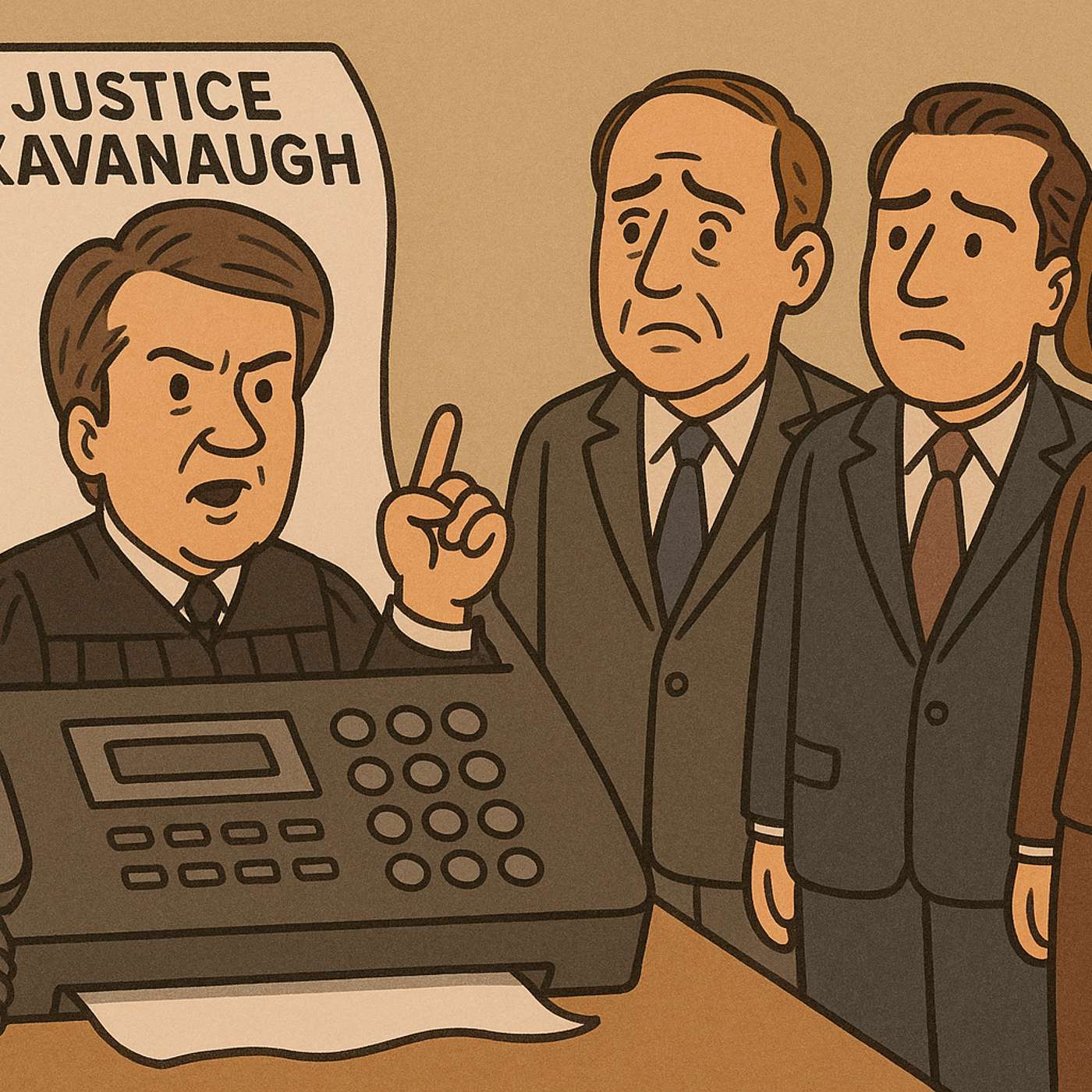
A Notebook LM review of a June 2025 United States Supreme Court case, McLaughlin Chiropractic Associates, Inc. v. McKesson Corp. et al., concerning the Telephone Consumer Protection Act (TCPA) and the Hobbs Act. The core issue revolves around whether district courts are bound by an agency's interpretation of a statute in civil enforcement proceedings, specifically the FCC's ruling on "telephone facsimile machines." The majority opinion concludes that district courts are not bound and must independently interpret the law, emphasizing a presumption of judicial review in enforcement proceedings unless Congress explicitly precludes it. The dissenting opinion, however, argues that the Hobbs Act's grant of "exclusive jurisdiction" to courts of appeals for determining the "validity" of agency orders does prevent district courts from re-litigating these interpretations, asserting that the majority's decision undermines the Act's intended finality and certainty.

A Notebook LM review of a June 2025 United States Supreme Court opinion addressing whether retailers of "new tobacco products" can judicially challenge a Food and Drug Administration (FDA) denial of a manufacturer's marketing application under the Family Smoking Prevention and Tobacco Control Act (TCA). The majority opinion affirms the Fifth Circuit's decision, holding that retailers are indeed "adversely affected" and can seek review, interpreting this phrase broadly in line with administrative law precedents. Conversely, the dissenting opinion argues that the TCA's structure and purpose indicate Congress intended only manufacturers to have standing for such challenges, viewing the majority's interpretation as an unintended expansion that could allow manufacturers to circumvent venue rules.
A Notebook LM review of the June 2025 United States Supreme Court case of Riley v. Bondi, Attorney General, addressing two key issues regarding judicial review of immigration decisions. First, it determines that an order from the Board of Immigration Appeals (BIA) denying Convention Against Torture (CAT) relief is not considered a "final order of removal" under 8 U.S.C. §1252(b)(1), meaning the 30-day appeal period does not begin with the BIA's CAT decision. Instead, the Final Administrative Review Order (FARO), which initially mandates removal, constitutes the "final order of removal." Second, the Court clarifies that the 30-day filing deadline for appealing a final order of removal is a claims-processing rule, not a jurisdictional requirement, preventing automatic dismissal of untimely petitions unless the government chooses to enforce the deadline. Justice Thomas's concurrence raises concerns about the Fourth Circuit's jurisdiction to review a standalone CAT order. Justice Sotomayor's partial dissent criticizes the majority's interpretation of "final order of removal" as illogical and creating an incoherent system that forces premature appeals.

Comments

Download from Google Play

Download from App Store
 United States