



 Claim Ownership
SOS Magazine Audio Examples
Subscribed: 60Played: 1,073
Subscribe

© All rights reserved
Description
SOUND ON SOUND is the world's premier music recording technology magazine - available in 5 formats: Paper, Web Sub, Replica, Full Issue PDF download or Tablet/Mobile apps. Based in Cambridge, England; independently-owned and continually published since 1985).
Every month our UK and USA editions deliver consistently more pages than any competing title, packed full of in-depth product tests of Recording Systems, Music Software, DAWs, Virtual Instruments, Plug-ins, Synthesizers, Keyboards & Rack Modules, Music Computers, Samplers, Audio Interfaces/Soundcards, Mixing Consoles, Effects & Signal Processors — and not forgetting studio essentials like Microphones and Monitors.
Plus the best Musician/Mix Engineer/Record Producer interviews you'll read anywhere.
Our regular DAW techniques and practical 'how to' Tutorials offer no-nonsense advice for beginners and professionals alike, helping our global readership gain the most from their studio equipment.
Every month our UK and USA editions deliver consistently more pages than any competing title, packed full of in-depth product tests of Recording Systems, Music Software, DAWs, Virtual Instruments, Plug-ins, Synthesizers, Keyboards & Rack Modules, Music Computers, Samplers, Audio Interfaces/Soundcards, Mixing Consoles, Effects & Signal Processors — and not forgetting studio essentials like Microphones and Monitors.
Plus the best Musician/Mix Engineer/Record Producer interviews you'll read anywhere.
Our regular DAW techniques and practical 'how to' Tutorials offer no-nonsense advice for beginners and professionals alike, helping our global readership gain the most from their studio equipment.
1438 Episodes
Reverse
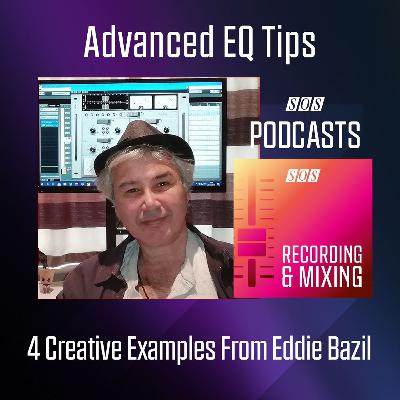
In this episode, Eddie Bazil breaks down the different types of EQ, explains their most common uses in mixing and production, and demonstrates how they shape and enhance sound with practical audio examples.
Chapters
00:00 - Introduction
00:48 - What EQ Is And Different Types
01:33 - Active And Passive
02:45 - Linear Phase And Minimum Phase
03:46 - High-Pass and Low-Pass Filters
04:36 - Example 1: Using Synth Filters
06:47 - Common Functions Of EQ
07:27 - Example 2: Shaping A Kick Drum
10:31 - Example 3: Rebalancing An Acoustic Guitar
13:48 - Selecting The Right EQ Shape
15:55 - Managing Redundant Frequencies
18:15 - Example 4: Rebalancing A Mix
#PultecEQP-1 #XferSerum #BozDigitalTransgressor2 #EventideSplitEQ #SonibleEntropyEQ+ #SSLNativeXSaturator #SSLValveComp #TokyoDawnTDRArbiter
Eddie Bazil Biog
Eddie Bazil launched his music industry career at the age of 17 as a synth programmer for a range of Electro / New Wave bands, including Art Of Noise, Spandau Ballet, Pet Shop Boys, Bobin, Paul Dee, DJ Krush, DJ Shadow, Jets Orchestra, and many more. By his 20s, he was working as a sound designer for Akai, Roland, Emu/Ensoniq, eventually signing on exclusively with the latter. Later, due to a growing demand for software instruments and libraries, Eddie began developing libraries for various software manufacturers, including Native Instruments, Kiesel, Sound Effects Library, Rob Papen, Arturia, and Propellerheads.
During this time, he trained in music production. He soon gained several prominent contracts working with some notable artistes such as Busta Rhymes, Greensleeves, 9 Bar, SFP, Sleeveless, Chris Campbell and Gam Productions. He contracted to Island Records and Chrysalis as a producer and remixer, and was commissioned to write the score for Macbeth that ran at 2 Way Mirror at Alexander Palace for the Cambridge Shakespeare Company. This led to him offering educational workshops and classes, and becoming a contributing creator and Forum moderator for Sound On Sound.
Recently, he was invited by the Recording Academy to become a professional member, approved educator, and mentor for their member base. Eddie now concentrates on providing private sound design and mixing/production tuition, and creating content for Sound On Sound magazine.
https://eddiebazil.co.uk/
Catch more shows on our other podcast channels: https://www.soundonsound.com/sos-podcasts
Cubase 15 Melodic Mode Within The Pattern Editor Audio Example 01 by Sound On Sound
Cubase 15 Melodic Mode Within The Pattern Editor Audio Example 03 by Sound On Sound
Cubase 15 Melodic Mode Within The Pattern Editor Audio Example 02 by Sound On Sound
Helix Stadium Example 1 by Sound On Sound
Helix Stadium Example 2 by Sound On Sound
SOSFA Cinematic Sci-Fi Audio Example 01 by Sound On Sound

Tony Platt talks with Paul White about his career highlights, developing his recording techniques and memorable sessions with Bob Marley, AC-DC, Gary Moore and Uriah Heep.
Chapters
00:00 - Introduction
00:27 - Contacting Studios
06:23 - Learning By Watching
08:59 - Tape Operator At Trident
11:19 - Moving To Island Studios
12:57 - Becoming An Engineer
14:56 - A Different Recording Era
15:58 - Recording Bob Marley
17:25 - Using Spill As An Advantage
20:26 - Recording Techniques
23:04 - Memorable Sessions
26:13 - Taking Time To Develop Bands
28:42 - From Analogue To Digital
33:54 - Incorporating Analogue
35:51 - Analogue Emulations
39:05 - Expanding Into Different Genres
41:56 - Current Music Projects
42:37 - AI In Music
Tony Platt Biog
Tony started as a “tea-boy” at Trident Studios in London before landing a job as tape operator at the now legendary Island Record's Basing Street Studios where he worked as an assistant on sessions with the likes of Traffic, The Who, Rolling Stones and Led Zeppelin.
He engineered on sessions with John Martin, Free and many more, leading to him mixing the “Catch A Fire” album for a hitherto unknown Jamaican artist, Bob Marley and then recording and mixing the “Burnin” album, both of which arguably would launch reggae music into the mainstream.
As a freelance he recorded demos that prefaced deals for Thin Lizzy and the Stranglers before becoming engineer for Mutt Lange and working on the AC/DC albums “Highway to Hell” and “Back in Black”, Foreigner – “4”, Boomtown Rats – “Fine Art of Surfacing’ and Broken Home.
He produced and engineered the work of artists such as Samson (with Bruce Dickenson singing), Krokus, Motorhead, Gary Moore, Cheap Trick, Ronnie Dio, The Cult and Marillion and recorded two albums for Buddy Guy - the Grammy winning “Damn Right I Got the Blues” and the follow up “Feels Like Rain”. He developed a close involvement with the well-respected “boutique” Jazz label, Dune Records, working with all their artists including Mercury nominated Soweto Kinch, Denys Baptiste, and Abram Wilson.
Many other productions in the Jazz genre have followed and Tony still undertakes mixing projects in his own studio.
He is a member of the steering group for the education initiative J.A.M.E.S. (Joint Audio Media Education Support), whilst occasionally providing guest lectures, master-classes and workshops for several universities running music industry courses worldwide.
www.platinumtones.com
www.jamesonline.org.uk
Paul White Biog
Paul White initially trained in electronics at The Royal Radar Establishment in Malvern then went on to work with Malvern Instruments, a company specialising in laser analysis equipment, before moving into technical writing.
He joined the Sound On Sound team in 1991 where he became Editor In Chief, a position he held for many years before recently becoming Executive Editor. Paul has written more than 20 recording and music technology textbooks, the latest being The Producer’s Manual.
Having established his own multitrack home studio in the 1980s he’s worked with many notable names including Bert Jansch and Gordon Giltrap. He’s played in various bands over the years and currently collaborates with Malvern musician Mark Soden, under the name of Cydonia Collective. Paul still performs live claiming that as he has suffered for his music he doesn’t see why everyone else shouldn’t too!
http://www.cydoniacollective.co.uk/
Catch more shows on our other podcast channels: https://www.soundonsound.com/sos-podcasts
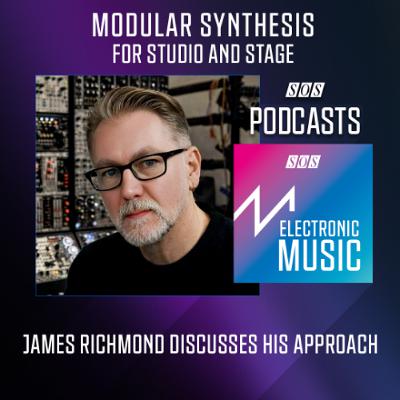
James Richmond and Julian Rodgers dive into the world of modular synthesis, explaining what it is and how it fits into both studio production and live performance. They explore the process of creating unique sounds from scratch, the challenges of patch recall and share practical advice for anyone looking to get started with modular gear.
Chapters
00:00 - Introduction
00:52 - Modular Synth Definition
01:50 - Semi-Modular
02:59 - James' Modular Synthesis Work
04:05 - Reaktor And Max
07:32 - The Appeal Of Modular
09:54 - Generating Your Own Sounds
11:24 - Creating A System
13:11 - Software Vs Hardware Systems
14:02 - Creating Brand New Sounds
16:16 - Stochastic Modulation
21:31 - Handling Recall
22:57 - Gigging With Modular
26:42 - Preparing For Performance
28:12 - East Coast Vs West Coast
29:44 - Practical Performance Challenges
31:34 - Careful Onstage Monitoring
33:08 - Starting Out In Modular
37:08 - Affordable Synthesis
#NIreaktor #cycling74max #makenoisemaths #mutableinstrumentsrings #mutableinstrumentsclouds #doepfer #verbos
James Richmond Biog
James Richmond is a composer, producer and audio engineer working across electronic and guitar-based music. He is the guitarist and producer for Liam Vincent & The Odd Foxes, has released experimental electronic work under the name Euclidean Circuits and has a solo project called The Deathbird. He also develops bespoke audio tools through EventFieldAudio and writes about music production, studio systems and monitoring from his hybrid modular and analogue studio.
https://www.jamesrichmond.com/
https://www.facebook.com/jamesrichmondaudio/
https://twitter.com/octatonic
https://www.instagram.com/jamesrichmondaudio
Julian Rodgers Biog
Julian Rodgers is a freelance writer and audio engineer with a background in live sound. After many years working in education introducing new users to Pro Tools, he now lives by the sea in West Cornwall, where he plays keyboards in a couple of bands. He also plays bass and guitar equally badly, and remains an enthusiastic collector of microphones and opinions about all things audio.
https://www.linkedin.com/in/julian-rodgers-04621926
Catch more shows on our other podcast channels: https://www.soundonsound.com/sos-podcasts
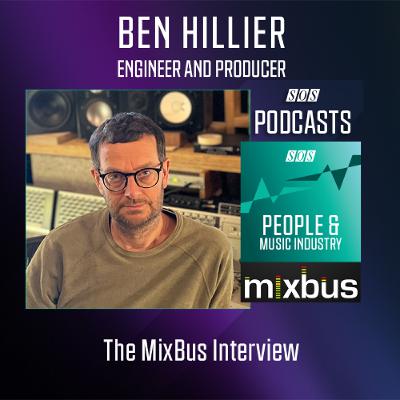
Music producer Ben Hillier reflects on his journey from orchestral percussionist to studio producer, from assisting on recordings to working with Elbow, Blur, Depeche Mode and Nadine Shah, sharing insights on feel, creativity and making records from his distinctive straw-built studio.
Chapters
00:00 - Introduction
02:36 - The Studio Design
03:56 - Recording Orchestras
08:51 - From College to Assisting
16:03 - Being A Good Engineer
20:08 - Recording Elbow
28:40 - Working With Blur
35:19 - Encouraging Creativity
40:35 - Engineering Depeche Mode
43:36 - Getting Feel Into Electronic Music
50:12 - Collaborating With Nadine Shah
57:46 - Being A Good Producer
59:20 - Creating A Good Studio Environment
1:01:13 - Choosing Which Projects To Work On
1:07:34 - Preferred Tools And Workflows
Ben Hillier Biog
Ben Hillier has been working in the recording industry for nearly 40 years. He spent the 90’s engineering and programming for various producers including Steve Osborne, Steven Street, Gil Norton and Nelly Hooper around London and internationally. In the 2000’s he moved into production making albums with bands like Elbow, Doves, Blur and three albums with Depeche Mode. In 2010’s he also began writing music, co-writing and producing five albums with Nadine Shah. In 2007 he set-up The Pool Studios with Nick Young at Miloco and was a partner in that studio for about 17 years. Ben continues to write and produce, most recently producing The Howling Bells, Sandhouse, Highschool and Dominie Hooper and writing with Shadowman, Storm Franklin and Nuha Ruby Ra. He currently lives near Brighton, UK, and has a studio (Agricultural Audio) made out of straw bales on working farm.
Instagram: https://www.instagram.com/agriculturalaudio/
Kevin Paul Biog
Kevin Paul started his career as a DJ but quickly found his passion was sound engineering. His first audio job was at Soho Studios in 1991, moving to Konk Studios six months later, where he worked alongside successful producers and engineers such as Bob Clearmountain, Adam Mosley, Pascal Gabriel and Gil Norton, as well as bands such as The Kinks, Galliano, Terrorvision, UFO and Elastica.
After working on archiving the Depeche Mode back catalogue in 1994, he was offered an engineering role at Mute Records’ in-house studio, which eventually lead to a position as Head Engineer, which gave him access to the entire Mute Records roster. Highlights include mixing Goldfrapp’s 'Felt Mountain', David Bowie’s 'Hours' and Nick Cave’s 'No More Shall We Part'. He also worked in 5:1, mixing Moby’s 'Hotel', Goldfrapp’s 'Black Cherry' and more for DVD.
In 2004 Kevin went freelance and re-mixed the entire Depeche Mode and Nick Cave and the Bad Seeds back catalogues for SACD/DVD. Since 2008, Kevin Paul has been in charge of mixing and remixing performances at the iTunes Festivals in the UK and Germany. He has mixed over 100 artists to date, including Adele, Ed Sheeran, Alicia Keys, Nick Cave & The Bad Seeds, The XX, Calvin Harris, Foo Fighters, Jack White, Linkin Park, Florence & The Machine, Deadmau5, David Guetta, Jessie J., Norah Jones, Oasis, Mumford & Sons, N.E.R.D., Lykke Li, James Blunt, KT Tunstall, Hot Chip, Paul Weller and many more.
He continues to record, engineer, produce and mix many projects in music and film, runs the mixing and surround mixing modules for the Masters Degree course at UK’s Westminster University and divides his time between London and Berlin. Recent works include the International selling new album by Nick Cave & The Bad Seeds and mixing the latest album of Denmark’s “Dúné” with the first single premiering at the Danish Music Awards, plus the latest iTunes Music Festival.
http://www.kevin-paul.com/
Catch more shows on our other podcast channels: https://www.soundonsound.com/sos-podcasts
SOS Hair Longer Than My Skirt SOLO _ LV no comps by Sound On Sound
SOS Hair Longer Than My Skirt MIX _ LV comps (Seba -15) by Sound On Sound
SOS Hair Longer Than My Skirt SOLO _ LV comps (Seba -25) by Sound On Sound
SOS Hair Longer Than My Skirt MIX _ LV comps (Seba -25) by Sound On Sound
SOS Hair Longer Than My Skirt MIX _ LV no comps by Sound On Sound
SOS Hair Longer Than My Skirt SOLO _ LV comps (Seba -15) by Sound On Sound
Moonlight (guitar DI with EQ) by Sound On Sound
Moonlight (guitar DI raw) by Sound On Sound
Moonlight (mic only) by Sound On Sound
Moonlight FINAL MIX by Sound On Sound

Comments

Download from Google Play

Download from App Store
 United States