


SOSV Deep Tech LIVE
Subscribed: 3Played: 26
Subscribe

© SOSV Deep Tech Live
Description
SOSV’s new Deep Tech LIVE event series features top technologists, researchers, and founders working on the frontiers of deep tech.
18 Episodes
Reverse

Plasma behaves in ways that are brutally hard to model. Up until recently, a single plasma simulation could take months. Every slow simulation means fewer designs tested, more physical prototypes built, greater cost, and ideas that never get explored.A new class of AI is changing that. Zenithon, a SOSV HAX portfolio company, is building the first world models for extreme physics, and specifically for plasma physics.In this SOSV Deep Tech LIVE, Susan Schofer (Partner & Chief Scientist at SOSV HAX) will talk with the Zenithon team, Alex Higginbottom (CEO & Co-Founder) and Dr. Lu Lu (Chief Scientist & Assistant Professor of Statistics & Data Science at Yale University), on what changes when one simulation’s worth of compute buys you a million design points.▪️The simulation bottleneck: why does plasma and extreme-physics simulation take months, and what does it cost fusion and semiconductor / wafer fabrication equipment teams? Why is Zenithon now able to unlock this bottleneck?▪️Physics-informed vs. general-purpose AI: what is a physics-informed neural network, and why can world models grounded in physics (with uncertainty estimates) be trusted in mission-critical settings?▪️Closing the lab-to-industry gap: How do you move from academic ML research into tools engineers actually use in existing workflows?📍 Broadcast live from our SOSV NY event space, this is the next installment of SOSV Deep Tech LIVE, our video podcast series exploring the frontiers of deep tech with leading founders, researchers, and technologists.

The AI buildout has a bottleneck, and it isn't chips. It's power. Interconnection queues stretch for years, deals get signed under NDAs, and roughly 70% of Americans now oppose data centers in their own communities, with opposition crossing party lines. The energy transition everyone was promised keeps getting deferred by the race to feed the models.Yet new Princeton research points to an escape hatch. A 500-megawatt data center able to flex its grid demand for less than 1% of the year can reach full operation three to five years sooner than one that can’t. Jesse Jenkins floated exactly that idea on Season One of Deep Tech LIVE, 18 months ago, when almost nobody was building that way. So is the real bottleneck electrons, or is it contracts and consent?Dr. Jesse Jenkins leads Princeton's ZERO Lab and the REPEAT Project, and was profiled by the Wall Street Journal as ‘The Professor Helping Guide Billions in Climate Spending.’ He has since added another hat, co-founding Firma Power, where he serves as CTO, working on the challenge of supplying clean firm power to hyperscale data centers.Jesse and moderator Duncan Turner (General Partner & Managing Director at SOSV HAX) will dig into what the analyst sees now that he is the one selling the power:Why flexibility, not new generation, may be the fastest path to powering AIWhich new energy technologies are actually helping - from grid hardware and storage to geothermal and nuclearThe exploding opposition to data centers crossing party lines sending midterm candidates scrambling (is it NIMBYism, or something else?)How “clean firm power” can be delivered to the right places at the right prices and, potentially, make hyperscalers and communities happy📍 Broadcast live from our SOSV NY event space, this is the next installment of SOSV Deep Tech LIVE, our video podcast series exploring the frontiers of deep tech with leading founders, researchers, and technologists.

What makes the brain so fast? And could the answer help us build more energy-efficient AI?Nobel laureate Dr. Jim Rothman joins SOSV’s Sean O’Sullivan to explore the molecular machinery behind neurotransmitter release, a surprising role for pressure inside synaptic vesicles, and what it takes to turn fundamental discoveries into technologies.Rothman’s foundational research revealed how SNARE proteins help cells transport and release substances. But it left a puzzle: How can the same basic machinery work thousands of times faster at a nerve ending than elsewhere in the body?After a decade spent building an artificial synapse, his team found something striking: twelve SNARE complexes assembling in two groups of six. In the mechanism he proposes, the first six drive membrane fusion, while the second six increase pressure inside the vesicle, accelerating release.Could the resulting fluid flow also carry information - adding a mechanical signal alongside chemical neurotransmission? Rothman discusses this provocative possibility while distinguishing experimental findings from hypotheses still being tested. The pressure research he describes was unpublished at the time of this conversation.In this episode:• Why synaptic release can happen in just 100 microseconds• Building an artificial synapse and counting individual molecules• The “six plus six” SNARE mechanism and the experiment that tested it• Possible connections to memory and focused ultrasound• What brain mapping and biological computing could teach AI• How Genentech’s leftover material helped advance Rothman’s early research• Lessons from co-founding ARIAD Pharmaceuticals and leading science at GE Healthcare• AI-assisted antibody discovery at Prellis Biologics• Funding basic science—and why venture capital cannot simply replace it“Science and discovery will always win out. It’s only a question of which culture embraces it.” — Dr. Jim RothmanSOSV Deep Tech LIVE brings founders, researchers, investors, and technologists together to explore the frontiers of deep tech and their impact on our world.Subscribe for more conversations on breakthrough science and the companies it could make possible.#DeepTech #Neuroscience #Biotech #AI #SOSV--SOSV is the most active deep tech venture capital firm globally. We support visionary founders intent on making a profound impact on human and planetary health.We have three deeply resourced locations for founders in New York, Newark, and San Francisco. Each year, SOSV makes roughly 60 pre-seed investments of up to $550K each, as well as another 150 follow-on investments in deep tech companies. The pre-seed founders spend 4–6 months working side-by-side with SOSV General Partners and the broader team of experts in science and engineering, design and product development, supply chain and product-market fit. Additionally, founders gain access to each location’s office space and equipped lab space. More info on our locations and to apply: https://sosv.com/locations/More more info on SOSV:https://www.sosv.comMore info on our portfolio companies:https://sosv.com/deep-tech-100/

𝐖𝐡𝐚𝐭 𝐭𝐮𝐫𝐧𝐬 𝐚 𝐬𝐭𝐫𝐮𝐠𝐠𝐥𝐢𝐧𝐠 𝐜𝐨𝐦𝐩𝐚𝐧𝐲 𝐢𝐧𝐭𝐨 𝐚 $𝟒𝟎𝟎𝐁 𝐢𝐧𝐝𝐮𝐬𝐭𝐫𝐲 𝐥𝐞𝐚𝐝𝐞𝐫?📈According to Dr. Rick Gottscho, it wasn’t a breakthrough technology. It was a set of core values that everyone lived by.After Lam Research’s leadership reset, the company built its culture around principles like:• Achievement• Honesty & integrity• Open communication• Continuous improvement & innovation• Teamwork, mutual trust & respectBut one idea stood above the rest:𝐂𝐮𝐬𝐭𝐨𝐦𝐞𝐫. 𝐂𝐨𝐦𝐩𝐚𝐧𝐲. 𝐈𝐧𝐝𝐢𝐯𝐢𝐝𝐮𝐚𝐥.When making tough decisions, Gottscho says the question was always asked in that order:What’s best for the customer?What’s best for the company?What’s best for the individual?Even more importantly, those values weren’t framed and forgotten. They were reinforced for years until they became part of how the company operated every day - including empowering employees to challenge leadership when they believed a decision was wrong.In this clip from his recent episode of 𝐒𝐎𝐒𝐕 𝐃𝐞𝐞𝐩 𝐓𝐞𝐜𝐡 𝐋𝐈𝐕𝐄, Dr. Rick Gottscho, retired Head of Products & CTO of Lam Research, broke down how embedding unvarnished truth and deep organizational alignment transformed their entire operational trajectory.As deep tech and plasma physics scale to meet the demands of physical AI and next-gen hardware, building the right culture from day one is just as critical as the physics.🚀 SOSV HAX is helping build this future with HAX Plasma Forge — a 10,000 sq. ft. lab and office facility in Princeton, NJ, designed to help founders turn plasma physics into commercial companies.
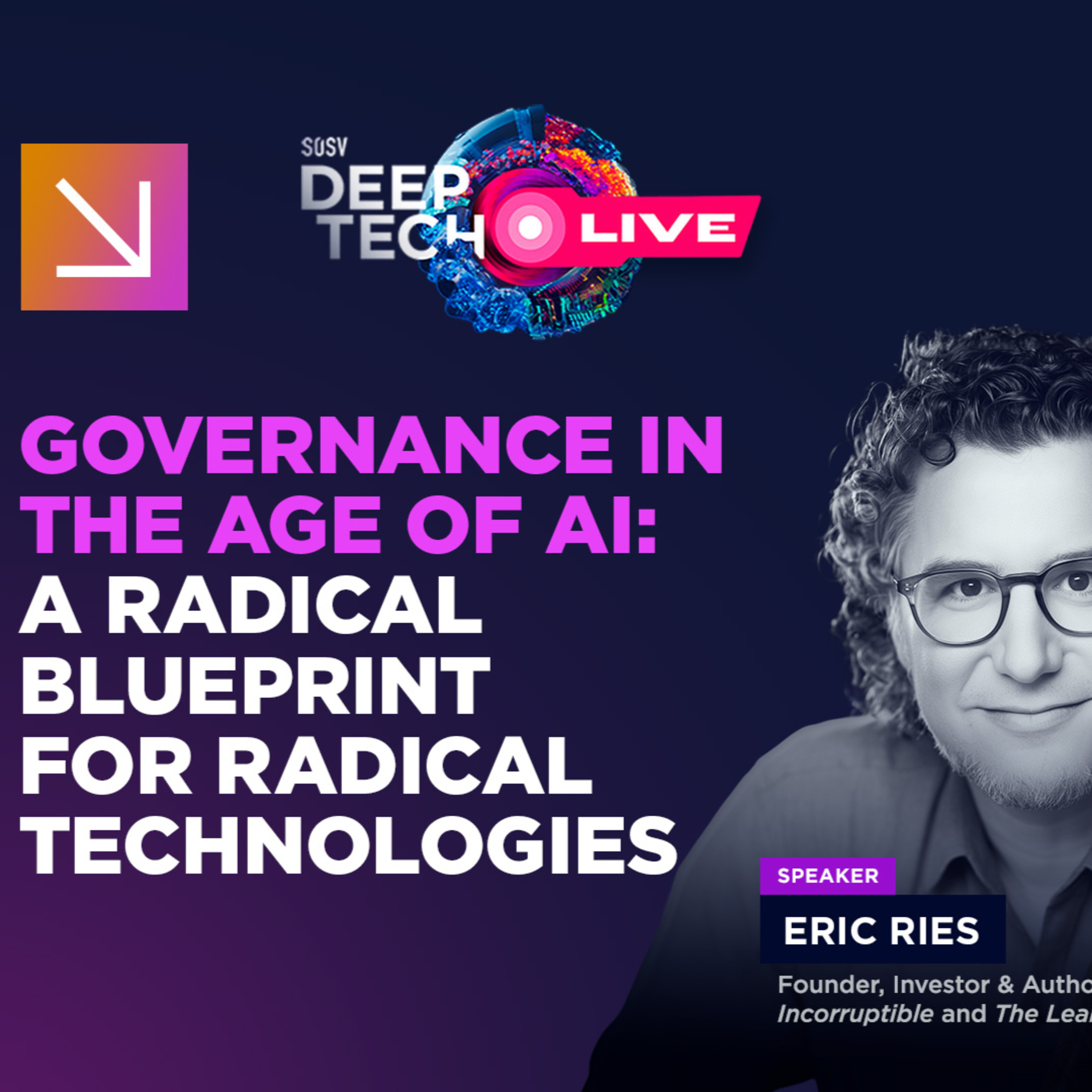
In this episode of SOSV Deep Tech Live, we sit down with tech visionary and investor Eric Ries, bestselling author of The Lean Startup, to tackle a problem that is quietly ticking beneath the surface of the entire innovation ecosystem. Fifteen years ago, Eric rewired how the world builds startups. Today, he’s back with a new book, Incorruptible, targeting an entirely different kind of broken system: modern capitalism itself. The central dilemma? While leading frontier AI labs like Anthropic have raced to establish alternative governance guardrails, the vast majority of early-stage deep tech and AI startups are still launching on the exact same boilerplate legal infrastructure that has driven corporate dysfunction for decades. According to Eric, if you aren't thinking about protecting your mission on Day 0, you are setting up a time bomb. "The most important idea in the book is that it's always too early until it's too late. If you wanna do this, do it while you actually still can." 🔬 WHAT WE COVER:00:00 - 𝗜𝗻𝘁𝗿𝗼: 𝗧𝗵𝗲 𝗖𝗼𝗿𝗲 𝗣𝗮𝗿𝗮𝗱𝗼𝘅: “It’s Always Too Early Until It’s Too Late.” Introducing the central challenge of preserving a company’s mission before outside pressures make it impossible.09:46 - 𝗧𝗵𝗲 𝗥𝗲𝗮𝗹 𝗘𝗻𝗲𝗺𝘆: 𝗦𝗵𝗮𝗿𝗲𝗵𝗼𝗹𝗱𝗲𝗿 𝗣𝗿𝗶𝗺𝗮𝗰𝘆: Why the rigid legal interpretation that a corporation’s sole purpose is to maximize immediate returns destroys long-term value, and how American stock holding periods shriveled to an average of just six months.13:47 - 𝗧𝗵𝗲 𝗟𝗼𝗻𝗴𝗲𝘃𝗶𝘁𝘆 𝗠𝘂𝗹𝘁𝗶𝗽𝗹𝗶𝗲𝗿: Alternative governance isn’t a modern gimmick—it’s armor. Discover how structures used by Zeiss, IKEA, Vanguard, Patagonia, and Novo Nordisk give companies five times the longevity of conventional corporations.14:20 - 𝗔𝗻𝘁𝗵𝗿𝗼𝗽𝗶𝗰’𝘀 𝗕𝗹𝘂𝗲𝗽𝗿𝗶𝗻𝘁 𝗘𝘅𝗽𝗹𝗮𝗶𝗻𝗲𝗱: Breaking down the mechanics of the uncompensated, two-tier Long-Term Benefit Trust structure that protects front-line AI safety missions.21:11 - 𝗠𝗶𝘀𝘀𝗶𝗼𝗻 𝗛𝗼𝗽𝗲𝗳𝘂𝗹 𝘃𝘀. 𝗠𝗶𝘀𝘀𝗶𝗼𝗻 𝗟𝗼𝗰𝗸𝗲𝗱: Why most “mission-driven” startups are legally obligated to maximize shareholder value—and what founders can do to change that.23:37 - 𝗜𝘁’𝘀 𝗔𝗹𝘄𝗮𝘆𝘀 𝗧𝗼𝗼 𝗘𝗮𝗿𝗹𝘆 𝗨𝗻𝘁𝗶𝗹 𝗜𝘁’𝘀 𝗧𝗼𝗼 𝗟𝗮𝘁𝗲: Eric explains why founders postpone mission protection through every funding round until the IPO, when they “fold like a cheap table.” The solution: implement mission lock while you still can.31:11 - 𝗔𝗹𝘁𝗲𝗿𝗻𝗮𝘁𝗶𝘃𝗲 𝗚𝗼𝘃𝗲𝗿𝗻𝗮𝗻𝗰𝗲 𝗮𝘀 𝗮 𝗧𝗮𝗹𝗲𝗻𝘁 𝗠𝗮𝗴𝗻𝗲𝘁: In deep tech, talent is scarcer than capital. Why leading scientific minds refuse to join startups unless their research is structurally guaranteed against short-term weaponization.54:11 - 𝗙𝗶𝗴𝗵𝘁𝗶𝗻𝗴 𝗙𝗶𝗻𝗮𝗻𝗰𝗶𝗮𝗹 𝗚𝗿𝗮𝘃𝗶𝘁𝘆: How founders can build stronger companies that resist the extractive pressures of the financial system—and eventually transmit their own mission-driven gravity.56:10 - 𝗥𝗲𝗱𝗲𝗳𝗶𝗻𝗶𝗻𝗴 𝗣𝗿𝗼𝗳𝗶𝘁: Why Eric argues that mission protection is not anti-profit; it’s a better way to create durable value and expand human flourishing.58:03 - 𝗧𝗵𝗲 𝗚𝗮𝗺𝗲 𝗧𝗵𝗲𝗼𝗿𝘆 𝗼𝗳 𝗙𝘂𝗻𝗱𝗿𝗮𝗶𝘀𝗶𝗻𝗴: How founders can use leverage in hot, cold, and one-investor fundraising scenarios to preserve mission protections before it’s too late.📖 GET THE BOOK:https://www.incorruptible.co - Check out Incorruptible, to discover the step-by-step blueprint for building a purpose-driven organization that lasts. Available now.📍 ABOUT SOSV DEEP TECH LIVE:Broadcast live from our SF and NY event spaces, SOSV Deep Tech LIVE is our video podcast series exploring the frontiers of deep tech with leading founders, researchers, and technologists.More about SOSV:https://sosv.com#EricRies #DeepTech #AlternativeGovernance #AIStartups #TheLeanStartup #Incorruptible #CorporateGovernance #BusinessStrategy

Comments

Download from Google Play

Download from App Store
 United States